



When to Retire Climbing Gear: The Professional Safety & Inspection Guide
A pristine appearance is the most dangerous mask your equipment can wear. While many climbers rely on the industry-standard 10-year shelf life, that number is a maximum theoretical limit, not a performance guarantee. In the high-stakes environment of vertical progression, the difference between a dependable anchor and a catastrophic failure often hides in microscopic abrasions or chemical degradation. Understanding exactly when to retire climbing gear requires moving beyond "looks fine" and into a disciplined protocol of technical inspection.
We know the tension you feel when weighing the high cost of replacement against the sobering reality of safety risks. It's difficult to sideline a favorite harness or a smooth-spinning pulley when the wear seems purely cosmetic. This guide provides the professional-grade clarity you need to make those calls with rugged confidence. You'll learn to distinguish between shelf life and service life while mastering the rigorous inspection standards required for fail-safe operation. We'll break down the 2026 UIAA guideline updates, tactile inspection techniques for soft goods, and the precise indicators that signal a carabiner or pulley has reached its true end-of-life.
Key Takeaways
- Contrast the maximum 10-year shelf life with actual service life to understand that age is only one factor in equipment integrity.
- Master the tactile "Touch Test" and visual inspection cues for webbing to decide exactly when to retire climbing gear.
- Pinpoint hardware red flags such as excessive rope-grooving in carabiners or compromised spring action in pulley gate mechanics.
- Account for environmental degradation from UV rays and chemicals that can compromise high-performance materials without obvious physical signs.
- Build a professional-grade safety system using structured gear logs and rigorous pre-use inspection protocols for every climb.
The Golden Rule: Manufacturer Lifespan vs. Service Life
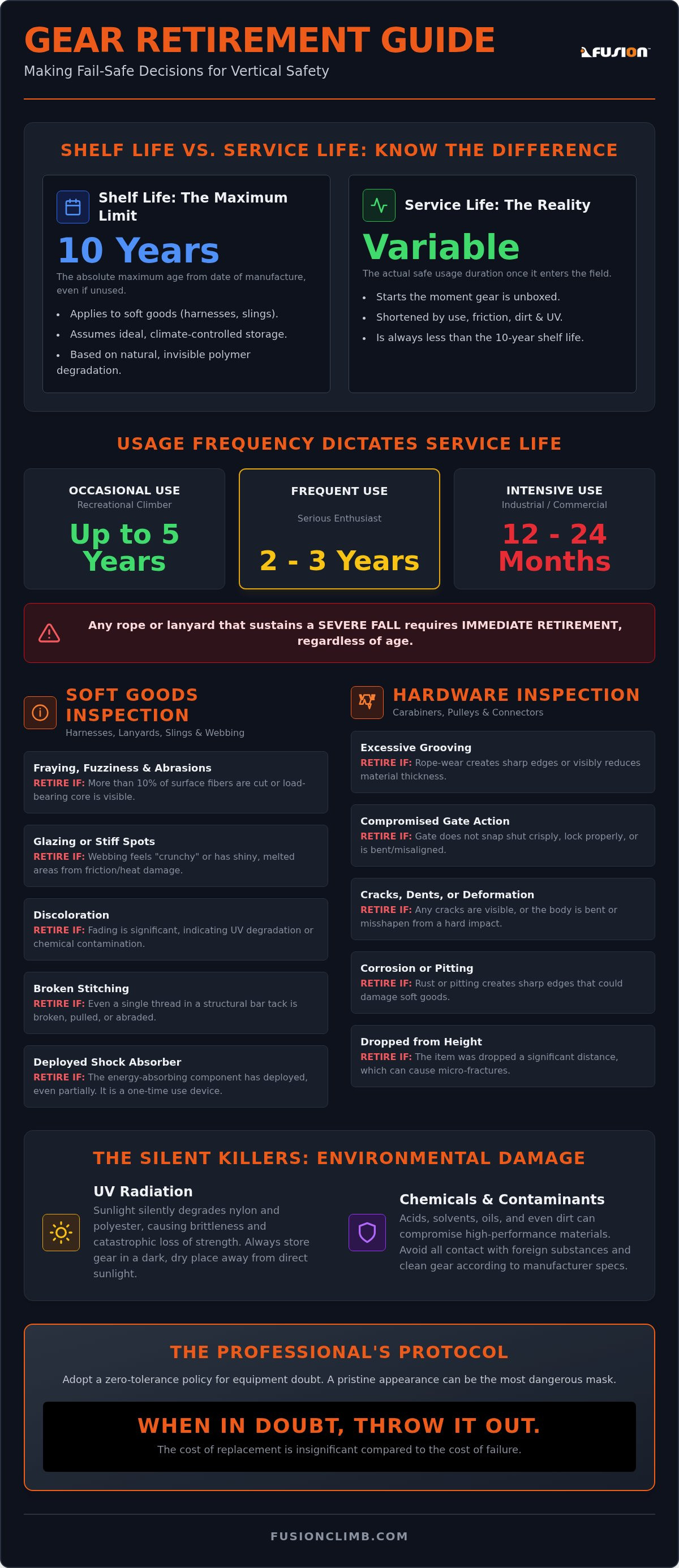
Deciding when to retire climbing gear isn't just a matter of checking a calendar. It requires a technical understanding of the difference between shelf life and service life. Shelf life is the maximum age a product can reach from its date of manufacture, provided it's kept in a climate-controlled environment away from sunlight and chemicals. For most soft goods like harnesses and slings, the industry standard is 10 years. This limit exists because synthetic polymers naturally degrade over time, even if they never see a day of sun. It's a hard ceiling that ensures the material integrity hasn't been compromised by invisible molecular breakdown.
Service life is the actual duration the equipment remains safe once it enters the field. The clock starts the moment you remove the gear from its packaging and introduce it to the elements. Exposure to dirt, moisture, and friction begins immediately, and these factors accelerate wear significantly. For a comprehensive overview of rock-climbing equipment, one must recognize that hardware and soft goods degrade at vastly different rates depending on their environment. Retirement is the point where gear no longer meets the original manufacturer's safety specifications.
Usage Cycles: How Often Do You Climb?
Frequency of use is the most aggressive driver of equipment failure. An occasional climber might see five years of safe use from a harness. In contrast, commercial zipline operators or industrial professionals often retire their gear within 12 to 24 months. Constant friction and heavy loading cycles fatigue the materials far faster than a typical recreational schedule. You must also account for high fall factors. If a rope or lanyard sustains a severe fall, its ability to absorb energy is permanently compromised. It must be retired immediately, regardless of how new it looks or how much it cost.
The 'When in Doubt' Protocol
Safety-first operation demands a zero-tolerance policy. If you no longer trust a piece of equipment, it's already reached its end. The psychological weight of doubting your gear can lead to hesitation in high-stakes environments, which creates its own set of risks. Don't let the cost of replacement cloud your judgment. A new carabiner or tether is a minor investment in your survival. The cost of a catastrophic gear failure is a price nobody can afford to pay. If a piece of hardware makes you second-guess your safety, it's time to take it out of service permanently. When in doubt, throw it out.
Retiring Soft Goods: Harnesses, Lanyards, and Tethers
Soft goods are the most vulnerable components of your vertical kit. Unlike metal hardware, nylon and polyester degrade silently. When assessing when to retire climbing gear, start with a meticulous visual scan. Look for glazing, which indicates heat damage from friction, or significant fraying that thins the webbing. Discoloration is often a sign of UV exposure or chemical contact. These aren't just aesthetic issues; they represent structural weakness. According to REI's guide to retiring climbing gear, even minor-looking fuzziness can signal deep abrasion that has reached the load-bearing fibers.
Perform a "Touch Test" by running the webbing through your fingers. If you feel stiffness or a "crunchy" texture, the fibers have likely been compromised by heat or chemical leaching. Pay extreme attention to the stitching. A single broken thread in a load-bearing bar tack is an automatic "Fail". For professionals using full body climbing harnesses in industrial environments, the stakes are higher. These harnesses often endure harsher conditions than recreational gear, requiring a lower threshold for retirement to maintain fail-safe standards.
Lanyards and Tethers: The Critical Links
Inspect zipline lanyards and tethers for bunching or thin spots, which often indicate internal core damage. Shock-absorbing lanyards require immediate retirement after any deployment. Even a partial deployment means the energy-absorbing material has performed its one-time function and can no longer protect you. Abrasion limits are strict. If more than 10% of the surface fibers are severed, the tether is no longer professional-grade and must be removed from service immediately.
Buckles and Adjustment Hardware
Metal components on soft goods deserve equal scrutiny. Look for corrosion or "pitting" on adjustment buckles, especially in humid or coastal environments. Pitting creates sharp edges that can slice through webbing under load. Test the functionality. Buckles must lock securely and should not slip when you pull on the webbing. If you notice the webbing is becoming polished or thin at the adjustment points, it will lead to buckle slippage. If your current harness shows signs of glazing or compromised stitching, reviewing a professional guide to full body climbing harnesses can help you select a fail-safe replacement.
Hardware Retirement: Pulleys, Carabiners, and Connectors
Metal hardware is the skeletal structure of any vertical system. Determining when to retire climbing gear involving metal components requires a focus on mechanical function and material loss. Start with the rope-bearing surface. If a carabiner develops a groove deeper than 1mm or 10% of its body thickness, it must be retired immediately. Deep grooves create sharp edges that can shear a rope or lanyard under tension.
Check every gate action during your inspection. It must snap shut instantly without hesitation. If the action is sluggish or requires manual assistance to lock, the internal spring is fatigued or the pivot is fouled with grit. While cleaning might help temporarily, a permanently slow gate is a professional liability. Examine the surface for burrs. Small nicks from metal-on-metal contact can act like a blade against soft goods, compromising your safety.
Impact damage is a serious concern for professional climbing carabiners. While the micro-fracture myth suggests invisible cracks form from every minor drop, the technical reality is more focused on structural deformation. If a carabiner hits concrete from height, inspect it for hair-line cracks or any change in gate alignment. If the gate doesn't seat perfectly in the notch, the frame has shifted and the unit is no longer fail-safe.
Zipline Pulleys: Bearings and Sheaves
Knowing when to retire climbing gear like commercial zipline pulleys involves monitoring bearing health and sheave alignment. Listen for grinding, clicking, or excessive noise during rotation. Spin the sheave and check for lateral play or wobble. Any deviation from a true, centered spin indicates bearing failure. High-speed operation generates intense friction heat. Inspect the housing for discoloration or warping, which signals that the metal has reached temperatures high enough to compromise the unit's structural integrity.
Steel vs. Aluminum Retirement
Steel hardware is the standard for high-wear rigging and industrial applications due to its superior durability. It generally offers a longer service life than aluminum but is prone to oxidation. Distinguish between surface rust, which can be cleaned, and structural pitting. Pitting is a mandatory retirement trigger. In salt-air or humid environments, aluminum can develop a white, powdery corrosion that eats into the alloy. If you see deep pitting or structural rust on heavy-duty rigging carabiners, they are no longer dependable and must be replaced.
The Silent Killers: UV, Chemicals, and Storage
Physical wear is often obvious, but environmental degradation acts on a molecular level. These silent killers are frequently the primary reason to pull equipment from service before its predicted end-of-life. Deciding when to retire climbing gear depends heavily on where it's used and how it's stored. For instance, coastal zipline operators typically face a 50% shorter retirement window compared to inland facilities because salt air accelerates metal corrosion and fiber breakdown. Humidity in a storage closet is another overlooked risk. Excess moisture leads to mildew and structural rot in nylon fibers, which compromises the integrity of your entire safety system.
UV Exposure in Aerial Parks
Sunlight is a relentless enemy of synthetic polymers. Gear used in outdoor aerial parks faces constant bombardment from UV rays, which leads to significant tensile strength loss over time. You must perform daily checks on ropes course safety equipment to identify sun-bleaching. If the vibrant color of a harness has faded to a pale, chalky shade, the fibers are likely brittle. Use the brittleness test: flex the webbing and look for surface flaking or a stiff, plastic-like texture. If the material has lost its natural suppleness, its ability to absorb energy is gone. High-altitude environments accelerate this process, making frequent replacement a technical necessity.
Chemical and Petroleum Exposure
Chemical contamination is often fatal for climbing gear. Battery acid is particularly catastrophic; even a microscopic drop can cause a harness to fail under standard loads. Never store your gear near car batteries or cleaning supplies like bleach. Even certain markers used for labeling contain solvents that can degrade nylon fibers from the inside out. Accidental contact with insect repellents containing DEET or heavy sunscreens also warrants immediate retirement. These substances can leach into the weave and weaken the core fibers without changing the gear's appearance. If your equipment has been exposed to harsh chemicals or environmental toxins, it's time to source professional-grade replacements from Fusion Climb to ensure your team remains fail-safe.
Implementing a Professional Inspection Protocol
Professional safety management requires more than just a keen eye. It demands a structured methodology that leaves nothing to chance. Implementing a rigorous protocol ensures that the decision of when to retire climbing gear is based on documented data rather than guesswork. This systematic approach protects both the user and the organization from the catastrophic consequences of equipment failure. A dependable safety culture is built on five non-negotiable steps.
- Step 1: Establish a Gear Log. Record every serial number, purchase date, and the date of first field service. This log serves as the definitive history for every piece of hardware and soft good in your inventory.
- Step 2: Pre-Use Inspection. Perform a functional check before every single session. This is a rapid but disciplined scan for obvious defects like sluggish gates or frayed webbing.
- Step 3: Periodic Deep Inspection. Conduct quarterly or bi-annual teardowns. This is the stage where you determine exactly when to retire climbing gear by analyzing cumulative wear against manufacturer specifications.
- Step 4: Immediate Quarantine. If a piece of gear is suspect, pull it from the line immediately. Label it clearly as "Do Not Use" and store it in a locked container until a final determination is made.
- Step 5: Destruction. Once gear is condemned, it must be destroyed. Cutting up a harness or rope prevents it from being scavenged or accidentally returned to service.
The 'Competent Person' Standard
In a professional or industrial context, inspections must be performed by a "Competent Person" as defined by ANSI and OSHA standards. This individual isn't just someone who climbs. They're a trained professional capable of identifying existing and predictable hazards in the equipment. They must have the authority to take prompt corrective measures, including the permanent retirement of expensive hardware. Training your staff to recognize subtle failure points is essential for maintaining legal documentation and aerial park compliance.
Safe Disposal and Repurposing
Destruction is the only way to ensure a retired item never sees a load again. To properly destroy a harness, you must cut the belay loop, the bridge, and both leg loops. Never donate retired safety gear to schools, clubs, or individuals. If you want to repurpose materials, retired ropes can be woven into gym mats or cut into dog leashes, but they should never be used for any application where a fall is possible. It's better to lose the cost of the equipment than to lose a life to a "good-looking" but compromised harness.
Elevating Your Vertical Safety Standards
Safety in vertical environments is a discipline of constant vigilance, not a one-time check. You've learned that the decision of when to retire climbing gear hinges on the intersection of manufacturer timelines and real-world environmental exposure. Whether you're managing a high-volume aerial park or an industrial rigging site, the transition from "functional" to "failed" can happen silently. By mastering the tactile "Touch Test" for webbing and monitoring the mechanical integrity of your hardware, you act as the dependable guardian of your team's security.
Fusion Climb brings over 25 years of safety-first engineering to every component we produce. Our ANSI Z359.11 compliant harnesses and high-performance hardware are trusted by commercial zipline operators nationwide for their industrial-grade durability and precision. Don't leave your safety to chance or aging equipment that no longer meets professional standards. Commit to a fail-safe future with gear designed for the most demanding environments on earth.
Ready for an upgrade? Explore Fusion Climb's professional-grade safety gear.
Frequently Asked Questions
How long does a climbing harness actually last if unused?
A climbing harness has a maximum shelf life of 10 years from the date of manufacture if stored in a climate-controlled environment. This timeline assumes the gear has never seen sunlight, moisture, or chemicals. However, once you introduce the harness to the field, the service life begins. Professional users often replace their equipment much sooner. Always check the manufacturer's tag for the specific production date before deciding when to retire climbing gear.
Can I use a carabiner that I dropped on a rock?
You must inspect a dropped carabiner for structural deformation and hairline cracks immediately. While modern alloys are resilient, a drop from height onto a hard surface can shift the frame's alignment. Check the gate mechanics to ensure the nose seats perfectly in the notch. If the gate sticks or the body shows any visible scoring, the unit is no longer fail-safe. When in doubt, retire the connector to maintain professional safety standards.
What are the signs of UV damage on a zipline harness?
UV damage on a zipline harness typically manifests as significant sun-bleaching or a chalky, pale appearance on the webbing. You might also notice the material feels stiff or "crunchy" rather than supple. Perform a flex test to look for surface flaking or fraying. These signs indicate that the synthetic fibers have lost their tensile strength. Because UV degradation is permanent and progressive, sun-damaged soft goods require immediate destruction and replacement.
Do steel carabiners ever need to be retired?
Steel carabiners require retirement if they show signs of structural pitting or deep rope-grooving. While steel is more durable than aluminum, it's not invincible. Retire any connector if a groove exceeds 10% of the cross-sectional diameter or if the gate action becomes sluggish. In industrial rigging or coastal environments, surface oxidation can hide deeper structural rust. Regular mechanical testing ensures these heavy-duty components remain dependable during high-load operations.
How many falls can a climbing rope take before retirement?
A standard climbing rope is tested to withstand a minimum of five UIAA falls using an 80 kg weight before failing. However, this is a laboratory metric. In real-world scenarios, you should retire a rope after a single severe fall with a high fall factor. Inspect the sheath for flat spots or core shots where the internal fibers are visible. Consistent use in grit or sand also accelerates internal abrasion and necessitates earlier retirement.
Is it safe to buy used climbing gear?
Buying used climbing gear is generally considered unsafe because the equipment's history is impossible to verify. You cannot know if a harness was exposed to battery acid or if a carabiner survived a 50-foot drop onto concrete. Without a documented gear log, you're gambling with your life. Professional operators prioritize reliability by purchasing new, certified equipment. It's the only way to guarantee that your safety system meets rigorous manufacturing standards.
What should I do with my retired climbing equipment?
You must physically destroy retired climbing equipment to prevent accidental reuse by others. Cut the bridge and leg loops on harnesses, and slice ropes into short, unusable sections. For metal hardware, you can use a hacksaw to render the frame useless. Never donate compromised safety gear to schools or clubs. While you can repurpose retired ropes for non-safety items like rugs or dog leashes, the load-bearing life of the equipment is over.
How does salt water affect gear retirement timelines?
Salt water and coastal air significantly accelerate the corrosion of metal hardware and the degradation of synthetic fibers. Operators in maritime environments should plan for a retirement window that is roughly 50% shorter than inland facilities. Salt crystals act as an abrasive inside rope weaves and can cause rapid pitting in aluminum carabiners. Frequent freshwater rinsing helps, but it doesn't stop the long-term chemical impact on your gear's structural integrity.