



Zipline Trolley for Continuous Belay: 2026 Buying Guide
What if a trolley appears to fit your cable but is still the wrong choice? A Zipline trolley for continuous belay systems must do more than roll along a line: it needs to match the installed system’s interfaces and operating requirements. A model can look suitable on paper, but broad claims about durability or throughput won’t answer the essential question: does it work with the full setup?
Trolley selection is not an isolated purchase. The pulley connects to other safety hardware, and the choice can affect equipment movement and participant transitions through a course. This guide explains how to evaluate trolley design, system interfaces, and operating needs before choosing. You’ll learn which specifications to compare, how to assess compatibility using exact product documentation, and why the wider assembly matters as much as the trolley itself. The goal is a practical, system-fit decision based on documented information, not a product claim.
Key Takeaways
- Separate continuous participant connection from the design of any one trolley. Systems can use different equipment and interfaces.
- Compare the cable interface, connection method, and operating constraints using documentation for the exact trolley and installed system.
- Include course layout and participant transfer points in your comparison, since workflow can shape equipment needs.
- Use a pre-purchase checklist to record system identity, cable details, intended use, manufacturer instructions, and the reason for your selection.
- Evaluate a Zipline trolley for continuous belay systems as part of the full safety assembly, including its connected hardware, rather than as a standalone solution.
What a Zipline Trolley Does in a Continuous Belay System
A zipline trolley is the moving hardware assembly that travels along a zipline cable. Its wheels or other contact components run on the cable, while its attachment points connect it to the rest of the equipment configuration. The cable provides the travel path; the trolley moves along it. For a general overview of what a zip-line is, including its basic mechanism, see the linked reference.
Continuous belay describes how a participant remains connected to a safety system while moving through a course. It does not refer to one universal trolley design. Depending on the installed system, the trolley may work with a dedicated connection method or system-specific interface. The configuration determines how the components work together, so a trolley that travels on a cable is not automatically suitable for every continuous belay setup.
How a trolley fits into continuous participant connection
As the participant advances, the trolley rolls along the cable. The system’s connection method maintains the participant’s attachment during movement and through designated transitions. The exact arrangement varies: components may connect directly or through other specified hardware, depending on the system design. Don’t assume a familiar-looking attachment point or connector works the same way across different installations.
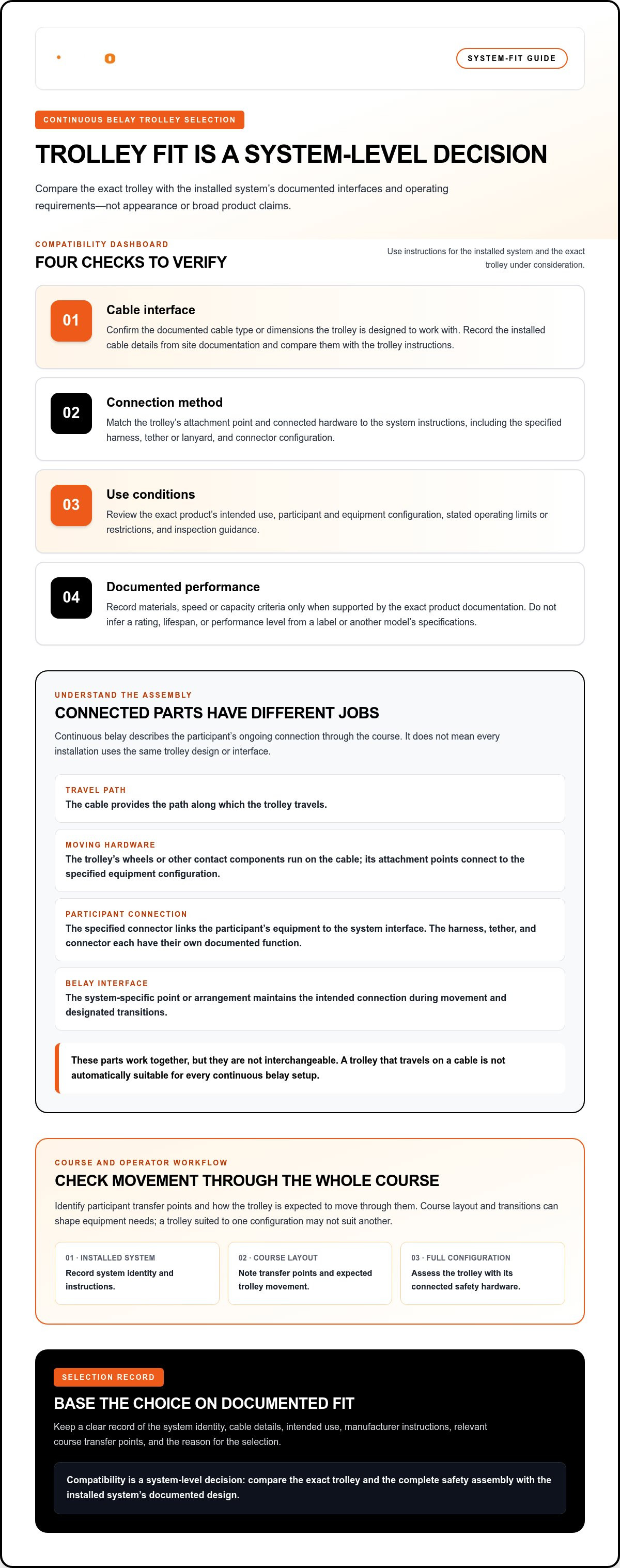
Keep the component roles distinct. The cable is the travel path. The trolley moves along it. The participant connector links the person’s equipment to the specified system interface. The belay interface is the system-specific point or arrangement that maintains the intended connection. These parts work together, but they aren’t interchangeable.
Why operators need a system-specific trolley decision
A trolley is the moving hardware that travels on the cable; a continuous belay system is the complete arrangement that keeps a participant connected as they progress. This distinction matters when selecting equipment. A mismatch at the cable or connection interface can interfere with intended movement, attachment, or transfers. Assess compatibility for the installed system and the exact equipment under consideration.
The trolley also has a different job from the participant’s harness, lanyard or tether, and connecting hardware. A harness supports the participant; a lanyard or tether forms a specified connection; and a carabiner or other connector joins components where the system design calls for it. Each part has its own function and must be used as documented, not treated as a substitute for another.
For a Zipline trolley for continuous belay systems, start with the installed system’s identity and instructions. Compare the trolley’s documented interface and intended use with the system documentation, including any stated limits or operating conditions. A product description alone can’t establish compatibility. Make the decision based on the complete configuration, not appearance or a broad performance claim.
Which Trolley Features Matter for Continuous Belay Compatibility?
Start with the system, not the product’s headline claims. A Zipline trolley for continuous belay systems needs to match the cable interface and connection arrangement documented for the installed setup. Record the system identity and cable details from site documentation, then compare them with the exact trolley’s instructions. Similar appearance is not evidence of compatibility.
Match the trolley interface to the installed system
Review how the trolley engages with the cable and how its attachment point connects to the belay system. Compare those details with the system manufacturer’s instructions, including any stated operating limits or restrictions. Account for the participant’s harness and the specified tether or connector configuration. Changes to connected equipment can affect whether the complete arrangement matches its documented design. For additional context on pulley selection, see this guide to commercial zipline pulleys.
Course layout matters, too. Identify where participants transfer between elements and how the trolley is expected to move through those points. A trolley suited to one configuration may not be appropriate for another. The Occupational Safety and Health Administration’s publication on worker safety regulations provides broader workplace safety context; use the applicable equipment documentation to assess trolley fit.
Evaluate construction and operational claims carefully
Look beyond broad labels such as “heavy-duty” or “commercial-grade.” For the exact trolley, check for documented materials, intended use, inspection guidance, operating limitations, and any stated speed or capacity criteria. Treat each as a product-specific fact. Don’t infer a rating, lifespan, or performance level from a label or another model’s specifications.
Build a comparison around details you can verify:
- Cable interface: Confirm the documented cable type or dimensions the trolley is designed to work with.
- Connection method: Match attachment points and connected hardware to the system instructions.
- Use conditions: Review the stated participant and equipment configuration, operating limits, and inspection guidance.
- Performance claims: Record only speed, capacity, or material specifications supported by the exact product documentation.
Compatibility is a documented system-level decision, not a conclusion based on a trolley’s appearance or general product claims. With your criteria in hand, compare them against the available zipline pulley and safety equipment categories as part of evaluating the full assembly.
Compare Trolley Options by Course Design and Operator Workflow
Compare candidate trolleys using the same evidence, then assess how each fits the course’s movement and transfer points. A trolley specification may be clear while its fit with a particular installation remains unresolved. Keep those conclusions separate. This prevents a feature that sounds useful from outweighing a documented mismatch or an unanswered system question.
Build a comparison around verifiable criteria
Use the system documentation, trolley instructions, and relevant maintenance guidance to complete a comparison. Mark each detail as documented, not stated, or requiring review against the system manufacturer’s instructions. The example columns below are prompts, not product assessments.
| Criterion | Evidence to record | Operational relevance | Unresolved fit question |
|---|---|---|---|
| System interface | Documented / not stated | Shows how the trolley connects within the installed belay arrangement | Does the system documentation support this interface? |
| Cable requirements | Documented / not stated | Helps assess whether the trolley is intended for the installed cable | Do cable details match the stated trolley requirements? |
| Intended use | Documented / not stated | Clarifies the use conditions described for the trolley | Does the intended use match the course configuration? |
| Inspection and maintenance | Instructions available / not stated | Shows what guidance supports routine checks and care | Can the specified inspection process be followed in operation? |
Don’t use unsupported speed or capacity comparisons to make a safety decision. Those figures are meaningful only when stated for the exact equipment and relevant to its documented use. OSHA’s OSHA safety guidelines for zip-lines provide broader worker-safety context, while the equipment instructions and applicable system documentation inform the specific trolley decision.
Account for course flow and participant transitions
Map the launch, each transfer point, and arrival. Note where the trolley must keep moving, where a participant connects to another element, and where equipment handling or inspection takes place. A layout with several transitions may create different handling and access needs than a straightforward run. Record the needs at each point instead of assuming one trolley suits every course.
Compare routine use with the trolley’s documented intended use and inspection instructions. For wider equipment context, see the ropes course safety equipment guide. Assess a Zipline trolley for continuous belay systems within its documented course workflow, not by isolated claims. Explore zipline pulley equipment as part of that system-fit evaluation.
Use a Pre-Purchase Checklist Before Specifying a Continuous Belay Trolley
Start with the paperwork. A disciplined review helps separate verified fit from assumptions before a trolley enters the equipment plan. Use this sequence to assess a Zipline trolley for continuous belay systems and create a traceable record of why you selected a candidate.
Document the system and trolley requirements
- Identify the installed system. Record the manufacturer, system name or configuration, and the version or revision details available in the site documentation.
- Capture cable details. Transcribe the cable information and interface requirements stated in the system documents. Don’t replace a documented specification with a visual estimate.
- Map existing connections. Note how the trolley, participant equipment, and other connection hardware are arranged. For more context on connected components, see the zipline lanyards and tethers guide.
- Gather current instructions. Collect the installed system’s instructions and the candidate trolley’s documentation. Compare intended use, interface details, and operating limitations across both sources.
- Resolve gaps before selecting. Pause the decision if the system identity is unclear, key cable or interface information is missing, or documents conflict. Mark the unresolved point for review against system-specific instructions rather than filling it with an assumption.
Plan inspection, use, and lifecycle records
A trolley decision also affects how equipment is tracked during routine operation. Before purchase, identify what the applicable instructions say about inspection, maintenance, and removal from use. Record inspection frequency or retirement criteria only when those instructions specify them; don’t create a schedule or threshold from a general product description.
Plan how the operator will trace each item through use. Keep equipment identification, inspection findings, and maintenance actions associated with the relevant unit, and record them consistently. This makes it easier to compare field records with the manufacturer’s guidance and identify missing information.
Checklist summary: Record documented system and trolley facts separately from assumptions. Leave unresolved compatibility questions open until system-specific documentation addresses them.
Close the review with a short selection rationale: identify the candidate, list the documents used, explain how its specified interfaces and intended use align with the system, and note any remaining limitations. Then explore zipline pulley and safety equipment as you evaluate components for the wider assembly.
Choose Zipline Trolley Equipment That Fits the Whole Safety Assembly
A trolley choice only makes sense in context. Evaluate it alongside the installed system, connected participant equipment, and course workflow. A trolley is one component of an assembly, not a standalone safety solution. Selecting a part in isolation can leave important interface questions unanswered.
Review the trolley alongside connected equipment
Trace the connection from the cable through the trolley and its specified attachment points to the participant’s tether, harness, and connectors. Each component has a distinct role, and the system documentation should establish how those parts are intended to work together. A harness or carabiner that appears suitable on its own doesn’t prove the complete configuration is compatible.
Connector details matter within that larger picture. For background on connector use, see the professional climbing carabiner guide. Use the instructions for the specific system and equipment to assess the actual interfaces. Don’t assume separately selected components form a compatible assembly just because each is designed for climbing or zipline use.
Include operational workflow in the same review. Consider how equipment moves through launch, transfer, and arrival points, and how the documented inspection process fits routine handling. Assess the setup against the actual course configuration, not a generalized description of how a trolley works.
Take the next step with a documented equipment decision
Before finalizing a Zipline trolley for continuous belay systems, bring together three kinds of evidence: system-fit information, the trolley and connected-component instructions, and the intended operating conditions. Record what the documentation supports and clearly identify unresolved details. This grounds the decision in the equipment’s stated use rather than assumptions or broad product claims.
Fusion Climb manufactures zipline pulleys and related safety hardware, including harnesses, lanyards, tethers, and carabiners. Explore Fusion Climb zipline equipment while comparing components for the wider assembly.
Safety-led selection starts with verified system information. Match the equipment to the documented configuration, then assess the complete assembly and workflow before making the decision.
Make Your Trolley Decision With Confidence
The right Zipline trolley for continuous belay systems is the one supported by the installed system’s documentation and suited to its cable interface, connected equipment, and operating workflow. Compare candidates using verified specifications, account for transfer points and inspection needs, and keep unresolved fit questions separate from confirmed facts.
A trolley is one part of the safety assembly. Consider its role alongside the harness, tether, and connectors specified for the configuration. A clear selection rationale keeps the decision grounded in system fit rather than broad product claims.
Fusion Climb manufactures zipline and climbing safety gear, including zipline pulleys, harnesses, lanyards, tethers, and carabiners. Explore Fusion Climb zipline equipment to compare components for your setup. Start with verified information and choose deliberately.
Frequently Asked Questions
What is a zipline trolley for a continuous belay system?
A zipline trolley is the moving hardware assembly that travels along the zipline cable. In a continuous belay system, it works within an arrangement intended to keep the participant connected as they move through the course. The trolley is only one component: the cable, connection method, harness, and other specified hardware each have distinct roles. The exact arrangement depends on the installed system, not on one universal trolley design.
How do I know whether a zipline trolley is compatible with my continuous belay system?
Compare the exact trolley’s instructions with the installed system’s documentation. Check the stated cable interface, attachment method, intended use, and operating constraints, then account for connected equipment and course transitions. A similar appearance or broad performance claim doesn’t establish compatibility. If the documents don’t resolve a key interface or conflict with one another, pause the selection until system-specific instructions address the question.
Can any zipline trolley be used with a continuous belay system?
No. Continuous belay describes an ongoing participant connection, not one trolley format or standardized interface. Different installations can use different cable arrangements, connection methods, and operating requirements. A trolley suited to one configuration may not fit another. Select only after comparing the candidate trolley’s documented use and interfaces with the installed system’s instructions. Don’t assume a general-purpose zipline pulley works across all continuous belay courses.
What specifications should I compare when choosing a zipline trolley?
Compare the specifications documented for the exact trolley and installed system: cable requirements, trolley-to-system interface, connection method, intended use, and stated operating limitations. Review the manufacturer’s inspection and maintenance instructions as well. Treat claims about speed, capacity, materials, or durability as product-specific facts, not general category standards. If a specification is absent or doesn’t clearly address your configuration, record it as unresolved rather than inferring a value.
How does a continuous belay trolley connect to a participant's harness?
The connection follows the installed system’s specified arrangement. Depending on the design, the trolley may connect to the participant’s harness directly or through a designated tether, lanyard, connector, or other interface. Don’t assume a carabiner or tether can be added or substituted based on appearance alone. Follow the system and component instructions to identify the required connection path and confirm that each part is intended for that configuration.
How often should a continuous belay trolley be inspected?
Use the inspection frequency and procedures stated in the applicable system and trolley instructions. There isn’t one interval that applies to every trolley or installation without reference to its documentation. Include inspection guidance in the equipment decision before purchase, and keep identification, findings, and maintenance actions traceable to the equipment. If instructions don’t provide the needed criteria, don’t invent a schedule or retirement threshold.
What information should an operator gather before buying a replacement trolley?
Gather the installed system’s manufacturer and configuration, cable details, existing equipment interfaces, and instructions for both the system and replacement candidate. Also document the intended use, course transfer points, and relevant inspection or maintenance guidance. Compare the candidate’s stated interface and operating constraints against those records. If the system identity, cable information, or a critical connection detail is missing, pause the selection rather than treating an assumption as proof of fit.
Does a zipline trolley include the connectors or lanyard needed for the system?
Package contents vary, so don’t assume a trolley includes a connector, lanyard, or tether. Check the exact product documentation and listed contents, then compare any supplied components with the installed system’s instructions. Included hardware alone doesn’t establish that it fits the complete assembly. Evaluate the trolley and each connected part by its documented role, interface, intended use, and compatibility with the specified configuration.