



Anchor Strap Buying Guide: Choose the Best Setup
The most versatile-looking anchor strap may still be the wrong choice for your setup. It needs to fit the anchor point, connect correctly with the surrounding equipment, and suit the intended application. A sturdy appearance alone doesn’t establish that it’s suitable.
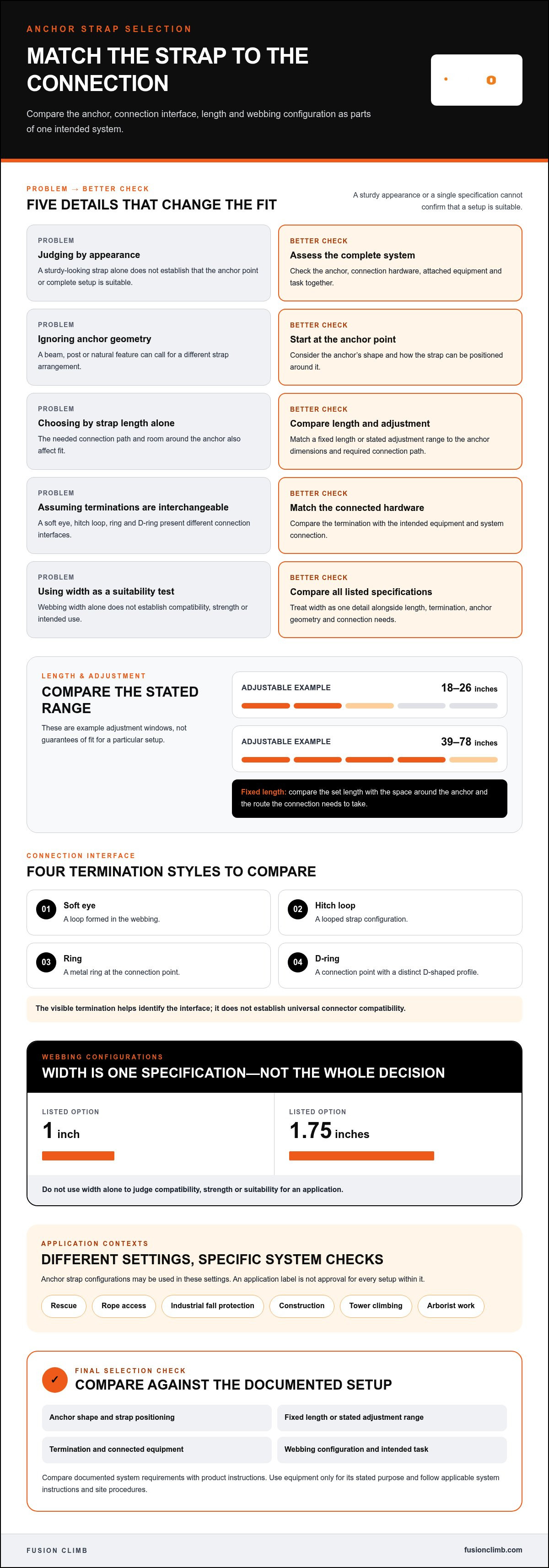
Length and strength are important comparison points, but connection geometry matters too. A fixed-length strap, an adjustable lanyard, a soft-eye loop, a ring, and a D-ring each create a different connection interface. Webbing configurations also vary, including 1-inch and 1.75-inch options. Don’t assume one setup suits every anchoring task.
This guide explains how to compare fixed and adjustable lengths, termination styles, adjustment ranges, and webbing configurations. It also shows how to match those details to an anchor point and intended connection, with examples from rescue, rope access, industrial fall protection, construction, tower climbing, and arborist operations. Start with the complete system and the task it needs to perform, then compare straps against those requirements.
Key Takeaways
- Match the anchor strap’s termination to the anchor geometry and the equipment it needs to connect.
- Compare fixed and adjustable options against the required length and adjustment range of your setup.
- Don’t use webbing width alone to judge compatibility, strength, or suitability for an application.
- Use a step-by-step selection check to compare configurations with your documented system requirements and product instructions.
- Consider different strap configurations as options for different applications, not as one-size-fits-all solutions.
What Is an Anchor Strap, and What Does It Connect?
An anchor strap is webbing equipment designed to wrap around a suitable structural anchor and create a connection point for compatible equipment within a larger system. Its configuration must suit the anchor’s shape, the intended attachment method, and the role it will perform. A strap by itself doesn’t establish that an anchor point or complete setup is suitable.
Anchor geometry affects how webbing can be positioned and connected. A beam, post, or natural feature may require a different arrangement, and the attached equipment must interface with the strap’s termination, such as a soft-eye loop, ring, or D-ring. For climbing context, Wikipedia’s overview of climbing anchor types and considerations describes different anchor categories and factors that can affect their use.
An anchor strap isn’t the same as a general-purpose tie-down strap. Tie-downs are intended to secure loads during transport or storage. Their appearance doesn’t establish that they’re suitable for a life-safety or climbing system. Use equipment only for its stated purpose and follow applicable system instructions and site procedures.
Where Are Anchor Straps Used?
Anchor strap configurations may be used in rescue, rope access, industrial fall protection, construction, tower climbing, and arborist work. These application labels describe broad settings, not approval for every setup within them. Assess the anchor, connection hardware, attached equipment, and task for the specific application. For related equipment context in recreational settings, see the guide to ropes course safety equipment.
How Does an Anchor Strap Differ from a Lanyard?
An anchor strap commonly creates a connection around a structural element, while a lanyard may connect a person’s harness or other equipment to an anchorage or another system component. The design and intended use determine each item’s role, not just the product name. Terminology can overlap: some configurations, for example, are described as anchor lanyards. Compare the actual length, adjustment, termination, and connection role. The guide to zipline lanyards and tethers provides related terminology and context.
Keep the complete system in view. A strap that fits around an anchor may still be unsuitable if its connection doesn’t match the attached equipment or the task. Assess each component as part of the intended setup rather than treating any one configuration as a universal solution.
Which Anchor Strap Features Should You Compare Before Buying?
Compare the features that determine how a strap fits the anchor and connects with the rest of the setup. Connection geometry matters because the anchor’s shape and the connector interface determine how the strap can be positioned and attached. A wider webbing option isn’t automatically compatible or more suitable. Width alone doesn’t establish a product’s strength or intended use.
| Feature | What to compare | Why it matters |
|---|---|---|
| Length | Fixed length or stated adjustment range | Compare the measurement with the anchor dimensions and required connection path. |
| Adjustment | Whether the strap is fixed or adjustable | Adjustment can accommodate different setups, but must remain within the product’s stated range. |
| Webbing width | Listed options include 1-inch and 1.75-inch designs | Width is one specification, not proof of compatibility, strength, or suitability. |
| Termination | Soft eye, hitch loop, ring, or D-ring | The end configuration affects how the strap interfaces with the connected equipment. |
| Connection needs | Anchor geometry and the equipment being attached | The components must work together as part of the intended system. |
Fixed Length or Adjustable Anchor Strap?
A fixed-length configuration has a set length. Compare it with the space around the anchor and the route the connection needs to take. Adjustable examples include listed ranges of 18 to 26 inches and 39 to 78 inches. These ranges provide different adjustment windows, not a guarantee that either option fits a particular setup. Follow the product instructions and assess the intended system before choosing.
Soft Eye, Hitch Loop, Ring, or D-Ring?
A soft-eye termination forms a loop in the webbing, while a hitch loop is a looped strap configuration. Ring options use a metal ring at the connection point, and a D-ring has a distinct D-shaped profile. These visible differences help you compare connection interfaces, but they don’t establish universal connector compatibility. Match the termination to the intended hardware and system. For more on connector interfaces, refer to the professional climbing carabiner guide.
For industrial fall-protection applications, selection also needs to account for the applicable requirements for the complete system. OSHA’s regulations for fall protection anchorages provide requirements for general-industry personal fall-protection systems. Compare your documented requirements with the product instructions, then review anchor strap configurations by their listed dimensions and terminations.
How Do Fusion Climb Anchor Strap Configurations Compare?
Fusion Climb’s examples illustrate how termination style and webbing configuration differ across products. Compare the listed details with your intended connection instead of treating a product name or shared application label as proof of suitability. The configurations below are examples, not universal recommendations.
Adjustable Lengths and Different Terminations
The Zip Line Tether Lanyard Adjustable Hitch Loop Delta Ring / 1" Webbing combines an adjustable design with a hitch loop, delta ring, and 1-inch webbing. The Zip Line Tether Adjustable Lanyard Soft Eye Loop / 1.75 Webbing is also adjustable, but has a soft-eye termination and 1.75-inch webbing. These are distinct connection arrangements. Webbing width alone doesn’t establish compatibility or suitability. Length choices can vary by listing, so use the current product details rather than assuming a measurement.
Rings, D-Rings, and Multiple Loops
The Zip Line Tether Adjustable Lanyard Triangle D-Ring / 1.75" Webbing pairs an adjustable lanyard configuration with a triangle D-ring and 1.75-inch webbing. Other collection examples include steel rings and dual-loop designs. A listed two-gear-loop configuration has two visible loops, but that description alone doesn’t establish their load-bearing role or how they should be used. Follow the product instructions and assess the complete system.
| Configuration example | Listed features | Compare for |
|---|---|---|
| Zip Line Tether Lanyard Adjustable Hitch Loop Delta Ring / 1" Webbing | Adjustable, hitch loop, delta ring, 1-inch webbing | Whether the termination and adjustment fit the intended connection |
| Zip Line Tether Adjustable Lanyard Soft Eye Loop / 1.75 Webbing | Adjustable, soft-eye loop, 1.75-inch webbing | Whether a soft-eye connection matches the system design |
| Zip Line Tether Adjustable Lanyard Triangle D-Ring / 1.75" Webbing | Adjustable, triangle D-ring, 1.75-inch webbing | Whether the ring geometry and listed dimensions meet system requirements |
For rigging context, Rigging Lab Academy explains the basket with anchor strap rigging technique. The example illustrates how configuration affects a strap’s arrangement in a system, but it doesn’t make any specific product right for every application. Check the current listing for dimensions and length options, then compare them with your documented requirements and product instructions before selecting an anchor strap.
How Do You Choose the Right Anchor Strap for Your Setup?
Work through the system in order before comparing product listings. The right configuration depends on the task and actual connection requirements, not a familiar product name or a single feature.
- Define the task. Identify what the setup needs to do and the role the strap will serve.
- Inspect the anchor geometry. Record the anchor’s shape, available clearance, and where the strap can sit.
- Identify the connections. Note the attached equipment and connector types, then determine the required strap reach and termination.
- Compare dimensions. Match the documented requirements against each listing’s length, adjustment range, webbing width, and configuration.
Application suitability depends on the complete system and its instructions. Follow applicable site procedures and product instructions for the intended setup. The strap is one component, so assess its fit with the anchor, connectors, and other connected equipment.
Measure the Anchor and Decide What Must Connect
Document the anchor’s shape and the space available for the strap, then map the connection path from the anchor to the equipment. Identify connector types and determine how much reach the setup requires before browsing options. Use measurements from the actual system requirements, not a guess based on a product photo or a length that seems close.
Avoid Common Anchor Strap Buying Mistakes
Don’t select by color, webbing width, or product title alone. A listing that mentions a familiar activity doesn’t prove that its configuration suits your specific application. A listed length is a product measurement, not confirmation that it provides the needed reach or clearance in your setup.
Read the product instructions and account for inspection requirements in your site procedures. Review the stated terms before ordering, too: supplied product descriptions state that soft goods, including lanyards, are made to order and aren’t eligible for returns, exchanges, or refunds. Choose deliberately, checking each component against the intended system.
Once you’ve documented the task, anchor, connections, and dimensions, compare Fusion Climb anchor strap configurations against those requirements.
Browse Fusion Climb Anchor Straps and Take the Next Step
You’ve narrowed the choice by application, anchor geometry, connection style, adjustment needs, and required length. Now compare those requirements with the details in each current collection listing. A familiar activity name or similar-looking configuration doesn’t establish that a strap fits your system.
Narrow the Collection by Configuration
Compare adjustable lanyards with fixed-length designs, then consider how each strap terminates. Hitch loops, soft eyes, and D-rings create different connection interfaces, and listed webbing options vary. Use these features to narrow your search, not to assume compatibility. Before ordering, review the current product listing for dimensions, length or adjustment options, and configuration details.
Keep your documented requirements beside you as you compare. Check that the selected length and termination align with the intended connection, and evaluate the strap as part of the complete system. Product descriptions and application labels can help identify relevant options, but they don’t replace system assessment or product instructions.
Make a Considered Purchase
Before selecting a listing, revisit the task, anchor shape, connection path, equipment interface, and required reach. Then read the product instructions and applicable site procedures for your intended setup. Choose based on those requirements, not on color, webbing width, or product title alone.
Plan the order carefully. Fusion Climb’s stated policy is that soft goods, including lanyards, are made to order and aren’t eligible for returns, exchanges, or refunds. Review the current product details and applicable terms before completing your purchase.
Ready to compare configurations with your documented system requirements? Browse Fusion Climb anchor straps and select the option that matches your intended setup.
Choose Your Setup with Confidence
A well-matched anchor strap starts with the intended application and anchor geometry, then accounts for the connection, adjustment needs, and required length. These details work together. No single termination or webbing configuration is right for every system.
Fusion Climb’s collection includes multiple lengths and attachment configurations, with examples such as adjustable lanyards, soft-eye loops, hitch loops, rings, and D-rings. Compare current product listings with your documented system requirements and follow the product instructions before choosing. Treat each strap as one component in the complete setup.
Ready to narrow your options? Compare Fusion Climb anchor strap configurations by their listed features and find an option that aligns with your intended connection. A careful comparison helps you make a more deliberate equipment choice.
Frequently Asked Questions
What is an anchor strap used for?
An anchor strap creates a webbing connection around a suitable structural anchor, linking it to other equipment in a larger system. Configurations may be used in rescue, rope access, industrial fall protection, construction, tower climbing, and arborist work. The strap’s role depends on its termination and how it connects with the other components. An application label alone doesn’t establish suitability, so follow applicable site procedures and product instructions for the intended setup.
How do I choose the right length anchor strap?
Choose a length by documenting the anchor geometry, available clearance, connection path, and reach needed to connect the equipment. Then compare those requirements with the listed fixed length or adjustment range. Don’t assume a product’s stated length confirms that it will fit your setup. The route around the anchor and the connector interface matter too. Follow the product instructions and assess the strap as part of the complete system before selecting a configuration.
What is the difference between a soft eye and a D-ring anchor strap?
A soft eye ends in a loop formed from webbing, while a D-ring configuration has a metal ring with a D-shaped profile at the termination. These designs create different connection interfaces. Neither is universally compatible with every connector or system. Compare the termination with the connected hardware and intended use, then follow the relevant product instructions. A familiar shape or name by itself doesn’t show that the complete connection is suitable.
Can an anchor strap be used around a beam, pole, or tree?
Some strap configurations are designed to wrap around structural elements, but a beam, pole, or tree isn’t automatically suitable as an anchor. Shape, surface, clearance, strap placement, and the complete system all matter. Assess the specific anchor and intended use under applicable site procedures, and follow the product instructions. Don’t assume a strap can be used on a particular structure just because it physically fits around it.
Are adjustable anchor straps better than fixed-length straps?
Not necessarily. An adjustable configuration provides a stated range for changing its length, which may help match certain connection paths. A fixed-length design has a set length to compare with the documented setup. The right choice depends on anchor geometry, required reach, connections, and system instructions. Adjustment doesn’t make a strap suitable for every arrangement, and a fixed strap isn’t inherently a better fit simply because its length is constant.
Does wider webbing mean an anchor strap is stronger?
No. Webbing width alone doesn’t establish an anchor strap’s strength, compatibility, or suitability for a specific application. Those judgments require the relevant product specifications and an assessment of the complete system. Fusion Climb’s listed options include 1-inch and 1.75-inch webbing, but width is only one detail to compare. Read the product information and instructions rather than using width as a substitute for verified system requirements.
Can I return an anchor strap if it does not fit my setup?
Fusion Climb’s stated policy is that made-to-order soft goods, including belts, harnesses, and lanyards, aren’t eligible for returns, exchanges, or refunds. Review the current product listing and applicable terms before ordering, and compare its dimensions and configuration with your documented system requirements. Don’t rely on returning a strap if it doesn’t fit. Carefully check the intended connection and product instructions before selecting it.