


Weather Resistant Zipline Pulleys: A Guide to Durability and Performance
A "stainless steel" label doesn't guarantee your hardware will survive a single season in a high-humidity or coastal environment. You've likely seen it happen. A pulley that ran smooth in July starts screaming by September because moisture breached the internal components. It's frustrating to watch your gear slow down or show surface rust when you've invested in weather resistant zipline pulleys that should be able to handle the elements. For commercial operators, these failures aren't just an annoyance; they're a liability that increases maintenance overhead and degrades the rider experience.
True durability requires a synergy of corrosion-proof metallurgy and high-integrity bearing seals, not just a shiny finish. In this guide, you'll discover how to identify, maintain, and select hardware engineered to withstand relentless rain and salt air without compromising safety. We'll explore the technical advantages of the Advent Zipline Trolley Pulley, which boasts a 50kN Minimum Breaking Strength, and the sealed bearing systems found in the Tesa Speed series. From understanding upcoming ANSI/ACCT 2026 revisions to mastering the 10% Rule for hardware retirement, this overview provides the technical assurance you need to keep your lines running fast and silent in any climate.
Key Takeaways
- Distinguish between cosmetic surface rust and critical internal degradation to ensure your hardware remains mechanically efficient in harsh environments.
- Evaluate the performance trade-offs between stainless steel and anodized aluminum when selecting metallurgy for high-salt coastal zones.
- Understand why sealed bearing systems are essential for weather resistant zipline pulleys to prevent moisture from seizing internal components.
- Implement a rigorous inspection cadence, including the "spin test," to detect internal grit or corrosion before it compromises rider safety.
- Select industrial-strength solutions like the Advent Zipline Trolley Pulley or Tesa Speed series to maintain consistent speeds and reduce maintenance overhead.
Defining Weather Resistant Zipline Pulleys: Beyond Surface Rust
Weather resistance in zipline hardware is the capacity of a pulley to maintain peak mechanical efficiency despite prolonged exposure to environmental stressors. It isn't just about avoiding a few spots of rust on the side plates. For commercial operators, a pulley that looks clean but runs slow is a failed asset. True durability ensures that the internal components remain as functional as the day they left the factory, regardless of rain, salt air, or extreme humidity.
You're fighting a two-front war when maintaining an outdoor course. On the outside, you have visible oxidation. On the inside, you have the silent killer: bearing seizure. Many weather resistant zipline pulleys are marketed based on their exterior finish, but the real engineering happens within the housing. Professional hardware utilizes "sealed for life" bearing systems that create a physical barrier against the elements. Without these seals, a pulley is essentially a ticking clock, waiting for the first major storm to begin its decline.
External Corrosion vs. Internal Bearing Failure
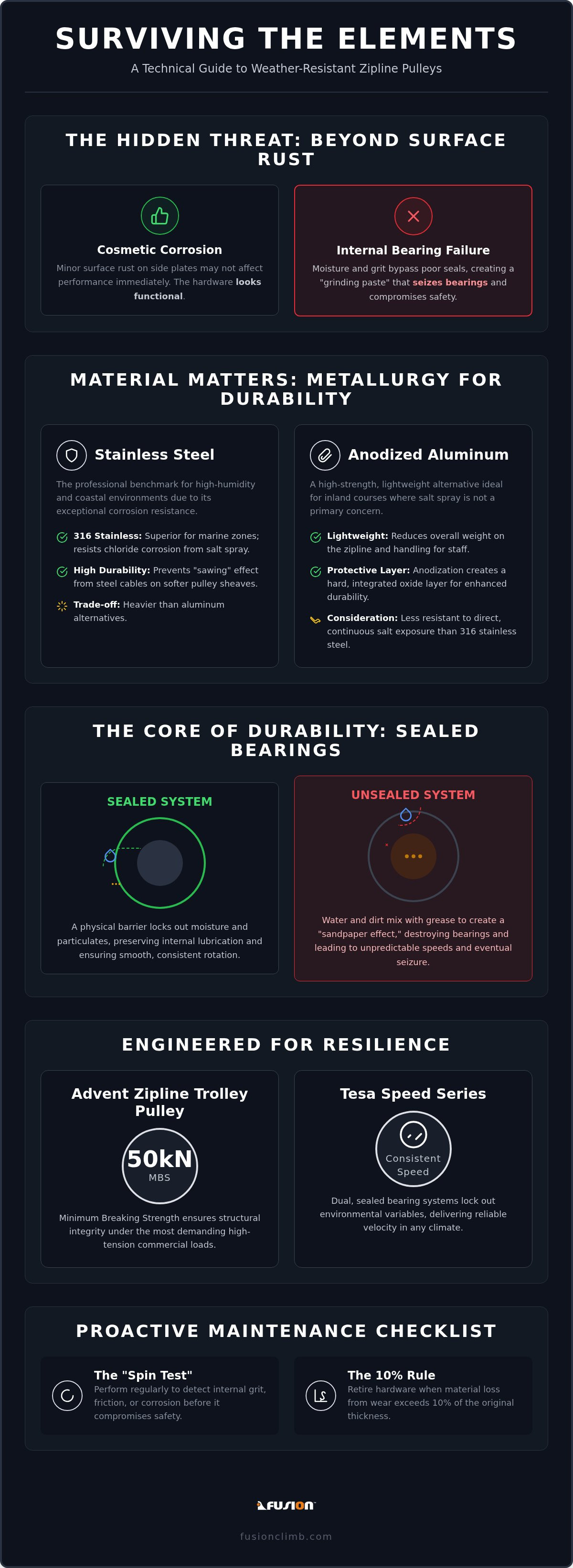
The process of corrosion doesn't just target the visible side plates; it attacks the structural integrity of the entire unit. While surface rust on a stainless steel component might be cosmetic, moisture bypassing a poor seal is catastrophic. When water and fine particulates enter the bearing race, they mix with the internal lubrication to create a grinding paste. This "sandpaper effect" destroys the smooth rotation of the sheaves, leading to noisy operation and unpredictable speeds. A pulley can look perfectly polished on the outside while the internal bearings are physically pitted and compromised.
The Role of Environmental Stress in Speed Consistency
Humidity levels directly influence friction management within dual bearing systems. When moisture enters a bearing housing, it displaces the grease, causing heat to build up faster during high-speed runs. This thermal load can lead to metal expansion, which alters bearing tolerances and slows the rider down. Environmental stress is the primary factor in zipline ride-time variability.
Standard climbing pulleys often fail in permanent outdoor installations because they are designed for intermittent use. They lack the high-strength aluminum or steel side plates and precision-machined sheaves found in industrial gear like the Tesa Speed Pulley. By utilizing dual, sealed bearing systems, professional hardware locks out environmental variables. This ensures that every rider experiences consistent velocity, whether the air is bone-dry or saturated with coastal mist. Precision engineering isn't just about strength; it's about maintaining that strength through every season.
Material Science: Stainless Steel vs. Anodized Aluminum
Choosing the right metallurgy determines whether your hardware survives the season or succumbs to the environment. For weather resistant zipline pulleys, the choice between stainless steel and anodized aluminum isn't just about weight; it's about chemical stability. High-performance hardware must balance the need for tensile strength with the reality of oxidation and mechanical wear.
Stainless Steel: The Choice for Coastal and Humid Climates
In coastal zones where salt spray is a constant factor, 300-series stainless steel is the professional benchmark. While 304 stainless provides excellent protection against inland humidity, 316 stainless steel is the superior choice for marine environments because of its increased resistance to chloride corrosion. Industrial gear like the Advent Zipline Trolley Pulley utilizes this robust metallurgy to achieve a 50kN Minimum Breaking Strength, ensuring the unit can handle high-tension loads without structural fatigue.
Stainless steel sheaves are essential for high-frequency commercial use on steel cables. Using a softer metal for the sheave results in a "sawing" effect where the harder steel cable quickly erodes the pulley. This leads to rapid material loss and compromises the 10% Rule for hardware retirement. If your course operates near the ocean, the weight of stainless steel is a necessary trade-off for the long-term longevity of the system.
Anodized Aluminum: Precision and Protection
Anodized aluminum offers a high-strength, lightweight alternative for inland courses. The anodization process creates an integrated oxide layer that is harder than the base metal, providing a durable shield against moisture and particulates. This material is typically used for side plates to reduce the overall weight of the trolley. This makes it easier for staff to handle and reduces the momentum-based wear on braking systems during high-volume days.
Precision-machined aluminum side plates, often found in dual bearing systems, are designed to provide structural rigidity while shielding the internal components. However, these are most effective when the sheaves themselves remain steel to handle the friction of the cable. For operators looking to balance weight and durability, exploring industrial-grade pulleys with hybrid material construction often provides the best results.
The interaction between your cable and pulley is the most frequent point of failure. Always ensure your sheave material is rated for the specific cable type in your installation to prevent premature wear. Reinforced side plates are also critical; they must be thick enough to prevent debris ingress while maintaining structural integrity under lateral stress. Whether you choose the ruggedness of the Advent series or the precision of the Tesa Speed series, matching the material to your environment is the only way to ensure consistent performance.
The Critical Importance of Sealed Bearings for Outdoor Longevity
The internal bearing is the heartbeat of any trolley. While the exterior plates provide structural support, the bearing dictates the ride quality. In the context of weather resistant zipline pulleys, the bearing is also the most vulnerable component. Standard open bushings, common in recreational setups, rely on a simple metal-on-metal interface that requires constant lubrication. In outdoor environments, rain quickly washes away this grease, leading to high-friction "dry" runs that can seize the pulley entirely. Professional hardware eliminates this risk by utilizing industrial-grade ball bearings designed for high-cycle environments.
Industrial-grade hardware replaces primitive bushings with high-precision ball bearings. These systems allow for higher RPMs and smoother movement, but they must be protected from environmental ingress. High-integrity seals ensure that the mechanical components remain isolated from the surrounding atmosphere. This creates a "maintenance-free" experience for commercial operators, as the internal lubrication remains trapped and functional regardless of the external humidity or precipitation levels.
Sealed vs. Shielded Bearings: What's the Difference?
Professional operators must distinguish between shielded and sealed bearings. A shielded bearing uses a metal plate to deflect large debris, but it lacks a watertight contact point. Moisture and fine salt particulates can still bypass this gap, leading to internal pitting and premature failure. In contrast, a true sealed bearing utilizes a rubber or silicone seal that makes physical contact with the inner and outer races. A sealed bearing is a self-contained environment that prevents lubricant washout. This physical barrier is non-negotiable for rain-exposed ziplines. It ensures that the factory-applied synthetic grease stays inside the bearing, maintaining a constant speed for riders over thousands of cycles.
Dual Bearing Systems for High-Speed Reliability
High-speed commercial lines often utilize dual bearing systems, such as those found in the Tesa Speed Pulley. By incorporating two bearings per sheave, the trolley achieves superior load distribution across the cable contact point. This design is particularly effective in outdoor parks where inconsistent rider weights and high-volume cycles put immense stress on the hardware. Dual bearings reduce the individual load on each ball, which directly translates to a longer lifespan in the field.
Dual bearings also play a critical role in thermal management. Friction generates heat. If a single bearing is overworked, that heat can degrade the weather seals, causing them to crack or lose their flexibility. By spreading the load, dual systems run cooler and preserve the integrity of the environmental seals. For a deeper look at how these systems integrate into park operations, consult our commercial zipline pulleys guide. This engineering ensures that whether it's the first rider of the morning or the last run of a humid afternoon, the performance remains identical.
Maintenance Protocols for High-Humidity and Coastal Environments
High-performance hardware is only as reliable as the protocol used to maintain it. Even the most robust weather resistant zipline pulleys require a structured inspection cadence to ensure that environmental stressors haven't compromised the internal mechanics. For commercial operators, this isn't a suggestion; it's a mandatory part of risk management. Establishing a daily, weekly, and monthly schedule prevents minor surface issues from becoming catastrophic failures.
The "spin test" is your primary diagnostic tool for assessing internal health. To perform this, hold the pulley by the side plates and spin the sheaves with your free hand. A healthy bearing will rotate silently and smoothly for several seconds. If you feel any vibration, resistance, or "notching," it indicates that moisture or particulates have bypassed the seals. This internal grit acts as an abrasive, quickly destroying the bearing race and leading to inconsistent rider speeds.
The Visual and Auditory Inspection Checklist
Daily inspections must focus on both sight and sound. Look for "pitting" corrosion on stainless steel side plates, which appears as small, dark craters on the metal surface. While often cosmetic initially, pitting can hide deeper structural fatigue. Listen for the "grind." A high-pitched squeal or a gravelly rumbling sound during a run is a clear indicator of weather damage. You should also check for sheave wear. Wet or dirty cables carry abrasive silt that can "saw" into the sheave groove over time, altering the pulley's profile and increasing friction.
- Daily: Perform the spin test and check for visible debris in the sheave housing.
- Weekly: Clean external surfaces with a damp cloth to remove salt crust or industrial pollutants.
- Monthly: Conduct a deep-dive inspection for material loss. Use calipers to verify that sheave wear hasn't exceeded 10% of the original thickness.
Cleaning and Storage for Seasonal Operators
Proper cleaning is vital for coastal zipline hardware. Salt spray is relentless. After operation, rinse your pulleys with fresh, low-pressure water to dissolve salt crystals before they can harden. Avoid high-pressure washers, as they can actually force water past the bearing seals. Once rinsed, dry the units thoroughly in a well-ventilated area away from direct heat. For similar hardware care, such as maintaining your connectors, refer to our carabiner maintenance guide.
Never apply penetrating oils or solvent-based lubricants like WD-40 to sealed bearing systems. These chemicals can break down the internal synthetic grease and wash it out, leaving the bearings unprotected. If the internal grease is gone, the pulley is retired. If you notice structural cracks, sheave deformation, or bearing seizure, remove the unit from service immediately. To upgrade your fleet with gear designed for these rigorous standards, explore our latest industrial-grade zipline pulleys.
Fusion Climb Solutions: Engineered for Environmental Resilience
Fusion Climb understands that professional hardware must endure where recreational gear fails. We design our weather resistant zipline pulleys to serve as the backbone of high-volume commercial operations. By focusing on high-strength materials and precision-machined components, we ensure that your course remains operational through every storm and heatwave. Our engineering philosophy prioritizes substance over style, providing the technical assurance you need to maintain a safe and efficient vertical environment.
The Advent Series: Stainless Steel Dominance
The Advent Zipline Trolley Pulley represents the pinnacle of weather resistant zipline pulleys in stainless steel engineering. Built with a Minimum Breaking Strength (MBS) of 50kN, this unit is designed for the most demanding environments on the planet. Coastal parks and high-humidity forests present unique chemical challenges that standard alloys cannot meet. The Advent's stainless steel construction provides a natural defense against salt air and relentless rain, ensuring the housing remains structurally sound over years of exposure.
Specific features include reinforced side plates that protect the internal mechanics from debris ingress. In wet conditions, cables often carry a slurry of grit and moisture that can bypass inferior seals. The Advent's precision-machined sheaves are engineered to resist the abrasive "sawing" effect of these elements, preventing premature material loss. This makes it the ideal choice for year-round courses where reliability is the only metric that matters.
Tesa Speed Pulley: The Professional's High-Speed Choice
Performance shouldn't fluctuate with the thermometer. The Tesa Speed Pulley utilizes a sophisticated dual bearing system to maintain consistent velocity across a wide range of temperatures. As environmental temperature shifts occur, metal components expand and contract. Our engineering ensures that these tolerances remain within strict limits, preventing the drag that often plagues hardware during extreme seasonal transitions.
The Tesa series features high-integrity sealed bearings that lock out moisture and particulates. This self-contained environment preserves the internal synthetic lubrication, allowing the sheaves to spin at high RPMs without excessive heat buildup. For commercial operators, this translates to reduced maintenance overhead and a predictable ride for every guest. The precision-machined sheaves also minimize cable friction, extending the cycle-life of your entire system.
Fusion Climb acts as your silent partner in safety. We provide the rugged confidence required to push physical limits in vertical environments. Our hardware remains rooted in traditional values of strength and meticulous US-based engineering. For bulk commercial needs or to discuss fleet upgrades for your course, contact the experts at Fusion Climb to find the right solution for your specific climate.
Secure Your Course Against the Elements
Reliability in the field isn't a luxury; it's a necessity for every commercial operator. Investing in weather resistant zipline pulleys means looking past the finish and prioritizing the internal engineering that keeps riders moving safely. By selecting 316 stainless steel for coastal zones and ensuring your hardware utilizes sealed bearing technology, you lock out moisture and prevent the silent degradation that halts operations. Rigorous maintenance protocols, like the daily spin test, serve as your final line of defense against environmental wear.
Fusion Climb provides the technical assurance required for these high-stakes environments. Our hardware features 30kN+ professional strength ratings and rugged US-based engineering designed to survive years of heavy use. Don't let humidity or salt air compromise your safety standards or your uptime. Explore Industrial-Grade Zipline Pulleys at Fusion Climb and equip your team with gear that's built for the long haul. Adventure is waiting, and with the right equipment, you're ready for whatever the season brings.
Frequently Asked Questions
Can I use a standard climbing pulley for a permanent outdoor zipline?
No, standard climbing pulleys aren't built for the constant friction of steel cables. Most recreational gear utilizes soft aluminum sheaves that a steel cable will quickly saw through. These units also lack the industrial-grade seals required to survive permanent exposure to the elements. For long-term installations, you must use hardware with steel sheaves and sealed bearings to ensure structural integrity and rider safety.
How do I know if my zipline pulley has internal rust?
Perform a manual spin test to detect internal degradation. Hold the side plates and spin the sheave; it should rotate silently and smoothly without vibration. If you feel a "notched" sensation or hear a gravelly grinding sound, moisture has bypassed the seals and corroded the bearing race. This internal damage is a non-negotiable marker for retirement, as it leads to unpredictable speeds and eventual seizure.
What is the difference between 304 and 316 stainless steel for pulleys?
The primary difference is the addition of molybdenum in 316 stainless steel, which provides superior resistance to chloride corrosion. While 304 stainless is effective for inland humidity, it often suffers from pitting in salt air environments. If your course is located in a coastal zone, 316 stainless steel is the professional benchmark for preventing structural fatigue and maintaining a clean, functional finish over several seasons.
Does rain affect the speed of my zipline trolley?
Rain increases drag on the cable and can penetrate inferior hardware, which slows the internal rotation. High-quality weather resistant zipline pulleys utilize high-integrity seals to keep moisture out of the bearing race. This engineering ensures that your ride times remain consistent even in saturated conditions. Without these seals, water displaces the internal lubrication, causing the trolley to run slower and louder as the day progresses.
Should I lubricate my sealed zipline bearings after it rains?
You should never apply external lubricants or solvents to sealed bearing systems. These components are designed to be self-contained, keeping factory-applied synthetic grease in and moisture out. Applying oils like WD-40 can actually break down the internal grease, causing it to wash away and leave the bearings unprotected. If a sealed bearing becomes noisy or rough after a storm, the seal has failed and the unit must be replaced.
How long do weather resistant zipline pulleys typically last in a commercial setting?
Lifespan varies based on rider volume and environmental severity, but industrial gear often lasts several seasons with proper care. You must monitor your hardware using the 10% Rule, which mandates retirement if material loss exceeds 10% of the original cross-sectional diameter. Regular cleaning and documented inspections are the only way to maximize the service life of your fleet while maintaining strict safety standards for your guests.
Are aluminum pulleys safe for use on steel cables in wet environments?
Aluminum side plates are safe and help reduce weight, but aluminum sheaves are unsuitable for steel cables. In wet environments, the cable carries abrasive silt that accelerates the wear on soft metals. Ensure your weather resistant zipline pulleys utilize stainless steel sheaves for the actual cable contact point. This hybrid construction provides the weight benefits of aluminum without compromising the durability of the high-friction surfaces.