



High Load Zipline Pulley: Professional Buying Guide
The pulley with the biggest number on its label may still be the wrong choice for your zipline. A Zipline pulley for high load capacity must be assessed in context: rating terms can describe different things, and the pulley’s fit with the line, connectors, and intended function matters as much as its headline figure.
Start by defining the pulley’s job and the line it needs to work with. Then compare each candidate’s ratings using the manufacturer’s definitions, review the stated compatibility, and note any gaps in the product documentation. This approach helps distinguish a suitable component from one that only looks right on paper. Equipment selection must also remain part of a professionally designed zipline system.
This guide covers load-rating terminology, cable and connector fit, pulley function, and relevant safety references, including ASTM F2959-26a and ANSI/ACCT 03-2019. Fusion Climb manufactures zipline pulleys and other climbing and zipline hardware. Use the criteria below to build a shortlist from documented specifications rather than a single impressive number.
Key Takeaways
- Learn why rating terms aren’t interchangeable and how to interpret them before comparing pulley options.
- Use a step-by-step review of the task, line, interfaces, ratings, and documentation to narrow your choices.
- Match a Zipline pulley for high load capacity to its intended role and the cable’s documented specifications.
- Distinguish cable-travel trolley designs from hauling or progress-capture pulleys so the hardware suits the job.
- Build a practical pre-purchase checklist for assessing pulley hardware as part of a professionally designed system.
What a High-Capacity Zipline Pulley Rating Actually Tells You
A high-capacity pulley isn’t simply the one with the largest figure in a product listing. It’s a component whose documented limits suit the role it will perform within a professionally designed system. For a Zipline pulley for high load capacity, first identify exactly what the rating describes. Then check whether that definition and its stated conditions apply to the intended setup.
“A pulley rating only has meaning when you understand what was rated, how it was tested, and how the component will be used in the complete system.”
A number can look reassuring while leaving essential questions unanswered. Is it a breaking-strength figure, a working limit, or another rated capacity? What test method and conditions apply? Which components and configurations does the documentation cover? Treat the rating as one piece of evidence, not as stand-alone approval for a rider or installation.
Breaking strength, working load, and rated capacity
Product listings may use terms such as breaking strength, working load, and rated capacity. Don’t assume these terms mean the same thing across manufacturers. Read each term as the manufacturer defines it in the technical documentation, including the stated test context, limitations, and intended application.
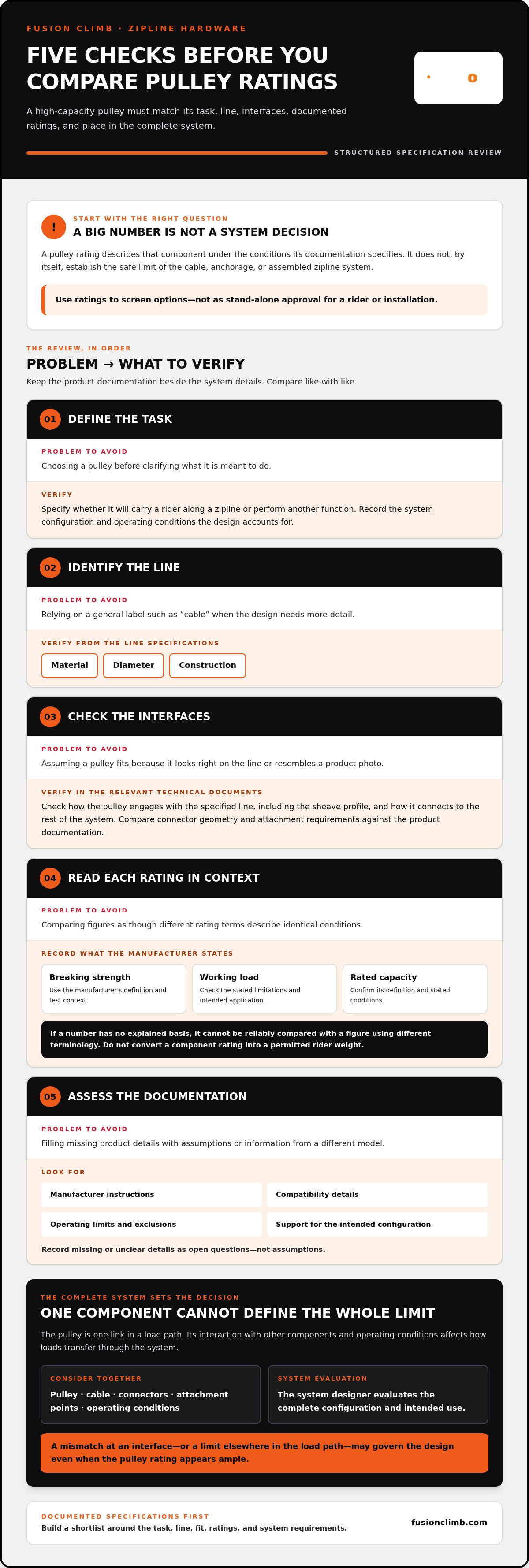
If a listing gives one number without explaining its basis, you can’t reliably compare it with a figure that uses different terminology. Look for the definition and supporting documentation for that specific pulley. Don’t convert a component rating into a permitted rider weight: rider limits depend on the design and evaluation of the full system, not a simple arithmetic relationship to one hardware figure.
Why the complete system sets the decision
The pulley is one link in a load path. Its interaction with the cable, connectors, attachment points, and operating conditions affects how loads are transferred through the system. A mismatch at an interface, or a limit elsewhere in the load path, may govern the design even when the pulley’s stated rating appears ample.
The system designer must evaluate the complete configuration and its intended use. That means considering how each component connects, which loads the design accounts for, and whether the equipment documentation supports the application. A pulley’s headline figure cannot establish the safe limit of the cable, anchorage, or assembled system.
Keep the distinction clear: a component rating describes that component under the conditions its documentation specifies. The system decision belongs to the people responsible for designing and evaluating the full installation. For more context on how pulley selection fits into professional operations, see this commercial zipline pulley engineering and operator guide.
Use ratings to screen options, not to make a final decision in isolation. Next, compare the pulley’s documented limits with the actual line, interfaces, function, and system requirements. If a detail needed for that comparison is missing, record it as an open question rather than filling the gap with an assumption.
How to Evaluate a Zipline Pulley’s Capacity and Compatibility
Turn a product listing into a structured review before comparing options. A Zipline pulley for high load capacity must suit the task, the line it travels on, and the connectors and configuration it will operate with. Work through these checks in order, keeping the product documentation beside the system details so you can compare like with like.
- 1. Define the task. Specify whether the pulley is intended to carry a rider along a zipline or perform another function. Record the system configuration and operating conditions the design accounts for.
- 2. Identify the line. Record its material, diameter, and construction using the line’s actual specifications. Don’t rely on a general label such as “cable” when the design requires more detail.
- 3. Check interfaces. Compare how the pulley engages with the line and connects to the rest of the system. Review connector geometry and attachment requirements against the product documentation.
- 4. Review the ratings. Record each rating term as written, along with its definition, test basis, and stated application. Don’t compare numbers as if they describe identical conditions.
- 5. Assess documentation. Look for manufacturer instructions, compatibility details, operating limits, exclusions, and information that supports the intended configuration. Flag missing or unclear details for resolution before selection.
Match the pulley to the cable and connectors
Check the exact line material, diameter, and construction against the pulley manufacturer’s stated compatibility. Then review the sheave profile and connector fit in the relevant technical documents. A pulley that appears to sit correctly on a line may still be unsuitable if its documented interface doesn’t match the line or connector. Don’t infer fit from appearance, a similar product photo, or a listing for a different model.
Compatibility means checking the documented limits of the line and connectors as well as the pulley. Compare the specific components and configuration, rather than relying on a general description such as “fits zipline cable.” The system designer can then assess whether the documented combination suits the intended application.
Read load documentation in its intended context
For each candidate, note the rating term, test basis, and stated application where available. Read the manufacturer’s instructions for operating limits and exclusions, then compare them with the planned use and configuration. If a listing gives a headline figure but leaves its meaning or context unclear, treat that detail as unresolved, not as evidence that the pulley has the capacity your system needs.
Standards and regulations also have defined scopes. OSHA’s fall protection standards address fall-protection systems and equipment criteria. Use them for relevant context, not as automatic approval of a zipline pulley or complete zipline system.
Use this process to narrow the field before reviewing Fusion Climb’s zipline pulley options. The product documentation and system designer’s evaluation remain central to a defensible equipment choice.
Which High-Capacity Zipline Pulley Design Fits the Job?
Choose a design by defining what the pulley must do, what line it must engage with, and how it fits the operating configuration. A cable-travel trolley is built to move along a zipline cable; a hauling pulley serves a different load-handling task. Similar-looking components aren’t interchangeable by default. For a Zipline pulley for high load capacity, compare the documented application and interfaces, not just the shape or number of sheaves.
Use this table as a screening tool. It describes general functions, not specifications for a particular model. Confirm exact compatibility and capacity in the manufacturer’s documentation.
| Design or function | Line compatibility | Documented capacity | Intended application |
|---|---|---|---|
| Cable-travel trolley | Zipline cable type, diameter, and construction stated for the specific pulley | Use the model’s published rating and its stated definition and conditions | Moving along a cable in the configuration the manufacturer specifies |
| Hauling pulley | Rope type and dimensions specified for that pulley | Check ratings and any use limits in the product documentation | Redirecting or assisting a hauling line, not automatically transporting a rider |
| Progress-capture pulley | Rope and connector interfaces specified for the device | Use only documented limits for its stated function and setup | Managing movement in a system designed for progress capture |
| Single-sheave or tandem trolley | Confirm the cable interface and permitted configuration for the exact design | Do not infer capacity from sheave count; consult the model’s documentation | Cable travel, when designed and documented for the intended zipline use |
Cable-travel pulleys versus hauling pulleys
A cable-travel trolley rolls along a fixed zipline cable as part of a travel setup. A hauling pulley works with a rope to redirect force or support a hauling arrangement. Progress-capture equipment has its own defined role in controlling movement. These functions differ, so don’t treat a rope pulley as a rider trolley or assume a trolley suits hauling. For broader operational context, review this ropes course safety equipment guide.
Single-sheave and tandem configurations
A single-sheave or tandem layout may affect how a trolley tracks on the line and how it fits the wider system, but neither configuration guarantees better performance. Check the manufacturer-stated application, cable interface, and permitted setup for the exact pulley. Don’t infer speed, stability, or capacity from the number of sheaves alone; those conclusions require product and system documentation.
Make the comparison specific: name the task, identify the line, and assess the documented design against the system layout. The right choice is the one supported for that application, not a universally “best” configuration. If your shortlist includes different trolley layouts, compare each one against the same system requirements.
A Pre-Purchase Checklist for High-Capacity Zipline Pulleys
Prepare the system details before comparing listings. A clear checklist helps you distinguish a pulley that fits the intended application from one that merely shows an appealing rating. It also gives the responsible system designer a focused record of what’s known, what’s documented, and what still needs a technical decision.
Information to gather before comparing options
- Application: Record the pulley’s role, such as cable travel, and describe the intended use. Don’t leave its function open to interpretation.
- System configuration: Note how the pulley will connect to the rest of the system and identify the configuration the design is intended to support.
- Cable details: Document the cable material, diameter, and construction from its specifications. Compare these details with the exact pulley’s stated line compatibility.
- Connector interfaces: List the connectors and attachment points that must fit the pulley and system. Geometry matters, so check the actual interfaces rather than relying on a general size description. This professional climbing carabiner security guide provides context for evaluating connector interfaces.
- Operating conditions: Record relevant environmental and use conditions for the designed setup so the technical review can account for the actual application.
- Design responsibility: Identify the governing design documentation and the person responsible for the equipment decision. List unresolved questions for that designer instead of filling gaps with assumptions.
Keep this record consistent across candidates. If one listing describes a cable interface in detail and another uses only a broad compatibility label, note the difference rather than treating the claims as equivalent. Include the source of each specification so the designer can review the information against the same product and system configuration.
What to review in product documentation
Read the complete manufacturer information for the specific pulley, not just a short listing summary. Record the rating term, its stated meaning, any available test context, and the application the manufacturer describes. Review operating instructions and stated limits, including exclusions that could affect the planned configuration.
Then look for inspection, maintenance, and retirement guidance supplied for the equipment. These details help establish how the pulley is managed over its service life and what conditions require action. Keep the documentation with your purchase records so the system designer can review it alongside the cable, connectors, and design requirements.
Keep missing or ambiguous details visible on your checklist as open items. Don’t interpret silence as proof that a pulley suits the system, and don’t settle technical questions by comparing headline figures alone. Resolve outstanding requirements through the responsible design process before final selection.
Once you’ve defined the system requirements, explore Fusion Climb zipline pulleys and compare available product information against your checklist. Base the decision on documented fit, intended role, and system review.
Choose Zipline Pulley Hardware with Fusion Climb
A sound purchase decision starts with the job the pulley must perform, not a headline capacity figure. Fusion Climb is a specialized manufacturer of zipline and climbing safety gear, including zipline pulleys for professional and commercial customers. Use your documented requirements to focus the product review, then keep the final selection within the responsible system-design process.
This approach makes comparisons more useful. Rather than weighing unrelated product claims, narrow the options to pulley hardware that matches the intended function and has documentation relevant to the planned configuration. A Zipline pulley for high load capacity should be assessed as one component of the system, with its stated role and interfaces considered alongside the requirements for the complete setup.
Move from requirements to a focused product shortlist
Start with two filters: the pulley’s intended function and its documented compatibility with the line and connections. Then compare specifications relevant to the application. A listing’s details matter when they help establish fit, capacity context, or operating limits. Keep unsupported assumptions out of the comparison, and leave unresolved technical requirements visible for the responsible designer.
- Function: Does the pulley’s documented role match the task?
- Interfaces: Do the stated line and connector details fit the planned configuration?
- Specifications: Are the rating terms and use limits relevant to the intended application?
- Decision record: Can the system designer review the product information against the system requirements?
If an option lacks information needed to make that comparison, don’t treat the gap as confirmation of suitability. Keep it off the shortlist until the open requirement is resolved through the design process. The goal is a focused set of candidates supported by relevant documentation, not a ranking based on one impressive number.
Keep the full hardware system in view
Once a candidate makes the shortlist, review its interfaces alongside the cable and connected hardware. A pulley’s documented fit is meaningful only in relation to the configuration it will be used in. Also retain the product’s inspection and maintenance guidance with the equipment records; those instructions inform ongoing decisions about equipment condition and use.
Fusion Climb’s pulley category gives buyers a place to review zipline hardware from a specialized manufacturer. Use the technical details available for each option to support comparison, while grounding application decisions in the system’s design requirements. Selection isn’t complete until the responsible technical review has considered the component in context.
With your application and requirements defined, explore Fusion Climb zipline pulley hardware and begin building a focused shortlist.
Make Your Next Pulley Decision with Confidence
Move from comparison to a clear, documented equipment decision. Before selecting a Zipline pulley for high load capacity, keep the intended application and system requirements at the center of the review, and leave final fit within the responsible design process. That discipline turns product research into a practical next step.
Fusion Climb specializes in manufacturing zipline and climbing safety gear, with zipline pulleys as part of its hardware category. Review the available options against your defined requirements, focusing on the product information that supports your system’s intended use.
Explore Fusion Climb zipline pulley hardware and take the next step toward a considered equipment choice. Keep the product documentation with your system records so the decision can be reviewed in context.
Frequently Asked Questions
Is a higher-rated zipline pulley always the safer choice?
No. A higher rating doesn’t make a pulley safer if its cable interface, connectors, or intended function don’t fit the system. For example, a pulley designed for a different line may be a poor choice despite its larger headline figure. Compare options against the system requirements and manufacturer instructions, then leave final approval to the responsible system designer. Suitability depends on documented fit, not a rating in isolation.
Can I use a hauling pulley as a zipline trolley?
Only if the manufacturer explicitly documents that pulley for the intended cable-travel application and configuration. Hauling pulleys are built for a different task, often involving rope movement or direction changes; their design and interfaces may not suit travel along a zipline cable. Don’t adapt equipment based on appearance or a successful unloaded fit. Use hardware only for its documented purpose within the system design.
How do I compare pulley capacity ratings from different manufacturers?
Compare definitions before comparing numbers. For each pulley, record the exact rating term, its stated test context, and the application covered by the documentation. If one manufacturer reports breaking strength and another gives a working limit, those figures don’t represent a like-for-like comparison. If the supporting details aren’t clear, mark the comparison unresolved and use the manufacturer’s technical documents and the system designer’s review to guide selection.
Does cable diameter determine which zipline pulley I need?
It’s a key compatibility requirement, but diameter alone doesn’t identify the right pulley. Cable material and construction, the pulley’s sheave profile, and the documented interface also matter. A Zipline pulley for high load capacity still needs to match the specific line and intended setup. Use the cable’s technical specifications and compare them with the pulley manufacturer’s stated compatibility, rather than relying on visual fit or a similar listing.
Can a zipline pulley’s rating be used as the rider weight limit?
No. A pulley rating isn’t a rider weight limit. It describes the component under the conditions and definition provided by its manufacturer, while rider limits belong to the designed zipline system and its operating requirements. Don’t convert a pulley figure into a rider allowance or use it to set operating rules. The responsible system designer or operator must establish applicable limits using the complete system’s documentation and design.
When should a zipline pulley be removed from service?
Remove a pulley from service when it meets the manufacturer’s retirement criteria, shows damage or deformation, doesn’t operate as specified, or is implicated in an event that requires evaluation under the system’s procedures. Don’t return questionable equipment to use based on a quick visual check alone. Isolate it, document the concern, and follow the manufacturer’s inspection guidance and the responsible person’s assessment before deciding whether it can remain in service.