


Professional Zipline Harness Guide: Safety, Standards, and Styles (2026)
What if the only thing standing between your commercial operation and a massive liability claim is a single piece of textile engineering that hasn't been updated in a decade? For high-volume aerial parks, a professional zipline harness is more than just a seat; it's the core of your safety ecosystem. You know that gear failure isn't an option, yet balancing rider comfort with rigorous ANSI Z359.11-2021 standards often feels like a constant trade-off. Frequent replacement costs and guest complaints about leg-loop discomfort can quickly erode your bottom line and your reputation.
This guide provides the technical clarity you need to optimize your fleet for the 2026 season. You'll master the ergonomic differences between full-body and Superman-style harnesses while ensuring your hardware meets the latest ASTM F2959-24 inspection protocols. We'll examine how precision-engineered gear improves throughput through easy adjustability and provides the long-lasting ROI that professional operators demand. From industrial-grade webbing to integrated hardware systems, learn how to build a setup that empowers adventure without compromising on a single stitch of security.
Key Takeaways
- Understand the industrial-grade tensile strength and ANSI standards required to differentiate a professional zipline harness from basic recreational gear.
- Compare the ergonomics of seated full-body and prone Superman styles to maximize rider comfort during long-duration suspensions.
- Master the technical requirements of integrated connection systems, focusing on the interface between harness D-rings, pulleys, and carabiners.
- Improve operational throughput by selecting adjustable hardware that allows staff to secure guests with speed and consistent precision.
- Prioritize cycle-life engineering and American-made quality to minimize gear replacement costs and maximize your long-term commercial ROI.
What Defines a Professional Grade Zipline Harness?
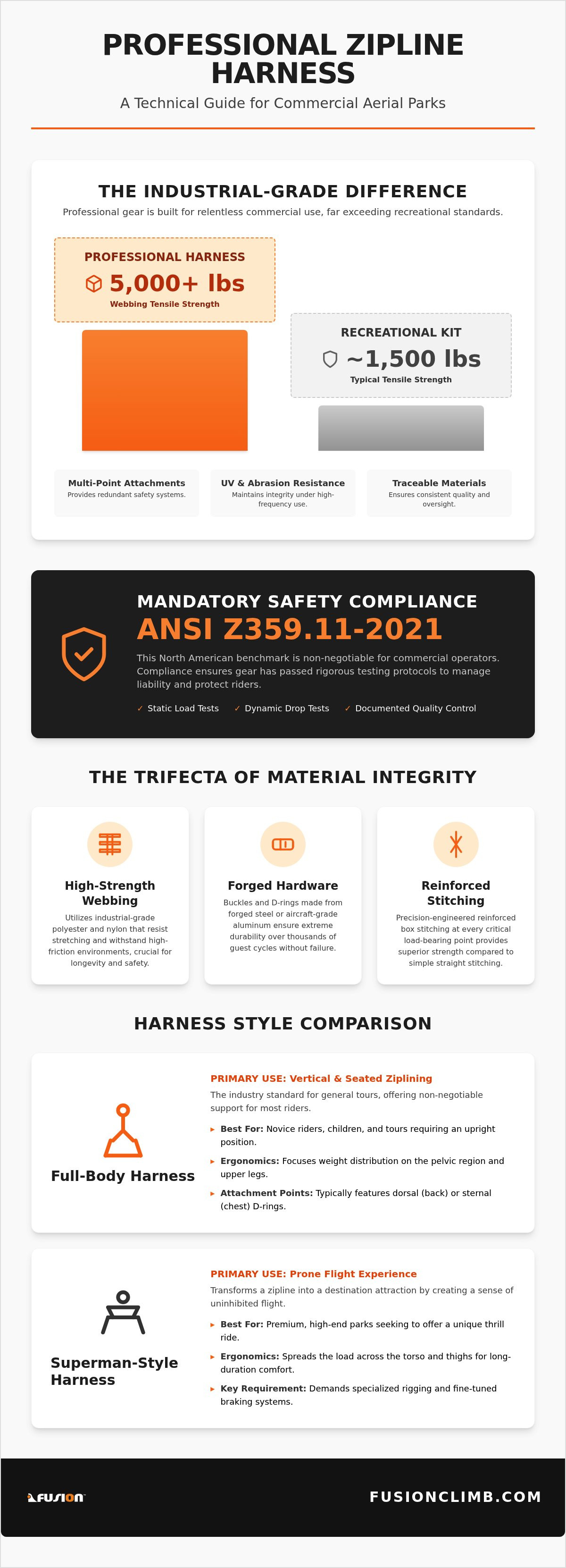
A professional zipline harness isn't just a piece of recreational equipment; it's an industrial-grade fall-arrest and suspension tool. Unlike consumer "adventure kits" found in big-box stores, commercial gear is built to withstand the relentless friction and weight cycles of a busy aerial park. The primary difference lies in the webbing tensile strength. While a backyard kit might prioritize lightweight materials, a professional zipline harness utilizes heavy-duty textiles designed to exceed 5,000 pounds of force. Commercial operations also demand multi-point attachment systems to provide redundant safety. This ensures that if one connection point is compromised, the rider remains securely suspended. For 2026 aerial parks, industrial-grade webbing standards require materials that maintain their structural integrity under extreme UV exposure and high-frequency abrasion.
ANSI Z359.11 and CE Standards for Aerial Adventure
ANSI Z359.11-2021 is the definitive benchmark for commercial operators in North America. This compliance ensures the gear has passed rigorous testing protocols, including static load and dynamic drop tests. Static tests verify the harness can hold a specific weight without failure, while dynamic tests simulate the violent force of a fall. Adhering to recognized Safety harness standards is a critical step in managing long-term liability. When you choose American-engineered gear with documented quality control, you're protecting both your riders and your business reputation. Manufacturing origin matters because it ensures material traceability and consistent manufacturing oversight.
Material Integrity: Webbing, Buckles, and Stitching
Material selection determines the lifespan of your equipment. High-strength polyester and nylon webbing are the industry staples because they resist stretching and handle high-friction environments. Your buckles shouldn't be the weak point. Mandatory standards for 2026 require forged steel or aircraft-grade aluminum hardware to ensure durability over thousands of guest cycles. Look for reinforced box stitching at every critical load-bearing point. This pattern provides a level of precision and strength that simple straight stitching cannot match. It's the difference between gear that lasts a single season and equipment that delivers a true return on investment. Every stitch and buckle must be engineered to provide a sobering sense of security for the operator and the guest alike.
Comparing Professional Styles: Full Body vs. Superman Harnesses
Choosing the right professional zipline harness depends on the specific thrill you want to deliver and the technical layout of your course. While traditional seated harnesses remain the industry standard for general tours, Superman-style configurations are transforming high-end parks into destination attractions. Each style requires a different approach to pressure point distribution. Seated harnesses focus weight on the pelvic region and legs, whereas prone harnesses spread the load across the torso and thighs to accommodate longer durations in the air. Selecting a professional zipline harness involves balancing these ergonomic needs with the mechanical requirements of your cable setup.
Full Body Harnesses for Vertical and Seated Ziplining
Full-body support is non-negotiable for novice riders and children who may lack the core strength to maintain a stable position. These harnesses typically feature dorsal (back) or sternal (chest) attachment points. Sternal points are ideal for upright zipping and maintaining guest orientation, while dorsal points are often utilized for vertical descents or specialized braking systems. Operators must strictly follow OSHA regulations for personal protective equipment to ensure all hardware meets mandatory load capacities. For comprehensive staff training, refer to this Safe Sizing: Climbing Harness Fitting Guide to ensure every guest is secured according to their specific body type.
Superman Style: The Prone Flight Experience
The prone position creates a psychological sense of uninhibited flight that a seated harness cannot replicate. This "Superman style" experience requires a specialized rigging system with multiple connection points to keep the rider’s body horizontal during the zip. It's a premium feature that demands specific operational protocols. Braking systems must be tuned for the increased aerodynamic profile of a prone flyer, and landing platforms require more precise guest deceleration. If you're looking to elevate your park's thrill factor, investing in specialized Superman Style Harnesses provides a distinct competitive advantage. These units are engineered for high-cycle use, ensuring that the immersion of flight doesn't come at the expense of industrial reliability.
Course incline and speed ultimately dictate your equipment choice. Steep, high-velocity lines benefit from the stability and restraint of a full-body configuration. Conversely, long, scenic lines over valleys are the perfect environment for an immersive prone experience. Choosing the correct professional zipline harness is a matter of matching engineering precision to the specific adventure your course provides.
The Integrated Connection System: Pulleys, Carabiners, and Tethers
Your safety setup is a chain where every link must be equally robust. A professional zipline harness serves as the anchor, but it's only as safe as the hardware that connects it to the cable. The critical interface between the harness D-ring and the zipline trolley represents the most vital junction in your operation. If this connection fails, the integrity of the harness becomes irrelevant. Operators must ensure that every component in this system is rated for commercial use and designed to work in unison. Following established harness guidelines for aerial adventure industry standards ensures that your gear meets the specific demands of high-volume environments. For long-term durability, steel hardware is preferred over aluminum for high-frequency commercial cable contact. Steel resists the abrasive "grooving" that occurs when metal meets cable at high speeds, extending the service life of your connection points.
Securing guests requires more than just a strong gate. You should utilize professional climbing carabiners with auto-locking mechanisms. These gates close and lock automatically, which significantly reduces the risk of human error during busy throughput periods. It's a simple engineering solution to a high-stakes problem.
Zipline Lanyards and Tethers: Managing Suspension
Lanyards are the bridge between the rider and the trolley. Fixed-length tethers offer simplicity and consistency for courses with uniform heights, while adjustable versions allow staff to fine-tune rider positioning on more complex course geometries. In high-speed braking zones, shock-absorbing elements within the lanyard are essential to mitigate the impact forces felt by the rider. Technical specifications for these components can be found in the Zipline Lanyards & Tethers Guide. Choosing the right tether ensures that the professional zipline harness remains properly oriented throughout the entire ride.
Matching Harnesses to Commercial Zipline Pulleys
Compatibility between your harness and your trolley is a matter of geometry and safety. You must ensure the harness attachment height aligns correctly with your commercial zipline pulleys to maintain proper cable clearance. Insufficient clearance can lead to rider contact with the cable, causing injury or equipment damage. Dual-track pulleys are often the best choice for full-body harnesses because they provide superior lateral stability. This prevents the "fishtailing" effect that can occur during high-velocity zips, keeping the rider centered and secure until they reach the landing platform.
Commercial Operator Logistics: Sizing, Throughput, and Maintenance
Efficiency at the gearing station directly impacts your bottom line. The "Throughput Challenge" is the constant pressure to harness guests quickly while maintaining a zero-error safety margin. A professional zipline harness designed for commercial use often features simplified adjustment points to speed up this process. Operators often debate between "one-size-fits-most" and specifically sized harnesses. While universal sizing reduces inventory complexity, sized harnesses often provide a more precise fit for extreme body types. To minimize staff errors during peak hours, look for gear with color-coded webbing or prominent sizing labels. These visual cues ensure that your team selects the right equipment for every rider, every time.
Gear longevity is a matter of both safety and ROI. You must retire equipment immediately if you observe significant UV fading, localized fraying, or any chemical exposure. Regular exposure to sun and humidity in outdoor parks accelerates textile degradation. Keeping a detailed log of every unit's service history is the only way to manage these risks effectively.
Daily and Monthly Inspection Protocols
Pre-flight checks are your first line of defense. Staff should inspect buckle function, webbing integrity, and D-ring corrosion before every tour. For a complete breakdown of documentation requirements, consult the Ropes Course Safety Equipment Standards guide. It's standard industry practice to enforce a mandatory retirement age for textile safety components, which typically ranges from 5 to 10 years regardless of visible wear.
Maximizing Rider Comfort for Higher Guest Satisfaction
Safety keeps guests alive, but comfort keeps them coming back. In high-heat environments, breathable padding is essential to prevent irritation and overheating. Properly designed leg loops are equally critical to prevent "harness hang syndrome," a dangerous condition caused by restricted blood flow during mid-cable stalls. A comfortable guest is more likely to focus on the adventure rather than their gear, leading to better reviews and repeat business. If you're ready to upgrade your fleet with equipment built for both safety and speed, explore our full range of professional zipline harnesses today.
Why Fusion Climb is the Choice for Professional Aerial Parks
Selecting a professional zipline harness is a decision that impacts every guest interaction and every safety audit your park undergoes. Fusion Climb stands as an industry leader by specializing in the engineering of both Superman and Full Body harnesses tailored for the high-stakes environment of commercial aerial adventure. We provide a comprehensive hardware ecosystem where every pulley, carabiner, and lanyard is designed to work in perfect synchronization with the harness. This integrated approach eliminates the guesswork of system compatibility, ensuring that your connection points are as reliable as the textiles themselves. As you prepare for the 2026 season, we invite operators to consult with our experts on large-scale fleet upgrades that prioritize both industrial reliability and rider comfort.
Engineering Safety into Every Stitch
Every piece of gear we produce carries the weight of a legacy that began in 1998. We don't just assemble equipment; we engineer it. Each professional zipline harness undergoes rigorous testing protocols before it ever leaves our facility to ensure it meets our exacting standards for tensile strength and durability. Purchasing directly from an American-based manufacturer gives you a direct line to the source of your equipment's quality control. Our "Rugged Confidence" isn't a marketing slogan; it's a manufacturing philosophy. We build gear for the toughest vertical environments on earth, providing the technical assurance you need to operate with total peace of mind. Substance always comes before style in our workshop.
Bulk Solutions and Operator Support
Commercial parks face unique logistical challenges that recreational users never encounter. Fusion Climb supports these high-volume operations with streamlined bulk ordering for our entire hardware range. Whether you need to replace a dozen pulleys or outfit an entire park with a new fleet of Superman Style Harnesses, we provide the scale and support required for professional success. Our catalog extends beyond standard sizes to include specialized gear such as children’s harnesses and equipment suitable for rehabilitation programs. This versatility ensures that your park remains accessible to the widest possible audience without compromising on safety protocols. When you're ready to invest in gear that delivers a long-lasting ROI and unmatched security, it's time to upgrade your course with Fusion Climb professional harnesses.
Securing the Future of Your Aerial Operation
Operating a high-throughput zipline course requires more than just enthusiasm; it demands an uncompromising commitment to engineering excellence. You've seen how a professional zipline harness acts as the cornerstone of a redundant safety system, bridging the gap between guest comfort and industrial-grade security. By prioritizing ANSI and CE compliance alongside specialized hardware, you ensure your operation remains resilient against the wear of high-cycle use. Fusion Climb has maintained a legacy of safety-first manufacturing since 1998. We specialize in providing the rugged, American-engineered gear required to protect your riders and your business reputation. Our rigorous testing protocols guarantee that every component, from Superman harnesses to auto-locking carabiners, performs exactly when it matters most. It's time to move beyond standard gear and embrace equipment built for the toughest vertical environments. Explore Professional Zipline Harnesses at Fusion Climb and prepare your fleet for a successful 2026 season. We're ready to help you push your limits with confidence.
Frequently Asked Questions
What is the difference between a climbing harness and a professional zipline harness?
A climbing harness is designed for vertical movement and occasional falls, whereas a professional zipline harness is engineered for prolonged suspension and high-cycle industrial use. Zipline-specific gear often features reinforced attachment points and padding optimized for sitting or prone positions during high-speed travel. Climbing gear lacks the specific durability required to withstand the friction and repetitive weight cycles common in commercial aerial parks. Always choose gear rated for your specific activity.
How often should a commercial zipline harness be inspected?
Commercial harnesses require three levels of inspection to maintain safety standards. Staff must perform a pre-flight check before every guest use to verify buckle function and webbing integrity. You should conduct a thorough, documented inspection every month to look for subtle signs of UV damage or fraying. Finally, a qualified third-party professional should perform an annual audit of your entire fleet to ensure compliance with the latest ASTM F2959-24 hardware standards.
Are Superman style harnesses safe for beginners?
Superman style harnesses are safe for beginners when provided by a professional operator with the correct rigging. These prone flight systems offer a unique thrill but require the guest to maintain a horizontal position. While they are accessible to most riders, they demand more core engagement than a standard seated harness. Operators must ensure guests meet specific height and weight requirements to guarantee the center of gravity remains stable during the entire flight.
What weight capacity is required for a professional zipline harness?
A professional zipline harness must typically accommodate riders within the standard ANSI range of 130 to 310 pounds for fall-arrest compliance. However, commercial-grade gear often features static tensile strengths exceeding 5,000 pounds to provide a massive safety margin. You should always check the manufacturer's specific rating for each unit. Ensuring your gear covers a broad weight spectrum allows your park to serve a diverse guest population without compromising on security.
Can I use a full body harness for both climbing and ziplining?
You can use a full body harness for both activities if the gear is dual-rated for climbing and industrial suspension. However, it's rarely the most efficient choice for commercial operators. Climbing harnesses prioritize range of motion, while zipline harnesses focus on rider comfort during suspension. Using specialized gear for each activity reduces wear and tear and ensures your guests have the most ergonomic experience possible during their adventure.
What is the lifespan of a professional-grade safety harness?
The industry standard lifespan for the textile components of a professional harness is typically 5 to 10 years from the date of manufacture. Hardware components like steel D-rings and buckles can last longer but must be retired immediately if they show signs of corrosion, deformation, or excessive wear. Factors like high UV exposure, salt air, or chemical contact can significantly shorten this window. Consistent logging of every unit's age is mandatory for liability management.
Does a zipline harness require ANSI compliance?
Yes, ANSI compliance is essential for any professional operation looking to manage liability and ensure rider safety. The current standard for 2026 is ANSI Z359.11-2021, which covers the requirements for full body harnesses. Adhering to these standards ensures the equipment has passed rigorous static and dynamic testing. Choosing ANSI-compliant gear demonstrates a commitment to industry best practices and provides a sobering sense of security for both staff and guests.
How do I choose the right size harness for a high-volume ropes course?
High-volume ropes courses benefit from a mix of universal harnesses and specific sizes for outliers. Universal harnesses with color-coded webbing allow staff to quickly identify adjustment points, which increases throughput at the gearing station. However, you should stock a range of sizes to accommodate children and larger adults safely. Clear sizing labels and staff training are the best tools for ensuring every guest is secured with precision and speed.