



The Ultimate Roofing Safety Harness Buying Guide: 2026 Professional Standards
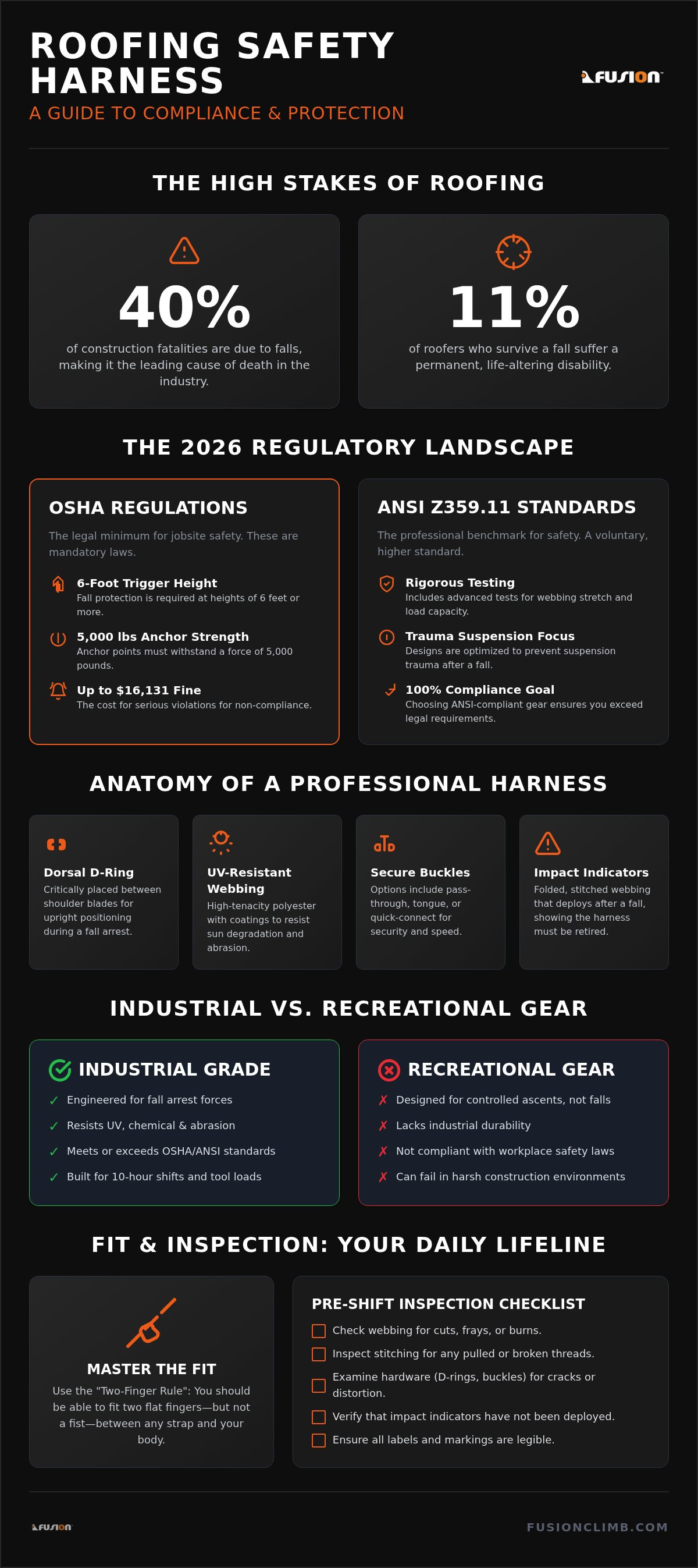
Falls account for nearly 40% of all construction fatalities annually, and 11% of roofers who survive a fall suffer a permanent disability. These statistics are a sobering reminder of the high-stakes environment you face every day on the job. You understand that roofing is one of the most dangerous trades, requiring gear that acts as a silent partner in your safety. It's frustrating to deal with an uncomfortable roofing safety harness that chafes during a ten-hour shift or leaves you questioning your compliance with the latest ANSI Z359.11 standards. High-performance engineering should provide security without sacrificing your mobility or comfort.
You deserve to master the technical requirements and professional standards necessary to choose equipment that protects your life and improves your workflow. This guide provides a methodical breakdown of the 2026 regulatory landscape, including OSHA's six-foot trigger height and the critical 5,000-pound anchor point strength requirements. We'll explore how to find a durable, precision-engineered harness that fits perfectly, ensures 100% regulatory compliance, and reduces physical fatigue. By understanding these industrial benchmarks, you can move with confidence and focus on the craft at hand.
Key Takeaways
- Understand the critical engineering differences between industrial fall arrest systems and recreational gear to ensure maximum protection on the job.
- Identify the essential hardware features, including dorsal D-ring placement and UV-resistant webbing, when evaluating a professional roofing safety harness.
- Distinguish between the mobility requirements of residential roofing and the heavy-duty tool compatibility needed for commercial industrial environments.
- Master the "two-finger rule" for a secure fit and follow a methodical pre-shift inspection checklist to maintain equipment integrity and user safety.
- Ensure 100% regulatory compliance by aligning your gear choices with the rigorous 2026 ANSI Z359.11 professional standards.
The Foundation of Fall Protection: Why Roofing Harnesses Are Non-Negotiable
A roofing safety harness is more than a piece of equipment; it's a precision-engineered full-body fall arrest component. Its primary function is to distribute the sudden, violent impact forces of a fall across the strongest parts of the human anatomy: the thighs, pelvis, chest, and shoulders. While a simple belt might keep you on a roof, only a full-body system prevents the internal injuries and spinal trauma associated with rapid deceleration. Understanding the Anatomy of a safety harness is the first step in moving from a basic worker to a protected professional.
Many beginners confuse recreational climbing gear with industrial fall protection. This is a dangerous oversight. Recreational harnesses are built for comfort during controlled ascents, whereas industrial gear is designed to withstand the harsh realities of a construction site. Professional equipment must resist UV degradation, abrasive shingle grit, and chemical exposure while maintaining its structural integrity. Avoid the "compliance in a can" mentality. While these pre-packaged kits might meet the bare minimum for a Saturday DIY project, they often fail the durability test of 10-hour shifts and rugged environments. Our philosophy centers on the gear being a silent partner. It should empower your movement and allow you to reach for a tool or navigate a steep pitch without restriction.
OSHA vs. ANSI: Understanding the 2026 Standards
Navigating safety requirements requires a clear distinction between mandatory laws and professional benchmarks. OSHA regulations are the legal floor. For both residential and commercial roofing, OSHA requires fall protection at a height of six feet or more. Failure to meet this can result in serious violations costing up to $16,131. In contrast, ANSI Z359.11 represents a voluntary, higher bar for safety. Professional contractors prioritize ANSI compliance because it includes rigorous testing for webbing stretch limits and trauma suspension. As a manufacturer, we certify our gear to these higher standards to ensure reliability when the stakes are highest.
The Cost of Non-Compliance on the Jobsite
The true cost of cutting corners isn't just a government fine. It's the psychological weight of working on a steep slope without total confidence in your gear. Inadequate protection leads to increased worker fatigue, as your body subconsciously tenses to compensate for a lack of security. High-quality gear reduces this physical strain, allowing for better focus and higher productivity. Fall arrest in residential roofing is a system designed to stop a worker's descent after a fall has occurred, preventing contact with the ground or lower levels. Investing in a professional roofing safety harness protects your life, your livelihood, and your team's future.
Anatomy of a Professional Roofing Harness: Key Features to Compare
Choosing a roofing safety harness requires an understanding of the engineering beneath the webbing. It's not just a collection of straps. It is a calculated system designed to save your life. The dorsal D-ring sits at the heart of this system. Its placement between the shoulder blades is critical. If it's too high or too low, the harness won't maintain the upright body position needed during a fall arrest event. This hardware must meet strict OSHA fall protection regulations to ensure it can withstand the 5,000-pound force requirements for anchor points.
Material choice defines the lifespan of your gear. High-tenacity polyester is the industrial standard because it resists stretching and maintains its shape under load. However, professional environments often demand specialized coatings. These treatments provide extra defense against UV degradation and the abrasive grit of asphalt shingles. Your buckle system also impacts daily performance. Pass-through buckles offer simplicity, while tongue-buckles provide a familiar, belt-like security. Quick-connect buckles are the choice for those prioritizing speed, allowing for a consistent fit every time you gear up.
Every professional roofing safety harness must include impact indicators. These are small sections of folded webbing stitched with a specific pattern. If the harness has arrested a fall, these stitches rip open to reveal a warning label. This is a "one-and-done" safety feature. If you see that indicator, the harness is retired immediately. There are no second chances with structural integrity.
Load Distribution and Ergonomics
Comfort is a safety feature. A 5-point adjustment system allows the harness to move with your body rather than against it. This precision fit ensures that if a fall occurs, the energy is distributed across your frame. Sub-pelvic straps are equally vital. They support the body after a fall and help prevent suspension trauma by keeping the user in a seated position while awaiting rescue. High-quality rigging hardware ensures these connections remain secure under extreme tension.
Hardware Integrity: Carabiners and Connectors
Your harness is only as strong as its weakest link. The synergy between your gear and professional climbing carabiners is what creates a truly secure connection. In roofing, steel hardware is often preferred over aluminum. It offers superior resistance to the abrasive dust and metal edges found on commercial sites. Gate strength is another technical detail you can't ignore. Professional-grade connectors feature heavy-duty locking mechanisms that won't fail under side-loading pressure. You can view our durable Full Body Harnesses to see these industrial standards in action.
Selecting the Right Harness for Your Trade: Commercial vs. Residential Needs
Not all roofs are created equal. A roofing safety harness designed for a flat commercial deck will feel cumbersome on a 12/12 residential pitch. Residential roofers require lightweight mobility. You move frequently and often work on steep slopes where every extra pound increases fatigue. Modern residential designs prioritize a streamlined profile to prevent snagging on shingle edges or ridge vents. This agility allows you to maintain your pace without fighting against your own gear.
Commercial and industrial roofing demands a different set of features. These jobsites often involve metal decking or flat membrane roofs where abrasion is a constant threat. Your harness needs reinforced wear points at the shoulders and legs to survive contact with sharp edges. Tool belt compatibility is also non-negotiable. A professional harness should allow for an integrated belt system that doesn't interfere with the fall arrest components. This ensures your tools are always within reach without compromising the integrity of the 5-point adjustment system.
Weight capacity is a technical specification you must verify before every purchase. By 2026 standards, a harness must be rated for the combined weight of the user and their equipment. If you carry a heavy nail gun and a full pouch, a standard 310-pound rating might not be enough. Always check the manufacturer's label for the maximum allowable capacity. Operating outside these limits can cause the webbing to fail during a fall arrest event, making the gear useless when you need it most.
Steep-Slope vs. Low-Slope Requirements
Lateral movement is the primary challenge on steep-slope roofs. Side D-rings assist in work positioning, allowing you to use both hands while remaining anchored to the slope. In specialized scenarios, such as navigating large commercial structures or transition zones, the use of zipline lanyards and tethers provides the necessary reach and security. Modular systems offer the most flexibility for your crew, letting you swap components based on the day's specific pitch and deck material.
The Comfort Factor: Breathability and Weight
Padding technology has evolved significantly by 2026. Older harnesses felt like wearing a heavy coat in July, but modern moisture-wicking linings actively pull sweat away from the body. This is critical for reducing heat stress during long summer shifts. Ergonomic padding now targets specific pressure points in the shoulders and thighs to reduce the risk of numbness during extended suspension. We build gear that balances rugged confidence with all-day wearability, ensuring your roofing safety harness never becomes a distraction from the job.
Avoiding Common Mistakes: Sizing, Inspection, and Maintenance
A professional roofing safety harness is a life-saving investment, but its performance depends entirely on your commitment to maintenance. Even the most durable gear degrades when exposed to the harsh realities of a jobsite. The "Two-Finger Rule" is your primary field test for a safe fit. Once adjusted, you should be able to slide two fingers between the strap and your body, but no more. If the fit is too loose, the impact forces during a fall will cause the harness to shift violently, leading to internal injuries. If it's too tight, it restricts the blood flow and mobility needed for a ten-hour shift.
Environmental hazards are the silent enemies of your equipment. Asphalt grit acts like microscopic sandpaper on high-tenacity polyester, working its way into the weave and severing internal fibers over time. UV rays from direct sunlight also cause "sun rot," which makes webbing brittle and prone to snapping under load. Chemical exposure from roofing adhesives or cleaners can weaken the textile structure without leaving visible marks. Store your gear in a cool, dry environment away from direct light to maximize its lifespan and protect your industrial investment. You can find durable, manufacturer-grade Full Body Harnesses that are engineered to withstand these rugged conditions.
How to Fit Your Harness Correctly
Establishing a consistent fitting routine ensures your gear performs as designed every time you step onto a pitch. Follow these steps for a secure fit:
- Step 1: Hold the harness by the dorsal D-ring and shake it to let the straps fall into place. Inspect the webbing and hardware for any signs of damage or wear.
- Step 2: Slip the straps over your shoulders like a vest. Ensure the dorsal D-ring is positioned exactly between your shoulder blades.
- Step 3: Connect and adjust the leg straps first. This establishes the foundation of the harness and prevents it from riding up during a fall.
- Step 4: Secure the chest strap and tighten the shoulder tension. The fit should be firm enough to keep you upright without pinching your skin.
When to Retire Your Gear
Identifying hidden damage is a critical skill for any professional roofer. Frayed internal fibers or chemical burns may not be obvious at a glance, but they compromise the structural integrity of the system. Most manufacturers recommend a five-year retirement age for textile-based fall protection gear, regardless of its appearance. However, real-world use often shortens this window. You must never reuse a roofing safety harness that has been involved in a fall event. The internal components are designed to stretch and absorb energy once. After that, the harness has done its job and must be destroyed to prevent accidental reuse. Check your labels regularly; if they are no longer legible, the harness is no longer compliant and must be retired.
The Fusion Climb Difference: Industrial-Grade Roofing Solutions
Fusion Climb has engineered gear for the vertical world since 1998. We don't just resell equipment. We manufacture it. Our legacy is built on providing industrial reliability for the men and women who keep our infrastructure standing. Every roofing safety harness we produce reflects a commitment to meticulous manufacturing and high-stakes performance. From the initial weave of our high-strength webbing to the final precision-testing of our hardware, we prioritize substance over style. We are a US-based manufacturer dedicated to the "silent partner" role of safety equipment.
Professional roofers trust our full-body fall arrest systems because we understand the physical challenges of the jobsite. We build gear that acts as a dependable guardian. It provides a sobering sense of security while you push your physical limits. This is the silent partner philosophy in action. Your equipment should be the last thing on your mind because you know it's been tested to exceed the most rigorous standards. We remain rooted in traditional values of strength while serving as a bold innovator in safety technology.
Top-Tier Fall Protection for Professionals
Our ANSI-compliant full-body harnesses are designed specifically for the unique demands of industrial roofing. We draw from a diverse engineering background, integrating the high-performance standards of ropes course safety equipment into our industrial fall protection line. This crossover ensures that our gear offers superior mobility and energy absorption during a fall event. We focus on "Superman style" and full-body designs that distribute forces effectively across the body. Upgrade your crew with Fusion Climb's roofing collection to experience the difference that professional-grade engineering makes on every pitch.
A Commitment to Safety Excellence
Safety is not a checklist. It's a culture of excellence. We support the national workforce by providing gear that ensures every worker returns home at the end of the shift. Using a complete, compatible system from a single trusted manufacturer reduces the risk of hardware failure. Our carabiners, lanyards, and harnesses are designed to work in synergy. This eliminates the guesswork and ensures that every component meets the same high-strength requirements. We remain rooted in traditional values of strength while innovating for the future of vertical safety. A professional roofing safety harness from our collection is a testament to that legacy. Browse the full range of professional roofing harnesses today and invest in gear that protects your most valuable assets.
Secure Your Future in the Vertical World
Professional safety on a jobsite is never a matter of chance. It's the result of choosing precision-engineered equipment that meets the highest industrial benchmarks. By mastering the 2026 ANSI Z359.11 standards and selecting a roofing safety harness tailored to your specific trade needs, you ensure your gear acts as a silent partner rather than a restriction. The integrity of your fall arrest system depends on daily inspections and a commitment to retiring gear at the first sign of structural compromise.
Since 1998, Fusion Climb has manufactured rugged, industrial-grade solutions that professionals trust in high-stakes environments. Our ANSI-compliant designs are built to withstand the abrasive realities of the roofing industry while providing the ergonomic support needed for long shifts. Don't leave your safety to luck when you can rely on meticulous manufacturing and proven reliability. Equip your team with Fusion Climb's professional roofing safety harnesses today. Move with confidence and focus on your craft with gear designed to protect your life.
Frequently Asked Questions
What is the difference between a roofing harness and a standard climbing harness?
Industrial harnesses are engineered for fall arrest, distributing violent impact forces across the thighs, pelvis, chest, and shoulders. Recreational climbing harnesses prioritize comfort during active suspension and typically use a front tie-in point. A professional roofing safety harness must feature a dorsal D-ring for vertical connections and meet ANSI Z359.11 standards. Industrial webbing is also specifically treated to resist the abrasive grit of asphalt shingles and jobsite chemicals.
How do I know if my roofing harness is ANSI Z359.11 compliant?
Compliance is verified through the manufacturer's label permanently stitched into the webbing. This label must explicitly state the ANSI Z359.11 designation and include the manufacturer's name and date of production. If this information is missing, worn away, or illegible, the harness is no longer considered compliant for professional use. Always check for a third-party certification mark to ensure the equipment has passed rigorous industrial testing protocols.
What size roofing safety harness do I need?
Harness sizing is determined by a combination of your height and weight, often listed on a manufacturer-specific chart. A properly sized roofing safety harness should allow for the "two-finger rule" at all adjustment points while keeping the dorsal D-ring centered between your shoulder blades. Most industrial models utilize 5-point adjustment systems to provide a precision fit for various body types. Selecting the correct size ensures you remain in an upright position after a fall.
How often should a roofing safety harness be inspected?
A personal inspection is mandatory before every shift. You must examine the webbing for frays, hardware for cracks, and stitching for broken threads. Additionally, OSHA regulations require a documented inspection by a competent person at least once every six months. If your gear is exposed to extreme UV rays or abrasive metal roofing environments, you should increase the frequency of these audits to maintain the structural integrity of your fall arrest system.
Can I wash my safety harness if it gets covered in tar or dirt?
You can wash your harness using a mild detergent and warm water, but you must avoid bleach or industrial solvents. These chemicals can damage the synthetic fibers of the high-tenacity polyester webbing. Hand-wash the equipment and hang it to air-dry in a cool, well-ventilated space away from direct sunlight. Never use a machine dryer or a high-heat source, as extreme temperatures can cause the webbing to shrink or become brittle.
What should I do with my harness after it has arrested a fall?
You must immediately remove the harness from service and destroy it to prevent any further use. Even if the gear looks structurally sound, the internal fibers have been stretched to their limit to absorb the energy of the fall. Professional harnesses include impact indicators that reveal a warning message once the system has been deployed. Once these stitches rip, the equipment has performed its one-time life-saving function and must be retired.
Are there weight limits for professional roofing harnesses?
Every harness has a maximum weight capacity that includes the user's body weight plus the weight of all tools and clothing. Standard industrial ratings often cap at 310 pounds, though some specialized models offer higher capacities. Exceeding these limits can cause the webbing to fail or prevent the fall arrest system from decelerating your body safely. Always confirm your total load against the manufacturer's label to ensure you are operating within tested safety parameters.
Can I use a zipline harness for roofing work?
You should not use a zipline harness for roofing unless it is explicitly certified as a full-body fall arrest system. Many zipline designs are built for seated suspension and lack the dorsal D-ring or the specific load-bearing webbing required for roofing safety. Professional roofing requires equipment that meets the rigorous ANSI Z359.11 standard to survive the violent forces of a vertical drop. Always use the specific gear engineered for the vertical challenges of a construction site.