


Robust Zipline Trolley Service for Commercial Operations
High usage quickly exposes weak points in a zipline system. Choose a robust zipline trolley for high usage based on repeated commercial operation, and match its documented load rating to the intended setup rather than judging suitability by a strength figure alone.
Operators already know that reliable equipment matters, but long service life also depends on routine inspection, maintenance, and how efficiently riders move through the course. The right trolley choice supports steady throughput without losing sight of safe operation.
Learn how wear and maintenance affect trolley service life, which features support frequent use, and how to interpret load specifications. This guide also covers key questions to resolve when selecting equipment for a commercial course, helping you make a decision grounded in your operating needs.
Key Takeaways
- Build maintenance into operations: routine checks and attention to wear help identify when a trolley needs service or replacement.
- Match trolley design to rider throughput and braking demands to support consistent commercial use.
- Read load specifications in context, including cable compatibility and the difference between a component rating and the limits of the complete setup.
- Use the article’s decision points to narrow equipment choices and identify where compatible pulleys, harnesses, and tether components fit your operation.
Trolley service life and maintenance
Commercial trolley service life depends on how often it is used, the demands of braking, and timely maintenance. In busy operations, combine scheduled inspections with clear procedures for taking worn equipment out of service.
Durability and Wear-Part Alerts
Check each trolley for changes in wheel movement, bearing noise, housing damage, and braking performance. These signs may indicate wear affecting smooth travel or consistent stopping. Record findings by unit so recurring issues are visible across shifts.
Magnetic braking systems have no moving parts or brake pads to replace, reducing those specific wear points. They still require regular trolley maintenance and safety checks. Staff training and clear rider instructions also support safe operation. Use inspection findings to decide when a trolley needs service or removal from use.
Warranties and Replacement Parts
U.S. warranty coverage, replacement-part access, and support terms vary by supplier. Before selecting a trolley, review the written warranty for covered components, exclusions, and the process for obtaining replacement parts. These details help operators plan for repairs without assuming every wear item receives the same coverage.
Treat that figure as one maintenance consideration, not a complete repair estimate: labor, downtime, and other parts also affect the effort involved. Track bearing condition and service history to help plan maintenance around operating needs.
No single braking system is safest for every high-traffic zipline setup. Choose a system suited to the course and check it regularly. Magnetic braking avoids moving parts and replaceable brake pads, while staff training and clear rider instructions remain essential.
Which U.S. suppliers offer warranties, parts, and support? Supplier terms differ, so compare written warranty coverage, replacement-part availability, and support procedures for the specific trolley. Use those details alongside inspection records to plan maintenance, rather than relying on a warranty alone.
High-throughput commercial trolleys
High-volume leisure parks may process hundreds of riders daily, making trolley performance part of the operating rhythm. A robust zipline trolley for high usage must suit repeated launches, braking demands, and efficient rider transitions.
Capacity and Feature Comparisons
Commercial trolleys use high-speed bearings and housings designed for repeated impact braking. Compare wheel design as one factor: 2-inch wheels commonly have efficiency ratings of at least 85%, while 1.5-inch wheels are typically above 90%. Bushings are estimated at 50%-70% of bearing-wheel efficiency.
Wheel-efficiency figures do not tell you how many riders a course can serve per hour. Loading, harness fitting, and landing-area clearance can still create bottlenecks. Assess trolley travel alongside the time staff need to prepare each rider. A robust zipline trolley for high usage should support the actual workflow, not just perform well as a standalone component.
Commercial trolley prices vary by capacity and features. Compare like-for-like configurations by rated capacity, cable compatibility, wheel and bearing design, braking components, and included replacement parts. This is a more practical way to assess a robust zipline trolley for high usage than comparing headline prices alone.
Certifications and Safety Standards
For U.S. operations, evaluate safety documentation against the intended course, cable, trolley, and braking setup. A trolley’s capacity rating or feature list alone does not establish that the complete installation meets applicable requirements.
Review the manufacturer’s documentation for the exact model and its intended use. Keep equipment inspection and maintenance records, and document staff procedures for rider instructions and operation. This connects the trolley’s stated performance to how the commercial course runs in practice.
To assess throughput, map the rider sequence from dispatch through landing and reset. Note where trolley movement, braking, or staff handoffs cause delays, then compare equipment features with those specific demands. This gives capacity figures useful context.
Match the trolley to the cable and operating pattern before weighing optional features. Review commercial zipline equipment as part of that planning process.
High-load trolley specifications
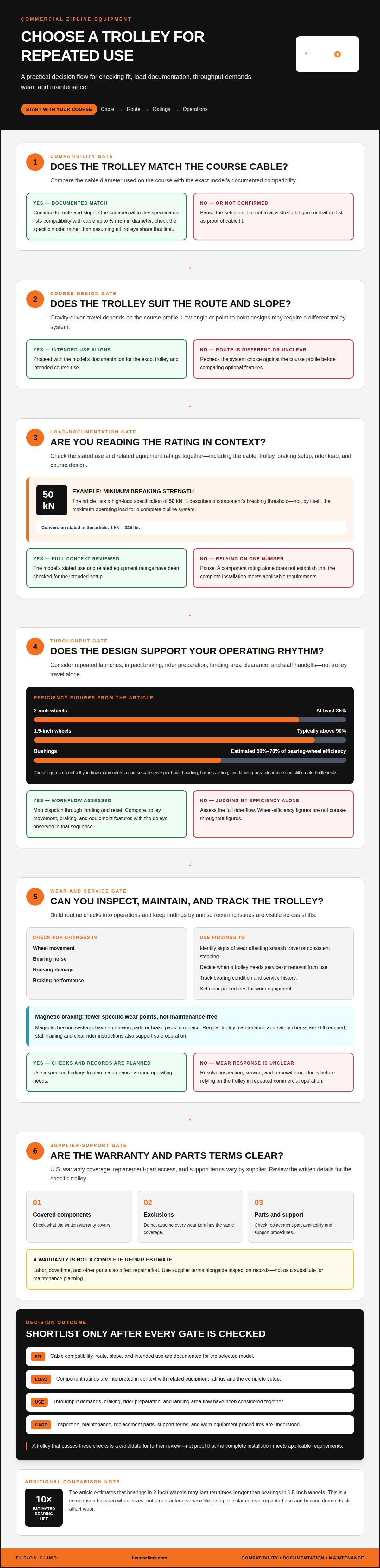
Choose a trolley by matching its documented specifications to the cable, slope, rider load, and course design. A strong component rating matters, but compatibility determines whether the trolley can travel smoothly in the intended setup.
Start with cable diameter. A commercial trolley specification lists compatibility with cable up to 1/2 inch in diameter, so compare that limit with the cable used on the course. Then consider slope and route: gravity-driven travel depends on the course profile, while low-angle or point-to-point designs may require a different trolley system.
One listed high-load specification gives a minimum breaking strength of 50 kN. For conversion, 1 kN equals 225 lbf. Minimum breaking strength describes a component’s breaking threshold; it is not, by itself, the maximum operating load for a complete zipline system. Review the trolley’s stated use and related equipment ratings together.
Wheel size and bearing design also influence operation and maintenance. A chart estimates that bearings in 2-inch wheels may last ten times longer than bearings in 1.5-inch wheels. Treat this as a comparison between wheel sizes, not as a guaranteed service life for a particular course. Repeated use and braking demands remain relevant to wear.
Material is another specification to interpret. A commercial trolley example lists heat-treated 304 stainless steel. The material description helps identify construction, but it does not replace checking cable fit, load documentation, and intended use.
For a practical comparison, review the trolley’s cable range, wheel dimensions, minimum breaking strength, material, and compatibility with the course slope and route. Consider rider weight and operating conditions as part of the complete setup, rather than treating one high number as proof of suitability. A compatible configuration supports smooth travel at course speeds, with each specification assessed in context.
Maximum load rating
A trolley’s maximum load rating guides its intended operation, but it is not the same as minimum breaking strength. Use the manufacturer’s stated operating limit for the exact model and assess it alongside the complete course configuration.
Start by checking how the rating is defined. Does the stated load refer to the rider alone, or include clothing, equipment, and attached hardware? If the manual defines a total supported load, use that basis consistently. Do not compare a rider-only figure with a total-load figure as if they mean the same thing.
Next, account for connected components. The trolley, cable, connectors, and harness each have their own specifications. Review their documentation together, including any limits stated for the intended use. A trolley’s individual rating does not establish the operating limit of an assembled system.
Course design matters too. Slope, braking arrangement, and intended cable compatibility affect how the equipment operates. A rating alone does not describe performance on every route or in every operating condition. Match the model documentation to the actual zipline design instead of choosing solely by the largest number.
For commercial operations, make rating checks part of a repeatable equipment-selection process:
- Record the trolley model and its stated maximum operating load.
- Use the manufacturer’s definition of load, including whether rider gear is counted.
- Compare connected equipment specifications and cable compatibility.
- Keep the model documentation with operational records so staff use consistent criteria.
The 50 kN minimum breaking strength cited for one trolley is a breaking-strength specification, not a substitute for its operating-load instructions. Keep those terms separate in procurement and staff records. For a commercial setup, explore zipline equipment alongside the load and compatibility criteria that shape your operation.
Fusion Climb
Fusion Climb supplies equipment for commercial zipline systems, including pulleys, harnesses, lanyards, and tethers. These components complement trolley selection, helping operators consider how rider support and connected equipment fit the course’s load and cable specifications.
Turn to Fusion Climb when planning equipment for a high-use operation or matching components to a zipline setup. Full Body Harnesses and Superman Style Harnesses serve different rider configurations, while Zipline Pulleys, lanyards, and tethers support other parts of the equipment system. Match each item to its intended application and the specifications of the complete setup.
For equipment questions related to your commercial zipline operation, contact Fusion Climb.
Plan Your Next Equipment Decision
Choosing a robust zipline trolley for high usage is one part of building an operation that can adapt to rider demand and course needs. Make your next step a focused review of the setup: identify the cable and operating conditions, clarify load requirements, and assess how each component fits the complete system.
Fusion Climb supplies Full Body Harnesses, Superman Style Harnesses, and Zipline Pulleys for commercial zipline equipment needs. These options let you consider rider support and pulley components alongside trolley selection, without treating any single item as a substitute for evaluating the whole configuration.
Bring your equipment questions and operating priorities into the selection process. A clear understanding of how the system is used helps keep decisions practical and grounded in your course requirements.
Contact Fusion Climb about trolley options and take the next step toward a well-matched setup.
Frequently Asked Questions
What features make a zipline trolley durable for frequent commercial use?
Durability in commercial use depends on components designed for repeated operation, including high-speed bearings and housings built to withstand repeated impact braking. A practical selection also accounts for cable compatibility and accessible wear parts. Review the model’s maintenance instructions and identify which components need inspection, so staff can spot changes in trolley movement or braking before continued operation.
Which zipline trolleys are rated for high daily usage and what are their load limits?
Commercial trolleys designed for repeated operation are the relevant category, but daily-use suitability and load limits are separate specifications. The Fusion Advent Speed Trolley is listed with a 50 kN minimum breaking strength; that figure is not a working load limit or daily-use rating. Select equipment using its stated operating limits and intended use, not breaking strength alone.
What materials and bearing types last longest in zipline trolley construction?
Heat-treated 304 stainless steel is listed for a commercial trolley, while bearing life depends on wheel design and operating conditions. A comparison estimates that bearings in 2-inch wheels may last ten times longer than those in 1.5-inch wheels. Treat that as a relative comparison, not a promised service interval. Frequent braking and actual use still shape wear.
How often should high-use zipline trolleys be inspected, serviced, and replaced?
Inspect and maintain trolleys regularly, following the manufacturer’s instructions and your operation’s inspection procedures. Set the service schedule according to use, observed wear, and braking performance rather than assuming a universal calendar interval. Replace a trolley or component when its instructions or inspection findings call for removal from service. Keep records by unit to track recurring needs and support consistent decisions.
What are the common failure risks of heavily used zipline trolleys and how can they be prevented?
Repeated operation can wear bearings and braking components, while impact braking puts repeated demands on trolley housings. Include these areas in routine safety checks, and remove equipment from operation if an inspection identifies damage or a change in performance. Staff training, clear rider instructions, and maintenance records help teams follow procedures consistently across shifts and identify recurring concerns.
What trolley speed-control and braking systems are safest for high-traffic ziplines?
No single braking system is safest for every setup. Choose one suited to the course and check it regularly. Magnetic braking has no moving parts or brake pads to replace, but staff training and clear rider instructions remain important.