


The Definitive Guide to Tower Climbing Safety Harnesses (2026)
A safety harness is not a piece of clothing; it is a life-support system designed for the most unforgiving environments on earth. Suspended hundreds of feet above the deck, your equipment is the only thing standing between a successful shift and a catastrophic failure. You know that every extra pound of poorly distributed weight feels like ten by the fourth hour of a climb. Selecting a tower climbing safety harness that balances uncompromising security with the mobility needed for modern infrastructure work is the difference between professional career longevity and debilitating physical fatigue.
Trust your gear. We understand the frustration of managing the shift to six-month inspection cycles and the technical nuances of the current ANSI Z359.11-2021 standard. This guide provides the technical clarity you need to master your equipment selection and ensure maximum safety at extreme heights. We'll break down the specific engineering behind load distribution, explain how to manage complex hardware like SRLs and lanyards, and identify the durability features required for the 2026 industrial landscape. Expect a methodical deep dive into the systems that protect you during vertical operations.
Key Takeaways
- Master the current ANSI Z359.11-2021 standards to ensure your equipment meets the rigorous manufacturing and testing benchmarks required for fall arrest.
- Identify critical hardware configurations, such as frontal and dorsal D-rings, to optimize your tower climbing safety harness for both vertical mobility and work positioning.
- Reduce physical strain and muscle fatigue by selecting ergonomic padding systems designed for the long-duration shifts typical of modern infrastructure projects.
- Implement a strict six-month professional inspection schedule and learn the specific condition-based criteria for retiring gear from active service.
- Match your equipment to the environment by choosing specialized coatings and high-strength webbing that resist corrosion and heat in harsh field conditions.
Understanding Tower Climbing Safety and Fall Protection Standards
A tower climbing safety harness is a specialized fall arrest system engineered specifically for vertical mobility and work positioning. It's not a generic piece of safety equipment. While a standard construction harness might suffice for a flat roof, it fails to meet the brutal demands of telecom and utility tower work. Technicians in this field face unique hazards including high-velocity falls from height, the physiological threat of suspension trauma, and constant environmental exposure. Understanding Tower Climbing Safety starts with recognizing that your harness is a precision tool designed to manage these specific risks through rigorous engineering.
The Regulatory Landscape: OSHA and ANSI Requirements
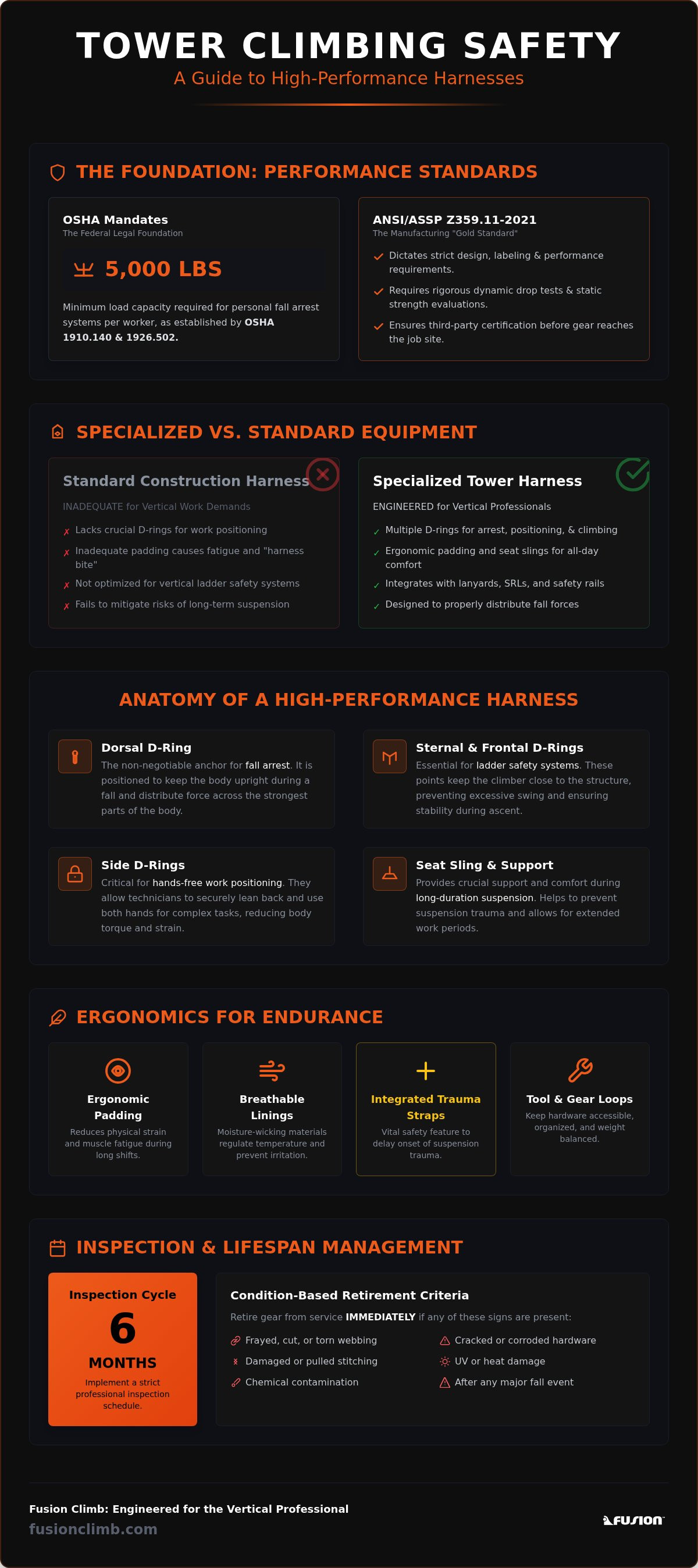
Federal mandates provide the legal foundation for safety, but manufacturing standards define the actual performance of your gear. OSHA 1910.140 and 1926.502 establish the criteria for fall protection systems, requiring that personal fall arrest systems withstand a minimum load of 5,000 pounds per worker. However, the ANSI/ASSP Z359.11-2021 standard is the gold standard for full-body harnesses. It dictates strict requirements for design, labeling, and performance. Look for third-party certification. This ensures that a tower climbing safety harness has survived dynamic drop tests and static strength evaluations before it ever reaches the job site. Compliance isn't a suggestion; it's a baseline for survival in a high-stakes industry.
Why Tower Work Demands Specialized Equipment
The physics of vertical climbing differ fundamentally from horizontal movement on a job site. When you're ascending a 300-foot lattice, you're fighting gravity with every step. This requires multiple attachment points, including frontal D-rings for ladder safety systems and side D-rings for work positioning. General construction gear lacks the specialized seat slings and heavy-duty padding needed for tasks that last multiple hours. Without these features, "harness bite" can lead to restricted blood flow and muscle fatigue. In the 2026 landscape of 5G rollouts and renewable energy expansion, towers are becoming more complex. You need a harness that integrates seamlessly with safety rails and lanyards while providing the suspension support necessary to prevent suspension trauma during a rescue scenario. Durable webbing and high-strength hardware aren't just features; they're the components of a dependable guardian for vertical professionals.
Key Features of a High-Performance Tower Harness
High-performance gear isn't about luxury. It's about technical survival. A tower climbing safety harness must act as a seamless interface between the technician and the vertical environment. Every component, from the webbing to the smallest buckle, serves a specific mechanical purpose. You don't just wear this equipment; you rely on it to manage the physical forces of your environment. Selecting a system with the right configuration ensures that you can focus on the task at hand rather than the limitations of your gear.
Attachment Points and Their Specific Functions
Dorsal D-rings are the non-negotiable anchor for fall arrest. They keep you upright during a drop and are designed to distribute force across the strongest parts of your body. Sternal and frontal points are essential for ladder safety systems. They keep you close to the structure during the climb to prevent excessive swing. Side and seat D-rings allow for hands-free work positioning. This is critical for tower climbing safety because it prevents the user from having to grip the tower while performing technical tasks. Proper placement reduces the torque on your body and minimizes physical strain during long hours on the steel.
Comfort and Ergonomics for All-Day Wear
Long shifts require breathable mesh linings. These moisture-wicking materials regulate temperature and prevent skin irritation. Integrated trauma straps are a vital safety addition. They allow a fallen climber to stand in the harness while awaiting rescue, which significantly delays the onset of suspension trauma. Organization matters too. Integrated tool tethering points and gear loops keep your hardware accessible. This prevents clutter and ensures that your weight remains balanced. Efficiency at height is often a matter of how well you can access your tools without compromising your center of gravity.
Trust your hardware. Choose your buckles based on the specific demands of your worksite. Quick-connect buckles offer speed and convenience for daily use. Tongue-buckle systems provide a traditional, fail-safe adjustment that remains secure even in muddy or icy conditions. Webbing must be high-strength. Many professional-grade options feature ratings of 7,000 lbs to exceed baseline safety requirements. Corrosion-resistant coatings on all hardware ensure the system remains functional after exposure to salt air or heavy rain. For gear that meets these rigorous manufacturing standards, consider exploring a high-performance full body harness designed for industrial reliability. Precision engineering is the only way to ensure long-term durability in harsh weather.
Selecting the Right Harness for Your Tower Environment
Choosing a tower climbing safety harness requires a clinical assessment of your specific work environment. You don't just buy a harness; you procure a system that mitigates the unique stressors of your site. If your shift involves five hours of hanging work on a lattice tower, you need a different solution than a technician performing a quick 20-minute inspection. Environmental factors like salt-spray corrosion or high-voltage electrical fields dictate the material composition of your gear. Failing to match the equipment to the environment doesn't just lead to discomfort; it leads to equipment failure at the worst possible moment.
Evaluating Work Duration and Mobility Needs
Work duration is the primary driver for comfort features. For rapid inspections or light maintenance, a lightweight harness minimizes the physical load on the climber. However, for heavy-duty construction and long-duration rigging, a harness with an integrated seat sling is non-negotiable. These slings distribute pressure across the gluteal muscles rather than concentrating it on the femoral arteries. This is a critical distinction for compliance with OSHA 1926.954 Fall Protection Standards, which emphasize the need for effective work-positioning equipment. When a technician's stamina is preserved through proper weight distribution, site productivity increases and the risk of fatigue-related errors drops.
Specialized Hazards: Arc Flash and Flame Resistance
Utility workers and technicians near high-voltage lines face the added threat of electrical discharge. In these environments, an ASTM F887-rated harness is mandatory. These specialized systems are designed to remain intact even after exposure to an arc flash event. Look for dielectric hardware. These components feature non-conductive coatings that prevent the harness from acting as a path to ground. If your work involves welding or grinding at height, ensure your webbing is flame-resistant. Standard nylon or polyester webbing can melt or degrade instantly when exposed to sparks, compromising the integrity of the entire fall arrest system.
Don't settle for a "one size fits all" approach. A poorly fitted harness is a major safety risk. If the straps are too loose, the dynamic force of a fall can cause the user to slip out of the system or suffer severe internal injuries. If they're too tight, they restrict the range of motion needed for complex rigging maneuvers. Precision in sizing ensures that the D-rings stay properly positioned during a fall. High-performance gear should offer multiple points of adjustment to accommodate various body types and seasonal clothing layers. Your harness must be a dependable guardian that fits perfectly every time you leave the ground.
Maintenance, Inspection, and Hardware Integration
A tower climbing safety harness is a life-support system that requires meticulous care. Neglect is a liability. You must perform a pre-use inspection before every shift to identify frayed webbing, distorted hardware, or signs of chemical exposure. Even a minor nick in a load-bearing strap can compromise the entire fall arrest system under dynamic load. Safety is a continuous cycle of verification that begins before your boots leave the ground.
The Daily Inspection Protocol
Start with the stitch patterns. High-performance harnesses feature integrated load indicators that reveal when the system has already arrested a fall. If these indicators are visible, the gear must be pulled from service immediately. Hardware functionality is equally critical. Check that all buckles, adjusters, and D-rings operate smoothly without binding or corrosion. After the climb, clean your equipment with mild soap and water to remove contaminants. Store the harness in a cool, dry environment away from direct sunlight. UV degradation is a silent killer of synthetic fibers, and proper storage preserves the life of the webbing.
- Webbing: Check for "fuzzing," burns, or hard spots caused by heat or chemicals.
- Hardware: Ensure gates and buckles snap shut and lock without manual assistance.
- Labels: Verify that all safety and certification labels are legible for compliance checks.
System Integration: Beyond the Harness
Your harness is only as strong as its weakest link. Secure connections are the backbone of vertical safety, which means integrating your system with professional climbing carabiners that feature auto-locking gates. This prevents accidental rollout during complex maneuvers. Choosing the correct carabiner gate type for tower-side attachments ensures that the load is always applied to the major axis of the hardware.
Pairing your system with the right zipline lanyards and tethers is essential for effective fall arrest. You must decide between shock-absorbing lanyards for fixed-length tasks or Self-Retracting Lifelines (SRLs) for greater mobility. Ensure all connectors are compatible to prevent gate loading. Incompatible hardware can force a carabiner gate to open under pressure, leading to a catastrophic failure. Industry standards often cite a five-year lifespan, but condition-based retirement is the professional reality. As of 2026, regulations require professional inspections every six months. If your gear shows structural distortion or excessive wear, retire it regardless of its age. For equipment that meets these rigorous manufacturing standards, browse our industrial-grade full body harnesses to ensure your crew remains protected at height.
Fusion Climb: Engineered for the Vertical Professional
Fusion Climb operates with a singular focus: the safety of those who work in the most demanding vertical environments. Since 1998, we've focused on high-stakes reliability through US-based manufacturing standards. A tower climbing safety harness from Fusion isn't just a product; it's a piece of professional-grade craftsmanship engineered for the rigors of the telecom and utility industries. We act as your silent partner. Our gear is designed to work as hard as you do, providing a sobering sense of security without hindering your progression on the steel. You don't have to compromise between mobility and protection when your equipment is built for the task.
The Fusion Advantage: Strength and Precision
Quality control isn't a checkbox for us; it's a core value. Our manufacturing processes exceed standard industry requirements to ensure every component survives real-world application. We specialize in full-body fall arrest systems that prioritize durability and precision. Whether you're managing complex rigging or performing routine maintenance, our gear supports professional industrial climbing with uncompromising strength. We build for technicians who need equipment that withstands harsh weather and heavy loads shift after shift. Our webbing is often rated at 5,000 lbs or 7,000 lbs, depending on the model, providing the industrial reliability that national tower crews trust for their daily operations.
Building Your Complete Fall Protection System
Safety is a holistic challenge. While the harness is the foundation, its synergy with specialized rigging hardware defines your overall security at height. We offer a comprehensive suite of ANSI-compliant gear, including high-strength carabiners and shock-absorbing lanyards. This integration ensures that every connection point in your system is as reliable as the harness itself. Safety managers and procurement officers can access detailed technical specifications to ensure full compliance with the latest regulations. Precision engineering and meticulous manufacturing are the hallmarks of every item we produce, from our full body harnesses to our most specialized pulleys and tethers.
Choosing Fusion means choosing gear that respects the physical limits of the user. We understand that muscle fatigue is a primary safety risk during long climbs. By focusing on weight distribution and ergonomic hardware placement, we help technicians maintain their focus on the task rather than their discomfort. Our commitment to industrial-strength manufacturing ensures that your gear remains a dependable guardian throughout its service life. View the Fusion Climb collection of professional safety gear to equip your crew with the most dependable hardware on the market.
Secure Your Future in the Vertical Environment
Tower work is inherently high-stakes. Every climb demands gear that balances technical compliance with physical comfort. You've learned that a tower climbing safety harness is more than just webbing; it's a precision-engineered system that must meet ANSI Z359.11 standards while integrating seamlessly with your lanyards and carabiners. Prioritizing ergonomic weight distribution and rigorous six-month inspections will keep your crew safe and productive throughout the 2026 season. Reliability isn't an accident. It's the result of meticulous manufacturing and a commitment to professional-grade standards.
Don't leave your security to chance on the steel. Fusion Climb has been a trusted partner for industrial professionals since 1998, providing US-based manufacturing expertise and rugged designs that survive the harshest environments. We build gear for those who push the limits of the vertical world every day. Equip your crew with Fusion Climb professional safety harnesses and experience the reliability of a dependable guardian. Stay safe, stay focused, and keep climbing.
Frequently Asked Questions
What is the difference between a tower harness and a standard fall arrest harness?
A tower harness is a specialized tool that includes work positioning D-rings and often a seat sling for long-duration suspension. Standard fall arrest harnesses usually only feature a dorsal D-ring for stopping a fall. Tower climbing requires frontal D-rings for ladder safety systems and side D-rings for hands-free work. This specialized design allows technicians to maintain stability while performing complex tasks at height, which standard construction gear simply can't support effectively.
How often should a tower climbing safety harness be inspected?
Professional inspection is required every six months, which is an update from previous annual requirements. In addition to these formal checks, a technician must perform a pre-climb inspection before every single use. You should look for frayed webbing, distorted metal hardware, and chemical damage. If the tower climbing safety harness has arrested a fall, it must be removed from service immediately regardless of how long it's been in use.
What does ANSI Z359.11 compliance actually mean for my gear?
ANSI Z359.11 is the current manufacturing and testing standard specifically for full-body harnesses. It ensures that the gear has survived rigorous dynamic drop tests and static strength evaluations. Compliance means the harness features mandatory components like load indicators and specific labeling. It provides the technical assurance that your equipment will perform as intended during a fall event. Choosing compliant gear is the only way to guarantee your protection meets modern industrial safety benchmarks.
Can I use a climbing harness for tower work if it isn't ANSI rated?
No, recreational or non-ANSI rated harnesses aren't legal or safe for industrial tower work. OSHA regulations require that personal fall arrest systems meet specific load capacities and manufacturing standards. A standard recreational climbing harness lacks the necessary attachment points for ladder safety systems and the durability required for industrial environments. Using non-compliant gear exposes you to catastrophic safety risks and significant legal liabilities for your employer.
What is suspension trauma and how does a harness help prevent it?
Suspension trauma occurs when a fallen worker remains upright and motionless in a harness, leading to blood pooling in the legs. A high-performance tower climbing safety harness helps prevent this through integrated trauma straps and ergonomic seat designs. These features allow the climber to stand up and relieve pressure on the femoral arteries while awaiting rescue. Proper weight distribution and the ability to move your legs are vital for surviving the time between a fall and extraction.
How do I choose the right size harness for my crew members?
Sizing is determined by a combination of height and weight measurements provided by the manufacturer. You should avoid a "one size fits all" approach because it compromises the positioning of the D-rings. A correctly fitted harness should allow you to fit two fingers between the leg straps and your skin. It's also important to accommodate seasonal clothing layers without restricting your range of motion. Always refer to the specific sizing chart for each model to ensure a precise fit.
When should a tower harness be retired from service immediately?
Retire a harness immediately if it's arrested a fall or if the load indicators are deployed. You must also pull gear from service if you find any structural damage, such as cut webbing, distorted D-rings, or broken buckles. Chemical spills, excessive UV fading, and heat damage are also grounds for immediate retirement. If there's any doubt about the integrity of the equipment, it's better to replace it than to risk a life on the tower.
Are there specific harnesses designed for women in the tower industry?
Yes, manufacturers now produce harnesses specifically engineered for the female anatomy. These designs often feature contoured chest straps to prevent uncomfortable pressure and adjusted leg strap placements for better weight distribution. These modifications improve both safety and comfort during long shifts at height. Providing gender-inclusive gear ensures that every technician on the crew has equipment that fits securely and functions correctly without causing unnecessary physical strain or distraction.