



High Speed Zipline Pulley: The 2026 Professional Guide to Velocity and Safety
A high-speed zipline is only as reliable as the bearings spinning at thousands of revolutions per minute just inches above a rider's head. When you push the limits of velocity, the margin for mechanical error disappears. Selecting the right high speed zipline pulley isn't just about chasing a thrill; it's about managing the extreme thermal energy and friction that can compromise equipment integrity during long, fast runs. Precision engineering is the difference between a controlled descent and a mechanical failure.
You understand that inconsistent speeds and premature cable wear aren't just maintenance headaches; they are risks to your operational reputation. It's frustrating to deal with bearing failure at high RPMs or heat buildup that degrades your gear. This 2026 professional guide will help you master the technical specifications and safety standards required for elite zipline operations. We'll analyze the engineering behind dual-bearing systems, compare sheave materials for maximum durability, and verify the ANSI and CE safety certifications necessary to keep your course running smoothly. Master your equipment. Protect your riders. Optimize your operation.
Key Takeaways
- Understand the engineering requirements of tandem dual-track designs to ensure maximum stability and tracking precision at extreme velocities.
- Select a high speed zipline pulley with sealed bearings to prevent seizure and manage the thermal energy generated during high-RPM operations.
- Optimize the rider experience by pairing professional trolleys with Superman style harnesses to improve aerodynamics and reduce the pendulum effect.
- Establish consistent maintenance protocols, such as the "Spin Test," to detect bearing resistance and sheave wear before they compromise safety.
- Recognize the durability benefits of stainless steel sheaves and industrial-grade manufacturing for high-use commercial zipline environments.
The Engineering of Velocity: What Defines a High Speed Zipline Pulley?
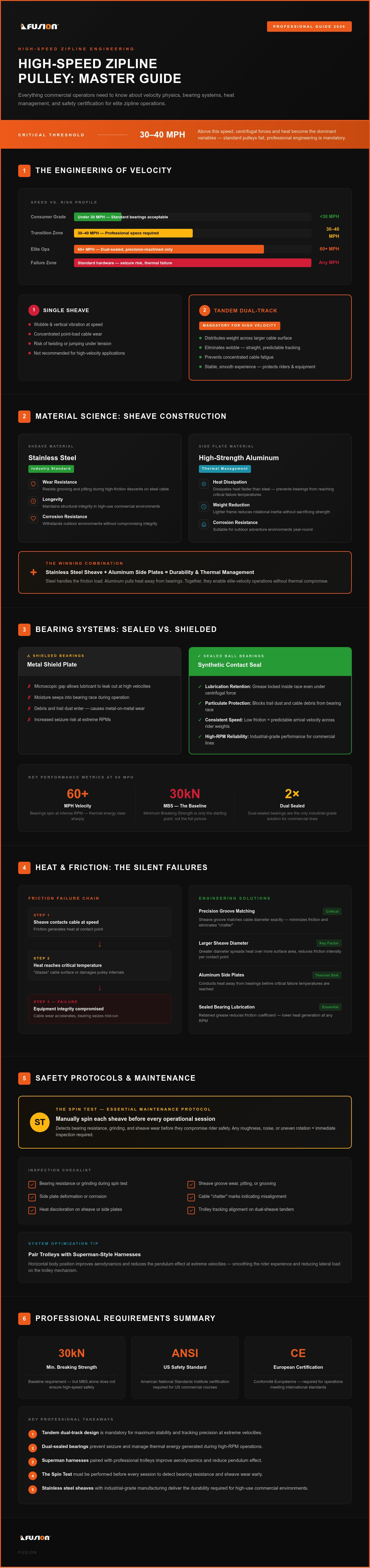
Velocity changes the physics of a zipline run. A standard pulley might handle a backyard zip, but once you cross the threshold of 30 to 40 MPH, centrifugal forces and heat become dominant variables. A professional high speed zipline pulley is defined by its ability to maintain mechanical integrity while rotating at extreme RPMs. While many consumer-grade options focus solely on a 30kN Minimum Breaking Strength (MBS), professional operators know that MBS is simply the baseline. At 60+ MPH, the real challenge is managing the violent interaction between the cable and the sheave. Precision manufacturing ensures that the sheave's groove matches the cable diameter perfectly, which minimizes friction and prevents the "chatter" that leads to premature equipment fatigue.
Tandem vs. Single Sheave Pulleys
Tandem pulleys are mandatory for any high-velocity application. By utilizing two sheaves in a dual-track configuration, the system distributes the rider's weight across a larger surface area of the cable. This alignment prevents the "wobble" or vertical vibration that plagues single-sheave designs at high speeds. Stability is safety. A tandem design ensures the trolley tracks straight, reducing the risk of the pulley jumping or twisting under the tension of a long-distance run. It creates a predictable, smooth experience for the rider while protecting the cable from concentrated point-load wear.
Material Science: Stainless Steel vs. Aluminum
The choice of materials determines how the system handles heat and wear. Precision-machined stainless steel sheaves, like those found in the Fusion Climb Advent series, are the industry standard for durability on steel cables. They resist the grooving and pitting that can occur during high-friction descents. However, the side plates often utilize high-strength aluminum. This combination provides a critical balance; aluminum dissipates heat faster than steel, preventing the bearings from reaching critical failure temperatures.
In outdoor adventure environments, these materials also provide the necessary corrosion resistance to withstand the elements without compromising structural integrity. Fusion Climb emphasizes industrial-grade manufacturing in the USA to ensure that every component, from the side plates to the dual-bearing systems, meets rigorous quality control standards. When you're operating at peak velocity, you don't just need strength; you need thermal management and precision tracking.
Technical Specifications: Bearings, RPMs, and Heat Management
High speed is a function of rotation. When a high speed zipline pulley reaches 60 MPH, the internal bearings spin at a frequency that generates intense friction and centrifugal force. Standard hardware fails under these conditions because it isn't designed to manage the resulting thermal energy. Professional operators prioritize specific technical metrics to ensure the system doesn't seize mid-run. Understanding the limits of your hardware is the first step toward maintaining a safe, consistent operation.
The distinction between sealed and shielded bearings is a critical safety factor. Shielded bearings use a metal plate that leaves a microscopic gap, which allows lubricant to leak out and moisture to seep in at high velocities. Sealed bearings utilize a synthetic contact seal to lock grease inside the race. This keeps the internal components lubricated even under extreme centrifugal forces. For those managing commercial lines, choosing a high speed zipline pulley with dual-sealed bearings is the only way to ensure industrial-grade reliability.
Sealed Ball Bearings for High-RPM Performance
Sealed bearings provide the protection necessary for outdoor environments. They are engineered to handle the following challenges:
- Lubrication Retention: Synthetic seals prevent grease migration during high-velocity descents.
- Particulate Protection: They block trail dust and cable debris from entering the bearing race, preventing metal-on-metal wear.
- Consistent Speed: Lower friction coefficients ensure that riders of different weights experience a similar, predictable arrival speed.
Heat Dissipation in Commercial Trolleys
Friction is the primary enemy of cable longevity. As the sheave rolls along the line, the contact point generates heat that can reach temperatures high enough to "glaze" the cable or damage the pulley's internal components. Sheave diameter plays a vital role here. A larger wheel covers more distance per rotation, which reduces the RPM required to maintain a specific ground speed. Lower RPMs translate directly to less heat buildup within the bearing housing.
Professional trolleys often feature skeletonized side plates or high-strength aluminum frames that act as heat sinks. These design features promote airflow and draw thermal energy away from the bearings. Without effective cooling, back-to-back commercial runs can cause the bearings to expand and eventually seize. Precision engineering ensures that your equipment stays cool, even when the pace of your operation is at its peak.
The Complete High-Speed System: Harnesses and Lanyards
A high speed zipline pulley is the engine of your flight, but the harness and lanyard system act as the chassis and suspension. If the rider's position creates excessive drag or instability, even the most advanced dual-bearing trolley won't deliver the intended performance. A complete high-speed system requires a holistic approach where every component is rated for the specific velocities and forces of your course. Safety isn't just about the strength of the pulley; it's about how the entire assembly interacts under tension.
Prone vs. Seated Flight Aerodynamics
Air resistance becomes a significant factor as speeds climb toward 60 MPH. In a traditional seated position, the rider's body acts like a sail, creating drag that can lead to inconsistent arrival speeds. Utilizing Superman style harnesses allows the rider to assume a prone, head-first position. This streamlined profile drastically reduces the surface area exposed to wind resistance. It ensures that the velocity generated by the high speed zipline pulley is maintained throughout the run, providing a more predictable experience for the braking system at the end of the line.
Beyond speed, prone flight shifts the center of gravity. This alignment minimizes the "buffeting" effect caused by crosswinds, which can otherwise cause the pulley to tilt or track unevenly. A stable rider is a safe rider. By keeping the weight centered directly under the cable, you reduce the lateral stress on the pulley sheaves and bearings. This precision tracking is essential for the longevity of your high-velocity gear.
Tethers and Lanyards for High-Speed Stability
The connection between the trolley and the harness is a critical point for vibration management. High-velocity transit often introduces a "pendulum effect" where the rider begins to swing or oscillate. Specialized zipline lanyards and tethers are engineered to dampen these vibrations before they reach the rider. Dual-leg tethers are particularly effective for high-speed applications. They provide redundant safety while ensuring the harness remains perfectly aligned with the pulley's direction of travel.
Every carabiner and tether in the chain must match or exceed the pulley's performance specs. Look for hardware with high MBS ratings that can withstand the shock absorption requirements of a high-velocity arrival. If a lanyard isn't designed for the specific tension of a high speed zipline pulley run, it can lead to excessive wear or mechanical fatigue. Professional-grade systems prioritize industrial reliability across the entire gear loop. Don't let a single weak link compromise a precision-engineered descent.
Safety Protocols: Maintenance and Inspection for High-Speed Pulleys
High velocity creates a high rate of wear. For any high speed zipline pulley, the margin for error is measured in microns. If a bearing begins to fail at 60 MPH, the result is often catastrophic rather than gradual. Maintenance isn't just a chore; it's a critical safety protocol that ensures every rider arrives safely at the platform. Professional operators must implement a rigorous inspection cycle that accounts for the extreme RPMs these systems endure daily. Safety isn't a suggestion; it's the foundation of your operation.
The "Spin Test" is your primary diagnostic tool. Hold the pulley by the side plates and flick the sheave with your finger. It should rotate silently and smoothly for several seconds. If you hear a clicking sound or feel a "gritty" resistance, the internal bearing races are likely compromised. This often happens when particulate matter bypasses the seals or when heat causes the internal lubricant to break down. A pulley that fails the spin test must be removed from service immediately. Don't gamble with bearing integrity when lives are on the line.
Daily Inspection Checklist for Operators
- Side-Plate Integrity: Conduct a visual check for side-plate deformation or cracks. Stress fractures often appear first around the carabiner attachment points.
- Sheave Alignment: Ensure the sheaves spin on a true axis without wobbling. Lateral movement indicates an axle or bearing failure.
- Hardware Security: Verify professional climbing carabiners for gate security. A sticky gate is a major failure point in a high-vibration environment.
Long-Term Maintenance and Bearing Care
Coastal or dusty environments require more frequent cleaning. Use compressed air to blow out debris from the gaps between the sheave and side plates. Never attempt to lubricate sealed bearings manually. These units are factory-packed with a specific volume of high-speed grease; adding external oils can degrade the internal seals and attract more grit. If the bearing is dry, the pulley has reached the end of its functional life.
Keep a detailed log of usage hours and cycle counts. Most industrial pulleys have a defined service life based on distance traveled or total rotations. If you notice sheave wear exceeding 10% of the original rim thickness, or if the cable groove has become deeply pitted, it's time to retire the unit. To ensure your course is equipped with the latest in safety technology, you can browse our full line of high speed zipline pulley systems and industrial hardware.
Fusion Climb: Industrial Reliability for High-Speed Operations
Theory is useless without hardware that can withstand the physical demands of high-velocity flight. Fusion Climb bridges the gap between engineering and the field by manufacturing equipment that prioritizes industrial reliability. Every high speed zipline pulley produced in our USA-based facility undergoes rigorous testing to ensure it exceeds ANSI and CE standards. We don't just meet the minimum requirements; we build for the extremes of the professional adventure industry. This commitment to domestic manufacturing ensures that every component maintains consistent safety performance across its entire lifecycle. Precision is our standard.
Spotlight on the Tesa Speed Pulley
The Tesa Speed series represents the pinnacle of our high-velocity engineering. It features a dual bearing architecture that provides superior RPM stability during long, fast descents. This design minimizes internal friction, which prevents the heat-related seizures discussed in previous sections. The integrated carabiner bracket simplifies the rigging process, allowing for a secure, direct connection that reduces hardware clutter. It is the ideal choice for canopy tours and long-distance speed lines where performance cannot be compromised. Reliability is built into the frame.
Operators choose the Tesa Speed when they need a balance of weight and strength. The high-strength aluminum side plates dissipate heat rapidly, protecting the sealed bearings during back-to-back commercial runs. This proactive thermal management ensures that the pulley maintains a consistent speed for every rider, regardless of their weight or the ambient temperature. It's a tool designed for professionals who demand repeatable results.
The Advent Series for Commercial Rigging
For high-frequency commercial operations, the Advent series offers a different level of durability. These trolleys utilize heavy-duty stainless steel construction to withstand the constant abrasion of steel cables. The sheaves are precision-machined to minimize cable wear, extending the life of your most expensive infrastructure. These units are designed for seamless compatibility with ropes course safety equipment standards. This ensures that your entire aerial system remains compliant with the latest safety regulations while delivering a smooth, professional experience for every rider.
Choosing a high speed zipline pulley is an investment in your operation's future. By selecting Fusion Climb, you're partnering with a manufacturer that values substance over style. We provide the technical assurance you need to push physical limits in vertical environments. From the Tesa Speed's velocity to the Advent's commercial-grade strength, our hardware is engineered to be your silent partner in safety. Build with confidence. Operate with precision. Trust the equipment that's tested for the real world.
Elevate Your High-Velocity Operations
Mastering the physics of a high speed zipline pulley requires more than just a focus on breaking strength. It demands a technical understanding of how dual-bearing systems manage thermal energy and how aerodynamic rider positions stabilize the descent. By integrating ANSI Z359.11 compliant manufacturing with rigorous inspection protocols, you ensure that your equipment remains a silent, dependable partner in every run. We've explored the importance of sealed bearings for RPM stability and the role of stainless steel sheaves in reducing cable wear. These aren't just specifications; they are the benchmarks of industrial reliability that protect your riders and your reputation.
Ready to upgrade your course with gear engineered for the extremes? Shop Professional High-Speed Zipline Pulleys at Fusion Climb to experience the difference that USA-based testing and industrial-grade durability make. Our hardware is used by professional zipline operators nationwide who refuse to compromise on safety. Push the limits of exploration with equipment built for the long haul.
Frequently Asked Questions
What is the maximum speed rating for a professional zipline pulley?
Professional ratings typically reach 60 to 70 MPH for standard commercial use. Some specialized hardware, like the Tesa Speed series, is engineered to handle even higher velocities through precision bearings. You must check the manufacturer's specific RPM limit rather than just ground speed. High-speed ratings depend on the assembly's ability to manage centrifugal force and the resulting thermal energy during long descents.
Can I use a climbing pulley for a high-speed zipline?
No, standard climbing pulleys aren't designed for the sustained RPMs or intense heat of a zipline run. Climbing hardware often uses bushings or single bearings intended for slow vertical hauling. A professional high speed zipline pulley requires dual-bearing systems and specific sheave materials. These components handle the friction of a fast descent without seizing or causing premature cable wear during operation.
How often should I replace the bearings in my zipline trolley?
Replacement frequency depends on cycle counts and environmental factors rather than a set calendar date. Commercial operators should perform a "Spin Test" daily and retire bearings at the first sign of noise or grit. Most professional trolleys require a comprehensive inspection every 500 to 1,000 runs. Always follow the manufacturer's industrial-grade guidelines to ensure the system maintains its structural integrity over time.
Do high-speed pulleys require special cable types?
Yes, high-velocity operations usually require 7x19 galvanized or stainless steel aircraft cable for optimal performance. The pulley sheave groove must match your cable diameter exactly to prevent "chatter." Using a mismatched cable creates excessive vibration and leads to uneven wear on the sheave surface. Proper alignment between the cable and the high speed zipline pulley is essential for a smooth and predictable rider experience.
What is the difference between a pulley and a zipline trolley?
A pulley is a general term for a single sheave in a housing, while a trolley is a specialized assembly built for horizontal cable travel. Trolleys, such as the Advent series, typically feature tandem sheaves for better tracking and stability. This dual-track design prevents the unit from twisting or wobbling on the line. This stability is a mandatory requirement for maintaining safety at high speeds.
How does rider weight affect the speed and performance of the pulley?
Heavier riders generate more momentum, which increases the RPMs and thermal load on the internal bearings. Professional pulleys are engineered to maintain a consistent friction coefficient to minimize speed variance between different riders. However, heavier loads accelerate the wear on the sheave and bearing races. You must account for these increased forces by implementing more frequent maintenance checks in high-volume commercial environments.
What safety certifications should I look for in a high-speed pulley?
Look for ANSI Z359.11 or CE EN 12278 certifications to ensure the hardware meets industrial safety standards. These ratings verify the Minimum Breaking Strength and structural integrity under heavy loads. Professional operators also prioritize manufacturing standards found in USA-based facilities. Domestic production often ensures more consistent quality control across all critical components, which is vital for equipment used in high-velocity vertical environments.
Can heat buildup cause a pulley to fail during operation?
Yes, intense friction generates thermal energy that can cause internal bearings to expand and seize mid-run. High-speed systems utilize aluminum side plates to act as heat sinks and sealed bearings to lock in lubricant. Without this thermal management, back-to-back runs can glaze the cable or lead to a total mechanical failure. Proper cooling and material selection are the primary defenses against heat-related equipment fatigue.