



Fixed Length Safety Lanyards for Restraint and Fall Arrest
A lanyard without a shock absorber isn’t automatically suitable for fall arrest. Most energy-absorbing fall-arrest lanyards are 6 ft long, but the right setup depends on the system’s design and whether there’s enough clearance to stop a fall before the worker reaches a lower level. Fixed length safety lanyards also serve restraint, where the goal is to keep a worker from reaching a fall hazard.
It’s easy to focus on length alone, but a lanyard’s purpose and construction matter just as much. Lanyard selection should account for whether the system is intended to prevent access to a hazard, support positioning, or arrest a fall.
This guide explains when an energy absorber is relevant, how to assess fall clearance, and how webbing, rope, and cable lanyards differ. It also covers how fixed-length restraint options can limit access to a hazard, helping you identify the right type for the task before choosing a setup.
Key Takeaways
- Choose fall-arrest equipment based on the system’s design and the clearance available below the work surface, not lanyard length alone.
- Compare webbing, rope, and cable by how their construction suits the work environment and the demands of the task.
- Use restraint equipment to prevent access to a fall hazard; it isn’t designed to arrest a fall.
- Understand how single-leg and dual-leg configurations affect movement between anchors and tie-off continuity.
Can I use a lanyard without an internal or external shock pack/absorber in a fall arrest application?
Use a lanyard without an absorber only when the complete fall-arrest system is designed for that configuration. Before selecting one, assess fall clearance, the system’s free-fall rating, and the manufacturer’s instructions.
Energy Absorption and Fall Clearance
During a fall, an energy-absorbing lanyard deploys its absorber to reduce impact forces on the worker and system. Because deployment takes space, clearance below the work surface must account for the fall and stopping process. A typical calculation considers lanyard length, absorber deployment, harness stretch and D-ring shift, plus a safety factor.
For a minimum clearance calculation, allow for harness stretch and D-ring shift, usually 1 ft; a dorsal D-ring height typically of 5 feet; and a 1½-foot safety factor. Check the manufacturer’s free-fall rating and required clearance before choosing a lanyard. If the available space is insufficient, that fall-arrest setup may not stop the worker before a lower level.
Fixed and Shock-Absorbing Lanyard Lengths
A fixed-length lanyard has a set working length and does not, by that feature alone, absorb fall energy. A shock-absorbing lanyard includes an energy absorber, and most energy-absorbing fall-arrest lanyards are 6 ft long. Length isn’t the only difference: the intended use and full system design determine whether a lanyard is appropriate for arresting a fall.
Don’t treat a fixed-length connector as fall-arrest equipment unless its instructions permit that use. A restraint lanyard, for example, keeps a worker from reaching a hazard, while a positioning lanyard requires a separate fall-arrest system as backup. These functions are different from stopping a fall.
Fall-Protection Requirements
In the United States, the U.S. Occupational Safety and Health Administration defines a leading edge as a walking or working surface with an unprotected side or edge that is 6 feet (1.8 m) or more above a lower level. For fall-arrest selection, account for clearance and the lanyard’s free-fall rating; follow the manufacturer’s instructions for the specific system.
Inspect fall-protection lanyards before use. Remove a lanyard from service if you find damage or if its absorber has deployed, and follow the manufacturer’s instructions for care, cleaning, and storage. Store equipment as directed, away from damaging conditions, and don’t return questionable gear to service.
Webbing, rope, and cable lanyard materials
For roofing or construction, no material is automatically the best choice. Match the lanyard to the task, nearby surfaces, movement, and conditions specified by its manufacturer. Roofing near exposed edges differs from work around rough construction materials, so assess the setup rather than choosing by material name alone.
Webbing Lanyards
Webbing is a flat, flexible strap that may feel less bulky against clothing than round rope. Inspect its broad surface carefully: check both faces, edges, and stitching for cuts, fraying, abrasion, or damaged seams. Repeated contact with a rough roof surface, for example, may cause visible wear that needs attention before use.
Rope Lanyards
A rope lanyard uses a round line rather than a flat strap. Its shape may suit tasks where the lanyard must move around equipment or fit a particular connection, but suitability depends on the system’s instructions. Inspect the full length for cuts, fraying, pulled strands, contamination, or other changes. Don’t check only the ends.
Cable Lanyards
Cable lanyards use a metal line and may suit work areas where the selected equipment needs to match the surrounding conditions. Check the cable, terminations, and connectors for visible damage, distortion, or corrosion. A metal exterior doesn’t make a lanyard suitable for every job; its intended application and the manufacturer’s guidance still matter.
For roofing, consider edge contact, the lanyard’s route, and whether the selected system is intended for that application. On a construction site, account for nearby materials, sharp surfaces, and repeated movement. Webbing, rope, and cable differ in form, but none replaces selecting the right system.
Before use, identify the lanyard’s intended purpose and inspect its full length, stitching or cable, and connection points. Follow the manufacturer’s instructions for use, care, and storage. If a label or visible condition raises doubts, keep the equipment out of service until its status is resolved.
Fixed-length restraint lanyards
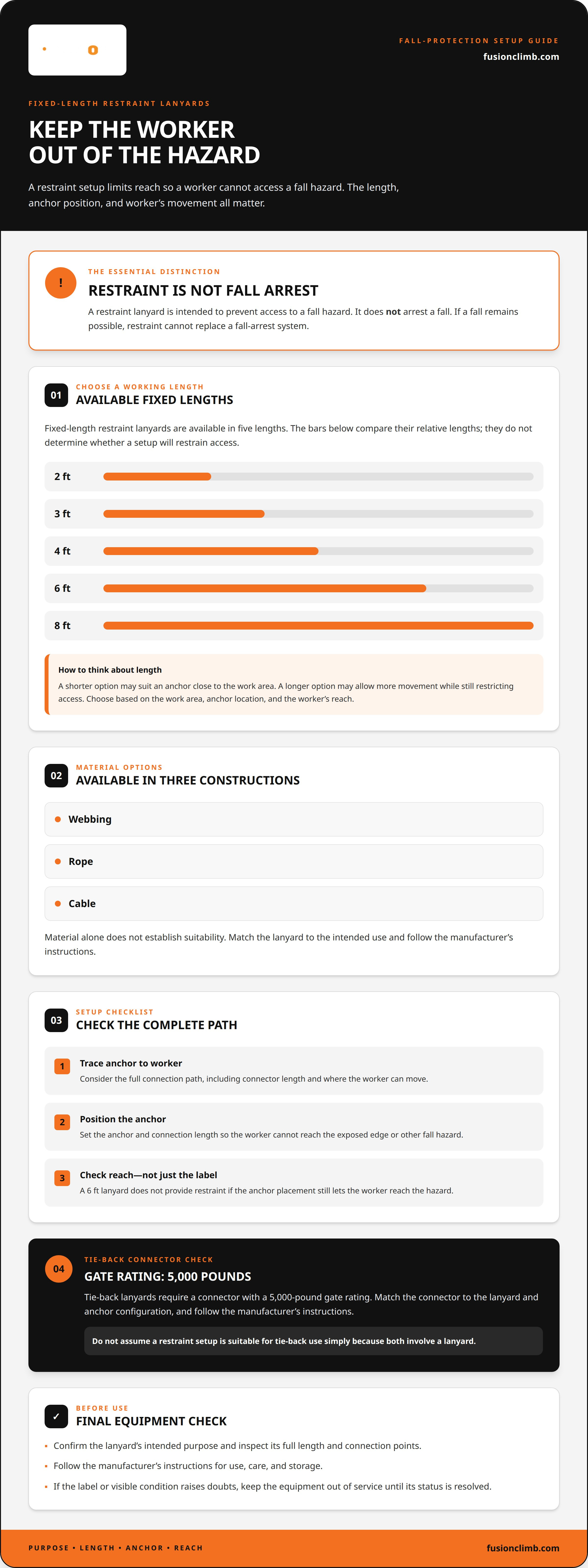
A restraint lanyard limits a worker’s reach to keep them from accessing a fall hazard. It doesn’t arrest a fall, so it cannot replace a fall-arrest system where a fall remains possible. The key is to set the connection length and anchor position so the worker cannot reach the hazard.
Fixed-length restraint lanyards are available in 2, 3, 4, 6, and 8 ft lengths, in webbing, rope, and cable. A shorter option may suit an anchor close to the work area; a longer one may allow more movement while still restricting access. The correct length depends on the work area, anchor location, and the worker’s reach.
To assess a setup, consider the complete path from anchor to worker. Account for connector length and where the worker can move, then position the anchor so the lanyard prevents reaching the exposed edge. For example, a 6 ft lanyard won’t provide restraint if the anchor placement still lets the worker reach the hazard.
Tie-back lanyards have a specific connector consideration: the connector must have a 5,000-pound gate rating. Match the connector to the lanyard and anchor configuration, and follow the manufacturer’s instructions for the intended use. Don’t assume a restraint setup is suitable for tie-back use simply because both involve a lanyard.
How much do fixed-length safety lanyards cost in the United States? Prices depend on factors such as material, length, connectors, and design. Compare the equipment’s intended function and configuration, not just its length or cost.
Before work begins, confirm the planned restraint reach, anchor position, and connection arrangement. Inspect the lanyard and connectors for visible damage, and follow the manufacturer’s use and care instructions. If the worker can still reach a fall hazard, the arrangement does not achieve its purpose. Revise the setup before relying on it.
What types of fixed-length fall-protection lanyards are available?
Fixed-length fall-protection lanyards differ by length, leg configuration, and intended use. Common lengths include 6 foot and 12 foot options. The right type depends on the anchorage arrangement, the worker’s movement, and the system’s instructions, not length alone.
A single-leg lanyard connects the worker to one anchor point. It may suit a task where the worker stays within reach of that anchor. Before selecting one, consider how far the worker must move and whether the connection remains appropriate throughout the task. Fixed length can limit reach, making anchor placement important.
A dual-leg lanyard has two legs and can support 100% tie-off while a worker moves between anchors. In practice, the worker connects the second leg to the next anchor before disconnecting the first. This configuration supports continuous connection during transitions, but each leg and connection must be used as instructed.
Length changes how far the worker can move from the anchor, and it also affects the overall system arrangement. A 6-foot option and a 12-foot option therefore shouldn’t be treated as interchangeable. Select a length that matches the intended setup, then follow the manufacturer’s instructions for the lanyard and its compatible connections.
Compare the task against these selection points:
- Choose a single-leg configuration when the work area and anchorage keep the task within its intended reach.
- Consider a dual-leg configuration when movement between anchors requires continuous tie-off.
- Match the lanyard length to the anchorage layout and the system’s instructions.
Before use, inspect the lanyard, legs, and connectors, then confirm that the selected configuration suits the work. A 12-foot lanyard doesn’t automatically provide a safer setup than a 6-foot model; suitability depends on the complete arrangement. Explore lanyard options for equipment that fits your planned connection setup.
Fusion Climb: Lanyard and tether
Fusion Climb offers lanyards and tethers for setups tailored to specific work or activity needs. First identify the intended function: restraint prevents access to a hazard, while fall-arrest equipment serves a different role. Length, material, connections, and system instructions all inform the selection.
For aerial adventure systems, Fusion Climb also offers Full Body Harnesses, Superman Style Harnesses, and Zipline Pulleys. These products serve different roles in a setup, so choose each according to its intended application rather than treating components as interchangeable.
If you’re considering a lanyard or tether for your setup, contact Fusion Climb to discuss your equipment needs.
Make the next equipment decision with purpose
Before selecting equipment, define the task the connection must support. Note whether the setup is intended to restrain movement or arrest a fall, where the anchor is located, and how the worker needs to move. These details turn a general equipment choice into a practical system decision.
Treat fixed-length safety lanyards as part of a complete setup, not as isolated components. Keep the intended use and equipment instructions central to your planning. A clear description of the work, anchor arrangement, and movement needs can make the next discussion more focused.
Ready to take that next step? Contact Fusion Climb about lanyards and describe the setup you’re planning. Build your selection around the task, then move forward with a deliberate approach to safety.
Frequently Asked Questions
If the shock pack is deployed, can it be replaced or repaired?
No. Take a lanyard with a deployed shock pack out of service; don’t reset or repair it for continued use. A fall can compromise parts beyond the visible absorber, so replacing only the pack may leave damaged equipment in the system. Follow the manufacturer’s instructions for retirement and replacement, and keep the lanyard out of use until then.
What is a fixed-length safety lanyard, and what is it used for?
A fixed-length safety lanyard is a connector with a set length, used as part of a compatible safety setup. Its role depends on its design: a restraint configuration limits a worker’s reach, while a fall-arrest lanyard is designed to stop a fall. For example, a worker approaching a roof edge needs equipment suited to the planned protection method, not simply a connector that reaches the anchor.
How do you choose the correct lanyard length for a specific job?
Choose a length that suits the task, anchor location, worker movement, and intended system function. Map the worker’s full reach from the anchor, including the route needed to complete the job. For restraint, the setup must prevent access to the hazard. For fall arrest, follow the manufacturer’s instructions and account for the complete system, including clearance below the work area.
How do you calculate fall clearance for a safety lanyard?
Use the lanyard manufacturer’s clearance method for the specific system. Identify the required free-fall and stopping distances, then include the equipment and body movement specified in the instructions. Compare the total with the unobstructed space below the worker. A platform, beam, or lower level within that space can make the setup unsuitable, even if the anchor and lanyard connect correctly.
What materials, connectors, and load ratings should you look for in a safety lanyard?
Select webbing, rope, or cable according to the intended application and conditions described by the manufacturer. Match connectors to the lanyard and anchor, and use only connection arrangements permitted by their instructions. Check product labels and documentation for applicable load ratings and use limits. Don’t choose a connector based on appearance or assume ratings apply to other components.
What are the risks of using a lanyard that is too long or attached to the wrong anchor point?
An unsuitable length or anchor can let a worker reach a hazard, increase fall distance, or leave too little room for the system to stop a fall. Poor anchor placement can also change the worker’s fall path. For example, a restraint line that allows access to an exposed edge does not provide effective restraint. Match the arrangement to the task and equipment instructions.