



Auto Locking Carabiners: Professional Rigging Guide 2026
In high-stakes rigging environments, the manual screw-gate is quickly becoming an unacceptable liability that professional crews can't afford to ignore. You know that even the most experienced technicians can suffer from oversight or physical fatigue during a demanding shift. Whether it's the constant vibration of a commercial zipline or the complexity of training staff on various auto locking carabiners, the fear of an unsecured gate is a reality every operator faces. Relying on memory alone in a vertical environment is a risk that compromises both safety and professional integrity.
We understand that your reputation depends on hardware that performs with industrial-grade reliability every single time. This guide will help you master the technical nuances of gate mechanisms to eliminate human error and ensure your equipment remains compliant with the latest ANSI Z359.12 and OSHA 1910.140 standards. You'll learn how to choose between 2-stage and 3-stage systems to maximize security in high-use environments. We also provide a professional framework for inspecting your gear to prevent mechanical failure and extend the service life of your industrial hardware.
Key Takeaways
- Differentiate between 2-stage and 3-stage mechanisms to balance operational speed with the necessary level of security for high-risk environments.
- Discover why professional-grade auto locking carabiners are the industry standard for eliminating the risk of forgotten manual locks in complex rigging setups.
- Select the optimal metallurgy for your application by comparing the lightweight performance of 7075-T6 aluminum against the rugged durability of industrial steel.
- Implement a rigorous daily maintenance routine using the "Snap Test" and specific cleaning protocols to remove grit and ensure reliable gate function.
- Optimize your safety system by matching specialized hardware to your harnesses and pulleys to improve ergonomics and reduce technician fatigue.
Understanding Auto-Locking Carabiners: Safety and Efficiency in Vertical Environments
Gate security is the bedrock of any fall arrest system. In professional rigging, the human factor is often the weakest link. Technicians working long shifts in aerial adventure parks or industrial sites face physical exhaustion that leads to mental fatigue. Manual locking hardware relies entirely on the user's memory. This is where auto locking carabiners become essential. They function as a self-closing, self-locking connector, ensuring the system is secure the moment the gate is released. By automating the safety check, you remove the variable of human oversight and create a more predictable work environment.
The Evolution of Locking Gate Technology
The transition from traditional screw-gates to modern spring-loaded designs reflects a broader industry commitment to risk management. Early Carabiner gate mechanisms required a manual rotation of a threaded sleeve. While effective in controlled environments, these manual locks are prone to vibration opening or simply being forgotten during complex transitions. Modern auto locking carabiners utilize internal spring tension to force the sleeve into a locked state instantly. This reduces operator liability and simplifies training protocols. Your team spends less time double-checking locks and more time focusing on the technical aspects of the rig.
Key Industry Standards: ANSI and CE Compliance
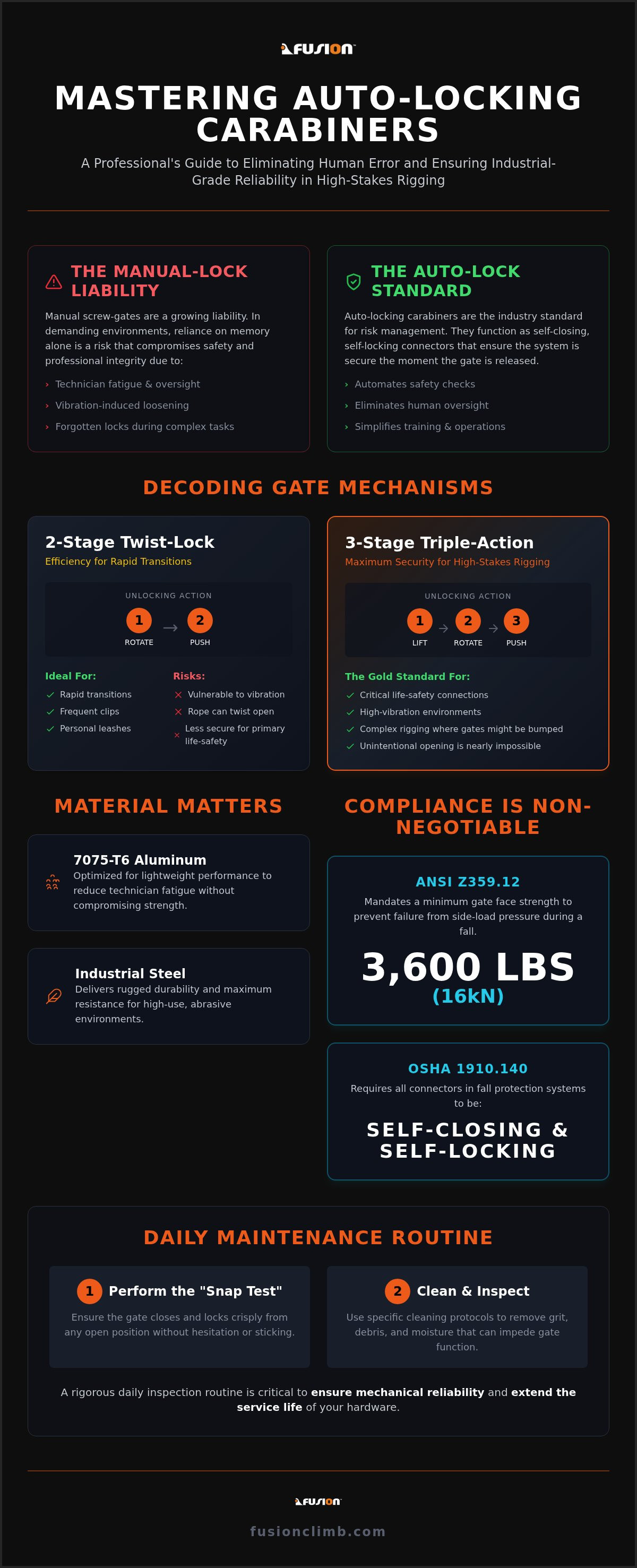
Compliance is non-negotiable in professional vertical environments. The ANSI Z359.12 standard specifically addresses the vulnerabilities of connector gates. It mandates a minimum gate face strength of 3,600 lbs (16kN). This high threshold prevents the gate from failing during a fall where the rope or hardware might exert side-load pressure. Fusion Climb manufactures hardware that strictly adheres to these rigorous quality control standards. Every connector is tested to ensure it can withstand the extreme forces of industrial rigging. Choosing hardware that meets these benchmarks isn't just about following rules; it's about providing a sobering sense of security for everyone on the line.
Investing in high-performance connectors is a proactive step toward a zero-accident workplace. When you standardize your fleet with hardware that meets these exacting requirements, you establish a culture of safety that prioritizes reliability over convenience. This commitment to quality ensures that your equipment remains a silent, dependable partner in every climb.
Decoding Gate Mechanisms: 2-Stage vs. 3-Stage Auto-Locking Systems
In professional rigging, a "stage" refers to the number of distinct, deliberate motions required to unlock the connector. Understanding this distinction is vital for meeting OSHA auto-locking carabiner requirements, which mandate that connectors in fall protection systems must be self-closing and self-locking. Choosing between 2-stage and 3-stage auto locking carabiners isn't just a matter of convenience. It's a strategic decision that balances the speed of your workflow against the severity of the risk involved. The more complex the environment, the more security stages you need to prevent unintentional gate opening.
2-Stage Twist-Lock: Efficiency for Rapid Transitions
The 2-stage mechanism, commonly known as a twist-lock, requires two quick motions: rotate the sleeve and push the gate open. It's the preferred choice for technicians who need to move quickly and perform frequent clips. You'll typically find these on personal leashes or non-critical rigging points where speed is a priority. While 2-stage auto locking carabiners are significantly safer than manual screw-gates, they aren't foolproof. They're more susceptible to "gate-shudder," where high-frequency vibrations from machinery or moving lines can momentarily unlock the sleeve. Additionally, a rope running across the sleeve can inadvertently twist it open, which makes them less ideal for primary life-safety points in high-friction environments.
3-Stage Triple-Action: Maximum Security for High-Stakes Rigging
For critical connections, 3-stage or triple-action mechanisms are the gold standard. Opening these requires three distinct motions: lift or pull the sleeve, rotate it, and then push the gate. This sequence is nearly impossible to trigger accidentally, providing a massive safety buffer against rope rollout or cross-loading. This level of security is why 3-stage connectors are preferred for commercial zipline pulleys and primary anchors. While they take slightly longer to operate, the added security prevents catastrophic failure in high-stakes environments where hardware might be bumped or dragged against surfaces. If you're building a system that demands absolute reliability, selecting industrial-strength carabiners ensures your team remains protected against the unexpected.
Strength and Durability: Aluminum vs. Steel Auto-Locking Carabiners
Selecting the right alloy for your rigging setup is a fundamental decision that impacts both the safety and the lifespan of your gear. While both aluminum and steel auto locking carabiners must meet strict strength requirements, their performance varies significantly under different environmental stressors. Fusion Climb engineers hardware to maximize these material properties by utilizing a Modified D frame shape. This specific geometry shifts the load toward the spine, the strongest part of the connector, ensuring maximum major-axis strength during a fall or under heavy tension.
When to Choose Aluminum Connectors
For mobile technicians and vertical professionals who are constantly on the move, weight is the primary concern. High-strength 7075-T6 aluminum offers an exceptional weight-to-strength ratio, making it the preferred material for professional climbing carabiners. Beyond portability, aluminum has superior heat dissipation properties. This is critical during high-friction rope work or rapid descents where heat buildup could damage synthetic fibers. Aluminum also naturally resists corrosion in standard outdoor environments, providing a reliable, low-maintenance solution for most rigging applications.
The Case for Heavy-Duty Steel in Commercial Parks
Commercial zipline operations present a unique challenge that aluminum often can't withstand: constant metal-on-metal wear. When a carabiner is connected directly to a steel zipline trolley, the resulting vibration and friction act as an abrasive force. Steel connectors are the rugged choice for these high-cycle environments. They offer superior hardness and fatigue resistance, preventing the "grooving" that occurs on aluminum surfaces over time. This durability ensures you remain compliant with OSHA and ANSI standards for fall protection while extending the service life of your fleet.
The trade-off for this durability is weight. Managing an inventory of steel hardware requires more physical effort from your staff, but the safety benefits in permanent rigging are undeniable. Steel remains the dependable guardian for stationary anchors and high-abrasion setups where equipment failure is not an option. By matching the metallurgy to the specific demands of your site, you ensure that your auto locking carabiners perform exactly as engineered, shift after shift.
Professional Inspection and Maintenance: Ensuring Mechanical Reliability
Mechanical reliability is the cornerstone of safe vertical operations. Even the most robust auto locking carabiners can fail if they aren't properly maintained. The "Snap Test" is your first line of defense. Open the gate fully and release it. The gate should snap shut and the locking sleeve must engage instantly without hesitation. If the sleeve requires manual assistance to close, the unit is compromised and must be removed from service immediately. This simple field check ensures that the spring-loaded mechanism hasn't been compromised by internal fatigue or external debris.
Environmental factors like salt air, grit, and fine dust are the enemies of precision hardware. Clean your connectors using warm water and a mild, pH-neutral detergent. Pay close attention to the knurled locking sleeve where debris tends to accumulate. For lubrication, avoid heavy oils or WD-40. These substances attract dirt and create a grinding paste that accelerates wear. Choose dry graphite lubricant instead. It provides the necessary slickness for the internal springs without compromising the mechanism's cleanliness or attracting abrasive particles.
Identifying Mechanical Warning Signs
Watch for sluggish gate return. This is often a symptom of spring fatigue or internal corrosion that isn't visible from the outside. A sticking sleeve is equally dangerous; if the auto-locking function is delayed, the system is vulnerable to accidental opening. Inspect the frame for physical deformities. Check for burrs, deep scratches, or grooves. While we discussed the durability of steel in the previous section, even steel can develop sharp edges that might damage your ropes or webbing. If you find any cracks or material loss exceeding 10% of the original diameter, retire the hardware immediately.
The Rigorous Inspection Checklist for Operators
Consistency is key for compliance and safety. Perform daily pre-flight checks on all zipline lanyards and tethers before the first guest arrives. Beyond these daily assessments, conduct quarterly deep-dive inspections for your entire commercial fleet. Document every finding. Accurate records are essential for meeting OSHA requirements and ensuring your aerial park remains within safety standards. Proper documentation proves your commitment to being a dependable guardian of your team's safety and extends the service life of your gear by identifying issues before they escalate.
Maintain your fleet's integrity by upgrading to professional-grade carabiners that meet rigorous industrial standards.
Optimizing Your Safety System with Fusion Climb Hardware
Efficiency in the vertical world requires more than just high-strength connectors. It demands a holistic approach where every component works in unison. The "Fusion System" focuses on the seamless interaction between your harness, pulleys, and auto locking carabiners. When these tools are designed to work together, you reduce the risks associated with hardware incompatibility. Fusion Climb prioritizes ergonomic design to help your team maintain peak performance throughout the day. By refining the spring tension and sleeve texture, we've created hardware that reduces hand fatigue for staff performing hundreds of cycles per shift. This focus on the user's physical experience ensures that safety protocols are followed correctly even at the end of a long day.
Reliability isn't just a safety metric; it's a financial one. Investing in industrial-grade hardware reduces long-term equipment costs by significantly extending the replacement cycle of your fleet. Cheaper, recreational-grade gear often fails under the constant vibration and abrasion of a commercial environment. Our hardware is built to withstand these rigors, providing a lower total cost of ownership over the life of the product. We position ourselves as your partner in vertical safety, offering the innovation you need to push boundaries without compromising on traditional manufacturing values.
Integrating Auto-Lockers with Professional Harnesses
Achieving secure connections with ropes course safety equipment depends on how the hardware sits against the harness. Improper alignment often leads to cross-loading, where the force is applied to the weaker minor axis rather than the spine. Our auto locking carabiners feature specialized frame geometries to minimize this risk at harness-to-lanyard attachment points. We also utilize "Keylock" noses on our connectors. This snag-free design ensures the gate won't catch on gear loops or webbing during high-speed rescues or complex transitions. It's a small engineering detail that makes a massive difference in high-pressure scenarios where every second counts.
Why Industry Professionals Trust Fusion Climb
Since 1998, we've focused on tactical and safety equipment that values substance over style. Industry professionals trust Fusion Climb because our manufacturing process prioritizes industrial reliability over marketing fluff. We understand that in demanding aerial adventure environments, your equipment is your silent partner. Every connector we produce is a testament to our commitment to safety-first engineering and rigorous quality control. Whether you're managing a commercial zipline park or a tactical rescue team, you can depend on our gear to perform when it matters most. We invite you to explore the Fusion Climb professional hardware collection and see the difference that professional-grade craftsmanship makes in your safety system.
Securing the Future of Your Vertical Operations
Mastering the technical nuances of your hardware is the most effective way to eliminate human error in high-stakes environments. By standardizing your fleet with the correct 2-stage or 3-stage mechanisms, you provide your team with a mechanical safeguard that doesn't rely on memory alone. Whether you prioritize the lightweight performance of aluminum for mobile technicians or the rugged durability of steel for commercial ziplines, your choice of auto locking carabiners serves as the foundation of your safety system.
Maintaining this equipment through the Snap Test and proper lubrication ensures that your connectors remain dependable guardians over years of service. Fusion Climb has been a trusted partner for commercial zipline operators since 1998, providing hardware that meets rigorous ANSI Z359.12 compliant gate strength requirements. Don't leave your safety to chance or outdated manual systems. Take the proactive step toward industrial reliability today. Upgrade to Fusion Climb Industrial Auto-Locking Hardware and build a safety culture rooted in strength, precision, and professional-grade craftsmanship.
Frequently Asked Questions
What is the main difference between a twist-lock and a triple-action carabiner?
The main difference lies in the number of deliberate motions required to open the gate. A twist-lock is a 2-stage mechanism that opens with a simple rotation and a push. In contrast, a triple-action carabiner requires three distinct motions: lift, twist, and push. This added complexity makes triple-action models the preferred choice for critical life-safety connections where accidental gate opening from rope friction or vibration must be completely eliminated.
Are auto-locking carabiners safer than traditional screw-lock models?
Auto locking carabiners are generally safer in professional environments because they eliminate the risk of human oversight. A traditional screw-lock requires a technician to manually thread the sleeve into place. If this step is forgotten or skipped due to fatigue, the system remains unsecured. Auto-locking mechanisms ensure the connector is locked the moment the gate snaps shut, providing a consistent safeguard against the "forgotten lock" errors common in high-pressure rigging scenarios.
Can an auto-locking carabiner fail to lock properly?
Yes, an auto-locking mechanism can fail if it's compromised by environmental debris, grit, or internal spring fatigue. Fine dust or sand can wedge into the locking sleeve, preventing it from rotating back into the locked position. This is why the "Snap Test" is a mandatory daily procedure. You must verify that the sleeve rotates and clicks into place independently every time the gate is released. Never assume a connector is locked without visual and physical confirmation.
What are the ANSI requirements for carabiners used in commercial rigging?
Current ANSI Z359.12 standards mandate that connectors used in fall protection must have a minimum breaking strength of 5,000 lbf (22.2kN). The gate itself must withstand a face load and side load of at least 3,600 lbf (16kN). These rigorous requirements ensure the hardware can survive a fall even if the carabiner is positioned poorly or forced against an edge; this provides a sobering level of security for industrial operators and commercial park owners.
How often should professional-grade auto-lockers be cleaned and lubricated?
Professional-grade hardware should be inspected daily and cleaned whenever the action feels sluggish or gritty. In high-use environments like commercial aerial parks, a monthly deep-cleaning schedule is recommended. Rinse with warm water and a mild detergent to remove salt and grit. Once dry, apply a small amount of dry graphite lubricant to the internal spring and sleeve. Avoid oils, as they attract contaminants that can cause the locking mechanism to stick or wear prematurely.
When should I retire an auto-locking carabiner from a commercial zipline?
Retire any connector that shows signs of physical deformity, such as cracks, deep grooves, or gate misalignment. In high-volume zipline operations, equipment should be pulled if material loss from friction exceeds 10% of the original diameter. If a carabiner fails the snap test after cleaning and lubrication, it's no longer fit for service. Proper documentation of these inspections is essential for maintaining compliance with OSHA standards and ensuring the long-term safety of your guests.
Is aluminum or steel better for high-volume zipline operations?
Steel is the superior choice for high-volume zipline operations involving metal-on-metal contact. Steel carabiners offer significantly higher resistance to the abrasive wear caused by zipline trolleys and steel cables. While aluminum is prized for its lightweight properties in climbing, it fatigues and grooves much faster under heavy commercial use. Standardizing your permanent rigs with steel hardware extends the service life of your inventory and reduces the frequency of expensive equipment replacement cycles.
What does "cross-loading" mean and how do auto-lockers help prevent it?
Cross-loading occurs when a carabiner is loaded along its minor axis, side-to-side, rather than its major axis from the spine to the gate. This reduces the strength of the connector by as much as 60%. Auto locking carabiners with a Modified D shape help prevent this by naturally centering the load along the spine. Using hardware with captive eye pins or specialized harness attachments further ensures the connector remains properly oriented during use.