



The Comprehensive Guide to Adult Full Body Harnesses: Safety, Standards, and Selection
In fiscal year 2025, fall protection was the most frequently cited OSHA violation for the 15th consecutive year. This staggering statistic highlights a sobering reality; even seasoned professionals often struggle with the complexities of fall arrest equipment. Selecting the right adult full body harness is not just about checking a box for compliance. It's about securing your life with a precision-engineered system that balances industrial-grade security with tactical mobility. You know that a single oversight in gear selection or a misunderstanding of standards can lead to catastrophic failure in high-stakes environments.
We understand the frustration of deciphering shifting regulations and the fear that an incorrectly sized harness might fail when it matters most. This guide promises to clarify those doubts by providing a masterclass in the technical specifications and safety standards required for 2026. You'll gain a clear understanding of the ANSI Z359.11-2021 framework and learn how to select durable gear tailored to your specific vertical environment. We will examine fall arrest mechanisms, sizing protocols, and the critical differences between industrial and recreational equipment to ensure you remain a confident, compliant professional at every height.
Key Takeaways
- Master the ANSI Z359.11-2021 standards to ensure your gear meets the rigorous manufacturing benchmarks required for 2026 safety compliance.
- Learn why an adult full body harness is essential for proper load distribution and how it differs from standard recreational sit-style equipment.
- Tailor your gear selection to specific vertical environments, whether you're managing a commercial zipline or executing a tactical rescue mission.
- Apply the two-finger rule and professional inspection protocols to guarantee a secure fit and maintain equipment integrity throughout its service life.
- Explore how specialized, ergonomic designs improve mobility and comfort for long-duration tasks in high-angle and professional rigging environments.
Understanding the Adult Full Body Harness: Safety and Support
A professional-grade adult full body harness serves as the backbone of a comprehensive fall arrest system. Unlike recreational gear designed for short-term suspension, these systems are engineered to manage the violent forces of a sudden stop from height. They provide the necessary support to keep a worker or adventurer safe during and after a fall event. A properly fitted Safety Harness is more than a collection of straps; it's a precision-engineered tool designed for survival.
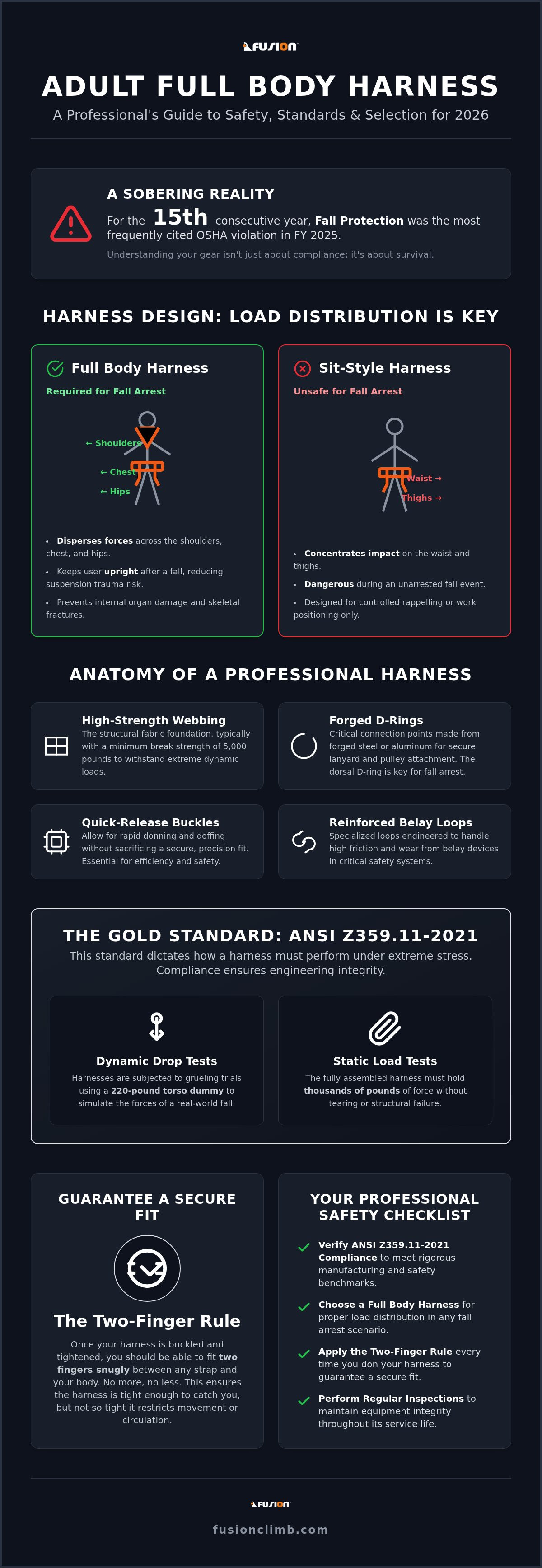
The primary difference between a sit-style harness and a full body design lies in load distribution. A sit harness concentrates impact forces on the waist and thighs. While this works for controlled rappelling, it's dangerous during an unarrested fall. A full body system disperses these forces across the shoulders, chest, and hips. This dispersion prevents internal organ damage and skeletal fractures. Central to this design is the dorsal D-ring. Located between the shoulder blades, this connection point ensures the user remains in an upright, vertical position after a fall. Upright suspension is critical. It reduces the risk of suspension trauma and allows for a more efficient rescue operation. For high-stakes vertical environments, this level of protection is the non-negotiable gold standard.
Fall Arrest vs. Work Positioning
Understanding the distinction between fall arrest and work positioning is vital for safety. Fall arrest systems are designed to stop a person already in free-fall. A well-designed adult full body harness prevents inverted falls, which is a common risk where the user flips upside down during deceleration. Shoulder straps play a pivotal role here. They capture the torso and distribute impact forces away from the lower back. Beyond the mechanics, there is a psychological advantage. Wearing gear that meets professional standards provides a sense of rugged confidence. It allows the user to focus on the task at hand, knowing their equipment is built for the worst-case scenario.
Anatomy of a Professional Harness
Every component of a professional harness must meet rigorous durability standards. The system consists of high-strength webbing, heavy-duty D-rings, and precision quick-release buckles. High-strength webbing is the foundation of the unit, typically featuring a minimum break strength of 5,000 pounds to withstand extreme dynamic loads. These components work in unison to create a dependable guardian for anyone operating at height.
- Webbing: The structural fabric that weaves through the entire system to provide a secure frame.
- D-Rings: Forged steel or aluminum points for secure lanyard and pulley attachment.
- Quick-Release Buckles: These allow for rapid donning and doffing without sacrificing security or fit.
- Reinforced Belay Loops: Specialized loops designed to handle the friction and wear of belay devices in safety systems.
ANSI Z359.11 and Safety Standards: Why Compliance Matters
Safety is a calculation, not a guess. In 2026, the ANSI/ASSP Z359.11-2021 remains the definitive benchmark for every adult full body harness used in professional capacities. This standard dictates how a harness must perform under extreme stress. It isn't optional for those who value their lives. Compliance ensures that the equipment can handle the dynamic forces of a fall without structural failure. This aligns with OSHA Fall Protection Standards, which mandate specific protection at heights as low as four feet in general industry. OSHA's enforcement isn't just bureaucratic; it's a response to the fact that falls remain a leading cause of workplace fatalities. When you're suspended at height, a label isn't just a sticker. It's a verified promise of engineering integrity.
Manufacturing Integrity and Testing
Certification requires grueling physical trials. Manufacturers must subject their designs to dynamic drop tests using a 220-pound torso dummy to simulate a real-world fall. They also perform static load tests where the harness must hold thousands of pounds without tearing. US-based manufacturing often yields higher quality control because engineers can oversee every stitch and rivet in real-time. This meticulous approach extends beyond the harness to include professional climbing carabiners, ensuring every link in your safety chain is equally robust. When you trust your life to a system, you need to know that every component has been pushed to its breaking point in a lab so it won't break in the field. Precision manufacturing eliminates the variables that lead to equipment failure.
Reading Safety Labels and Certifications
You must know how to audit your own gear. Every compliant adult full body harness features a permanent, legible label detailing its certifications and manufacturing date. Look for the ANSI Z359.11 stamp; it's your proof of professional-grade engineering. Don't confuse this with recreational markings like EN 12277, which are often designed for climbing gyms rather than industrial job sites. Check the "retirement date" or "date of manufacture" religiously. Most textile-based safety equipment has a maximum lifespan of ten years, even if it looks pristine. If the label is missing or unreadable, the harness is effectively retired. Regular inspections keep you safe and your gear mission-ready. You can find ANSI-rated safety gear that prioritizes these clear markings for easy compliance checks.
Applications: From Commercial Ziplines to Tactical Rescue
The choice of an adult full body harness depends entirely on the operational environment. Vertical environments dictate design; a technician servicing a wind turbine requires different lumbar support than a tactical officer rappelling into a confined space. While the fundamental engineering remains consistent across professional gear, the specialized features differ based on whether you are managing a high-volume adventure park or performing a cliff-side extraction. Compliance with OSHA safety standards for fall protection ensures that regardless of the application, the primary mission of life preservation is met through rigorous performance benchmarks.
Commercial Zipline and Adventure Parks
Commercial operators face the unique challenge of processing high volumes of guests while maintaining absolute safety. They need equipment that withstands constant UV exposure and heavy abrasion from diverse user groups. In these settings, "Superman style" harnesses are often the preferred choice for their ability to suspend the user in a prone position, creating a true flight experience. These specialized designs require robust hardware that integrates seamlessly with a commercial zipline pulleys guide for total system reliability. Padding in these environments must be breathable yet durable enough for back-to-back use in harsh outdoor conditions. Operators prioritize adjustable sizing to accommodate a wide range of body types without compromising the security of the fit.
Tactical and Search & Rescue (SAR)
For Search and Rescue (SAR) and tactical units, the priorities shift toward speed, stealth, and mobility. These professionals often transition rapidly between helicopter hoists, rappelling, and ground movement. Low-profile, high-strength webbing is essential to ensure the adult full body harness fits comfortably under tactical vests or heavy packs without adding unnecessary bulk. Quick-release buckles are mission-critical, allowing for immediate egress in emergency situations where seconds matter. The crossover between tactical gear and high-angle rescue is significant. Both require equipment that offers maximum freedom of movement while maintaining the 5,000lb break strength required for professional rigging hardware. Specialized rescue harnesses often include additional attachment points for medical kits or specialized extraction tools, ensuring the professional is prepared for complex suspension angles.
- Zipline Operators: Prioritize weather resistance, guest comfort, and rapid adjustability.
- Tactical Teams: Focus on low-profile designs, matte finishes, and rapid-deployment hardware.
- Rescue Professionals: Require multi-point attachment systems for complex, high-angle environments.
Sizing, Fitting, and PPE Inspection Procedures
Even the most advanced adult full body harness fails if it isn't worn correctly. A loose strap or twisted webbing can turn a manageable fall into a medical emergency. Precision in fitting is as critical as the engineering behind the buckles. You must treat the donning process as a methodical pre-flight check. It's the final barrier between a safe catch and a dangerous equipment failure.
Achieving the Perfect Fit
Start by holding the harness by the dorsal D-ring and shaking it to let the straps fall into place. Check for twists in the leg loops and shoulder straps before stepping in. Donning the gear without twists ensures that impact forces distribute evenly across the webbing as designed. You must adjust the harness to accommodate your current attire. Winter layers require more slack; summer gear demands a tighter cinching to maintain security. Proper integration with zipline lanyards and tethers ensures that your connection points remain accessible and correctly oriented throughout the workday.
Use the "two-finger rule" to verify tension. You should be able to slide two fingers between the strap and your body, but no more. This ensures the harness is snug enough to prevent slipping during a fall but loose enough to allow for circulation. Perform a suspension test in a controlled environment before heading into the vertical. Hanging for a few moments identifies pressure points or fit issues that aren't apparent while standing. If the harness rides up or pinches, readjust before you're hundreds of feet in the air.
Gear Maintenance and Retirement
Professional gear requires a disciplined inspection routine. Check for red flags like "fuzziness" or fraying in the webbing, which indicates heavy abrasion. Look for discoloration from chemical exposure or the stiff, brittle texture of sun damage. For commercial compliance, maintain a logbook documenting the serial number, purchase date, and every formal inspection. Retire any harness that has been involved in a significant fall event, regardless of visible damage. Internal fibers can stretch or break during high-impact events, compromising the system's ability to catch a second fall.
Follow this daily checklist before every use:
- Inspect all D-rings for cracks, sharp edges, or deformation.
- Verify that quick-release buckles engage and lock securely with an audible click.
- Check webbing for burns, cuts, or pulled stitches along the entire length.
- Ensure all safety labels are present and legible for compliance audits.
Maintain your professional safety standards by browsing our full body safety gear to replace any components that show signs of wear.
Selecting Professional-Grade Gear: The Fusion Climb Difference
Choosing an adult full body harness isn't just a procurement task; it's a commitment to your survival. In 2026, the market is flooded with options, but professional rigging requires gear that moves as fluidly as you do. Ergonomic movement is often overlooked in traditional industrial designs, yet it's critical for reducing fatigue during long shifts at height. A harness should act as a silent partner, providing a sobering sense of security without restricting your range of motion. When you select gear from a manufacturer dedicated to vertical environments, you're investing in decades of engineering refinement and real-world testing.
ANSI-rated equipment is a non-negotiable baseline for the modern professional. While some brands focus on aesthetics, the true value lies in the meticulous manufacturing standards that prevent equipment failure under extreme dynamic loads. Every stitch and rivet must be a verified promise of integrity. Sourcing from a specialist ensures that your adult full body harness isn't just a generic safety product, but a precision-engineered system built for the specific demands of your vertical journey.
Innovations in Aerial Safety
Innovation at Fusion Climb is driven by the unique needs of aerial adventure and tactical professionals. Our Superman style harnesses represent a peak in engineering for prone flight, allowing for a secure, horizontal orientation that standard designs cannot achieve. We integrate industrial-strength standards into recreational adventure gear, ensuring that even high-volume commercial parks benefit from tactical-grade durability. This technical assurance is further detailed in our ropes course safety equipment guide, which explores the hardware necessary for maintaining a secure environment in 2026.
Your Partner in the Vertical World
We've been a dependable guardian in the industry since 1998, rooted in traditional values of strength and precision. We don't rely on marketing fluff or trendy slogans; we rely on substance and rigorous quality control. Whether you're a rescue professional or a zip-line operator, you need an accessible expert who understands the high stakes of your craft. Prioritize testing and origin over hollow promises. Your safety depends on the reliability of your equipment, and we're committed to providing the technical assurance you need to push your physical limits. Take the next step in securing your vertical environment and explore the full collection of professional harnesses today.
Secure Your Future at Height
Operating in vertical environments demands more than just courage; it requires an unwavering trust in your equipment. We've explored how the modern adult full body harness serves as a precision-engineered safety system, distributing impact forces and maintaining upright suspension during critical fall events. You now understand that meeting ANSI Z359.11 standards is the only way to ensure compliance and survival in professional settings. Whether you're managing a commercial ropes course or executing a tactical rescue, the integrity of your gear remains your most dependable guardian. Precision fitting and meticulous daily inspections are the final steps in mastering your safety protocol.
Don't leave your safety to chance. Since 1998, Fusion Climb has provided US-based manufacturing excellence that commercial zipline operators trust across the nation. Our commitment to technical assurance ensures that every component in your kit is mission-ready and built to endure. Browse Professional ANSI-Rated Full Body Harnesses to equip yourself with gear that prioritizes substance and proven performance. Step into your next vertical challenge with the rugged confidence that comes from professional-grade protection.
Frequently Asked Questions
Is an adult full body harness safer than a sit harness for climbing?
An adult full body harness is significantly safer for professional fall arrest because it distributes impact forces across the shoulders and chest rather than just the waist. This design prevents the user from flipping upside down during a fall, which is a common risk with sit harnesses. While sit harnesses offer more mobility for recreational ascent, full body systems remain the gold standard for industrial safety and high-angle rescue operations.
What does the ANSI Z359.11 rating actually mean for my safety?
The ANSI Z359.11-2021 rating indicates that your equipment has passed rigorous dynamic drop tests and static load requirements. It ensures the harness can withstand a minimum of 5,000 pounds of break strength and maintains specific performance benchmarks for frontal and dorsal connections. This rating is your technical assurance that the gear meets the latest 2026 industrial safety standards for personal fall arrest systems. It's a non-negotiable requirement for anyone working in high-stakes professional environments.
How often should I inspect my full body harness for wear and tear?
You must perform a visual and tactile inspection before every single use to identify immediate hazards. Beyond these daily checks, OSHA mandates a formal, documented inspection by a competent person at least once every twelve months. Professional rigging environments often require more frequent formal audits depending on the severity of the conditions. Always check for fraying, chemical damage, or buckle deformation to ensure the system remains mission-ready. Regular maintenance is the key to preserving your safety at height.
Can I use an industrial fall protection harness for recreational rock climbing?
While an industrial harness provides superior fall arrest, it's generally not recommended for recreational rock climbing due to its weight and restricted mobility. Industrial gear is engineered for upright suspension and professional rigging, whereas recreational harnesses prioritize comfort during active movement and seated hanging. Using industrial hardware for sport climbing can lead to unnecessary fatigue and may interfere with specific techniques required in a gym or crag setting. Always use gear designed for your specific activity.
What is the maximum weight capacity for a standard adult full body harness?
Most standard ANSI-rated harnesses are certified for a weight capacity between 130 and 310 pounds, including the user's tools and clothing. Some specialized professional models offer higher ratings, but you must always verify the specific capacity on the manufacturer's label. Exceeding these limits compromises the energy-absorbing components of the system. This can lead to higher impact forces on the body during a fall, potentially causing serious internal injuries or equipment failure. Always calculate your total load accurately.
How do I know if my harness is the correct size?
Your harness fits correctly when you can slide two fingers between the webbing and your body, but no more. The shoulder straps should be snug enough to prevent the harness from sliding off during a fall without restricting your breathing. All buckles must lock securely with an audible click, and the dorsal D-ring should sit squarely between your shoulder blades. Perform a suspension test to ensure there are no painful pressure points before starting your work in any vertical environment.
When should I retire my climbing or zipline harness?
You must retire any harness immediately if it's been involved in a fall event, regardless of its outward appearance. Most textile-based safety equipment has a maximum service life of ten years from the date of manufacture, even if stored in a climate-controlled environment. Other red flags include illegible safety labels, chemical exposure, or significant UV damage. If you have any doubt about the integrity of the webbing or hardware, remove it from service to maintain professional safety standards.
Are Fusion Climb harnesses made in the USA?
Yes, Fusion Climb is a US-based manufacturer that's been producing professional rigging and safety gear since 1998. We maintain rigorous quality control over our production lines to ensure every adult full body harness meets or exceeds national safety standards. By keeping our manufacturing operations in the United States, we provide technical assurance and rugged reliability for commercial zipline operators and tactical professionals. We prioritize substance and meticulous engineering in every piece of hardware we produce.