



Commercial Zipline Harness Inspection: What Operators Must Check
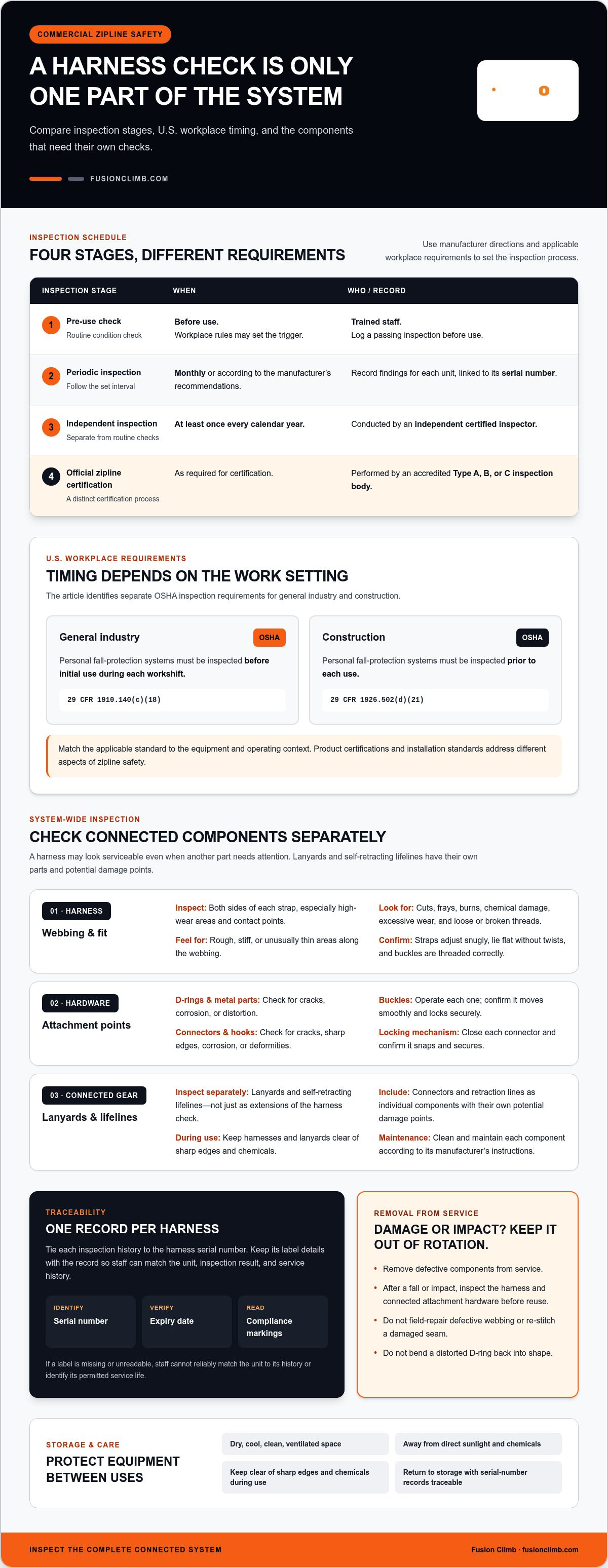
A harness inspection alone doesn’t clear the rest of the system. Commercial zipline harness inspection standards should account for each connected component: OSHA requires personal fall-protection systems in U.S. general industry to be inspected before initial use during each workshift under 29 CFR 1910.140(c)(18), while construction systems must be inspected prior to each use under 29 CFR 1926.502(d)(21). Inspect lanyards and self-retracting lifelines separately from the harness, too; each has its own parts and potential damage points.
That distinction matters when equipment sees daily use, changing weather, and repeated rider cycles. A harness may look serviceable even when a connector, lanyard, or retraction line needs attention.
This guide explains how to distinguish pre-use checks from periodic and annual inspections, what to examine on harnesses, lanyards, and self-retracting lifelines, and when to remove damaged or impact-loaded equipment from service. It also outlines the safety frameworks that may apply to U.S. zipline operations, helping you build an inspection process suited to your equipment and operating context.
Key Takeaways
- Match the applicable standard to the equipment and operating context; EN 1651 certification and zipline system standards address different considerations.
- Keep an inspection history for each harness, tied to its serial number, and make sure labels remain legible.
- Check lanyards, connectors, and retraction lines as individual components, not just as extensions of the harness inspection.
- Remove gear from service after damage or an impact event, and don’t return it to use until the required inspection is complete.
- Use the comparison of safety frameworks to shape an inspection process that fits your operation and equipment.
What certifications apply to commercial zipline harnesses?
There isn’t one certification that covers every harness and every zipline system. Product certifications and installation standards address different aspects of zipline safety. Treat product certification and installation standards as separate checks. For commercial zipline harness inspection standards, also distinguish routine equipment checks from independent certification inspections.
How often must commercial zipline harnesses be inspected? Check each unit before use, follow the manufacturer’s inspection interval, and schedule an independent certified inspection at least once every calendar year. In U.S. general industry, the Occupational Safety and Health Administration requires personal fall-protection systems to be inspected before initial use during each workshift under 29 CFR 1910.140(c)(18). Construction work has a separate rule: inspection prior to each use under 29 CFR 1926.502(d)(21).
Record every inspection against the individual harness, not just the equipment pool. Use the serial number to connect the unit’s label, inspection result, and service history. Clear records help staff distinguish similar-looking harnesses as they rotate between riders.
| Inspection stage | Timing | Record or qualification |
|---|---|---|
| Pre-use check | Before use; workplace rules may set the trigger | Trained staff; log a passing inspection before use |
| Periodic inspection | Monthly or according to manufacturer’s recommendations | Record findings by unit and serial number |
| Independent inspection | At least once every calendar year | Independent certified inspector |
| Official zipline certification | As required for certification | Accredited Type A, B, or C inspection body |
What do manufacturer instructions require for commercial zipline harness inspection and maintenance? Follow the harness manufacturer’s directions for inspection intervals, care, and service life, along with applicable workplace requirements. Inspect periodically, monthly or at the interval recommended by the manufacturer, and record the schedule for each unit.
Read the label before putting a harness into rotation. Confirm the serial number, expiry date, and compliance markings are legible. If the label is missing or unreadable, staff cannot reliably match the unit to its history or identify its permitted service life. Keep the label details with the serial-number record.
Who is qualified to inspect and repair commercial zipline harnesses? Trained staff can perform routine checks, while annual independent inspections require certified inspectors. Official zipline certification is performed by an accredited Type A, B, or C inspection body. For construction systems, employees must be trained in the correct inspection procedures. Do not field-repair defective webbing. Remove the harness from service.
How should inspected zipline harnesses be stored, cleaned, and maintained? Store each unit in a dry, cool, clean, ventilated space, away from direct sunlight and chemicals. Keep harnesses and lanyards clear of sharp edges and chemicals during use. Clean and maintain each component according to its manufacturer’s instructions, then return it to storage while keeping its serial-number record traceable.
Harness attachment inspection
Inspect the harness as a connected system, not as webbing alone. Check each attachment point, buckle, and metal component for damage before use. In U.S. general industry, the Occupational Safety and Health Administration requires personal fall-protection systems to be inspected before initial use during each workshift under 29 CFR 1910.140(c)(18). Defective components must be removed from service.
Start with the webbing that transfers load to the harness hardware. Examine both sides of every strap, especially high-wear areas and contact points. Look for cuts, frays, burns, chemical damage, and excessive wear. Check seams for loose or broken threads. Even a small defect near an attachment point can affect the connected assembly’s integrity.
Next, check how the hardware moves and locks. Work through the harness methodically:
- Check D-rings and other metal parts for cracks, corrosion, or distortion.
- Operate each buckle and confirm it moves smoothly and locks securely.
- Inspect lanyard connectors and hooks for cracks, sharp edges, corrosion, or deformities.
- Close each connector and confirm its locking mechanism snaps and secures.
- Confirm straps can be adjusted snugly and lie flat without twists.
Fit matters, too. A twisted strap or loose adjustment can change how the harness sits on the rider. During a fit check, trace each strap from its buckle to its attachment point. Confirm the buckle is threaded correctly and the strap lies flat against the body. Recheck the fit after adjustments. A fastened buckle alone does not mean the harness is positioned correctly.
Use sight and touch. Run your fingers along the webbing to find rough, stiff, or unusually thin areas that may be hard to see. Inspect stitching at attachment points without pulling or altering it. Remove any harness with defective webbing from service. Do not field-repair or re-stitch a damaged seam. A bent, cracked, or distorted D-ring is also grounds for removal, not a part to bend back into shape.
After a fall or impact, inspect the harness and connected attachment hardware before reuse. Impact can cause damage that a quick glance misses. Keep the affected unit out of rider rotation until it receives the required inspection. Record the result against the harness’s serial number so the finding stays tied to the correct unit.
For an attachment setup review, compare the harness connection configuration with the equipment’s intended use and manufacturer instructions.
Harness service life and retirement criteria
A harness does not remain serviceable simply because its label shows a future expiry date. Commercial use exposes webbing and hardware to repeated loading, abrasion, sunlight, chemicals, and changing storage conditions. Treat the manufacturer’s expiry date as one decision point, then assess the unit’s condition and documented history. If its service history is uncertain, remove the harness from use.
Retire a harness immediately after a fall-arrest or arrest-load event, visible damage, hardware deformation, chemical contamination, or uncertainty about its history. These conditions can compromise load-bearing parts even when damage seems limited. A damaged D-ring, for example, must not be bent back into shape. Remove defective personal fall-protection components from service.
Distinguish an arrest event from other impacts. Fall-protection equipment that has been impact-loaded requires inspection by a competent person before reuse. If the harness sustained a fall-arrest or arrest-load event, retire it. After another impact, keep the unit out of service until a competent person inspects it and determines its condition.
Use a clear decision process for each affected unit:
- Identify the harness by its serial number and read its label.
- Record the fall, impact, contamination, damage, or history concern.
- Remove the unit from service while its status is assessed.
- Retire it when a listed retirement condition applies; otherwise, require the competent-person inspection after impact loading before reuse.
- Update the unit’s record so staff can distinguish retired equipment from active stock.
Check the visible condition of both fabric and metal. Inspect webbing for cuts, frays, burns, chemical damage, or excessive wear, and look for broken or loose stitching. Remove a harness with defective webbing from service rather than field-repairing it. Do not re-stitch a cut or opened seam for continued use. These defects affect load-bearing material or seams.
Review inspection records alongside the physical harness. Missing history can make it impossible to establish whether the unit experienced a fall, impact, or chemical exposure. The serial number links the label and inspection history to that specific harness. Clearly separate retired units from equipment available for riders, so their status is not lost during rotation or storage.
No single service-life figure overrides the harness label, manufacturer instructions, and actual condition. Follow the stated expiry date, but remove a harness sooner if damage, contamination, an arrest-load event, or uncertain history warrants retirement. When impact loading does not already require retirement, a competent person must inspect the harness before it is reused.
Harness, trolley, and retraction-line checks
Inspect the harness, trolley, lanyard, and retraction line as separate components. A sound harness does not establish that connected hardware is in good condition. Commercial zipline operators should conduct visual hardware checks every morning, including harness checks. In Tennessee, operators must document daily inspections of harnesses, platforms, and other equipment before riders use it.
Follow a consistent route through each harness before it enters rider rotation. Check both sides of the straps, including high-wear areas, then inspect stitching and buckles. Feel the webbing as well as looking at it. Make sure straps lie flat without twists and adjust snugly. The Occupational Safety and Health Administration requires personal fall-protection systems to be inspected before initial use and during each workshift for mildew, wear, damage, and other deterioration. Remove defective components from service.
Check the trolley and its connected hardware as distinct parts of the riding setup. Look for visible cracks, corrosion, distortion, or other damage. Inspect connectors and hooks for sharp edges or deformities, then operate their locking mechanisms. The lock must snap and secure. Compare the setup with the equipment’s intended configuration and manufacturer instructions. Passing one component does not clear the others.
Inspect a self-retracting lifeline separately. Examine the line and visible hardware for wear, damage, or deterioration, and follow the device manufacturer’s inspection procedure. Keep it out of service if you find a defect. A harness check does not replace inspection of the retraction line or its connections.
- For harness webbing or lanyard material, check for cuts, frays, burns, abrasion, chemical damage, and UV damage.
- For lanyard connectors and hooks, check for cracks, corrosion, sharp edges, deformities, and secure locking.
- For a shock-absorbing lanyard, confirm tear-away stitching remains intact and the absorber hasn’t deployed.
- For each connected unit, check its label and record inspection findings against its serial number.
Visually and manually check fall-protection harnesses and lanyards before each use. Inspect them again after any fall or impact, since damage may be hidden. Equipment that has been impact-loaded requires a competent-person inspection before reuse. Remove defective components from service rather than relying on the inspection result for another part.
Record the outcome for each component, not just the overall setup. In Tennessee, document the daily inspection before riders use the equipment. For other operations, keep records traceable to each unit and follow the manufacturer’s instructions. This helps staff distinguish inspected equipment from gear awaiting inspection or removal from service.
Commercial zipline safety standards
Zipline safety draws on more than one framework. EN 15567 addresses installations, including load-bearing cables and secondary arrest-device testing. ACCT guidance covers aerial operations, including clearance zones and rider envelopes. These frameworks concern different parts of the system, so an installation inspection doesn’t replace checks of each harness and connected component.
Do state or local regulations impose additional zipline harness inspection requirements? Yes. Tennessee requires documented daily inspections of harnesses, platforms, and other equipment before riders use them. It also requires commercial zipline operators to have the entire system inspected and recertified annually by an ACCT-certified person.
Federal workplace rules also matter when an operation falls under their scope. The Occupational Safety and Health Administration requires personal fall-arrest systems to be inspected before each use for wear, damage, and deterioration. For U.S. general industry, 29 CFR 1910.140(c)(18) specifies inspection before initial use during each workshift. Construction work has a different trigger under 29 CFR 1926.502(d)(21): prior to each use.
Use these requirements as separate inspection layers, not substitutes:
- Before use: Inspect harnesses and connected fall-protection equipment under the applicable workplace rule.
- Daily operation: Document checks of harnesses, platforms, and other equipment before riders use them where Tennessee requirements apply.
- Periodic review: Inspect harnesses and lanyards monthly or according to manufacturer’s recommendations.
- System inspection: In Tennessee, arrange annual inspection and recertification of the entire zipline system by an ACCT-certified person.
Tennessee’s process shows how state oversight can add operational steps. Commercial operators must notify the Tennessee Department of Labor and Workforce Development when starting a business so the zipline can be inspected and issued a permit. Operators must also provide a certificate of insurance. If an inspector finds a Tennessee zipline unsafe, it cannot operate until a state inspector or division representative reinspects it and removes its red tag.
Build a site-specific inspection calendar from the rules that apply to your operation, then record each check by equipment unit and date. Keep harness inspections distinct from system-level reviews: EN 15567 addresses installation concerns, while harness checks focus on the individual equipment. For Tennessee operators, include the documented daily inspection and annual system recertification in that calendar.
Use the applicable standards to review your equipment inspection plan and keep each inspection layer clear.
Fusion Climb: Full Body Harnesses
Fusion Climb offers full body harnesses, Superman style harnesses, zipline pulleys, and lanyard and tether equipment for operators assembling zipline systems. Use the inspection criteria above to assess your current gear, identify worn or retired components, and determine what replacement equipment your operation needs. Match each item to its intended use and maintain its own inspection and service record. Equipment selection is only one part of readiness. Routine checks and applicable operating standards remain essential.
Explore Fusion Climb’s zipline safety gear when reviewing harnesses and connected equipment for your operation. Contact Fusion Climb or visit fusionclimb.com to learn more.
Plan the next equipment decision
Make inspection planning part of equipment selection, not a task to add after purchase. Before replacing a unit, consider its role in your operation’s maintenance process and retirement criteria. This helps clarify whether you need rider support, a trolley connection, or replacement for worn equipment. Use the commercial zipline harness inspection standards that apply to your operation as part of that review, alongside the equipment’s intended use and manufacturer instructions.
Fusion Climb offers full body harnesses, Superman style harnesses, and zipline pulleys. These equipment categories can help focus a gear review on harnesses and connected system components. Base each choice on the item’s intended role and your established inspection process.
Ready to discuss equipment for your operation? Ask Fusion Climb about inspection needs. Move forward with a clear plan and a steady focus on rider safety.
Frequently Asked Questions
Do lanyards and self-retracting lifelines need separate inspections?
Yes. Inspect each lanyard and self-retracting lifeline as its own component, alongside the harness. A sound harness, for example, does not prove that a lanyard’s shock absorber is intact or that an SRL’s line and hardware are undamaged. Follow the device manufacturer’s inspection instructions, including any required function checks. If a connected component is defective, remove that component from service rather than relying on another component’s inspection.
How Do You Inspect a Safety Harness Before Use?
Use a consistent sequence: identify the harness, inspect its webbing and stitching, operate its buckles, then check its metal attachment points. Look for cuts, frays, burns, chemical damage, loose threads, cracks, corrosion, or distortion. Check straps for twists and confirm buckles lock securely. Read the label and compare the harness with its unit record. If inspection reveals a defect or unresolved history, keep the harness out of rider use.
What Harness Damage Means It Should Be Removed From Service?
Remove a harness with cut, frayed, burned, chemically damaged, or excessively worn webbing. Loose or broken stitching, an opened seam, and cracked, corroded, or distorted hardware also require removal. Do not bend a damaged D-ring back into shape, re-stitch an opened seam, or field-repair defective webbing. For example, a harness with one opened seam is defective even if its other straps look sound.
What If the Harness Has Been Involved in a Fall?
Retire the harness immediately after a fall-arrest or arrest-load event. Do not return it to rider rotation based only on a visual check. Record the event against the unit’s serial number and separate the harness from active equipment. If a harness or connected fall-protection component experiences another impact, keep it out of use until a competent person inspects it before reuse. A quick check may not reveal hidden damage.
What if the harness label is unreadable?
Keep the harness out of service until staff can establish its identity, expiry information, and inspection history. The label should show legible compliance markings, expiry date, and serial number. Without these details, operators cannot confidently match the unit to its individual inspection record or verify its service history. Do not substitute a handwritten identifier for manufacturer information. Record the issue and keep the harness separate from equipment cleared for riders.
What standards govern commercial zipline harness inspection in the United States?
Applicable requirements depend on the operation and work context. The Occupational Safety and Health Administration specifies inspection rules for personal fall-protection systems: 29 CFR 1910.140(c)(18) for U.S. general industry and 29 CFR 1926.502(d)(21) for construction work. EN 15567 addresses zipline installations, while ACCT provides guidance for aerial operations. State rules may add requirements; Tennessee, for example, requires daily documented equipment inspections and annual system recertification.
What pre-use inspection steps should zipline operators follow for harnesses?
Start by matching the harness to its serial-number record, then inspect webbing, seams, buckles, and attachment hardware. Check both sides of the straps and feel for damage that sight alone may miss. Confirm the buckles operate and lock, and that straps adjust snugly without twists. Inspect connected lanyards and connectors separately. Record the inspection outcome before the harness enters rider rotation.
What detailed criteria determine whether a zipline harness is safe or must be removed from service?
Assess the harness label and history, webbing, stitching, buckles, and metal hardware. Cuts, frays, burns, chemical damage, excessive wear, broken threads, or opened seams warrant removal. Cracked, corroded, or distorted hardware also disqualifies the unit. Retire it after an arrest-load event, visible damage, chemical contamination, or uncertain history. If an impact occurred without a known arrest event, require a competent-person inspection before reuse.