



Fall Arrest Energy Lanyard: How to Compare and Choose
The lanyard that looks like an obvious fit can still leave too little room to stop safely. A Fall arrest energy lanyard helps reduce the forces on a worker during a fall, but its absorber needs room to deploy, and the lanyard alone can’t make a system safe. Length, connectors, harness, anchorage, and clearance all matter.
Rather than starting with style or connector options, start with the task and the complete fall-protection setup. An energy absorber has limits, and the wrong configuration can create compatibility problems or leave inadequate clearance below the work area.
This guide explains how energy-absorbing lanyards work, what they can and can’t do, and how to compare single-leg, Y-style, and adjustable configurations against your work requirements. You’ll also learn what to review in product documentation, how to account for fall clearance, and what to inspect before use. Choose equipment as part of a competent safety process, with the harness, connectors, and anchorage working together as a system.
Key Takeaways
- Evaluate a Fall arrest energy lanyard as part of a complete setup, not as a standalone solution.
- Estimate required fall clearance using the lanyard’s documented deployment information and the system’s geometry.
- Compare single-leg and twin-leg configurations based on task movement, connection points, and edge conditions.
- Use product documentation to assess connector fit, anchorage compatibility, and equipment limitations.
- Follow a consistent pre-use inspection process and remove worn or damaged equipment from service.
What a Fall Arrest Energy Lanyard Does, and What It Cannot Do
A Fall arrest energy lanyard is a connecting device designed to reduce the forces transmitted to a worker when a fall is arrested. Its energy absorber deploys according to the manufacturer’s design and conditions, helping manage deceleration. That deployment is part of the system’s response, not a promise that a fall will be gentle or injury-free.
The lanyard alone cannot guarantee adequate fall clearance or prevent every hazard. Select and use it with compatible body support, connectors, and anchorage, and account for the fall exposure in the work area. Its role is specific: connect components and help limit forces during arrest. It doesn’t replace sound planning or make an unsuitable setup safe.
How an energy absorber responds during a fall
During a fall, the absorber may progressively tear, extend, or otherwise deploy according to its design. This controlled action increases the time and distance over which the worker slows, helping limit forces compared with an equivalent connection that lacks energy absorption. The absorber doesn’t erase the fall’s energy, stop the fall before it starts, or ensure the worker avoids nearby structures or a lower level.
This is the key difference between fall arrest and restraint. A restraint setup is intended to keep a worker from reaching a fall hazard; an energy-absorbing lanyard is used to arrest a fall after it begins. The right approach depends on the task and system design. Performance can vary with product design, user conditions, and how components are assembled and used. Rely on current product documentation, not appearance or lanyard length alone.
Deployment has a practical consequence: an absorber that extends during a fall needs space to do so. Calculate clearance for the complete system, not just the lanyard. The overview of Fall arrest systems offers broader context on fall arrest and related concepts.
Where the lanyard fits in fall protection
Think of the setup as connected parts with distinct jobs. The anchorage provides the connection point, body support distributes forces through a compatible harness, and the lanyard and its connectors link the worker to the anchorage. If one element is unsuitable, the system may not perform as intended. A connector must attach securely to the intended harness point and anchorage, close and lock as designed, and remain compatible with the components it joins.
Connector terminology can help clarify differences in gates, locking mechanisms, and intended connections. Fusion Climb’s professional climbing carabiner guide covers connection considerations relevant to evaluating carabiners. Follow the lanyard and connector documentation for permitted attachment points and use.
This guide focuses on selection and component comparisons, not on creating a complete fall-protection program or replacing task-specific training. Before choosing a lanyard, consider the work position, potential fall path, available clearance, and documented limits for every connected component. The goal is a coordinated setup; no single piece of equipment can account for every hazard on its own.
How Energy Absorption, Fall Distance, and Clearance Interact
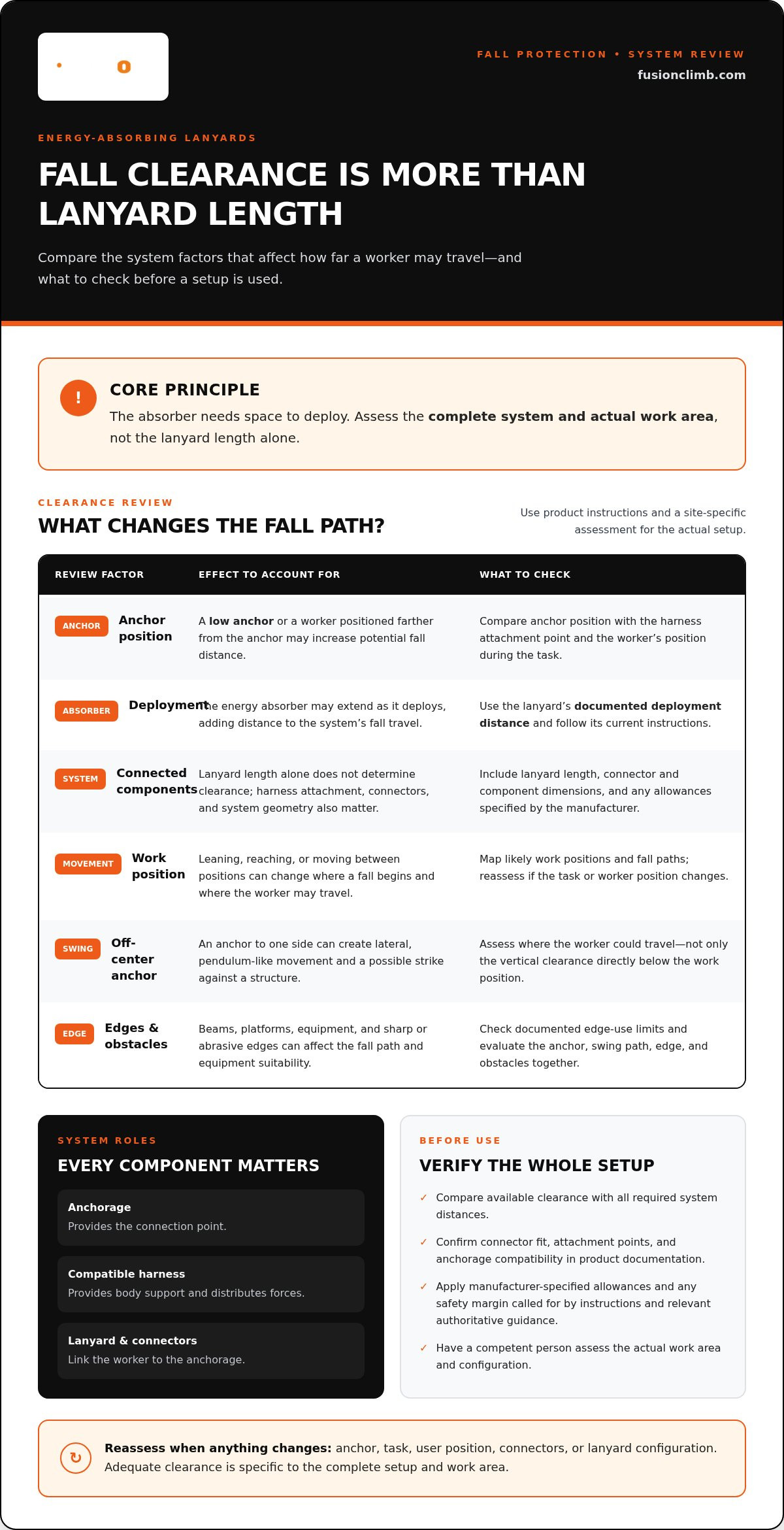
Fall clearance is the open space below a worker that the complete system needs to arrest a fall without the worker striking a lower level or obstruction. Lanyard length alone doesn’t determine it. A Fall arrest energy lanyard may extend as its absorber deploys, while the worker’s starting position, connection height, harness attachment point, connectors, and system geometry also affect how far the worker can travel.
Insufficient clearance can leave a worker at risk of striking a lower level even when an energy-absorbing lanyard is connected. Treat available space as a site-specific calculation, not a general estimate. Follow current lanyard and system instructions, and have a competent person assess the actual work area and setup before use.
What changes the clearance calculation?
Start by comparing the anchor’s position with the harness attachment point and the worker’s position during the task. A low anchor or a worker positioned farther from the anchor may increase potential fall distance. Include the lanyard’s length, the absorber’s documented deployment distance, connector or other component dimensions, and any allowances specified by the manufacturer.
Then account for movement and the work area. A worker may lean, reach, or move between positions, while beams, platforms, and equipment can obstruct the fall path. Apply any safety margin called for by product instructions and relevant authoritative guidance. OSHA’s Fall Protection Systems Criteria provides regulatory context, but it doesn’t replace a product-specific and site-specific assessment.
Why swing fall and edge exposure matter
If the anchorage is off to one side instead of above the worker, a fall can produce lateral movement and a pendulum-like swing. The worker could strike a structure even when there appears to be enough vertical clearance directly below the work position. Assess where the worker could travel, not just where a fall might begin.
Edges add another constraint. A lanyard’s suitability for contact with a sharp or abrasive edge depends on its documented design limits and permitted use. Don’t assume an energy absorber makes edge exposure acceptable. Check the instructions for the exact system, and have a competent person evaluate the anchor location, potential swing path, edge, and obstacles together.
Before approving a setup, map likely work positions and fall paths, then compare available clearance with all required system distances. Reassess if the anchor, task, user position, connectors, or lanyard configuration changes. A clearance assessment for one arrangement may no longer apply if an adjustment moves the connection point or changes how far the worker can reach.
Use the manufacturer’s current instructions for deployment information and system limitations, and document the competent person’s site-specific assessment through your safety process. If the available space can’t accommodate the system’s required clearance, don’t rely on a guess. Evaluate the work setup before proceeding. As you compare components, review Fusion Climb’s lanyards and tethers alongside the connector and harness requirements for the intended setup.
Compare Fall Arrest Energy Lanyard Configurations by Task
The right configuration depends on where the work takes you, how connections are managed during movement, and what the complete system permits. Compare a Fall arrest energy lanyard against the task, not by configuration name alone. Use the table as a starting point, then verify each option against current manufacturer instructions, applicable requirements, and the fall-protection plan.
| Configuration or equipment | Movement and connection needs | Edge and clearance checks |
|---|---|---|
| Single-leg energy-absorbing lanyard | Connects the user to one anchorage point at a time. Consider whether the task allows movement without frequent disconnection. | Assess the fall path, absorber deployment, anchor position, and any edge exposure against documented limits. |
| Twin-leg energy-absorbing lanyard | Two legs may support transitions when maintaining an attachment is part of the task plan, but the connection sequence and compatible attachment points matter. | Review clearance for the leg in use, possible anchorage changes, and any swing or edge exposure. |
| Restraint lanyard | Configured to limit travel so the user can’t reach a fall hazard, if the system is correctly designed for that purpose. | Confirm the restraint reach and work-area layout prevent access to the hazard; don’t treat it as fall-arrest equipment. |
| Self-retracting lifeline (SRL) | A separate equipment category that pays out and retracts line as the user moves, subject to its specific use conditions. | Check the device instructions for anchorage position, fall path, edge conditions, and required clearance. |
Single-leg or twin-leg: match connection needs to movement
A single-leg setup uses one lanyard leg to connect the harness to an anchorage. A twin-leg setup has two connection legs, but intended use varies by product. If the task involves moving between anchor points, a twin-leg design may suit a planned transition, provided the instructions allow that use and the system remains compatible. Review the transition steps, anchor spacing, and clearance at every position.
Lanyard, restraint, or self-retracting lifeline?
Choose by function. Fall arrest allows a fall to begin and uses a system to stop it; restraint is intended to prevent the worker from reaching the fall hazard. An SRL is not simply a shorter lanyard. It has distinct operating conditions, limitations, and clearance considerations. For specialized tether applications in zipline settings, Fusion Climb’s zipline lanyards and tethers guide provides related context.
No configuration is universally safer or suitable for every task. For each option, map the user’s movement, connection points, possible transitions, edge conditions, and clearance needs. Confirm harness attachment compatibility and connector use in product documentation, and assess the complete system. This comparison is a selection aid, not a substitute for applicable requirements or a task-specific fall-protection plan.
Use This Checklist to Evaluate a Fall Arrest Energy Lanyard
Work through the task and complete system in sequence. A Fall arrest energy lanyard may have the right general configuration but still be unsuitable for a particular anchor location, movement pattern, or available clearance. Use this checklist to organize the comparison, then apply current product instructions and your site’s competent safety process.
Start with the task and complete system
- Define the work. Record where the user will work, how they’ll move, where they may need to transition, and whether the task exposes them to a fall hazard. Note potential edges, obstacles, and lower levels in the work area.
- Map the connected components. Identify the harness and its intended attachment point, lanyard configuration, each connector, and anchorage. Check how the components connect and whether their documentation permits the intended combination and use.
- Choose the system approach. Determine whether the task plan calls for restraint, fall arrest, or another suitable approach. Restraint is intended to keep a worker from reaching a fall hazard; fall arrest is designed to stop a fall after it begins. Establish the system’s purpose before choosing a lanyard.
- Assess clearance and movement. Compare work positions and likely fall paths with the system’s required clearance. Consider anchor location, lanyard configuration, absorber deployment information, connectors, and movement during the task. Have a competent person evaluate actual site conditions.
- Compare documentation and limitations. Review the product label and current instructions for intended applications, connector requirements, use restrictions, and stated performance limits. Check which standards the product documentation identifies, and verify applicable OSHA and ANSI/ASSP references for the work and jurisdiction before relying on them.
- Plan inspection and removal from service. Follow the manufacturer’s inspection instructions and retirement criteria. Before use, examine the equipment for visible wear, damage, or other conditions identified in the documentation. Remove equipment from service when it meets the manufacturer’s rejection criteria; don’t guess at service life or inspection intervals.
Review documentation, compatibility, and condition
Keep product information available to the people selecting, inspecting, and using the equipment. Match labels and instructions to the task, harness attachment, connectors, anchorage, and worker movement. If an intended use or limitation is unclear, pause the selection process and resolve the issue through the organization’s competent safety process before putting the setup into use. Inspection doesn’t replace compatibility review, and a compatible setup still needs inspection.
Apply the same disciplined comparison to lanyards and tethers intended for commercial or recreational use: the task, connections, and documented limitations must align. Explore Fusion Climb lanyards and tethers as you evaluate connecting equipment for your planned setup.
Choose a Fall Arrest Energy Lanyard with Fusion Climb
A sound selection starts with the task, not a product label. Define where the user will work, how they’ll move, where the anchorage sits, and what hazards or obstructions could affect a fall. Then compare the lanyard’s documented configuration and intended application with the harness, connectors, anchorage, and available clearance. Choose a compatible system that fits the work plan, not a component in isolation.
What to consider when comparing Fusion Climb lanyards and tethers
Fusion Climb manufactures lanyards and tethers for climbing and zipline safety applications. As you compare options, use current product documentation to understand each item’s intended application, configuration, restrictions, and relevant performance information. Don’t infer suitability from appearance or a general category description. Match documented use to the task and system requirements, including clearance, edge exposure, and movement conditions.
Connectors and body support are part of the same decision. Fusion Climb also offers carabiners and full-body harnesses, but each component must be evaluated for its intended role and compatibility within the specific setup. Review instructions for attachment points and connector use, and account for the anchorage and work plan. Base any certification, standard, or performance claim on the current documentation for the specific equipment, not assumptions about an entire category.
Make the next step a system-level decision
Use your task and clearance checklist during equipment selection. Confirm that the configuration suits planned movement and transitions, the connected components are compatible, and available fall space meets the system’s documented needs. Include inspection in the selection process: understand the manufacturer’s inspection guidance and removal criteria before equipment enters service.
No single component replaces a complete fall-protection system, thoughtful planning, or appropriate training for the work. A Fall arrest energy lanyard can serve its intended role only when selected and used within the limits of the full setup. Keep the decision practical: task first, then compatibility, clearance, documentation, and inspection.
Explore Fusion Climb safety gear to review lanyards, tethers, connectors, and related equipment as components of a carefully planned system.
Put Your Selection Plan to Work
Before the next job begins, turn your lanyard choice into a decision the whole team can follow. Keep the selected equipment’s instructions with the work plan, ensure the people responsible for setup and inspection understand its limitations, and revisit the assessment whenever the task or anchorage changes. A Fall arrest energy lanyard is most useful when its role is clear within a carefully planned system, not when selection rests on a familiar style or assumption.
Apply the same disciplined approach when evaluating equipment for climbing and zipline applications. Fusion Climb manufactures specialized safety gear, including lanyards and tethers. Product documentation is the basis for determining how a specific component fits your work plan.
Explore Fusion Climb lanyards and safety gear as you plan your next equipment selection. Choose deliberately, with the task, documentation, and complete safety process in view.
Frequently Asked Questions
What is a fall arrest energy lanyard?
A fall arrest energy lanyard is a connecting device used in a personal fall-arrest setup to connect a worker’s harness to an anchorage while helping manage forces if a fall occurs. It isn’t the same as an ordinary positioning or restraint tether, even if they look similar. Don’t substitute equipment based on length or connector fit alone. Check the lanyard’s label and instructions.
How does an energy-absorbing lanyard work during a fall?
An energy-absorbing lanyard slows a fall through controlled deployment of its absorber, according to the product’s design. This can help limit forces, but it doesn’t eliminate them or guarantee that a fall causes no injury. Treat a lanyard involved in a fall as potentially compromised: remove it from use and follow the manufacturer’s instructions and your organization’s process for evaluating equipment after a fall before it’s used again.
How much clearance is needed when using a fall arrest lanyard?
There isn’t one clearance figure that applies to every setup. The required space depends on the equipment’s documented deployment, anchorage and harness positions, connectors, worker movement, and the distance to obstructions or a lower level. For example, a measurement taken with the worker directly below an anchor may not represent a position reached while moving sideways. Use the product’s clearance instructions and have a competent person assess the actual work location.
Can an energy-absorbing lanyard be used with any harness?
No. The lanyard must be compatible with the harness and attached only at a point permitted by both products’ instructions. A connector fitting through a loop doesn’t prove the connection is suitable for fall arrest. Check the harness label and documentation for its intended use and attachment points, then confirm the lanyard’s instructions allow that connection. Consider connector closure, orientation, and interaction with adjacent equipment as part of the review.
What is the difference between a fall arrest lanyard and a restraint lanyard?
A fall-arrest lanyard is used in a system designed to stop a fall after it begins. A restraint lanyard is part of a setup intended to limit a worker’s reach so they can’t access the fall hazard. For example, a task near an unprotected edge might be planned around restraint if the work can be completed without reaching the edge. The equipment and setup must match that purpose; don’t assume the terms are interchangeable.
When should a fall arrest energy lanyard be removed from service?
Remove a lanyard from service if its absorber has deployed, it has been involved in a fall, or inspection reveals damage or a condition the manufacturer identifies as unacceptable. Look for issues such as cuts, frayed stitching, deformed connectors, corrosion, or an unreadable identification label, and check the instructions for additional rejection criteria. Keep questionable equipment out of use while it’s handled under your organization’s process. Don’t repair it or return it to service based on guesswork.
Do fall arrest energy lanyards need to meet OSHA or ANSI standards?
Workplace fall-protection obligations depend on the applicable OSHA rules and the work being performed. ANSI/ASSP standards are consensus standards, and whether a specific standard applies can depend on regulations, contracts, or the equipment’s intended use. Don’t assume every lanyard has the same designation. Check its label and current product documentation, then verify applicable OSHA requirements and ANSI/ASSP references for your work setting with a competent safety professional.