



Adjustable Length Work Lanyards: How to Choose the Right Setup
The lanyard with the widest adjustment range may be the wrong choice for the task. An Adjustable length work lanyard must suit the work and its role in the complete safety system, not simply reach a desired length.
It’s easy to confuse adjustment mechanisms, configurations, and intended uses, especially when a lanyard connects to a harness, anchor, and other hardware. The distinction matters: equipment intended for work positioning isn’t automatically suitable for fall arrest, and an adjustment range that works in one setup may not fit another.
This guide explains what adjustable length means in a work-lanyard context and how to compare adjustment styles by task, working range, and system compatibility. You’ll also learn what to review in product documentation and applicable requirements before use, including the lanyard’s intended application and specifications. Fusion Climb manufactures lanyards and tethers alongside harnesses and carabiners, so consider the full equipment system when selecting components. Choose for the work, match each connection, and review the setup before relying on it.
Key Takeaways
- Compare adjustment method, material, connection layout, and intended function instead of treating “adjustable” as proof of suitability.
- Choose an Adjustable length work lanyard by defining the task and the role the lanyard must perform in your safety system.
- Determine the working reach the task requires, then check how the lanyard’s design and approved use affect that range.
- Check compatibility across the harness, anchor, and connectors, and review product documentation before use.
- Use a task-first checklist to narrow your options and build a setup around function, range, and system fit.
Adjustable Length Work Lanyards: Purpose and Design
An adjustable length work lanyard is a configurable connection designed for a stated work-at-height task. Its adjustment mechanism changes the usable length between connection points, allowing a worker to set the lanyard for the intended setup. “Adjustable” describes a feature, not a safety function. It doesn’t establish whether the lanyard is designed for positioning, restraint, or fall arrest.
Definition: A work lanyard with adjustable length is a task-specific connection whose usable length can be changed within its designed range. Its suitability depends on its documented function and compatibility with the complete safety system.
This distinguishes work-at-height equipment from a badge lanyard or general-purpose cord. Badge lanyards hold identification; ordinary cords may secure or carry objects. Neither should be treated as fall-protection equipment just because it has a cord, clip, or adjustable slider. A work lanyard is engineered and documented for a defined application, with connectors and construction intended for its stated role.
How Does Length Adjustment Help During a Work Task?
Changing the effective length can help position a worker relative to a work area. For example, a worker may need a shorter connection to remain close to an anchor or a different setting to reach a designated work position. The useful range depends on the task, anchor location, harness connection point, connectors, and the lanyard’s designed limits.
Adjustment doesn’t replace product instructions. Set and use the lanyard only as its manufacturer documents, and consider the full system rather than length alone. A setting that allows access in one configuration may not be suitable in another.
Positioning, Restraint, and Fall Arrest Are Not Interchangeable
Work positioning supports a worker at a work location, often allowing hands-free work. Travel restraint limits movement so the worker can’t reach a fall hazard. Fall arrest is designed to stop a fall after it begins, as part of a compatible system. These functions have different purposes. Don’t assume a lanyard intended for one is suitable for another.
Use a lanyard only for the function stated in its product documentation. In particular, don’t assume an adjustable positioning or restraint lanyard can arrest a fall. Fall arrest depends on a complete system, not an adjustable connection by itself. Fall arrest systems and components offers an overview of how those elements work together. Before use, review the product instructions and applicable requirements for the specific task and setup.
Compare Adjustable Work Lanyard Configurations Before You Choose
Compare the documented configuration, not just the label. An Adjustable length work lanyard can vary by adjustment method, material, connection layout, and intended function. Those details determine whether its working range and attachments suit the task. Use the product instructions to identify approved use and specifications.
| What to compare | What to look for | Why it matters |
|---|---|---|
| Adjustment method | How the mechanism operates, as described by the manufacturer | Shows how usable length is set and controlled |
| Material and construction | Stated materials, construction details, and care instructions | Helps assess handling and suitability for the work environment |
| Connection layout | Single-leg or twin-leg configuration, connector types, and attachment points | Indicates how the lanyard connects within the system |
| Intended function | Documented application and any stated use limits | Prevents assuming one configuration suits every task |
| Documentation | Instructions, specifications, applicable markings, and standards information | Provides the basis for evaluating approved use and system fit |
Use this comparison to narrow your options, then verify the details against the exact product documentation. OSHA’s standards for personal fall protection systems are relevant to general-industry fall protection. Requirements depend on the work and setting. Don’t assume a lanyard meets a requirement based on its appearance or adjustability.
Adjustment Mechanism, Material, and Working Range
Adjustment mechanisms can operate differently, so compare their operation only where the manufacturer explains it. Check how the device is adjusted and secured, and follow the stated instructions rather than inferring how it works from its shape. Material and construction can affect handling and durability, but suitability depends on the specific product and task. Compare its documented usable range with the work position you need, not simply its longest possible setting.
Connector Layout and Harness Compatibility
Connector type and attachment location shape how the lanyard fits into the system. Check that each connector is suitable for its intended connection, and use only harness attachment points approved in the harness instructions. A single-leg layout has one lanyard leg; a twin-leg layout has two. These are distinct configurations, not interchangeable solutions. Their use depends on the system design and product documentation. For connector considerations, see this professional climbing carabiner guide.
Build the setup as a complete system, matching the lanyard, harness, and connectors to the task. Fusion Climb’s lanyards and tethers are part of its broader range of specialized climbing and safety equipment. Product documentation is a practical starting point for comparing configurations.
Will an Adjustable Work Lanyard Fit Your Safety System?
Adjustability can help set a connection for a task, but it doesn’t make a lanyard compatible with every harness, anchor, or work-at-height application. The usable adjustment range is only one part of the decision. The lanyard’s intended function, connectors, attachment points, and instructions also determine how it may be used.
System compatibility depends on each component’s documented intended use. Consider the lanyard, harness, connectors, and anchor as one system. For example, a connector that physically attaches may still be unsuitable if the equipment instructions don’t approve that connection or use. Review the documentation for each component together rather than judging fit by whether the parts can be joined.
An Adjustable length work lanyard can provide task-level length control, which may help a worker reach a designated position or limit movement. But the adjustment mechanism can’t change the lanyard’s intended function or expand its approved use. If the task requires fall arrest, a lanyard documented for positioning or restraint shouldn’t be treated as fall-arrest equipment.
Check the Intended Function and Approved Attachment Points
Start with the lanyard’s instructions and markings. Identify whether its documented purpose is positioning, restraint, fall arrest, or another stated application. Don’t infer performance or certification from its appearance, material, or connector style.
Then check the harness instructions for the approved attachment point for that function. Use the attachment points specified by the equipment manufacturer, and confirm that the lanyard and its connectors are intended to work with them. A connection that looks convenient isn’t a substitute for an approved system setup.
Understand the Standards and Documentation for the Application
Requirements depend on the work and setting. Review applicable OSHA rules and, where relevant, ANSI/ASSP Z359 requirements for the equipment and task. These references aren’t interchangeable: regulations and consensus standards serve different roles, and a standard’s relevance depends on the product’s documented application.
Before use, check the specific lanyard’s markings, instructions, intended function, and any stated standard. Review the harness, connector, and anchor documentation as well. Confirm that the proposed setup stays within each component’s approved use and the lanyard’s stated limits. If instructions are unclear or components appear inconsistent, pause and resolve the uncertainty before relying on the configuration.
- Match the lanyard’s documented function to the task.
- Use only manufacturer-approved harness attachment points.
- Check that connectors and the anchor suit the documented setup.
- Review all component instructions and applicable requirements together.
This system-level approach applies across work-at-height equipment, not just lanyards. A ropes course safety equipment guide can provide broader context for considering hardware as part of a coordinated system.
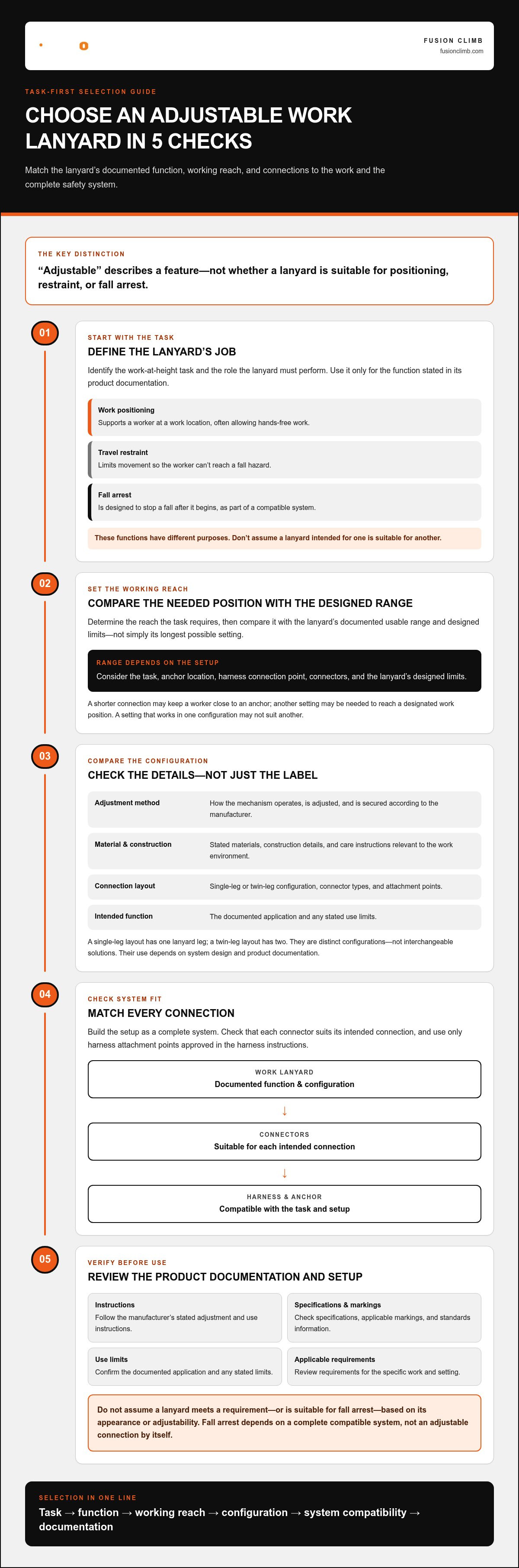
Choose the Right Work Lanyard Length With a Task-First Checklist
Choose length based on the work configuration, not habit or a rough guess. An Adjustable length work lanyard should reach the required work position within its manufacturer-stated range while serving its documented function and fitting the rest of the system. Use this sequence to turn the task into clear selection criteria.
- Define the task. Identify where work will take place, the position the worker must reach, and how the worker will move during the task. Note nearby edges or other hazards that affect the setup.
- Identify the system function. Determine whether the equipment is intended for positioning, restraint, or fall arrest. Use only a lanyard documented for that function.
- Map the required reach. Record the intended work position, anchor location, and harness attachment point. Compare those locations with the lanyard’s stated adjustment range and product instructions.
- Check compatibility. Review the harness, lanyard, connectors, and anchor as a complete system. Confirm that their instructions support the proposed connections and use.
- Review the documentation. Check the product markings, instructions, inspection criteria, care requirements, and applicable standards for the specific application.
This process helps distinguish a product that can physically reach the work area from one whose documented range and use fit the planned system. For application-specific decisions, involve qualified safety oversight. General selection guidance can help organize the questions, but it doesn’t replace task-specific training, product instructions, or workplace procedures.
Measure the Task and Required Adjustment Range
Map the worker’s intended position and connection points before comparing products. Include the anchor location, harness attachment point, and any connectors in the setup. Then compare the distance and working position with the manufacturer-stated usable range. A range that suits one anchor layout may not suit another, so don’t select by a familiar length or assume one value fits every task.
Stay within the product’s documented setup. If the work position changes, reassess the arrangement rather than assuming the same adjustment remains suitable. If the measurement or system configuration is uncertain, pause and get qualified guidance before use.
Review Use, Inspection, and Retirement Instructions
Read and follow the selected equipment’s manufacturer instructions for use, inspection, care, and retirement. Inspect it as directed before use, and act on damage, unusual loading, or a fall event according to the applicable instructions. Equipment subjected to an actual fall must be removed from service. Don’t return questionable equipment to use based only on appearance.
For additional context on lanyard setups in a related application, consult this zipline lanyards and tethers safety guide. For task-based selection, explore Fusion Climb lanyards and tethers and compare each product’s documented range and intended use with your system.
Build a Work-Ready Lanyard Setup With Fusion Climb
Make the selection in a deliberate order: identify the task and the lanyard’s intended function first, then compare its adjustment range, system compatibility, and product documentation. This sequence prevents a familiar length or convenient connector from driving the decision before you know what the setup must do.
Fusion Climb manufactures specialized climbing and safety equipment, including lanyards and tethers, harnesses, pulleys, and carabiners. Founded in 1998, the company brings a manufacturer’s perspective to equipment that needs to work as part of a coordinated setup. Keep the focus on the actual application: product category alone doesn’t determine whether a component suits a particular system.
Match the Lanyard to the Complete Equipment System
Start with the task’s documented system function. Then assess the lanyard alongside the harness, connectors, and anchor, using each component’s instructions to understand how the parts are intended to work together. Select the lanyard within the requirements of the complete setup, rather than treating it as an isolated accessory that can solve a reach or connection issue on its own.
For example, a lanyard’s adjustment range may appear to suit the work position, but that alone doesn’t establish whether its function, connectors, or harness attachment points fit the setup. Product documentation connects those details to approved use. Review the exact information for the equipment under consideration rather than assuming another configuration has the same limits or application.
Move From Comparison to a Confident Equipment Choice
Before choosing, use this quick checklist to keep the comparison grounded in the task:
- Function: Is the lanyard documented for the role the task requires?
- Range: Does its stated adjustment range suit the work position and connection locations?
- Compatibility: Do the instructions support the planned harness, connectors, and anchor configuration?
- Documentation: Have you reviewed the relevant product instructions, markings, and applicable requirements?
If any answer is unclear, pause before relying on the setup and seek qualified safety oversight for the application. This checklist supports a more informed comparison, but it doesn’t replace equipment instructions, workplace procedures, or task-specific training. Confirm the selected arrangement against the actual work configuration before use.
Explore Fusion Climb lanyards and tethers to compare this category as part of a broader range of safety hardware. Choose the Adjustable length work lanyard by function, range, compatibility, and documentation, then follow the specific product instructions.
Put Your Next Work-At-Height Setup on Solid Ground
Before the next task begins, turn your selection into a clear setup plan. Record the work position, connection arrangement, and equipment chosen so the configuration can be reviewed when the task or worksite changes. A different anchor location or work position may call for a fresh assessment, even if you’re considering the same Adjustable length work lanyard. Keep the manufacturer’s instructions accessible, and involve qualified safety oversight when the application raises questions.
Planning helps make equipment decisions deliberate, repeatable, and tied to the actual work rather than routine. Choose each component for its documented role, and review the setup before use.
Explore Fusion Climb lanyards and tethers as you consider equipment for your next task. Build the setup carefully and follow the product instructions.
Frequently Asked Questions
Can an adjustable work lanyard be used for fall arrest?
Yes, but only if the specific lanyard is designed and documented for fall arrest within a compatible fall-arrest system. A lanyard intended for positioning or restraint shouldn’t be used to stop a fall. Check the product instructions for its function and limits, and make sure the full system is designed for the application. If a fall occurs, remove the equipment from service and follow the manufacturer’s instructions.
How do I choose the right length for an adjustable work lanyard?
Choose a length based on the work position and exact connection arrangement, not a familiar measurement. An Adjustable length work lanyard should have a manufacturer-stated range that suits the task while remaining within its documented use. Account for the anchor and harness connection locations, plus any connectors in the setup. If the work area or anchor changes, reassess the arrangement instead of assuming the original setting still fits.
Are adjustable work lanyards compatible with every harness?
No. A lanyard’s connectors may physically attach to a harness without making the combination suitable for the task. Check the harness instructions for approved attachment points and review the lanyard’s intended use and connection requirements. For example, don’t assume a waist attachment is appropriate for a function requiring a different connection point. Confirm that the harness, lanyard, connectors, and anchor instructions support the complete setup.
What is the difference between a work-positioning lanyard and a restraint lanyard?
A work-positioning lanyard supports a worker at a work location, often so the worker can perform a task hands-free. A restraint lanyard limits travel to help prevent the worker from reaching a fall hazard. They serve different purposes, so don’t substitute one for the other based on length or appearance. Check the product documentation and assess the work area to determine which function the task requires.
How often should a work lanyard be inspected?
Inspect a work lanyard before each use, and follow the manufacturer’s instructions for any additional inspection schedule or procedure. Look for signs such as cuts, fraying, damaged stitching, corrosion, or a connector that doesn’t operate as directed. If the lanyard has been involved in a fall, remove it from service. Don’t rely on a visual check alone to return equipment with unusual loading or suspected damage to use.
Do adjustable work lanyards need to meet OSHA or ANSI requirements?
Applicable requirements depend on the work setting, the lanyard’s function, and the safety system. OSHA regulations may apply, while relevant ANSI/ASSP Z359 standards provide equipment and use criteria for particular applications. Don’t assume one standard applies to every lanyard. Review the product’s markings and instructions, identify the requirements relevant to the task, and confirm that the full system is used within its documented limits.
Can one adjustable work lanyard be used for several different tasks?
Possibly, if the manufacturer’s documentation permits each intended application and the lanyard remains suitable for every task configuration. A change in anchor position, harness connection, or system function can affect whether the same equipment is appropriate. For instance, a lanyard used for one positioning setup shouldn’t automatically be reassigned to restraint or fall arrest. Reassess compatibility and instructions each time the task changes.