



Zipline Lanyard Inspection Checklist: Professional Safety Standards for 2026
In the high-stakes environment of 2026 aerial adventure, a lanyard isn't just a length of rope. It's a complex safety system where the textile-to-hardware interface represents the most common point of invisible failure. Implementing a rigorous zipline lanyard inspection checklist is the only way to catch these silent risks before they compromise a rider's life. You likely understand that even the most durable gear eventually succumbs to the rigors of high-volume commercial use. The fear of missing microscopic webbing fatigue or miscalculating a retirement timeline is a heavy burden for any professional operator.
This article empowers you to master technical protocols and ensure absolute regulatory compliance. We'll break down the specific retirement criteria for soft goods, explore the 2026 updates to ANSI Z359.11 and ASTM F2959-24 standards, and establish a repeatable workflow that protects your operation from liability. You'll gain the technical assurance needed to manage your fleet with industrial-grade precision and a sobering sense of security. It's time to transition from basic visual checks to a professional-grade inspection program that prioritizes durability and precision.
Key Takeaways
- Update your knowledge on ANSI Z359.13 and ASTM F2959-26 standards to maintain full regulatory compliance in 2026.
- Deploy a technical zipline lanyard inspection checklist to detect invisible webbing fatigue and UV degradation before they become critical failures.
- Identify how hardware wear at connection points impacts textile integrity using the 10% rule for metal-to-fabric interfaces.
- Establish clear retirement criteria that reconcile manufacturer timelines with the high-cycle demands of commercial zipline operations.
- Optimize fleet longevity through professional-grade cleaning and storage protocols designed for heavy-duty industrial lanyards.
Zipline Lanyard Standards and 2026 Regulatory Requirements
Lanyards and tethers serve as the vital bridge between the rider's harness and the trolley system. This connection point is where the most dynamic forces occur during a descent. Because they are constantly handled by staff and exposed to the elements, these components are classified as high-wear items. While a harness might last several seasons, a lanyard often requires earlier retirement due to its high-cycle duty and exposure to grit. Understanding the full scope of Zipline Components and Safety is essential for any operator building a robust gear management program that prioritizes rider security.
Lanyards experience significant internal friction. When microscopic dust or sand particles enter the weave, they act like sandpaper on the core fibers during every flex and load cycle. This invisible degradation is why lanyards are considered more vulnerable than other soft goods. A professional zipline lanyard inspection checklist must account for these hidden stressors by mandating both visual and tactile reviews. Relying solely on a quick glance is insufficient for commercial operations where through-put is high and safety margins are non-negotiable.
ANSI vs. ASTM: Which Standard Governs Your Course?
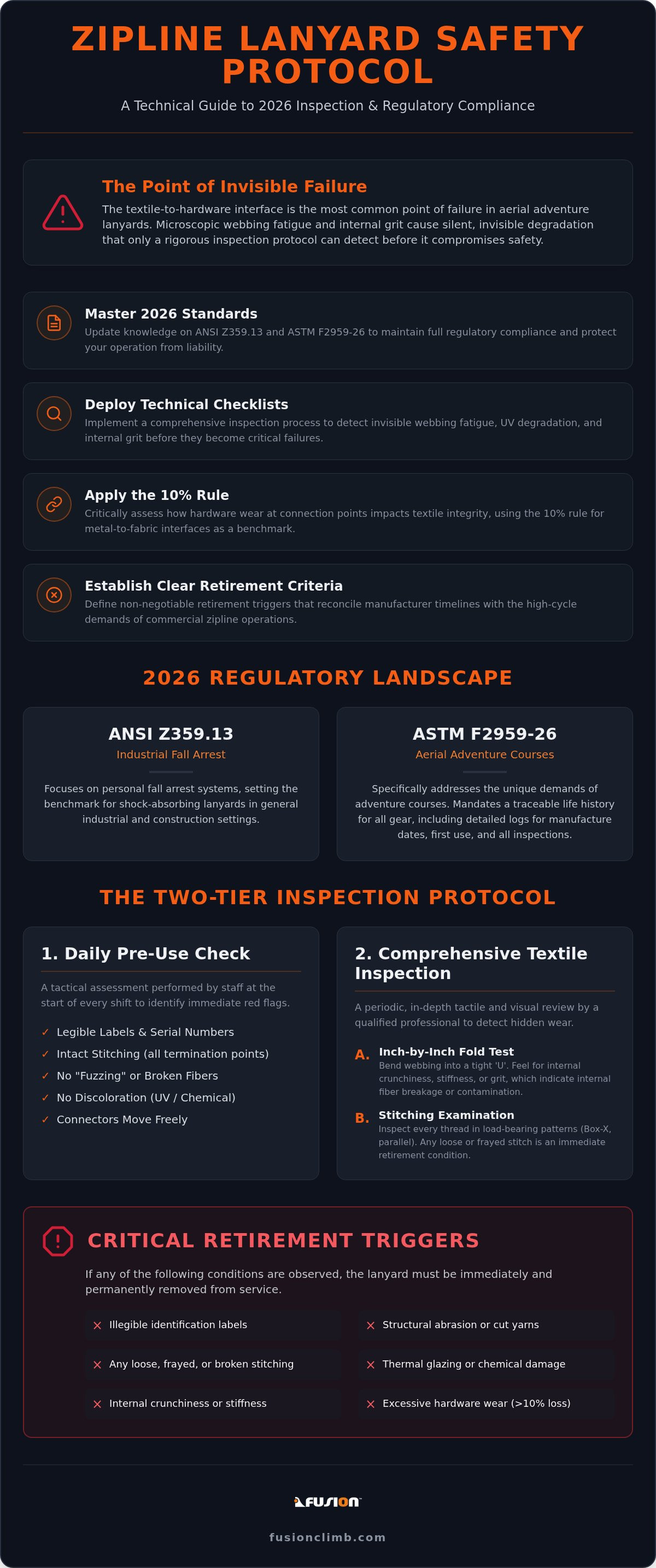
ANSI Z359.13 focuses primarily on personal fall arrest systems, setting the benchmark for shock-absorbing lanyards in industrial settings. However, ASTM F2959-26 specifically addresses the unique demands of aerial adventure courses. It mandates that every piece of gear has a traceable life history from the moment it leaves the manufacturer. Your 2026 documentation must include detailed gear logs that track manufacture dates, first-use dates, and every formal inspection. This level of record-keeping is a core requirement for commercial liability protection and regulatory compliance. You must distinguish between daily pre-use checks and the more intensive periodic inspections conducted by a qualified professional.
The Daily Visual Inspection Protocol
Every shift begins with a tactical assessment. Staff must perform a pre-use check to identify immediate red flags like heavy abrasion, thermal glazing, or chemical staining. A professional zipline lanyard inspection checklist starts with verifying that all labels and serial numbers remain legible. If you can't identify the manufacture date or the model number, the item must be pulled from service immediately. Operators must also ensure the lanyard’s length and material are compatible with the specific line velocity and braking system in use. Common daily check points include:
- Verifying the integrity of the stitching at all termination points.
- Checking for "fuzzing" that indicates broken surface fibers.
- Ensuring no discoloration from UV exposure or chemical contact.
- Confirming that carabiners and connectors move freely within the lanyard eye.
The Comprehensive Zipline Lanyard Inspection Checklist: Textile Integrity
Textile integrity is the backbone of rider safety in any aerial environment. Unlike metal hardware, webbing hides its fatigue within the weave, making it difficult to spot without a methodical approach. A professional zipline lanyard inspection checklist must prioritize a sensory strategy that combines visual acuity with a tactile feel for the material. Professionals often refer to industry-wide Zipline Lanyard Standards to establish a baseline for acceptable wear versus critical failure. In high-volume operations, the transition from used to unsafe can happen rapidly under intense UV exposure, color fading, and constant friction.
Perform the inch-by-inch fold test by bending the webbing into a tight U shape along its entire length. You are looking for internal fiber breakage that isn't visible on the surface. If the webbing feels crunchy or unusually stiff, it likely has internal grit or thermal damage from high-speed friction. Examine the stitching patterns; whether they are Box-X or parallel, every thread must be intact. Any loose or frayed stitch in a load-bearing area is an immediate cause for retirement. This level of scrutiny ensures that your gear meets the rigorous demands of commercial duty cycles.
Evaluating Webbing Wear and Abrasion
Distinguishing between superficial fuzzing and structural abrasion is a critical skill for inspectors. Fuzzing is common in high-cycle environments, but if you don't identify individual broken yarns, you might miss a lanyard that has lost its rated strength. Glazing appears as a shiny, melted surface caused by heat. This usually happens when the lanyard rubs against a cable or another component during a high-velocity run. Chemical contamination from grease or cleaning agents can also weaken synthetic fibers without changing their appearance. If your fleet shows signs of extreme wear, consider upgrading to heavy duty climbing lanyards engineered for industrial reliability.
Shock-Absorbing Pack Integrity
A professional zipline lanyard inspection checklist isn't complete without a deep dive into shock-absorbing pack integrity. If your course utilizes shock-absorbing tethers, the deployment indicator is your primary red flag. Any visible tear-tape or a popped indicator means the unit has seen a fall and must be destroyed immediately. Inspect the protective cover for tears or UV damage that could expose the internal shock-absorbing core to the elements. The internal stitching must remain pristine; any compromise here renders the entire safety system void and puts your riders at risk.
Inspecting Connection Points: Carabiners, Hooks, and Terminations
The interface between synthetic textiles and metal hardware is the most dynamic point in your safety chain. While previous sections focused on the webbing itself, a professional zipline lanyard inspection checklist must scrutinize the connection points where friction and mechanical stress are highest. High-cycle commercial operations often see hardware wear that directly compromises the lanyard eye. If a carabiner develops a "hot spot" or a sharp burr from trolley contact, it can slice through high-tension fibers during a single descent. You must examine the internal radius of the lanyard eye by rotating the connector to check for hidden abrasion or melted fibers caused by metal-on-fabric friction.
Testing gate functionality is a non-negotiable step for every inspection cycle. Modern aerial parks rely on auto-locking or double-locking mechanisms to eliminate human error. Every gate must snap shut and lock instantly without manual assistance. If a gate sticks, hangs, or fails to lock due to grit or spring fatigue, the hardware is retired immediately. You should also look for pitting or oxidation on steel and aluminum components. Surface oxidation is often superficial, but deep pitting on load-bearing surfaces suggests structural compromise that could lead to catastrophic failure under peak loads.
Termination Stitching and Eye-Loop Security
Plastic thimbles and protective sleeves are designed to prevent the connector from rubbing directly against the load-bearing webbing. However, these protectors can sometimes hide damage. You must inspect the plastic for cracks or deformation that might allow the carabiner to shift and cross-load. Check for stitch elongation at these high-load points. If the "Box-X" or parallel stitching appears pulled or the thread is noticeably thinner than when new, the lanyard has likely seen a significant arrest force or has reached the end of its commercial duty cycle. Ensure all connectors are properly captured to prevent dangerous cross-loading scenarios.
Hardware Mechanical Failure Red Flags
Mechanical failure often starts with subtle red flags. Test the gate spring tension to ensure it provides a firm, reliable closure every time. For high-impact snap shackles or specialized connectors, use a high-lumen light to search for hairline fractures, particularly around the hinge and the nose of the gate. These microscopic cracks are early indicators of metal fatigue. For a deeper technical dive into hardware specifications and load ratings, refer to our guide on Professional Climbing Carabiners. Maintaining a rigorous zipline lanyard inspection checklist ensures that these mechanical components remain a dependable guardian for your riders throughout the season.
Critical Retirement Criteria: When to Pull a Lanyard from Service
Deciding to retire a piece of equipment is the most critical step in your safety protocol. While many manufacturers state a maximum service life of ten years, commercial reality often dictates a much shorter timeline. High-volume parks may see lanyards reach their fatigue limit in just one or two seasons. Your zipline lanyard inspection checklist must account for these real-world duty cycles rather than relying solely on a date printed on a label. If the gear looks tired, it's already past its prime. Professional operators prioritize substance over style; they know that a lanyard's integrity is non-negotiable.
Impact loading is an immediate retirement trigger. If a lanyard has arrested a fall or been subjected to a significant dynamic load, it must be pulled from service and destroyed. Chemical exposure is equally dangerous. Common substances like sunscreen, insect repellent, or industrial cleaning agents can silently degrade synthetic fibers without leaving a visible mark. We also apply the 10% Rule for hardware. If 10% of the metal's cross-sectional area has worn away from friction, the textile component it's attached to is no longer considered secure and must be retired immediately. This prevents the "hot spot" failures discussed in previous sections.
Environmental Factors in Gear Aging
High-humidity and salt-air environments are brutal on synthetic gear. Salt crystals act as internal abrasives within the webbing weave, cutting fibers from the inside out during every use cycle. UV degradation remains the silent killer of zipline soft goods. If you notice significant color fading or a change in the "hand" of the webbing, the structural integrity is likely compromised. Extreme temperature fluctuations also stress the polymers in the webbing, leading to premature brittleness. You must adjust your retirement timelines based on your specific geographic climate to maintain a sobering sense of security.
Documenting the Retirement Process
Maintaining a "Birth-to-Death" gear log is a 2026 regulatory necessity. Every lanyard needs a unique serial number tracked from its first day in the field. When an item fails the zipline lanyard inspection checklist, follow a strict tag-out procedure. Don't just toss retired gear in a bin where a staff member might accidentally grab it for a rescue or a new line. Standardize a destruction protocol. Cut the webbing into small pieces and remove the hardware to ensure it never finds its way back into your active fleet. When your fleet reaches its retirement limit, invest in commercial-grade zipline lanyards and tethers designed for the rigors of industrial use.
Professional Maintenance and Fleet Management
Professional gear management extends far beyond the moment you pull a lanyard from the shelf. While a zipline lanyard inspection checklist identifies existing damage, a disciplined maintenance routine prevents premature failure. Start with cleaning. Use only mild soap and lukewarm water to remove sweat, grit, and surface contaminants. Avoid industrial degreasers or harsh chemicals; these can strip the protective coatings from hardware or weaken synthetic fibers. For high-volume courses, implementing an RFID-based tracking system is no longer a luxury. It's a 2026 necessity for managing large fleets with precision and ensuring no item misses its scheduled review.
Storage is where many operators fail. Never allow your gear to sit in a gear pile where moisture can become trapped between layers of webbing. Store lanyards in a cool, dry, and well-ventilated area away from direct sunlight. UV exposure during storage is a silent thief of equipment life. When your current inventory shows signs of systemic wear, it's time to upgrade. Transitioning to Zipline Lanyards & Tethers designed for 2026 standards ensures your operation remains at the forefront of industrial-grade reliability and regulatory compliance.
Cleaning and Drying Procedures
Air-drying is non-negotiable. Hang your lanyards in a ventilated space away from direct heat sources like heaters or blow-dryers, which can cause fibers to become brittle. Never use high-pressure washers on webbing. The force of the water can drive grit deeper into the weave or physically separate the yarns, compromising the rated strength. For hardware connection points, use only manufacturer-approved dry lubricants. Wet lubricants tend to attract the very dust and sand that cause the internal abrasion issues discussed in earlier sections, leading to accelerated wear on the lanyard eyes.
Building a Safety-First Inspection Culture
A professional zipline lanyard inspection checklist is only effective if your staff feels empowered to use it. Train your team to prioritize safety over throughput. If a guide feels a crunchy spot in a lanyard during a busy Saturday, they must have the authority to pull that gear immediately without fear of slowing down the operation. Supplement your internal checks with annual third-party professional audits to catch the subtle trends your daily staff might miss. For a holistic view of site safety, reference our Ropes Course Safety Equipment Guide. This approach turns safety from a chore into a core value of your brand.
Securing the Future of Your Aerial Operation
Maintaining a professional safety program requires more than a passing glance at your equipment. By implementing a standardized zipline lanyard inspection checklist, you ensure every textile-to-hardware interface meets the rigorous demands of 2026 regulatory standards. You've mastered how to identify invisible webbing fatigue and when to apply the 10% rule for hardware retirement. These technical protocols act as a dependable guardian for your riders and your business reputation. Precision in the gear room translates directly to confidence on the line.
Substance always beats style in high-stakes vertical environments. It's time to move beyond generic safety checks and adopt industrial-grade reliability for your entire fleet. Our equipment features ANSI Z359.13 compliant hardware and is engineered for high-volume commercial use. When you prioritize tactical-grade durability, you provide a sobering sense of security that allows your guests to push their limits with absolute peace of mind. Your commitment to these protocols defines the standard of excellence for the entire industry.
Shop Industrial-Grade Zipline Lanyards and Tethers to upgrade your course with gear built for the long haul. Stay vigilant, keep your logs precise, and lead the way in aerial adventure safety.
Frequently Asked Questions
How often should zipline lanyards be inspected in a commercial park?
Commercial parks must follow a three-tier schedule. Staff perform daily visual and tactile checks before the first rider. Monthly in-depth reviews involve documenting the condition of every serial number. Finally, an annual audit by a qualified third-party professional is required for regulatory compliance. This rigorous approach ensures your zipline lanyard inspection checklist remains current and protects your operation from liability during high-volume seasons.
Can I use a climbing lanyard for a commercial zipline course?
You shouldn't substitute standard recreational climbing gear for commercial applications. Industrial-grade lanyards are engineered for the high-cycle duty and extreme friction typical of zipline environments. Recreational gear often lacks the durability and specific certifications, such as ANSI Z359.13 or ASTM F2959-26, required for commercial park insurance and safety standards. Always select heavy-duty climbing lanyards designed specifically for professional aerial adventure courses to ensure rider security.
What is the maximum lifespan of a synthetic zipline tether?
Most manufacturers state a maximum shelf life of ten years from the date of manufacture. However, the real-world service life in a high-volume commercial setting is often much shorter, typically one to five years. Factors like UV exposure, grit penetration, and high-frequency use cycles dictate the actual retirement date. Your zipline lanyard inspection checklist should prioritize the physical condition of the webbing over the age listed on the product label.
How do I know if a lanyard has been subjected to a fall or impact?
Look for a popped deployment indicator on shock-absorbing models. For standard tethers, inspect the load-bearing stitching for elongation or broken threads. If the webbing feels unusually stiff or crunchy in specific sections, it may have undergone internal fiber stress from a dynamic load. Any lanyard suspected of arresting a fall must be removed from service immediately and destroyed to prevent accidental reuse in your safety chain.
Is it safe to clean zipline webbing with a pressure washer?
Never use a pressure washer on synthetic webbing or tethers. The concentrated force of the water drives abrasive grit deeper into the weave and can physically separate the load-bearing yarns. This leads to internal fiber damage that isn't visible on the surface. Instead, wash the gear by hand using lukewarm water and a mild soap, then allow it to air-dry naturally away from direct sunlight or heat.
What should I do if the serial number on my lanyard is no longer legible?
Retire the lanyard immediately if the serial number or manufacture date is no longer legible. Traceability is a non-negotiable requirement for 2026 safety standards and insurance compliance. Without a clear ID, you can't verify the item's age or its history in your gear log. Professional operators maintain a strict policy of "if you can't identify it, you can't use it" to ensure a sobering sense of security for every rider.
Can UV damage occur even if the lanyard looks new?
Yes, UV radiation weakens the synthetic polymers of the webbing even if the surface appears relatively clean. While significant color fading is a primary indicator of sun damage, the loss of tensile strength can begin before the visual changes are extreme. If gear is stored outdoors or used in high-altitude environments with intense solar exposure, you must adjust your retirement timeline to account for this invisible silent killer of soft goods.
Does a lanyard need to be retired if only the carabiner is damaged?
You must retire the entire assembly if the carabiner is permanently integrated into the lanyard eye. If the hardware shows signs of pitting, gate failure, or wear exceeding the 10% rule, the friction has likely already damaged the internal fibers of the textile loop. In cases where connectors are removable, you may replace the hardware, provided the webbing passes every step of your professional-grade inspection protocol without showing signs of thermal glazing.