



Rope Rescue Full Body Harness: Professional Buying Guide
What if the harness that fits one job isn’t appropriate for your rescue system? Choosing a full body harness for rope rescue operations takes more than comparing labels or features. The harness must suit the task, fit the people who will wear it, and connect as intended with the rest of the equipment.
That’s a practical concern for any team: poor fit, uncertain compatibility, or missing documentation can undermine an otherwise careful equipment decision. A harness alone doesn’t make a rescue system safe, and a product description shouldn’t replace model-specific instructions or qualified judgment.
This guide offers a selection checklist for assessing fit and adjustment, intended use, connection compatibility, inspection, replacement planning, manufacturer documentation, and applicable standards. It also explains which questions to take to the manufacturer, a qualified professional, or current standards documentation before purchase.
Key Takeaways
- Start with the rescue task and complete system, not a feature list or general-purpose label.
- Assess adjustment and movement during manufacturer-guided wearer trials, using the clothing expected in service.
- Compare harnesses using documented intended use, connection interfaces, and maintenance requirements.
- Use a selection checklist for a full body harness for rope rescue operations, and route unresolved questions to the manufacturer, a qualified professional, or current standards documentation.
- Ask Fusion Climb for model-specific intended-use information and applicable documentation before considering a harness for rescue use.
What makes a full body harness suitable for rope rescue operations?
A rescue harness is one component of a planned personal protective and rope rescue system, not a stand-alone solution. Suitability depends on the task, the wearer, the system design, and the instructions and documentation for the specific model. A harness described as full body equipment isn’t automatically appropriate for every rescue configuration.
Define the application before comparing products. General climbing, work positioning, fall arrest, and rope rescue can place different demands on equipment. A harness intended for one application may not be documented for another, especially when the system requires specific connection interfaces or supports a wearer in a different position. A broad overview of safety harness types can provide context, but the manufacturer’s model-specific documentation should guide product evaluation.
A harness is one part of a complete system. Its suitability depends on the task, the wearer, compatible equipment, and documented intended use.
Which tasks and operating conditions should the harness support?
Describe the work before shopping by features. List expected work positions, access methods, and rescue scenarios, then consider what the wearer must do while connected. Account for duration, movement, clothing layers, and environmental conditions that could affect fit or access to connection points.
Separate routine duties from exceptional scenarios. If a less common rescue situation requires a different configuration or equipment, review that use separately. Don’t assume a harness selected for routine work will cover it. This task list gives the team and manufacturer a specific basis for checking the model’s intended use.
What does the harness not do on its own?
A harness cannot establish the performance of the entire system. Ropes, connectors, anchors, devices, and operating procedures all contribute, and their interaction must be assessed as part of the planned system. Product-category labels alone don’t confirm that a particular model suits a specific rescue task.
For each candidate, check the manufacturer’s documentation for stated applications, limitations, and compatible interfaces. If the intended use or connection details aren’t clear, ask the manufacturer or a qualified professional before purchase. This guide supports product evaluation, not rescue training or procedural instruction. Teams should rely on qualified expertise and applicable current documentation for operational decisions.
Which full body harness features matter for rope rescue selection?
Evaluate features against the planned task and system, not in isolation. A full body harness for rope rescue operations should fit its intended wearer, allow the movement the task requires, and have interfaces supported by the manufacturer’s documentation. A feature checklist can organize a review, but it cannot establish certification or prove that a model is suitable for a particular rescue application.
How should teams assess fit and adjustability?
Have representative wearers try each candidate according to the manufacturer’s instructions. Check the adjustment range over the clothing layers expected in service, then assess whether the harness stays correctly positioned and adjustments remain secure during task-relevant movement. A fit that feels acceptable while standing still may not remain suitable through the team’s expected range of motion. Use the manufacturer’s fitting guidance as the reference, and record concerns for review before acceptance.
How should attachment points and connectors be evaluated?
First identify the connections required by the planned system. Then compare them with the specific harness instructions. Don’t infer an attachment point’s function or intended loading from its position or appearance. Have a qualified system reviewer assess connector compatibility, orientation, and loading in the planned configuration. OSHA’s fall-protection rule includes a prompt-rescue requirement for employees after a fall. Consult OSHA requirements and confirm which provisions apply to the workplace and task.
Which standards and documents should buyers verify?
Check whether ANSI/ASSP Z359.11, OSHA requirements, or NFPA 2500 apply to the intended use, and confirm each document’s current edition and scope. These references address different aspects of equipment and operations, so a citation isn’t a substitute for the model’s instructions. Ask the manufacturer for the exact model’s intended-use statement, user instructions, applicable declarations, available test records, limitations, and traceability details.
A standard reference is not proof that a specific harness suits your rescue task. Confirm the model, use, and system compatibility in current documentation. Take unanswered questions to the manufacturer or a qualified professional. For fit and connector evaluation, use relevant published guidance alongside the harness and connector manufacturers’ instructions.
Fusion Climb offers full body harnesses and connectors, but the available product information doesn’t confirm a specific model for rope rescue. If you’re reviewing its full body harness options, request model-specific intended-use information and applicable documentation before selecting a harness.
How do rescue harness options compare for a team's actual system?
Compare specific models using their manufacturer documentation, not labels such as “rescue” or “full body.” Consider a full body harness for rope rescue operations only against the team’s tasks, existing equipment, wearer needs, and inspection process. If the documentation doesn’t support a like-for-like comparison, record the gap instead of assuming similarly described harnesses serve the same purpose.
How does a rescue-focused evaluation differ from a category comparison?
A category comparison describes types of equipment. A rescue-focused review asks whether a particular model’s documented capabilities align with operational requirements and the complete system. Consider what the team already uses, how equipment is inspected and tracked, and whether the harness’s stated interfaces match the planned configuration. General equipment-system guidance can provide context, but it can’t replace model-specific instructions or a qualified system review.
Use a table to compare candidates consistently. Enter manufacturer-documented facts, and mark anything unconfirmed as a question rather than an assumption.
| Comparison area | Record for each candidate |
|---|---|
| Intended use | Exact tasks and limitations stated in the model documentation |
| Fit range | Documented sizing and fit details; confirm with representative wearers |
| Adjustments | Adjustment instructions and any relevant limits |
| Interfaces | Documented attachment points, connection instructions, and restrictions |
| Maintenance | Inspection guidance, care instructions, and traceability information |
Standards references also need careful review. NFPA’s NFPA 1983 standards page can help orient a review. Verify current editions, scope, and applicable documents, including whether NFPA 2500 applies to the intended use. A reference on a label or product page doesn’t answer every model-specific question.
What should teams ask before approving a harness?
Before procurement, ask the manufacturer which tasks the exact model is intended for, how its connections must be used, what restrictions apply, and what inspection and maintenance guidance governs it. Confirm whether accessories under consideration are identified as compatible. Compare the answers with the system design through qualified reviewers.
- Mark each comparison item as documented, verified, or unresolved.
- Record who must answer each open technical question.
- Hold approval until relevant questions are resolved using manufacturer documentation or other qualified sources.
Don’t rank harness styles as universally best. Select a model only when its documented capabilities align with the team’s requirements, and keep the supporting evidence with the procurement record.
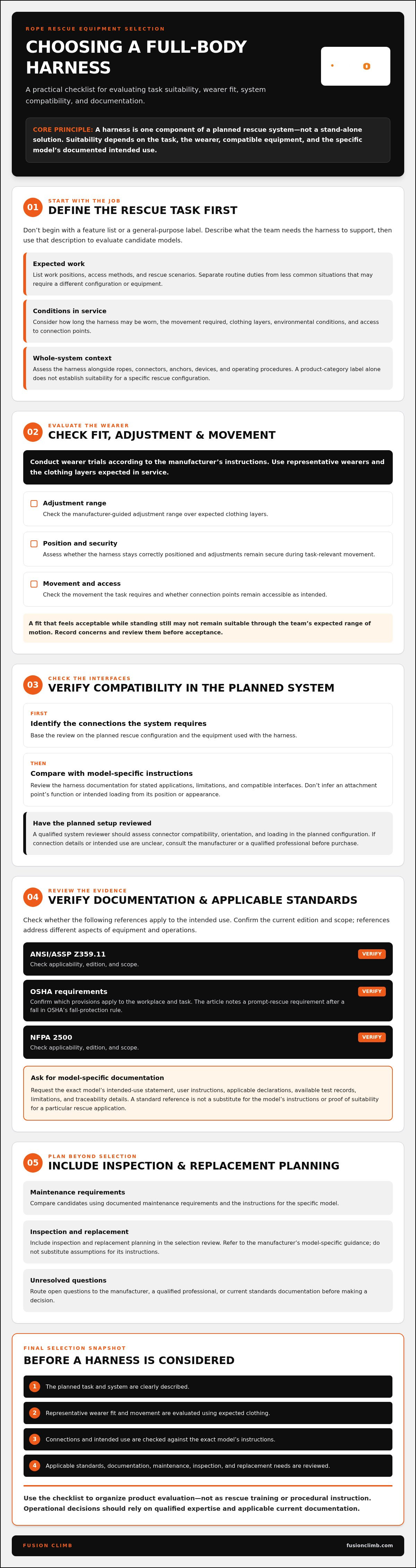
How can a team evaluate fit, compatibility, and readiness before buying?
Turn the selection criteria into a documented approval process. A full body harness for rope rescue operations should move forward only when the team can verify intended use, wearer fit, system compatibility, and ongoing management requirements. Keep the evidence with the purchasing decision so the choice can be reviewed later.
What should a pre-purchase checklist include?
Use this workflow to move from operational needs to a documented decision:
- 1. Define the task. Record expected duties, access methods, rescue scenarios, work positions, environmental conditions, and clothing requirements.
- 2. Identify users and equipment. Note who needs to wear the harness and document the ropes, connectors, devices, and other equipment in the planned system.
- 3. Record candidate details. Capture each exact model identifier and collect its current instructions, intended-use information, applicable declarations, and available test documentation.
- 4. Review fit and interfaces. Arrange representative wearer trials under the manufacturer’s guidance. Have qualified reviewers assess compatibility with the planned system and resolve questions about connections or applicable standards.
- 5. Approve with evidence. Record what has been verified, any limitations, the reviewers involved, and why the candidate meets the team’s documented requirements. Keep unresolved questions open until an appropriate source answers them.
How should teams plan acceptance and ongoing inspection?
Procurement doesn’t end at approval. Before accepting equipment, confirm that the team can follow the manufacturer’s instructions for inspection, care, and storage, and that those requirements fit its equipment-management process. Define how records will identify each item and capture relevant inspection or maintenance information.
Base retirement decisions on manufacturer instructions and team policy. If equipment is damaged, its history is unclear, or its condition raises concern, remove it from service under the team’s process while a qualified person determines the next step. Plan for the harness alongside the rest of the equipment and its records, not as a standalone purchase.
Fusion Climb manufactures full body harnesses and related equipment, but the available product information doesn’t confirm a specific model for rope rescue use. Request model-specific documentation from Fusion Climb to verify intended use and applicable information before your team approves a candidate.
How can Fusion Climb support a documented harness selection?
Fusion Climb manufactures full body harnesses and related climbing and safety equipment, including connectors. These product categories don’t establish that a particular model is intended or approved for rope rescue. Treat manufacturer information as evidence to verify, not as a substitute for matching the exact harness to your team’s requirements.
For a full body harness for rope rescue operations, keep the review model-specific. Ask about the precise candidate, identify the intended tasks, and request documentation that lets technical reviewers assess fit, connections, limitations, and applicable standards. Save the responses with product records so the basis for selection is clear.
What information should buyers request from the manufacturer?
Ask for the current user instructions and intended-use statement for the exact model, along with applicable standards information, stated limitations, and available test documentation. Request model-specific guidance on fit range and adjustment, plus written information about compatible connection hardware and any restrictions on its use. If a response refers generally to a product category, follow up for details tied to the exact model and its documentation.
- What tasks does the manufacturer identify for this model, and what uses are excluded?
- Which instructions cover fitting, adjustment, inspection, care, storage, and retirement?
- What connection hardware is documented as compatible, and under what conditions?
- Which standards or test records apply to this model, and what are their scope and limitations?
Keep answers in writing where possible. If information is unavailable or unclear, mark it as unresolved rather than treating silence as confirmation.
When is it time to contact Fusion Climb?
Contact the manufacturer when model documentation doesn’t clearly address intended use, adjustment, interfaces, or another point required by your selection process. Describe the operational requirements and equipment interfaces you need to assess, but don’t treat them as proof that a product is suitable. Ask for clarification that you can share with the team’s qualified reviewers.
Manufacturer replies can help verify product facts. They don’t replace a qualified review of the complete system or a check against current standards and applicable requirements. Keep those responsibilities distinct, and hold approval until relevant questions are answered.
Next step: Ask Fusion Climb for model-specific documentation, then compare the confirmed product information with your team’s recorded requirements before approving a harness for operational use.
Move Forward With a Documented Harness Decision
Choose based on evidence, not a broad product label. A full body harness for rope rescue operations must match the team’s documented task and complete system. Review model-specific intended use, fit, connection compatibility, and manufacturer instructions before approval. Include inspection and replacement planning so the equipment can be managed throughout its service life.
Fusion Climb offers full body harnesses and connectors, but the available product information doesn’t confirm that a specific model is designed or approved for rope rescue. Verify the exact model’s documentation and consult qualified reviewers on system-level questions.
Prepare a clear list of operational requirements and open questions, then contact Fusion Climb to discuss full body harness options and model-specific documentation. Compare the confirmed product information with your team’s requirements before making a decision.
Frequently Asked Questions
Can any full body climbing harness be used for rope rescue?
No. A harness marketed for climbing or described as full body isn’t automatically appropriate for every rescue task. Verify the exact model’s instructions, intended use, connection requirements, and applicable standards. Then have a qualified reviewer assess it alongside the ropes, connectors, anchors, devices, and procedures in the planned system. If the documentation doesn’t address your task or configuration, seek clarification before approving the harness.
Which standards should I check when buying a rope rescue harness?
Ask which standards and requirements apply to the exact model and intended task, then verify their current edition and scope in authoritative documentation. ANSI/ASSP Z359.11, OSHA requirements, and NFPA 2500 may be relevant in some contexts, but they aren’t interchangeable labels. Don’t infer compliance from a product category page. Review model-specific instructions and supporting documents, and ask the manufacturer or a qualified professional to clarify uncertainties.
How do I know whether a rescue harness fits correctly?
Follow the manufacturer’s fitting and adjustment instructions, and assess each intended wearer in representative clothing and equipment. Check that the harness can be adjusted as directed, remains correctly positioned during expected movement, and doesn’t interfere with task-related mobility. A fit assessment should reflect the planned use, not just a brief standing check. If fit or adjustment remains uncertain, consult the manufacturer and qualified safety personnel before approval.
What should a rope rescue harness be compatible with?
Compatibility depends on the harness instructions and complete system design. Check how the model is documented to connect with the planned ropes, connectors, devices, and other equipment, including restrictions on attachment points or loading. Components that physically connect aren’t necessarily compatible for a given use. Have a qualified reviewer assess the configuration and resolve questions against current manufacturer documentation before approving the equipment.
How often should a rope rescue harness be inspected or retired?
Follow the manufacturer’s inspection, care, storage, and retirement instructions, together with applicable organizational requirements. Don’t substitute a generic schedule for model-specific guidance: inspection and retirement decisions can depend on use, condition, exposure, and documented criteria. Keep equipment records, and remove a harness from service if its condition or history is uncertain. Refer unresolved questions to the manufacturer or a qualified person before returning equipment to use.
Does Fusion Climb offer a harness specifically for rope rescue?
Fusion Climb manufactures full body harnesses, but the available product information doesn’t confirm that a particular model is specifically intended or approved for rope rescue. Ask for the exact model’s intended-use information and supporting documentation, including applicable instructions and limitations. Then have qualified personnel assess that evidence against your team’s tasks and complete system. Don’t treat a product-category listing or general company information as model-specific confirmation.