


Professional Climbing Hardware: The Industrial Standard for Safety & Performance
Most commercial operators realize too late that a carabiner's peak break strength is the least important number on its spec sheet. When your business relies on vertical movement, the real metric of success is how that gear performs on its ten-thousandth cycle, not its first. Investing in professional climbing hardware isn't just about preventing a single catastrophic failure. It's about maintaining operational integrity under the relentless stress of a high-volume season. Reliability is the silent partner in every successful ascent.
You've likely felt the frustration of retiring gear months ahead of schedule or second-guessing whether your current setup meets the latest ANSI Z359.11 standards. We understand that in the world of commercial ziplines and climbing gyms, confusion over certification isn't just a headache; it's a risk to your reputation and your staff. This article will help you master the technical standards and engineering requirements that define industrial-grade equipment. We'll break down the differences between recreational and professional-grade hardware, providing a clear path to 100% safety compliance and long-term durability. We'll examine the specific manufacturing benchmarks that ensure your equipment survives the rigors of the professional environment while establishing a dependable foundation for your daily operations.
Key Takeaways
- Identify the technical standards that separate professional climbing hardware from recreational gear, ensuring your facility meets rigorous ANSI and CE requirements.
- Explore the engineering behind high-performance alloys and heat-treatment processes that provide the industrial durability needed for high-volume commercial use.
- Learn to select specialized equipment like Superman style harnesses and industrial pulleys that optimize both safety and the user experience.
- Implement a structured inspection and maintenance schedule to reduce gear retirement frequency and maintain a safe operational environment.
- Understand how American-engineered safety equipment provides a reliable foundation for long-term commercial success and risk management.
Defining Professional Climbing Hardware: Standards and Certifications
Professional climbing hardware is more than a marketing label. It's a specific technical classification for equipment engineered to withstand the relentless demands of commercial, industrial, and rescue operations. Unlike gear found at a local retail store, professional-grade tools are designed for high-cycle environments where failure isn't just an inconvenience; it's a liability. Every piece of equipment must carry a pedigree of traceability. Manufacturers perform rigorous batch testing to ensure that the carabiner or pulley in your hand meets the exact specifications of the original design. This accountability ensures that safety is a measurable metric, not a vague promise.
The Role of ANSI and CE Standards
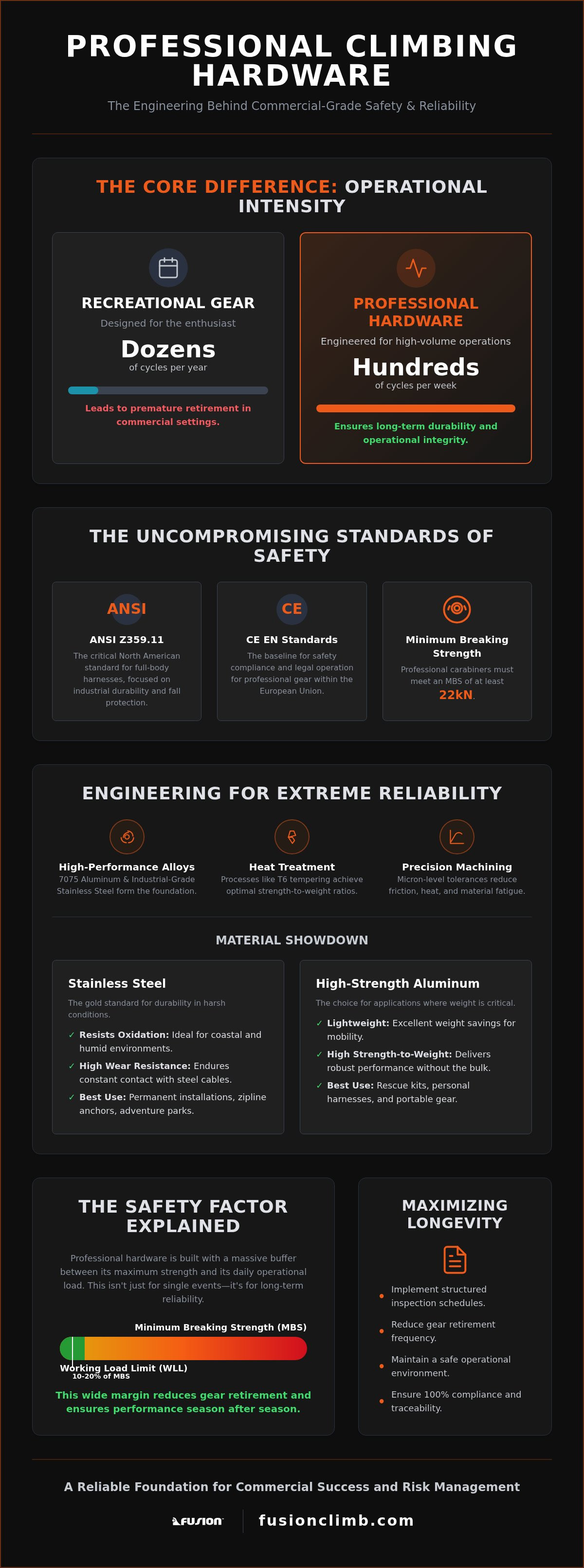
Technical compliance provides the baseline for safety in vertical environments. For commercial operators, ANSI Z359.11 is the critical standard for full body harnesses. It dictates the requirements for fall protection, including specific harness attachment points and weight capacities. While European operators look to CE EN standards, North American professionals often prioritize ANSI for its focus on industrial durability. Understanding these Climbing Equipment Standards helps managers navigate the complex landscape of legal and operational compliance. Professional carabiners must maintain a Minimum Breaking Strength (MBS) of at least 22kN to meet industrial safety requirements.
Commercial vs. Recreational: The Cycle Count Difference
The primary differentiator between these two worlds is the cycle count. Recreational gear is built for the weekend enthusiast who might use a harness a few dozen times a year. In a high-volume zipline park or climbing gym, that same gear might experience hundreds of cycles in a single week. This high-frequency usage accelerates wear and tear, leading to premature retirement of recreational equipment. Environmental factors like UV exposure and grit also degrade gear faster in commercial settings. Defining professional climbing hardware requires an understanding of these operational realities.
Professional hardware bridges this gap with a superior safety factor. This is the ratio between the Minimum Breaking Strength and the Working Load Limit (WLL). By maintaining a wide margin between the load a piece of gear can theoretically hold and the load it actually carries, professionals ensure long-term performance. This engineering philosophy reduces gear retirement frequency and keeps your staff and customers secure. It's the difference between equipment that simply meets a test and equipment that survives the season.
Engineering for Reliability: Materials and Manufacturing Processes
Reliability begins at the molecular level. In the production of professional climbing hardware, manufacturers utilize high-performance alloys like 7075 aluminum and industrial-grade stainless steel. These aren't standard metals. They undergo rigorous heat treatment processes, such as T6 tempering, to achieve the optimal strength-to-weight ratios required for vertical operations. Precision machining then transforms these alloys into functional tools. For zipline pulleys, this means tolerances measured in microns. Smooth operation isn't just about comfort. It's about reducing friction that leads to heat buildup and eventual material fatigue.
Steel vs. Aluminum in Commercial Hardware
Choosing the right material depends entirely on your environment and application. Stainless steel is the gold standard for permanent installations and coastal adventure parks. Its natural resistance to oxidation ensures that hardware remains functional despite constant exposure to salt air and moisture. Conversely, high-strength aluminum is preferred for rescue kits and personal gear where mobility is paramount. While aluminum offers excellent weight savings, it has a lower wear resistance compared to steel when used against steel cables. Professionals often consult OSHA Fall Protection Standards to ensure their material choices align with site-specific safety requirements. For those managing high-volume courses, a mix of both materials is often the most efficient strategy.
Advanced Pulley Engineering for Zipline Operations
In a commercial zipline setting, the pulley is the workhorse of the system. The internal mechanics determine how long that workhorse stays in service. Sealed ball bearings are the industry preference for high-speed applications because they reduce rolling resistance and protect the internal components from grit and debris. Bushings are often relegated to lower-speed or static rigging tasks. Dual-track designs provide a stable platform on the cable, preventing the wobble that can cause uneven wear on both the pulley and the line. The geometry of the pulley side-plates is engineered to encapsulate the cable, preventing friction against the housing and minimizing lateral cable wear during high-speed traverses. When selecting zipline pulleys for your operation, prioritize designs that feature these precision-machined side-plates and high-efficiency bearings.
To further enhance longevity, professional climbing hardware receives specialized corrosion-resistant coatings. Hard-coat anodizing on aluminum components creates a protective layer that resists scratches and chemical degradation. For steel components, zinc plating or passivating provides a barrier against the elements. These finishing processes ensure that the gear doesn't just pass an initial test but remains a dependable guardian throughout its service life. Every decision in the manufacturing process, from alloy selection to the final coating, is a commitment to the user's safety in high-stakes environments.
Choosing Hardware for High-Stakes Aerial Environments
Selecting the right equipment requires a deep understanding of your specific operational environment. It's not enough to simply buy high-rated gear; you must match hardware specifications to the unique stresses of your site. Professional climbing hardware serves as the foundation for this safety culture. Whether you're managing a high-volume zipline or a technical rescue team, your choices dictate the margin of safety. Adhering to UIAA Safety Standards ensures that every component has been tested against rigorous international benchmarks. This systematic approach eliminates guesswork and builds trust with both staff and participants.
Security in professional settings often relies on removing human error from the equation. This is why auto-locking mechanisms are a necessity for professional carabiners. Manual screw-gates are prone to being left open or vibrating loose under constant use. Auto-locking gates ensure the system is secure the moment it's clipped. When building your fleet, sourcing high-quality carabiners and harnesses is the first step toward long-term operational success. Integrating these components with lanyards and tethers creates a cohesive fall arrest system that protects users without hindering their movement.
Zipline and Ropes Course Safety Equipment
Harness design is a primary factor in both safety and user experience. In commercial settings, gear must accommodate diverse participant demographics without compromising security. Full body harnesses are the standard for general use because they provide superior orientation during a fall. For specialized attractions, Superman style harnesses offer a prone flight experience that transforms a standard zipline into an aerial adventure. These designs distribute pressure across the torso, ensuring comfort during longer durations of suspension. Pair these with zipline pulleys featuring integrated handles to provide users with a stable, controlled grip throughout the ride.
Rescue and Industrial Fall Protection
Industrial and rescue operations demand a different level of ruggedness. Work-at-height safety often involves tower climbing or structural maintenance where gear exposure to abrasive surfaces is constant. Heavy-duty rigging carabiners are essential here. They must feature robust gates and high gate-open strengths to handle unpredictable loading scenarios. Ensure your tethers and shock absorbers are fully compatible with your anchor points. A mismatched system can lead to increased impact forces during a fall arrest event. Safety depends on every link in the chain performing as a single, cohesive unit. Prioritize equipment that offers clear labeling and easy inspection points to simplify your daily safety checks.
Maximizing Longevity: Inspection and Maintenance Protocols
Safety is a continuous commitment. Once you've invested in professional climbing hardware, your focus must shift to preservation and rigorous oversight. A reactive approach to maintenance is a liability your operation can't afford. Establishing a tiered inspection schedule is the only way to ensure your gear remains a dependable guardian. Daily visual checks by staff, monthly deep dives by equipment managers, and annual third-party audits create a comprehensive safety net. Logging every incident and usage cycle provides the data needed to predict gear failure before it happens. Documentation is your best defense against both mechanical failure and legal scrutiny.
Proper care extends the life of your investment. Clean your equipment with mild soap and water to remove grit that acts as an abrasive on moving parts. For zipline pulleys, maintain the sealed bearings by keeping the housing free of debris. Lubricate gate hinges and pulley axles only with manufacturer-approved dry lubricants to avoid attracting dirt. Storage is equally critical. Keep harnesses and tethers in a cool, dry, and dark environment. UV radiation and chemical fumes from cleaning supplies or vehicle exhaust can silently degrade textile fibers, compromising their structural integrity. Never store wet gear; allow it to air dry away from direct heat sources.
Developing a Rigorous Inspection Checklist
Precision is paramount during inspections. Use a high-lumen light to scan metal surfaces for hairline fractures or unusual patterns of wear. Pay close attention to high-friction areas on carabiners where the rope or cable makes contact. For textile components, look for "fuzziness" or discoloration that signals UV damage or chemical exposure. Verify that carabiner gates snap shut instantly and lock without hesitation. If a gate sticks or feels sluggish, it's a sign of internal contamination or mechanical fatigue. Any deviation from "like-new" functionality is a red flag.
Retirement Criteria for Life-Critical Hardware
Every piece of gear has an expiration date. For textile-based equipment like full body harnesses, distinguish between "shelf life" (time spent in storage) and "active life" (time spent in use). Most manufacturers recommend a maximum service life of ten years for textiles, though high-volume commercial use often shortens this to two or three years. For hardware, listen to your equipment. A pulley that emits a grinding noise or exhibits side-plate deformation must be removed from service immediately. Any piece of gear involved in a major fall event must be retired and destroyed instantly, regardless of its outward appearance.
Maintain your operational readiness by sourcing professional climbing hardware that stands up to daily scrutiny and rigorous industrial use. High-quality gear makes the inspection process more predictable and ensures your facility remains a leader in safety standards.
Fusion Climb: Your Partner in Professional Safety
Safety is the silent foundation of every vertical operation. Since 1998, Fusion Climb has dedicated itself to the meticulous manufacturing of American-engineered safety equipment. We understand the high-stakes nature of commercial aerial adventure and industrial work. Our commitment to manufacturing excellence ensures that every piece of professional climbing hardware leaving our facility is built for substance, not just style. We act as a dependable guardian for your staff and customers, providing gear that survives the rigors of high-cycle environments. Reliability isn't a feature; it's a requirement.
Specialized Hardware for Every Aerial Challenge
Every course presents unique obstacles. Our product line addresses these challenges with precision-engineered solutions that balance ergonomic comfort with industrial strength. Fusion Climb pulleys utilize high-efficiency sealed ball bearings to minimize friction and heat, while our carabiners feature robust auto-locking mechanisms for maximum security. We specialize in unique Superman style harnesses that provide participants with a stable, prone flight experience without sacrificing safety. Our full body harnesses are designed for diverse demographics, ensuring a secure fit and proper orientation during any fall event. This focus on durability reduces your gear retirement frequency and maintains a high standard of performance throughout the season.
Bulk Solutions and Professional Support
Managing a national operation requires a reliable supply chain. National operators and safety managers choose Fusion Climb for fleet-wide gear updates because we provide the consistency and traceability required for modern safety standards. For those looking to expand their commercial footprint, The Federal Group provides the property development finance and private equity expertise needed for large-scale facility growth. We support your safety goals by manufacturing ANSI-compliant gear, including harnesses that meet rigorous ANSI Z359.11 requirements. Whether you're replacing a dozen zipline harnesses or outfitting a new ropes course with lanyards and tethers, we provide the industrial reliability your business demands. Our team understands the sobriety of technical specifications and the importance of real-world testing. We're here to help you establish a relationship with a manufacturer that values product integrity above all else.
Explore our full catalog of professional climbing hardware at Fusion Climb to find the dependable solutions your commercial operation needs to thrive.
Elevate Your Operational Standards
Mastering the technical requirements of professional climbing hardware is a necessity for any commercial operation. You now understand that safety isn't just about peak break strength; it's about cycle counts, precision materials, and uncompromising standards like ANSI Z359.11. By implementing rigorous daily inspections and choosing gear engineered for industrial use, you protect both your participants and your professional reputation. Every component in your system represents a link in a life-critical chain. High-quality hardware provides the technical assurance needed to push physical limits with absolute confidence.
Fusion Climb has been a trusted silent partner for commercial zipline operators nationwide since 1998. We specialize in American-engineered, ANSI-compliant harnesses and pulleys designed to withstand the most demanding aerial environments. Don't settle for recreational gear when lives and livelihoods are on the line. Equip your operation with professional-grade hardware from Fusion Climb. Your commitment to safety starts with the equipment you trust. Take the next step toward 100% compliance and industrial durability today.
Frequently Asked Questions
What is the difference between ANSI Z359.11 and recreational climbing standards?
ANSI Z359.11 is a technical standard for full body harnesses used in industrial fall protection, requiring specific attachment points and rigorous testing. Recreational standards like UIAA 105 focus on sport climbing where usage cycles are lower. Industrial certification requires more rigorous testing for static strength and dynamic drops. Choosing ANSI-compliant equipment ensures your operation meets the highest legal and safety benchmarks for work-at-height environments.
How often should commercial zipline pulleys be inspected?
You must perform visual inspections on commercial zipline pulleys before every use to check for debris or damage. A more thorough, documented inspection should occur monthly to evaluate bearing smoothness and side-plate wear. High-volume operations often increase this frequency to weekly checks during peak seasons. Annual audits by a qualified professional are necessary to maintain traceability and ensure the equipment still meets its original performance specifications.
Can I use aluminum carabiners for heavy-duty rigging applications?
You can use high-strength aluminum carabiners for rigging if their Minimum Breaking Strength meets your operational requirements, but steel is the better choice for permanent installations. Steel provides greater resistance to the abrasive forces of steel cables and maintains its integrity better under high-cycle industrial stress. While aluminum is excellent for rescue kits where weight is a factor, steel remains the standard for durability in high-stakes rigging and commercial parks.
What are the retirement criteria for a professional full body harness?
A professional full body harness must be retired immediately if it shows signs of webbing abrasion, stitch failure, or chemical contamination. Even if the gear looks fine, it must be removed from service after a major fall event or once it reaches its manufacturer-specified expiration date. While some textiles have a ten-year shelf life, commercial operators should expect to retire active gear every two to three years due to high usage.
Why is a dual-track pulley preferred for commercial zipline operations?
Dual-track pulleys are the preferred choice because they offer increased stability on the cable, which prevents lateral movement during high-speed traverses. This stability reduces friction and heat buildup, protecting both the pulley wheels and the zipline cable from premature wear. By distributing the load across two tracks, the system provides a smoother ride for participants and reduces the frequency of expensive cable replacements in commercial facilities.
What does "Minimum Breaking Strength" (MBS) mean for climbing hardware?
Minimum Breaking Strength (MBS) is the force at which a component is statistically likely to fail under a single load. When selecting professional climbing hardware, you must ensure the MBS is significantly higher than your intended working loads to maintain a safe operational margin. This rating is verified through destructive testing in a controlled environment. Use the MBS to calculate your safety factor for any specific rigging or zipline application.
Are Superman style harnesses safe for all ages on ziplines?
Superman style harnesses are safe for any participant who fits within the manufacturer's designated weight and height ranges. These specialized harnesses are designed for prone flight and require precise adjustment to ensure the user's torso and legs are properly supported. Operators must verify that younger or smaller participants can be securely cinched into the harness before use. When used correctly, they provide a unique and secure experience for diverse demographics.
How do I identify if my climbing gear is professional grade?
You can identify professional-grade gear by looking for permanent markings that indicate compliance with industrial standards like ANSI or CE. Professional climbing hardware will also feature unique serial numbers for equipment logging and traceability. High-quality materials like 7075 aluminum and stainless steel are hallmarks of industrial gear. If the equipment lacks clear certification markings or feels flimsy compared to industrial standards, it's likely intended for recreational use only.