



Zipline Tether Replacement Guide: Safety Standards & Retirement Criteria
Your zipline tether is not a permanent fixture. It's a consumable safety component with a finite lifespan that defines the boundary between a successful run and a catastrophic equipment failure. You probably recognize that gear naturally wears down over time, yet distinguishing between superficial scuffs and structural UV degradation remains a significant challenge for many operators. It's easy to feel uncertain when inspecting webbing integrity or trying to separate human-grade gear from recreational imitations. Understanding the timing for a zipline tether replacement is the most critical part of your maintenance routine.
This guide provides the technical clarity you need to manage your gear with professional-grade precision. We'll ensure your setup meets rigorous industrial safety standards, including the 5,000 lb Minimum Breaking Strength (MBS) and ASTM F2959-24 inspection protocols. You'll learn exactly how to identify retirement triggers through a clear, technical inspection checklist. We also cover the nuances of lanyard length and the correct installation procedures for your specific trolley and harness configuration. By the end of this article, you'll have the confidence to select and install rated gear that prioritizes substance and safety over marketing fluff.
Key Takeaways
- Master the visual inspection process to identify glazing, fraying, and "furring" that signal your synthetic soft goods have reached the end of their safe service life.
- Understand why a 5,000 lb (22.2kN) Minimum Breaking Strength is the non-negotiable industry benchmark for professional-grade safety components.
- Learn to distinguish between ANSI-rated life-safety gear and pet-grade hardware to eliminate the catastrophic risks of using unrated equipment.
- Execute a secure zipline tether replacement by using the Cow Hitch knot to properly connect your hardware to the harness tie-in point.
- Discover the advantages of using adjustable, USA-made webbing to accommodate varying trolley-to-harness distances across different course configurations.
When to Retire Your Zipline Tether: A Safety Checklist
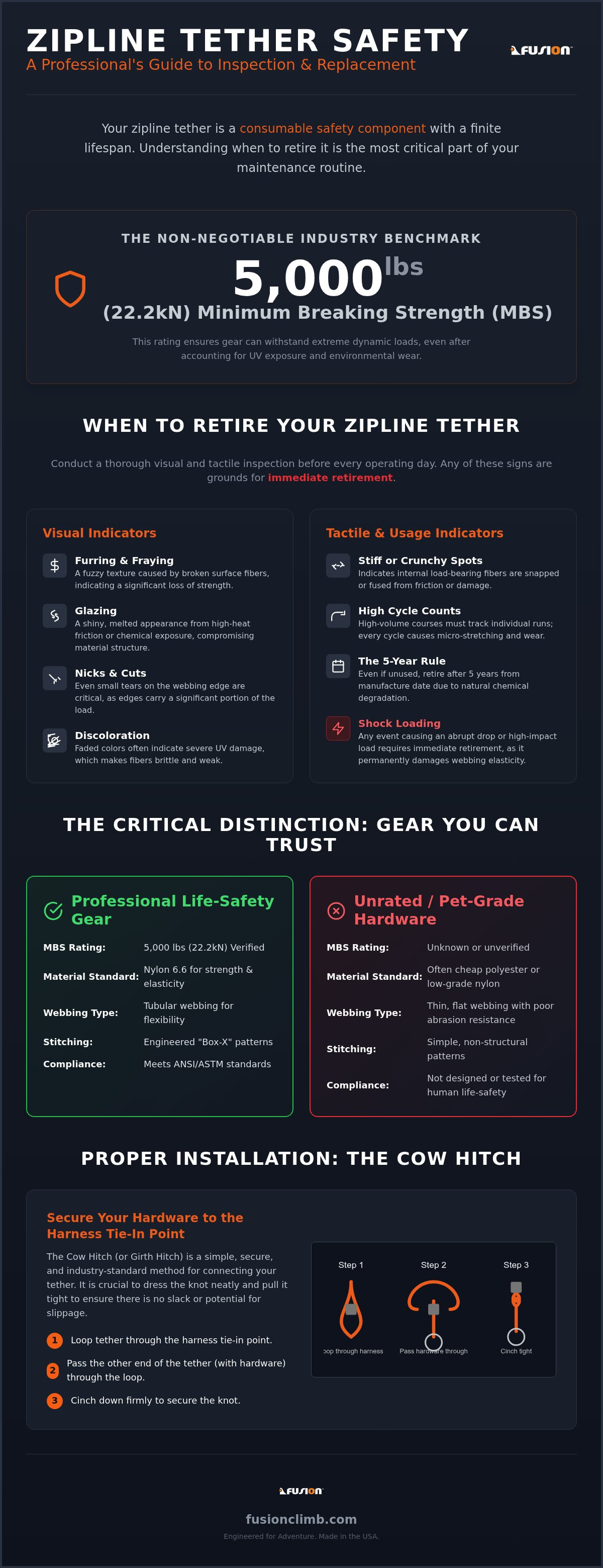
Safety gear is a consumable asset with a finite functional life. You can't rely on guesswork when a rider's safety is on the line. A proactive zipline tether replacement strategy ensures that your equipment never reaches the point of catastrophic failure. Most synthetic soft goods used in aerial environments follow a strict "five-year rule." Even if the webbing appears pristine, the chemical bonds in nylon and polyester degrade over time due to oxidation and internal friction. Professional installation and inspection are mandatory for all life-safety gear to ensure these standards are met.
Conduct a thorough inspection before every operating day. Look for "furring," which occurs when surface fibers break and create a fuzzy texture. While minor abrasion is common, deep furring suggests a significant loss of cross-sectional strength. You should also perform tactile inspections by running your hand along the entire length of the lanyard. If you feel stiff spots or a "crunchy" texture inside the webbing, the internal load-bearing fibers are likely snapped or fused. Never attempt to clean a tether with harsh industrial chemicals; these can dissolve internal bonding agents without leaving a visible mark.
Visual Indicators of Critical Webbing Failure
Examine the edges of the webbing for nicks or tiny cuts. Since the edge carries a significant portion of the load, even a small tear is grounds for immediate retirement. Look for discoloration; a faded tether often indicates severe UV damage that has made the fibers brittle. Glazing is another red flag. This shiny, melted appearance usually results from high-heat friction or chemical exposure, both of which compromise the material's molecular structure and reduce the safety margin of the equipment.
The Impact of Cycle Counts on Tether Integrity
Commercial operators shouldn't rely solely on the calendar. High-volume courses must track "cycle counts" or individual runs. Every time a rider zips, the tether undergoes micro-stretching. If a tether experiences a shock load, such as a heavy rider dropping abruptly onto the line, it must be retired immediately. Shock loading permanently alters the elasticity of the nylon, making it unable to absorb future energy. A timely zipline tether replacement should always account for these high-stress events to maintain course integrity. Retirement criteria represent the non-negotiable threshold where equipment must be permanently removed from service to prevent mechanical failure.
Technical Specifications for Professional Replacement Tethers
Don't compromise on specifications. A professional zipline tether replacement must meet industrial benchmarks that recreational hardware simply cannot match. The core of this standard is a Minimum Breaking Strength (MBS) of 5,000 lbs, or 22.2kN. This rating ensures the gear can withstand the extreme dynamic loads generated during a zip, even after accounting for the natural strength loss caused by UV exposure and environmental grit. Choosing a tether with an unverified rating puts every rider at risk.
Selecting the right webbing type is equally important. Tubular webbing is the preferred choice for many professionals because its hollow core provides superior flexibility and knot-holding security. Flat webbing is often denser and thinner, but it can be less forgiving during installation. Most operators choose between fixed lengths like 16-inch or 24-inch options, though adjustable tethers offer the most versatility for courses with varying trolley-to-harness distances. If you need precision and reliability, consider the Made in the USA tethers and lanyards from Fusion Climb.
Material Science: Why Nylon 6.6 Dominates Zipline Safety
Nylon 6.6 is the gold standard for life-safety webbing. It offers a unique balance of high tensile strength and controlled elongation. This stretch is vital. It acts as a micro-shock absorber, making the ride smoother for the user while reducing the peak force on the anchors. While polyester webbing is lighter and resists water better, it lacks the energy-absorption properties necessary for high-impact aerial activities. Nylon also provides superior abrasion resistance, which is critical in high-friction environments where the tether may rub against other hardware.
Stitch Patterns and Structural Integrity
Stitch integrity is non-negotiable. Professional gear utilizes complex "box-X" or multi-pass stitching patterns with heavy-duty bonded nylon thread. These patterns are engineered to distribute the load evenly across the webbing fibers. Inspect the hitched loop area regularly for any broken or loose threads. If the stitching is compromised, the gear is dead. DIY repairs or home sewing are strictly prohibited because they cannot replicate the precision of industrial manufacturing. All life-safety hardware requires professional installation and inspection to maintain its rated strength.
Human Safety vs. Pet Hardware: The Critical Distinction
Don't let a generic search engine algorithm compromise your safety. A common pitfall in the search for a zipline tether replacement is the accidental selection of pet-grade equipment. Online marketplaces often mix human life-safety gear with "dog zipline" kits, creating a lethal confusion for the uninformed buyer. While a leash might be labeled as "durable," it lacks the engineering required to support the dynamic weight and velocity of a human rider. Using hardware designed for a 50-pound animal to secure a 200-pound person is a recipe for catastrophic failure. Safety is not a place for compromise.
Life-safety ratings, such as ANSI Z359.11, are not mere suggestions. They are rigorous certifications that ensure every component can withstand specific force thresholds. Pet products rarely provide a Minimum Breaking Strength (MBS) and never meet the 5,000 lb industry benchmark. Hardware also differs significantly. Professional setups utilize locking carabiners with secure gates, whereas pet gear often relies on simple spring-loaded clips that can easily vibrate open during a high-speed run. Weight capacity is never "one size fits all" in the vertical world. Every pound of force matters when you're suspended mid-air.
How to Identify Industrial-Grade Hardware
You must verify the technical markings on every piece of metal. Authentic life-safety connectors feature stamped kN (kiloNewton) ratings, indicating their tested strength along the major axis. Look for manufacturer tags that list batch numbers, production dates, and specific compliance standards. If a tether lacks this documentation, it isn't gear; it's a liability. For a deeper look at what makes a connector safe, review our Professional Climbing Carabiners Guide. Authentic gear is always backed by data.
The Risks of Cross-Contamination in Safety Gear
Dedicated equipment is the only way to manage commercial liability and personal risk. Multi-purpose gear that claims to work for both pets and people often fails at the specialized tasks required for aerial safety. Industrial safety gear is engineered for predictable failure points, unlike consumer-grade pet products. Every component in your system must be a rated life-safety tool. Mixing unrated hardware into your rig compromises the entire chain of survival. Professional installation and inspection by a qualified person remain mandatory for all new components to ensure they function as intended within your specific environment.
Rigging and Installing Your Replacement Tether
Precision rigging is the final link in your safety chain. A successful zipline tether replacement requires meticulous attention to the physical connection between the rider and the cable, as even the highest-rated gear fails if installed incorrectly. You aren't just swapping parts; you're calibrating a life-safety system. Every twist in the webbing or loose connection point introduces unnecessary friction and potential failure modes. Professional installation and inspection remain mandatory for all new components to ensure they function within the manufacturer's intended parameters.
The Cow Hitch Connection Method
The Cow Hitch, also known as a Larks Head knot, is the industry standard for connecting a tether to a harness bridge. This soft-to-soft connection is superior to using a carabiner because it eliminates the risk of gate failure or cross-loading at the harness tie-in point. It also reduces weight and prevents metal-on-metal wear. Follow these steps to secure the connection:
- Identify the primary tie-in point or bridge on your full-body or Superman-style harness.
- Feed the small attachment loop of the tether through the harness bridge.
- Pass the entire length of the tether, including the trolley-end hardware, back through the small loop.
- Cinch the knot tightly against the harness, ensuring the webbing is "dressed" neatly without any overlaps or twists.
A properly dressed Cow Hitch stays secure under tension and provides a predictable load path. Once the knot is set, pull it firmly to ensure it sits flush against the harness bridge. This connection should be inspected daily for any signs of shifting or abrasion.
Trolley Integration and Clearance
The connection between the tether and the trolley requires a locking carabiner rated for at least 5,000 lbs (22.2kN). Ensure the carabiner is oriented so the gate is not in contact with the trolley plates, which can cause accidental opening or "roll-out." For more details on hardware compatibility, consult our Commercial Zipline Pulleys Guide. Maintaining rider-to-cable clearance is the primary safety objective here. If the tether is too long, the rider’s head may come dangerously close to the cable; if it's too short, the rider will experience an uncomfortable, jarring ride.
Adjustable tethers are particularly useful for courses that serve both children and adults, as they allow you to fine-tune the clearance for different body types. Before you send the first rider of the day, perform a test hang to verify that the webbing doesn't twist during flight. If you are ready to upgrade your setup with gear that meets these rigorous standards, you can shop our selection of professional zipline tethers to find the right fit for your course.
Fusion Climb Professional Lanyards: Engineered for Adventure
Reliability is the foundation of every successful aerial operation. When you execute a zipline tether replacement, you're making a calculated decision to prioritize rider safety over equipment longevity. Fusion Climb builds gear for those who demand industrial-grade performance in high-stakes environments. Every tether and lanyard we produce is manufactured in the USA, allowing for meticulous quality control and rigorous testing protocols that exceed international benchmarks. We don't just follow standards; we set them through traditional values of strength and modern engineering precision.
Our commitment to excellence extends beyond the assembly line. We understand that commercial operators require hardware that is as versatile as it is durable. By focusing on technical assurance and product integrity, we provide the substance that professional guides and course owners rely on every day. Professional installation and inspection remain mandatory for all new components to ensure they integrate seamlessly with your existing safety systems. Choosing a domestic manufacturer means choosing a partner who understands the specific demands of the North American adventure industry.
Adjustability and Versatility
Commercial ropes courses and zipline tours must accommodate a diverse range of riders. The Fusion Climb Adjustable Safety Lanyard series provides the flexibility required for mixed-age environments. With an adjustable range typically spanning from 24 inches to 72 inches, these tethers allow guides to fine-tune rider clearance on the fly. This adaptability is vital for maintaining the correct distance between the harness and the trolley across various course configurations. For a comprehensive look at how to select the right length for your rig, consult our Zipline Lanyards & Tethers Guide.
Commitment to Uncompromised Safety
Integrity is the core of our "New Gear Guarantee." We maintain a strict non-returnable policy for all soft goods, including harnesses and tethers. This policy isn't a limitation; it's a critical safety feature. It ensures that every customer receives factory-fresh, uncompromised gear that has never been subjected to unknown stresses or improper storage by a previous user. We don't restock soft goods because we don't take chances with your safety. Every Fusion Climb tether is a "silent partner" in the user’s safety journey. We also support commercial operators with bulk hardware solutions, ensuring that your entire course is outfitted with consistent, high-performance equipment that stands up to heavy-cycle use. If you're ready to upgrade your course, you can shop our professional zipline tethers to ensure your next zipline tether replacement meets the highest standards of the craft.
Secure Your Next Adventure with Industrial Precision
Maintaining a safe course requires more than just high-quality gear; it demands a relentless commitment to inspection and retirement protocols. By mastering the visual and tactile signs of webbing degradation, you eliminate the guesswork from your maintenance routine. A proactive zipline tether replacement is the only way to ensure your system consistently meets the 5,000 lb Minimum Breaking Strength required for life-safety applications. Distinguishing between certified industrial gear and unrated consumer hardware remains a non-negotiable skill for every operator who values substance over style.
Fusion Climb provides the technical assurance you need to push boundaries safely. Our tethers and lanyards are Made in the USA and undergo rigorous MBS testing to meet the highest performance standards. It's why we're trusted by commercial operators across the globe to deliver gear that performs under pressure. Don't leave your safety to chance with unrated or aged equipment. Shop Professional Zipline Tethers & Lanyards today and invest in hardware engineered for the vertical world. Every successful run starts with the confidence that your gear is uncompromised and ready for the challenge.
Frequently Asked Questions
Can I use a climbing sling as a zipline tether replacement?
No. Climbing slings are engineered for static or low-impact climbing loads and lack the specific elongation properties required for ziplining. A dedicated zipline tether replacement must meet industrial life-safety standards like ANSI Z359.11 to handle high-velocity dynamic forces. Using a standard sling can result in an uncomfortable ride or catastrophic failure. Always utilize gear specifically designed for the high-cycle environments found on professional zipline courses.
How often should a commercial zipline operator replace their tethers?
Commercial operators must adhere to a maximum five-year retirement window for all synthetic soft goods. However, high-volume courses often require replacement much sooner based on cycle counts and daily wear. You should retire gear immediately if inspections reveal any glazing, furring, or internal stiffness. Technical assurance depends on removing equipment from service before it reaches its failure point. Professional installation and inspection remain mandatory for all new components.
What is the difference between a lanyard and a tether in ziplining?
These terms are often used interchangeably in the industry. A tether typically refers to the webbing connecting the harness to the trolley, while a lanyard is a broader term for safety components used in fall protection. In a zipline context, both must meet the 5,000 lb Minimum Breaking Strength (MBS) benchmark. Regardless of the name, the component must be rated for life-safety and manufactured using high-strength bonded nylon thread.
Is it safe to use a tether that has been left outside all winter?
No. Leaving synthetic gear exposed to winter elements introduces significant risks. Extreme temperature cycles and moisture can weaken nylon fibers, while ice crystals can cause internal micro-tears during use. UV exposure also continues to degrade the material even in cold weather. If your gear was not stored in a cool, dry, and dark environment, it requires immediate professional inspection and likely retirement to ensure rider safety.
What weight capacity should a zipline tether have for an adult?
A professional zipline tether must have a Minimum Breaking Strength (MBS) of at least 5,000 lbs, which is approximately 22.2kN. This high capacity accounts for the dynamic loads generated during flight and provides a necessary safety factor for riders of all sizes. Gear with lower ratings is often intended for recreational pet use or light utility tasks and is never appropriate for securing human life in a vertical environment.
Can I wash my zipline tether if it gets muddy?
You can clean webbing using only cool water and a mild, non-detergent soap approved for life-safety gear. Avoid all harsh industrial chemicals or bleach, as these can dissolve internal bonding agents without leaving a visible mark. Always air-dry the gear away from direct heat or sunlight. If the mud contains heavy grit that has penetrated deep into the weave, the resulting internal abrasion may necessitate a full zipline tether replacement.
Does the color of the tether webbing affect its strength or UV resistance?
Webbing color does not dictate its initial strength, but darker pigments can sometimes offer slightly more resistance to UV penetration than lighter shades. However, all nylon eventually becomes brittle under sun exposure regardless of its hue. You should rely on manufacturer-certified UV inhibitors rather than the color of the fabric. Once a tether shows significant fading or discoloration, it is a clear technical indicator that the material has reached its retirement criteria.
How do I know if my carabiner is compatible with my new tether?
Compatibility is determined by the physical fit and the industrial ratings of both components. The carabiner must be a locking model rated for at least 5,000 lbs and must fit through the tether loop without bunching or pinching the webbing. Ensure the connector allows for a clean connection that does not interfere with the gate's locking mechanism. Professional installation and inspection are mandatory to verify that the carabiner and tether function correctly as a system.