



Zipline Tether Inspection Guide: 2026 Safety & Maintenance Standards
A quick visual glance at your gear isn't an inspection; it's a gamble with a 5,000-pound life-safety system. You understand that the difference between a successful season and a catastrophic failure often hides in the subtle glazing of a stitch or a microscopic fray in the webbing. It's natural to feel the weight of responsibility when evaluating equipment that must meet rigorous industrial standards. This zipline tether inspection guide empowers you to master professional protocols for evaluating lanyards and tethers with absolute precision.
We'll move past surface-level checks to provide a clear, standardized framework for identifying "red flag" damage before it becomes a liability. You will learn the exact tactile rituals for daily checks, the 10% wear rule for hardware retirement, and the specific documentation needed to ensure your course remains fully compliant with the latest ASTM F2959-26a safety mandates. From the "inch-by-inch" fold test to chemical contamination triggers, this guide provides the technical assurance you need to maintain a professional-grade operation and protect every rider on your line.
Key Takeaways
- Identify the core structural elements of professional-grade tethers, including high-tensile webbing and specialized industrial bar-tack stitching patterns.
- Execute a precise "inch-by-inch" tactile and visual protocol using this zipline tether inspection guide to uncover hidden internal damage and core compaction.
- Recognize the subtle indicators of UV degradation and chemical contamination from common aerosols that can silently weaken synthetic safety components.
- Establish definitive retirement thresholds based on operational cycles, hardware wear limits, and the mandatory "One-Strike" rule for shock-loaded gear.
- Build a robust compliance framework with serialized tracking and documentation to satisfy 2026 ASTM F2959-26a and ACCT regulatory standards.
Fundamentals of Zipline Tether Integrity and Safety
The zipline tether serves as the vital lifeline connecting the rider to the cable system. It is the primary connection point between the trolley and the harness, enduring constant tension and cyclic loading. Understanding zip line mechanics and attachment systems is essential for any operator, as the tether is often the most stressed component in the setup. A failure here is non-negotiable. This zipline tether inspection guide starts with the basics: knowing exactly what you're looking at before you step onto the platform.
Professional tethers are engineered from high-tenacity polyester or nylon webbing. These materials provide a high strength-to-weight ratio and essential resistance to abrasion. The stitching, typically a dense bar-tack pattern using bonded nylon thread, is the structural heart of the assembly. Manufacturers often use contrast stitching, where the thread color differs from the webbing. This design choice isn't for aesthetics; it's a safety feature that makes broken or pulled threads immediately visible during a check. A critical but often overlooked feature is the shock absorption capacity. In a sudden stop, the webbing's elasticity helps dissipate energy, preventing the force from transferring directly to the rider's body.
Textile vs. Hardware Components
Industrial-grade lanyards often feature integrated hardware such as carabiners or rapid links. While the webbing handles the flexibility and shock absorption, these metal interfaces manage the hard connections. Using USA-manufactured gear ensures that both the textiles and the metal components meet strict quality control standards. You must evaluate the interface where the webbing meets the metal, as this is a high-friction zone prone to heat-induced glazing. Whether you're using a full body harness or a Superman style harness, the connection point is where wear patterns first emerge.
The Life-Safety Chain Concept
In aerial adventure rigging, we treat the rider's equipment as a life-safety chain. The tether is frequently the weakest link because it's a textile component subjected to more movement, UV exposure, and environmental grit than a steel pulley. While a pulley might last years, a tether requires more frequent oversight due to its synthetic nature. Every component must meet a Minimum Breaking Strength (MBS) of 5,000 lbs (22.2 kN) to satisfy ASTM F2959-26a standards. Maintaining this integrity is both a legal requirement and a moral obligation to your participants. Regular use of a zipline tether inspection guide ensures that no link in your safety chain is compromised by invisible wear or aging.
Step-by-Step Visual and Tactile Inspection Protocol
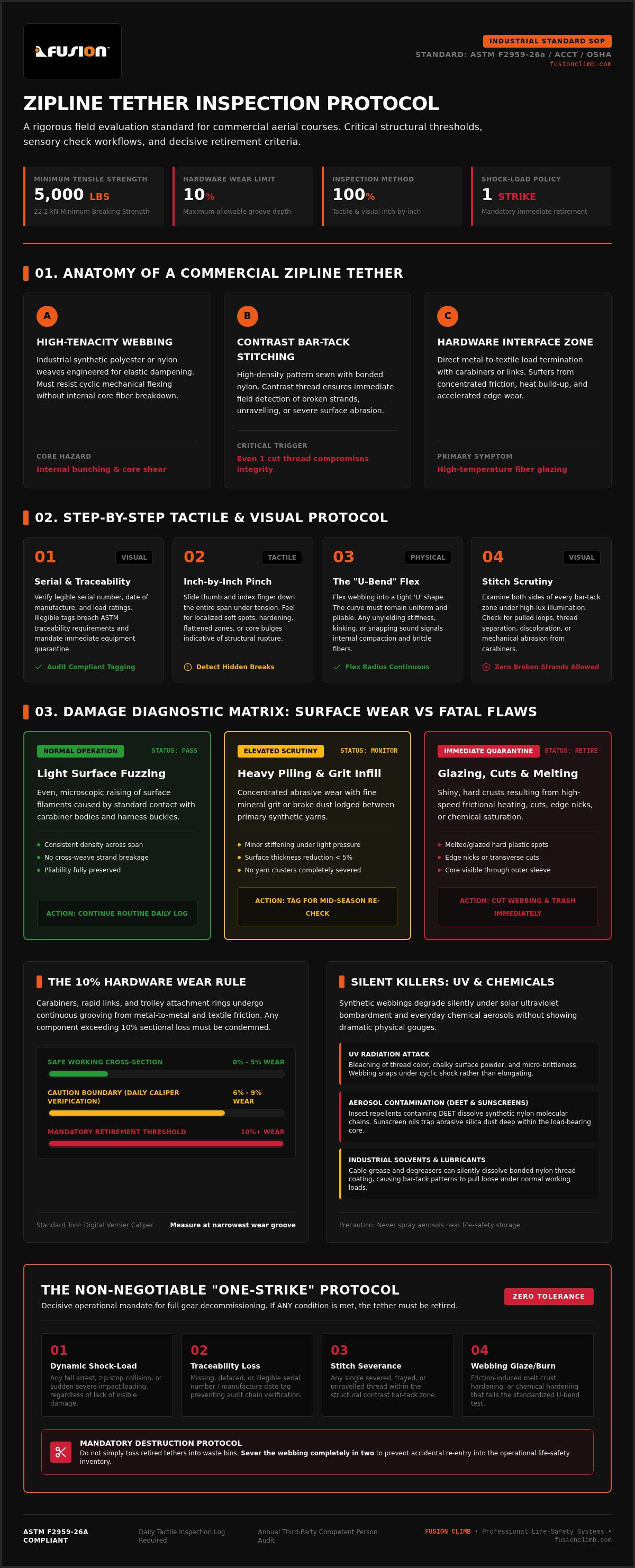
Inspection isn't a passive activity. It requires a deliberate, sensory ritual where your hands confirm what your eyes might miss. This zipline tether inspection guide demands a tactile "touch-test" along the entire length of the webbing. You're searching for internal fiber breakage, core bunching, or localized stiffening that indicates structural compromise. If the lanyard feels brittle or fails to maintain a smooth "U-bend" when flexed, it's finished. Physical integrity is the only thing standing between a rider and a fall.
Following OSHA fall protection inspection protocols ensures your operation remains grounded in industrial safety standards. Beyond the feel, you must verify that all manufacturer labels and safety markings are legible. A tether without a visible serial number or manufacture date loses its chain of custody. It can't be legally tracked or audited, which makes it an immediate candidate for the retirement bin. Traceability is as critical as the webbing itself.
Webbing Surface Analysis
Don't confuse light surface "fuzzing" with dangerous abrasion. Fuzzing is often a natural result of synthetic fibers rubbing against hardware over time. However, if you see distinct "nicks" in the edge of the webbing or deep gouges that reveal internal yarns, the tensile strength is compromised. Look for "glazing." This shiny, melted appearance occurs when high-heat friction from braking or trolley movement sears the polyester fibers. Glazed webbing is brittle and prone to sudden failure under load. It's a clear signal that the gear has reached its limit.
Stitching and Load-Bearing Points
Adopt the "inch-by-inch" method for every bartack pattern. These dense clusters of thread are the only thing holding the lanyard together. Inspect for pulled, cut, or frayed stitches. If you notice "discolored" thread, it often signals chemical exposure from sunscreens or solvents that have begun to dissolve the nylon. Pay special attention to the "eye" of the tether where it interfaces with professional climbing carabiners. This high-friction zone is where 10% cross-sectional wear on the metal can begin to saw through your textile loops. For operators demanding maximum reliability, upgrading to industrial-grade lanyards and tethers provides a sturdier foundation for these critical connection points.
Environmental Degradation: Identifying UV and Chemical Damage
UV radiation acts as a silent killer for synthetic gear, stripping away tensile strength without leaving a visible scar. While our previous sections focused on mechanical wear, environmental stressors operate on a molecular level. This zipline tether inspection guide highlights that gear stored in the sun or exposed to harsh chemicals can lose significant rated strength while still appearing new to the untrained eye. For operators, understanding these invisible threats is the difference between a safe line and a catastrophic failure.
Beyond the sun, the very products intended to protect participants can destroy the equipment. Sunscreens, insect repellents, and even certain industrial cleaning agents contain volatile compounds that react with nylon and polyester. These reactions aren't always immediate but can lead to a sudden, brittle failure under load. Professional vigilance means monitoring not just how the gear is used, but what it's exposed to during every shift.
UV Exposure Indicators
Fading and color loss are your first indicators of solar damage. If a once-vibrant lanyard now looks dusty or washed out, the fibers are likely compromised. Perform a brittleness test by flexing the webbing; if it feels crunchy or stiff rather than supple, the internal structure has likely crystallized. Scientific research on nylon webbing degradation confirms that UV exposure significantly reduces energy absorption capacity over time. While polyester webbing offers slightly better UV resistance than nylon, neither material is immune to the relentless bombardment of solar radiation in high-altitude or outdoor environments.
Chemical and Biological Contamination
Petroleum-based products and common aerosols are catastrophic for zipline lanyards and tethers. DEET, found in high-concentration bug sprays, can dissolve synthetic fibers at the microscopic level, creating "soft spots" that fail during a dynamic event. Similarly, sunscreens leave behind oily residues that attract mineral grit. This grit then acts like internal sandpaper, severing fibers from the inside out as the tether flexes. Biological growth also presents a risk; mold and mildew thrive in damp, poorly ventilated storage, eventually eating away at the webbing's core. Always clean gear with pH-neutral soap and fresh water, then air-dry it away from direct heat or sunlight.
Coastal operations face the added challenge of salt air. Salt crystals can form deep inside the webbing, acting as tiny knives that sever fibers during cyclic loading. Likewise, extreme temperature fluctuations impact the elasticity of the polymers. Moving from freezing nights to blistering days causes the fibers to expand and contract, which can lead to premature aging. Consistent, climate-controlled storage is a safety requirement for extending the life of your equipment. This zipline tether inspection guide recommends a dedicated gear room to mitigate these environmental variables.
Retirement Criteria: Knowing When to Remove Gear
Retirement is a binary decision. Gear is either fit for service or it is industrial waste. There is no middle ground. This zipline tether inspection guide emphasizes that professional safety relies on hard thresholds rather than optimistic guesses. While textiles have a theoretical shelf life of 10 years, the reality of high-volume commercial operations dictates a much shorter window. Most tethers on active courses reach retirement within 1 to 3 operating seasons due to the relentless cycle of friction, grit, and UV exposure. You must establish a clear retirement date for every serialized component in your fleet.
Usage-based tracking is the gold standard for modern operators. A tether that sees 50 riders a day in a dusty environment wears differently than one used once a week in a climate-controlled setting. If you can't verify the cycle count or the age of the equipment because of an illegible label, the decision is already made. Remove it. "When in doubt, throw it out" isn't just a phrase; it's the only professional stance that protects your riders and your business from liability. If you need to refresh your inventory with gear built for these rigors, explore the range of USA-made zipline lanyards and tethers from Fusion Climb.
Serviceable vs. Retired Checklist
- Surface Pilling: Minor pilling is often acceptable, but deep-core abrasions that reveal internal yarns require immediate retirement.
- Hardware Integrity: If a carabiner gate is sluggish, fails to lock, or shows 10% cross-sectional wear, the entire assembly must go.
- Labeling: Illegible manufacturer markings break the chain of custody and violate ASTM F2959-26a compliance.
- Webbing Geometry: Any permanent deformation, stiffness, or "flat spots" in the webbing indicates internal fiber collapse.
Post-Incident Retirement
The "One-Strike" rule is absolute. If a tether is subjected to a significant shock load or a fall arrest event, it must be decommissioned immediately. A shock load in a zipline context occurs when a rider experiences a sudden, violent stop that exceeds normal operating tensions. Visual inspection cannot detect internal fiber stretching or molecular fatigue. Once a component has been flagged for retirement, you must physically destroy it. Cut the webbing through the eyes and bar-tack patterns to ensure it can never be accidentally put back into service. True safety ends with the total destruction of compromised gear.
Professional Compliance and Documentation for Operators
Compliance is the final layer of the safety ritual. While the physical checks in this zipline tether inspection guide identify damage, documentation proves your commitment to rider safety. ANSI Z359 and ACCT standards require more than a cursory glance; they demand a verifiable history for every piece of gear in service. This includes understanding how ropes course safety equipment protocols overlap with zipline operations. You aren't just managing equipment. You're managing liability and trust.
Implementing a serialized tracking system is the only way to maintain a true chain of custody. Every lanyard must have a unique, legible identifier. Without it, you cannot accurately track usage cycles or identify batches affected by manufacturer recalls. Daily pre-flight checks are your first line of defense. These are visual and tactile assessments performed before the first rider of the day. However, periodic deep inspections are different. These are documented technical audits that look for the "silent killers" like internal fiber compaction or hardware fatigue.
Creating an Inspection Logbook
Your logbook is a legal record. It must capture the date of inspection, the specific serial number, the name of the inspector, and the final status (Pass, Fail, or Quarantine). Whether you use a digital asset management system or a rugged physical binder, the data must be accessible for third-party audits. Digital systems often integrate with commercial zipline pulleys and other hardware via RFID or QR codes, streamlining the process. Retention periods vary by jurisdiction, but standard practice dictates keeping records for at least five years or the life of the gear plus three years.
Staff Training and Competency
Not everyone is qualified to sign off on a life-safety component. A "Competent Person" is someone designated by the employer who can identify existing and predictable hazards and has the authority to take corrective action. A "Qualified Person" usually holds a degree or professional certificate in the field. High-risk aerial parks often implement a double-check system where one staff member inspects the gear and another verifies the logbook entry. This redundancy eliminates human error and reinforces a safety-first culture. Ensure your fleet is mission-ready with Fusion Climb professional tethers, manufactured to meet the highest industrial benchmarks for strength and traceability. Use this zipline tether inspection guide to build a culture of accountability that starts on the ground and extends to the highest platform.
Secure Your Connection with Industrial Precision
Mastering equipment safety is a continuous discipline that demands both technical knowledge and unwavering attention to detail. This zipline tether inspection guide provides the technical foundation for identifying hidden wear, from microscopic UV degradation to internal fiber compaction. You now have the framework to execute precise tactile protocols and maintain the strict documentation required by 2026 standards. Professional safety is a ritual of vigilance that ensures every rider's journey starts and ends with total confidence.
Safety isn't just about the protocol; it's about the integrity of the gear you trust. When you need to replace retired components, choose hardware built for the most demanding vertical environments. Upgrade Your Safety Fleet with Fusion Climb Tethers and Lanyards. Since 1998, we've manufactured professional-grade equipment in the USA using high-tenacity materials designed for commercial longevity. Every product undergoes rigorous industrial testing to ensure it meets the highest real-world safety standards. Equip your team with the confidence to push their limits while remaining grounded in total security.
Frequently Asked Questions
How often should zipline tethers be inspected in a commercial setting?
Commercial operators must follow a three-tier protocol to maintain safety compliance. Tier 1 requires a visual and tactile check before the first rider of the day. Tier 2 involves a monthly, documented inspection conducted by a designated Competent Person. Tier 3 is an annual third-party audit performed by an ACCT-accredited inspector. Consistent use of a zipline tether inspection guide ensures these intervals are met, protecting both your participants and your legal standing.
Can I wash my zipline tethers if they get dirty or muddy?
You can wash synthetic tethers using fresh water and a pH-neutral soap. Don't use harsh detergents or industrial cleaners that can degrade the nylon or polyester fibers at a molecular level. After rinsing, always air-dry the equipment in a well-ventilated area away from direct sunlight or artificial heat sources. Never use a pressure washer, as the high-velocity water can force abrasive grit deep into the webbing's internal core.
What is the maximum lifespan of a synthetic zipline tether?
Most manufacturers define the absolute maximum shelf life as 10 years from the date of manufacture. However, the operational lifespan in a commercial aerial park is significantly shorter. Due to constant UV exposure and mechanical friction, most tethers require retirement within one to three operating seasons. You must retire any piece of gear that shows signs of compromise, regardless of its chronological age or any remaining theoretical lifespan.
How do I know if a tether has been "shock loaded"?
Shock loading often leaves subtle physical markers like internal core bunching, localized stiffness, or permanent elongation. You should perform the tactile "U-bend" test to feel for internal fiber breakage that isn't visible on the surface. If a tether has been involved in a fall arrest event or a violent stop, it's considered compromised. Retirement is mandatory because the webbing's energy-absorbing properties are permanently diminished after a single significant load.
Is it safe to use a tether with a slightly frayed edge?
It depends on the depth of the damage. Light surface "fuzzing" from normal use is generally acceptable, but any distinct nick, cut, or abrasion that severs the edge yarns is a critical failure. These nicks act as stress concentrators that can lead to a sudden tear under load. If you can see the internal load-bearing yarns or if the fraying is localized near a stitch pattern, retire the gear immediately.
Does the color of the tether affect its UV resistance?
While darker dyes can sometimes provide a marginal increase in UV shielding, the base material is the primary factor in solar resistance. Polyester generally outperforms nylon in high-sun environments. In this zipline tether inspection guide, we treat color fading as a proxy for structural damage. If a tether shows significant color loss, it's a signal that the synthetic fibers have undergone enough solar radiation to warrant a thorough strength assessment.
What are the specific ANSI standards for zipline tethers in 2026?
The primary governing standard for commercial aerial adventure courses is ASTM F2959-26a. This mandate requires all life-safety tethers and lanyards to maintain a Minimum Breaking Strength (MBS) of 5,000 lbs. Additionally, fall protection components must align with ANSI Z359.11 requirements for 2026. These standards ensure that every connection point in the safety chain can withstand the dynamic forces generated during a fall or a sudden, high-velocity stop.
Can I replace just the carabiner on a fixed zipline lanyard?
No, you cannot replace hardware on a permanently sewn assembly. If the carabiner is integrated into the tether loop with a factory bar-tack, any damage to the metal requires the retirement of the entire unit. Attempting to cut and re-sew the webbing voids the manufacturer's certification and creates a massive liability risk. For gear that allows hardware replacement, you must use specialized rapid links or connectors designed for that specific purpose.