



Zipline Pulley with Integrated Carabiner for Adventure Parks
A pulley choice starts with fit, not appearance. A zipline pulley with an integrated carabiner combines the trolley and connection in one assembly, but it still needs to suit the line, bearing requirements, and operating setup. For adventure-park installations, guidance gives a 3-6% slope; children under age 10 should use the zipline under adult or guardian guidance, and the stated weight limit for children and adults is 250 pounds.
Those details matter because a trolley is part of a complete system, not a standalone component. Look beyond the carabiner: consider how the pulley travels on the cable or rope, which bearing design suits the application, and what maintenance supports consistent operation. This article explains how trolley design, line compatibility, bearings, and a captive pivoting carabiner affect selection, followed by practical inspection and maintenance guidance. You’ll have a clearer basis for matching hardware to an adventure-park zipline.
Key Takeaways
- Match trolley design to the zipline’s layout and operating needs, rather than choosing by appearance alone.
- Use bearing condition and smooth movement as key maintenance considerations when assessing a pulley.
- Check that the pulley is designed for the line type and dimensions used in the system.
- Consider how a captive, pivoting carabiner connects and moves within the complete setup.
Adventure-park zipline trolley design
For US adventure parks, applicable requirements depend on the installation and jurisdiction. Use pulleys and carabiners within their documented limits and follow site operating procedures. A trolley works as part of the complete zipline system, not in isolation. Its frame, wheels, connection point, and line all affect how it travels and carries a rider.
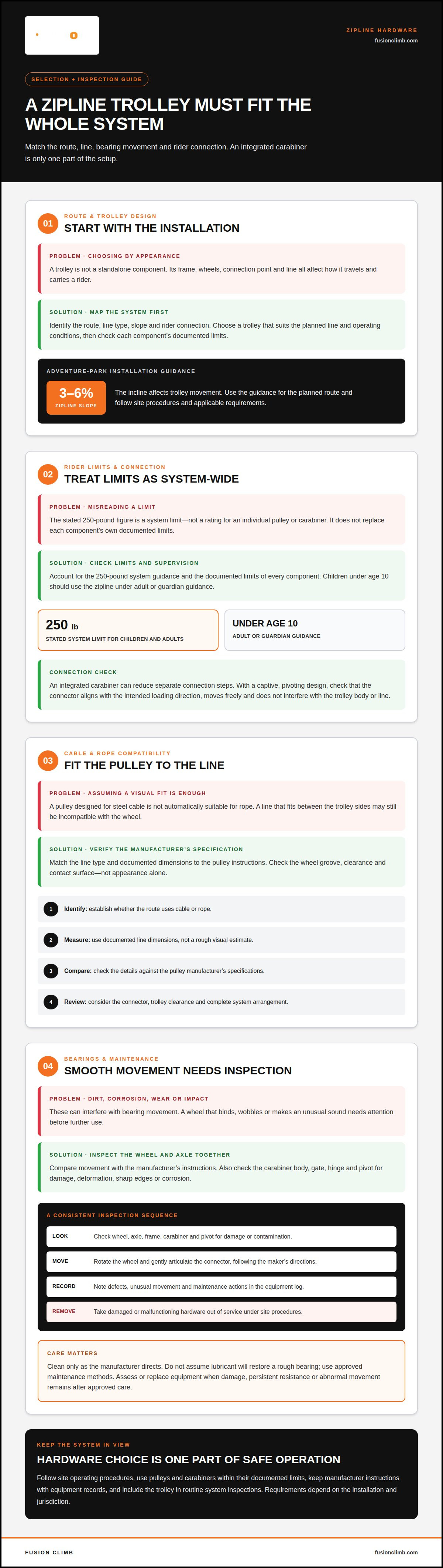
Start with the route. Installation guidance gives a 3-6% slope for the zipline run. That incline affects trolley movement, so the trolley must suit the planned line and operating conditions. The same guidance gives a 250-pound weight limit for children and adults. Treat that figure as a system limit, not a reason to overlook other equipment limits. Children under age 10 should use the zipline under adult or guardian guidance.
Next, consider how the trolley connects to the rider’s setup. An integrated carabiner can reduce separate connection steps, while a captive pivoting design keeps the connector attached and able to move. Orientation matters: the connection should align with the intended loading direction and avoid interference with the trolley body or line. A pulley designed for steel cable may not fit a rope system, so check the specified line compatibility before selecting a trolley.
- Map the system: identify the route, line type, slope, and rider connection.
- Match the limits: account for the 250-pound guidance and each component’s documented limits.
- Review the connection: check how an integrated carabiner pivots and aligns under use.
For example, don’t assume a cable trolley is suitable for rope just because its carabiner connects. Wheel shape, clearance, and line contact determine whether the assembly suits the route. Keep the manufacturer’s instructions with the equipment records, and include the trolley in routine system inspections. Before operation, look for visible damage, restricted wheel movement, or a connector that no longer pivots freely. Stop using defective equipment until it has been evaluated under site procedures. These checks link design choice to practical operation without treating one component as a complete safety system.
Requirements vary with the installation and jurisdiction. Use pulleys and carabiners within their documented limits, follow site operating procedures, and include the trolley in routine system inspections.
The 250-pound figure is a system limit, not a rating for an individual pulley or carabiner; each component must be used within its documented limits. Follow site operating procedures during use.
Bearings and maintenance
Bearings let a pulley wheel rotate around its axle as it travels. Dirt, corrosion, wear, or impact can interfere with that movement. Inspect the wheel and axle together. A wheel that binds, wobbles, or makes an unusual sound needs attention before further use. Compare its movement with the manufacturer’s instructions rather than relying on sound alone.
Integrated hardware also requires a connector check. Examine the carabiner body, gate, hinge, and pivot for visible damage, deformation, sharp edges, or corrosion. Open and release the gate as instructed. It should move and close as designed, and the pivot should turn without sticking. Check that the connector remains captive and that no part obstructs the pulley wheel.
Use a consistent inspection sequence:
- Look: check the wheel, axle, frame, carabiner, and pivot for damage or contamination.
- Move: rotate the wheel and articulate the connector gently, following the maker’s directions.
- Record: note defects, unusual movement, and maintenance actions in the equipment log.
- Remove: take damaged or malfunctioning hardware out of service under site procedures.
Clean the assembly only as its manufacturer directs. Some cleaning agents or lubricants can affect materials, seals, or moving parts. Don’t assume that lubricant will restore a rough bearing. Use only approved maintenance methods, and keep the instructions with the equipment records. A seasonal opening inspection, for example, can include checking for storage-related corrosion and testing movement before operation. Follow the site’s inspection schedule and any additional checks required after an unusual event.
Replace or assess equipment when damage, persistent resistance, or abnormal movement remains after approved care. Don’t return a questionable assembly to service based on appearance alone. For equipment selection or replacement, explore zipline pulley options alongside the line and connector requirements. Clear records help staff identify recurring wear and make consistent decisions across the course.
Cable and rope compatibility
Start with the line, then select the trolley. A pulley designed for steel cable isn’t automatically suitable for rope. The wheel groove, clearance, and contact surface must match the line specified by the pulley manufacturer. A mismatch can affect tracking, movement, and wear. Treat compatibility as a system requirement, not a visual guess.
Record the line type and documented dimensions before choosing hardware. For cable, note its construction and diameter. For rope, use the manufacturer’s stated type and diameter. Compare those details with the pulley instructions. Don’t infer compatibility just because a line fits between the trolley sides. The wheel profile must support the intended line correctly.
- Identify: establish whether the route uses cable or rope.
- Measure: use the line’s documented dimensions, not a rough visual estimate.
- Compare: match the line details against the pulley manufacturer’s specifications.
- Review: consider the connector, trolley clearance, and full system arrangement.
For example, cable and rope trolleys may have different wheel grooves. Rope can compress or change shape under load, while cable retains its construction. Those differences affect how each line meets the wheel. Having the same carabiner connection doesn’t make two pulley assemblies interchangeable. Confirm the assembly’s intended line use before installation.
Compatibility also depends on the route setup. Check that the pulley travels along the intended line without binding, rocking, or contacting adjacent hardware. Observe the line path through transitions and connection points. If the line specification changes, reassess the trolley selection rather than assuming the previous match still applies. Keep the line and pulley instructions together for maintenance staff.
During inspection, look for uneven wear on the wheel and at the line contact area. Record its location and appearance, then follow the manufacturer’s assessment and maintenance directions. A change in line type, dimensions, or trolley can alter the fit. Keep each component within its documented use, and evaluate the complete assembly whenever the system configuration changes. Precise line information is the starting point for a correctly matched, assembled system.
Captive, pivoting carabiner
A captive carabiner stays attached to its pulley assembly, while its pivot allows movement around the connection point. Compared with separate pulley and carabiner components, an integrated design can reduce loose parts and connection steps. Separate components allow independent replacement but require compatible parts and correct assembly.
Load ratings and speed limits vary by model. Use the manufacturer’s exact specifications for the complete assembly, and keep every component within its stated limits. The lowest-rated component governs allowable system use.
Install and use the assembly according to its manufacturer’s instructions and site operating procedures. Before use, confirm the pulley suits the line, the carabiner is correctly oriented, and its gate closes as designed. Keep the connector aligned with the intended loading direction, without cross-loading or obstruction.
A home zipline can expose users to falls or equipment failure if the anchors, line, trolley, or connections are unsuitable. An integrated connector cannot correct a weak support, incompatible line, or incorrect installation. Treat the full setup as a system, and keep children under adult or guardian guidance.
During setup, use this practical sequence:
- Read: follow the pulley and carabiner instructions for assembly and use.
- Inspect: look for damage, deformation, corrosion, or restricted gate movement.
- Connect: attach only at the intended point and check that the pivot moves freely.
- Reassess: stop use if the connection shifts, binds, or shows damage.
For example, a captive pivot may help the connector follow movement, but it doesn’t remove the need to inspect gate closure or loading orientation. A separate carabiner may be easier to replace independently, yet mismatched parts can create fit problems. Choose by the complete system’s requirements, not convenience alone. Review integrated zipline pulley options for hardware suited to your setup.
Fusion Climb: Zipline Pulleys
Fusion Climb offers zipline pulleys and carabiners for adventure-park equipment needs. Consider these products when selecting hardware for a system where pulley movement, line compatibility, and connector configuration must work together. Compare equipment requirements with the manufacturer’s specifications, including the intended line type and the limits of the complete setup.
Fusion Climb also offers full-body harnesses and Superman-style harnesses. These options suit different zipline and aerial adventure configurations; the right combination depends on the system design and intended use. Focus selection on compatibility, correct operation, and maintenance requirements rather than choosing components in isolation.
For equipment options suited to your setup, contact Fusion Climb.
Put the Next Setup in Motion
Start your next equipment decision with a clear system brief. Note the intended application, line type, connection arrangement, and maintenance approach before selecting hardware. This gives your team a practical basis for comparing a zipline pulley with integrated carabiner against separate components, using documented specifications rather than convenience alone.
Bring those requirements together with the operating procedures for your course or project. A consistent selection process helps staff understand how each component fits the overall arrangement and what to inspect during routine maintenance. As your setup evolves, keep the focus on compatibility, correct use, and clear equipment records.
For a considered next step, contact Fusion Climb about zipline pulleys and discuss the hardware that fits your application. Build your setup with care, then keep that same discipline in operation.
Frequently Asked Questions
What is a zipline pulley with an integrated carabiner?
It’s a trolley pulley and carabiner combined in one equipment assembly. The pulley rolls along the zipline, while the carabiner connects the assembly to a compatible rider attachment. Some designs keep the carabiner captive and allow it to pivot. Integration describes how the parts are joined; it doesn’t determine whether the assembly suits a particular line or application.
How do you choose the correct zipline pulley for cable diameter and zipline design?
Choose a pulley whose manufacturer’s specifications cover the cable’s documented diameter and construction, then consider the course layout and intended setup. For a replacement, use the cable details in the installation records rather than relying on appearance or a broad label such as “steel cable.” Confirm the pulley’s intended application and relevant system limits before selecting it.
What load ratings and speed limits do integrated zipline pulley carabiners have?
Load ratings and speed limits vary by model. Follow the manufacturer’s specifications for the complete assembly; the lowest-rated component governs allowable use.