


Zipline Hardware: Professional Operator’s Guide (2026)
Your zipline hardware isn't just a line item in your maintenance budget. It's the only thing standing between a successful season and a catastrophic liability. In a high-volume environment, the relentless friction on pulleys and the stress on harnesses can lead to rapid hardware turnover that drains your resources. You understand that maintaining a fleet of zipline hardware for parks requires more than just checking weight capacities. It demands a rigorous commitment to industrial-grade standards and high-cycle engineering.
This guide helps you master the technical requirements and safety standards necessary for commercial-grade operations in 2026. We'll show you how to reduce maintenance downtime by selecting components built for longevity and 100% safety compliance. You'll gain a clear understanding of the revised ANSI/ACCT 03-2019 standards and the 5,000-pound minimum breaking strength required for tethers. We'll also explore how to balance rider throughput with the uncompromising safety protocols that define a world-class adventure destination.
Key Takeaways
- Identify the critical distinction between static load ratings and dynamic impact resistance to select zipline hardware for parks that withstands high-cycle commercial use.
- Evaluate the precision engineering of high-speed pulleys to manage heat dissipation effectively during repeated runs.
- Master the technical requirements of full body and Superman style harnesses to ensure maximum rider comfort without compromising structural integrity.
- Navigate the 2026 safety landscape by aligning your operations with current ASTM F2959 and ANSI Z359.11 compliance standards.
- Streamline your supply chain by sourcing industrial-grade, US-manufactured components that prioritize durability and reduce seasonal maintenance downtime.
Essential Hardware Requirements for Commercial Zipline Parks
Operating a professional adventure park requires a shift in perspective from recreational gear to industrial-grade engineering. While backyard enthusiasts might focus on simple weight limits, professional operators must prioritize high-cycle durability. The zipline hardware for parks faces hundreds of cycles every week. This constant friction and mechanical stress demand components that can withstand the rigors of high-throughput environments without compromising structural integrity.
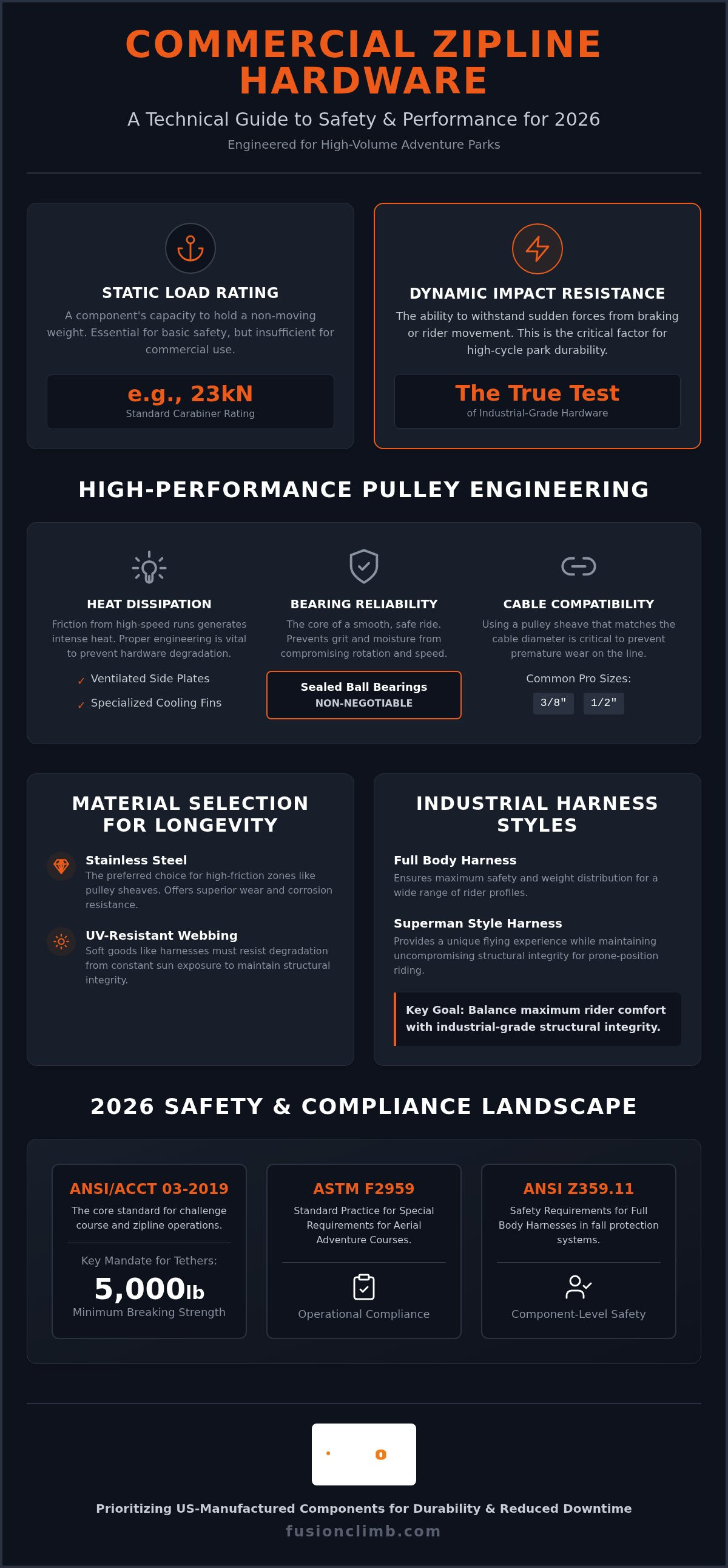
Safety starts with understanding the difference between static load ratings and dynamic impact resistance. A carabiner might be rated for 23kN of static weight, but the sudden engagement of a braking system or a rider's descent creates dynamic forces that test the limits of standard equipment. By reviewing zipline history and terminology, it's clear that the transition from simple gravity rides to complex commercial systems has necessitated a move toward hardened alloys and precision-machined steel. Professional rigging relies on these materials to absorb energy and maintain a high margin of safety during every run.
The High-Cycle Durability Standard
Component fatigue is a silent threat in high-volume park environments. Consumer-grade aluminum components often fail prematurely because they lack the hardness required for repeated metal-on-metal contact. In a professional setting, operators need hardware that resists "grooving" or thinning caused by cable friction. Rigorous quality control in manufacturing ensures that every batch of zipline hardware for parks meets specific hardness benchmarks. This level of precision prevents micro-fractures that lead to catastrophic failure under load. US-based manufacturing often provides the oversight necessary to guarantee these industrial standards are met consistently.
Material Selection for Longevity
Choosing the right material is a balance of performance and environmental resilience. Stainless steel is the preferred choice for high-friction zones, such as pulley sheaves and attachment points, because it offers superior wear resistance compared to plated steel. In coastal or humid environments, salt air can degrade lower-grade metals in a single season, leading to pitting and structural weakness. To combat this, many operators turn to specialized fabricators like Donewright Stainless for custom platform components and safety railings that meet strict industrial standards. Beyond the metal, soft goods like full body harness webbing must feature high UV resistance to prevent degradation from constant sun exposure. Investing in durable, weather-resistant hardware keeps your park running longer and your riders safer.
Precision engineering is the backbone of high-speed dual track systems. Unlike recreational trolleys, commercial pulleys must handle extreme velocities while maintaining perfect alignment. The choice of zipline hardware for parks depends heavily on cable compatibility. Most professional installations utilize 3/8-inch or 1/2-inch super swaged galvanized aircraft cable. Using a pulley sheave that doesn't match the cable diameter leads to premature wear on both the hardware and the line. This mismatch creates unnecessary vibration and reduces the lifespan of your critical infrastructure.
Heat Management in High-Speed Pulleys
Friction generates intense heat during repeated runs. This thermal energy can degrade the pulley sheaves and the cable's structural integrity. High-performance trolleys feature specialized side plates designed to dissipate heat away from the core. Look for hardware with cooling fins or ventilated plates that allow airflow to reach the internal components. Identifying signs of thermal fatigue is a daily requirement for ground crews. Discoloration of the metal or a glazed appearance on the sheave indicates that the hardware is exceeding its operational temperature range. If you notice these changes, the component's structural temper may be compromised.
Bearing Reliability and Maintenance
Sealed ball bearings are non-negotiable for high-throughput operations. Unlike open bushing systems, sealed bearings prevent dust, moisture, and grit from compromising the rotation. This reliability is essential for maintaining consistent rider speeds and maximizing daily throughput. Operators must establish rigorous service intervals for commercial zipline pulleys to prevent unexpected downtime. Adhering to ACCT industry standards provides a framework for these inspections, ensuring every component meets professional safety benchmarks.
Replace trolleys before they reach a point of failure. If a trolley exhibits any grinding noise or lateral play, it's time for immediate replacement. Don't wait for a catastrophic event. Proactive hardware rotation is the hallmark of a well-managed facility. For those looking to upgrade their fleet, choosing industrial-grade pulleys ensures your equipment stays as resilient as your terrain. It's about protecting the rider and the park's longevity simultaneously.
Industrial Harnesses: Full Body and Superman Styles
While pulleys and cables provide the mechanics of the ride, the harness is the primary interface between the guest and the system. Professional operators must move beyond basic sit harnesses to ensure maximum security in high-velocity environments. High-throughput facilities require specialized zipline hardware for parks that prioritizes both safety and rapid guest turnover. Selecting industrial-grade harnesses isn't just about weight capacity; it's about managing the human body's orientation during rapid acceleration and braking.
Full Body Protection Standards
Inversion is a critical risk factor during high-speed commercial runs. Full body harnesses mitigate this by utilizing multi-point attachment systems that keep the rider upright. These systems distribute impact forces across the shoulders, chest, and pelvis, significantly reducing the risk of internal injury during a sudden stop. ANSI Z359.11 establishes the safety requirements for the design, performance, and testing of full body harnesses used for fall arrest and positioning. By adhering to these standards, operators provide a level of security that standard recreational gear cannot match. Every attachment point is engineered to withstand dynamic loads that exceed typical rider weights by a significant margin.
Superman Style and Prone Flight Gear
The rise of prone flight experiences has introduced a new category of rigging requirements. Superman style harnesses require specialized hardware to maintain horizontal stability throughout the descent. These harnesses utilize a complex network of tethers and lanyards to balance the rider's center of gravity. Ensuring these components meet the ASTM F2959 hardware standard is essential for maintaining the structural integrity of the flight system. Ergonomic design plays a vital role here; contoured padding and rigid support frames prevent the "taco" effect, where a rider's body sags uncomfortably during the ride. This attention to detail transforms a standard zipline into a premium flight experience.
Efficiency at the launch platform is just as important as safety on the line. Modern industrial harnesses feature intuitive adjustment points that allow guides to secure diverse rider sizes in seconds. This speed doesn't sacrifice security. High-contrast stitching and color-coded buckles help staff identify proper fitment at a glance. When your zipline hardware for parks includes ergonomic, easily adjustable harnesses, you reduce rider fatigue and improve overall throughput.
Safety Standards and Compliance for Park Operators
Compliance is the foundation of park longevity. In a commercial environment, adhering to rigorous safety standards isn't just a legal necessity; it's a commitment to every rider who steps onto your platform. Professional zipline hardware for parks must meet specific industrial benchmarks to handle the dynamic loads and high cycle counts of a busy season. Operators who ignore these standards face significant liability risks and the potential for catastrophic equipment failure. Safety starts with a deep understanding of the regulatory landscape and a disciplined approach to gear management.
Understanding ANSI and ASTM Compliance
The ASTM F2959 standard dictates the design, manufacturing, and installation requirements for aerial adventure courses. This standard ensures that every component in the system works in harmony to provide a safe experience. When sourcing ropes course safety equipment, you must verify that each item carries third-party certification labels. ANSI Z359.11 requirements specifically govern professional-grade harnesses, ensuring they provide the necessary fall arrest and positioning capabilities. Non-compliant hardware is a liability. It exposes your park to legal action and undermines the trust of your guests. Always prioritize hardware that has undergone independent laboratory testing to confirm it meets or exceeds these industrial benchmarks.
Inspection and Retirement Protocols
Visual inspections are your first line of defense. Daily checklists must include a physical examination of all metallic and textile components. Look for hairline fractures in carabiners and pulleys that could indicate metal fatigue. Even a small nick in a load-bearing surface can become a failure point under stress. When checking zipline lanyards and tethers, feel for "crunchy" spots or visible abrasion that suggests internal fiber damage. Soft goods are particularly susceptible to UV degradation and friction heat.
Adhere strictly to the "Retire on Doubt" rule. If a guide or inspector questions the integrity of a component, remove it from service immediately. Don't wait for a failure to happen. Document every inspection and log the retirement dates for all zipline hardware for parks. This paper trail is essential for insurance compliance and demonstrates a proactive safety culture. For operators looking to replace aging gear with certified components, sourcing industrial-grade safety gear from a trusted US manufacturer ensures your park remains compliant with the latest 2026 standards.
Retirement cycles should be based on manufacturer recommendations and real-world usage. A pulley used 100 times a day in a humid environment will fatigue much faster than one used occasionally in a dry climate. Establish clear thresholds for gear retirement and stick to them. This disciplined approach protects your riders and your business reputation simultaneously.
Sourcing Industrial-Grade Hardware for Professional Rigging
Sourcing the right zipline hardware for parks is a strategic decision that impacts every facet of your operation. Professional operators understand that high-cycle environments demand more than just standard climbing gear. They require components engineered specifically for the relentless friction and dynamic loads of a commercial course. Choosing a US-based manufacturer provides a level of oversight and quality control that overseas suppliers simply cannot match. When you source directly from specialized hardware manufacturers, you gain access to technical expertise that ensures your rigging meets the most stringent industrial requirements.
The Advantage of Industrial Manufacturing
Fusion Climb’s commitment to rugged, safety-first engineering is rooted in a heritage of domestic manufacturing that began in 1998. We don't just sell parts; we provide structural solutions for the most demanding aerial environments. Our US-based facility allows for meticulous quality control over every pulley, harness, and carabiner that leaves our floor. This proximity to production is vital for park operators who need bulk hardware solutions for large-scale installations. Large parks require a consistent supply of identical, high-performance components to maintain uniform safety protocols across multiple lines. Expert support for course designers ensures that even the most unique course layouts utilize hardware that exceeds standard safety margins.
Building a Reliable Safety System
Standardization is the key to simplifying staff training and reducing operational errors. When every line uses the same high-performance components, your guides can identify wear or improper setup with greater speed and accuracy. Integrating professional climbing carabiners into your park rigs ensures that every connection point is a point of absolute security. These connectors are designed for high-cycle use, featuring gated mechanisms that resist the grit and moisture common in outdoor environments. By standardizing your zipline hardware for parks, you create a predictable maintenance schedule that keeps your course running at peak efficiency.
Finalizing your park’s safety ecosystem requires a partner who understands the stakes of commercial adventure. Reliable supply chains prevent the seasonal bottlenecks that can lead to park downtime. Whether you are replacing a fleet of full body harnesses or upgrading to Superman style prone flight gear, having a dependable manufacturer ensures you never have to compromise on safety due to availability issues. Trusting your rigging to industrial-grade gear isn't just a best practice. It's the most effective way to protect your riders and your long-term investment. Build with confidence. Rig with precision. Ensure every descent is backed by the strength of industrial engineering.
Secure Your Park’s Future with Industrial Engineering
Selecting the right zipline hardware for parks is a decision that defines your facility’s reputation and safety record. You've seen how high-cycle pulleys and ANSI Z359.11 compliant gear provide the durability required for high-throughput operations. Moving beyond recreational gear ensures your equipment withstands the thermal stress and mechanical fatigue of a demanding season. By prioritizing precision engineering and rigorous inspection protocols, you minimize maintenance downtime while maximizing rider security.
Maintaining an uncompromising safety ecosystem requires a partner dedicated to manufacturing excellence. Since 1998, professional operators have relied on our rugged, safety-first designs to power their aerial adventures. We remain committed to providing the technical assurance you need to push the limits of vertical environments with complete confidence. It's about substance, strength, and meticulous craftsmanship that stands up to real-world application.
Equip your park with professional-grade zipline hardware from Fusion Climb. Our US-based manufacturing excellence provides the dependability your team deserves. Prepare your park for a high-performance season and give your guests the secure, exhilarating experience they expect.
Frequently Asked Questions
What is the difference between commercial and backyard zipline hardware?
Commercial hardware is engineered for high-cycle durability and extreme dynamic loads, whereas backyard kits are designed for occasional use. Professional zipline hardware for parks utilizes stainless steel and hardened alloys to resist the friction of hundreds of daily runs. Backyard equipment often relies on aluminum or plated steel, which wears down rapidly in high-throughput environments. Using industrial-grade gear ensures your park meets the rigorous safety benchmarks required for commercial liability and rider security.
How often should zipline pulleys be replaced in a commercial park?
Pulleys should be replaced based on rigorous inspection rather than a fixed calendar date. High-volume parks typically rotate hardware every season or when wear indicators appear, such as sheave grooving or lateral bearing play. Heat discoloration on the side plates is a critical sign of thermal fatigue. Establish a tracking log to monitor cycle counts for each unit. Replacing trolleys before they reach their service limit prevents unexpected downtime and maintains consistent rider speeds.
Are full body harnesses required for all zipline park riders?
Full body harnesses are the industry standard for commercial aerial parks because they prevent rider inversion during sudden braking. While some low-speed courses use sit harnesses, professional operators prefer full body protection for its superior weight distribution and fall arrest capabilities. These harnesses secure the chest and shoulders, keeping the guest upright and stable throughout the descent. Providing this level of protection is a hallmark of a safety-first culture in any professional adventure facility.
What does ANSI Z359.11 compliance mean for my park equipment?
ANSI Z359.11 compliance signifies that a harness has passed rigorous industrial testing for safety, design, and performance in fall arrest scenarios. This standard ensures the equipment can withstand dynamic impact forces while maintaining the rider's position. For park operators, using ANSI-compliant gear is essential for meeting insurance requirements and minimizing liability. It confirms that the manufacturer has utilized high-strength materials and precision manufacturing to protect users in high-stakes vertical environments.
Can I use aluminum carabiners for high-volume zipline courses?
Steel carabiners are the preferred choice for high-volume courses due to their superior resistance to wear and friction. While aluminum is lighter, it lacks the surface hardness required for constant metal-on-metal contact with zipline trolleys and cables. Aluminum connectors can develop deep grooves and structural thinning in a single busy season. Investing in industrial-grade steel carabiners ensures your connections remain secure and reduces the frequency of hardware replacement in your park.
How do I determine the retirement age for zipline lanyards and tethers?
Determine the retirement age by combining manufacturer recommendations with daily physical inspections. Most synthetic lanyards and tethers have a maximum service life of five to ten years, but high-volume use can shorten this significantly. Inspect the webbing for "crunchy" spots, visible abrasion, or fading that indicates UV degradation. If the fibers appear fuzzy or the stitching is compromised, retire the gear immediately. Adhering to a "Retire on Doubt" policy protects your riders.
What hardware is needed for a Superman style zipline flight?
Prone flight requires specialized Superman style harnesses and a specific configuration of lanyards and tethers to maintain horizontal stability. The hardware must be engineered to balance the rider's center of gravity and prevent sagging during the descent. High-speed pulleys with excellent heat dissipation are also critical for these experiences. Using the correct zipline hardware for parks ensures that the horizontal flight feels smooth and secure, transforming a standard ride into a premium adventure.
Is stainless steel hardware necessary for all outdoor aerial parks?
Stainless steel is highly recommended for all outdoor parks to ensure maximum longevity and corrosion resistance. In coastal or humid environments, salt air and moisture can cause pitting and structural weakness in standard plated steel within months. Stainless components maintain their structural integrity and smooth finish even after years of exposure to the elements. Choosing stainless steel hardware is a proactive investment that reduces long-term maintenance costs and ensures the safety of your rigging infrastructure.