



Zipline Hardware Inspection Checklist: The 2026 Professional Operator’s Guide
A hairline crack in a high-speed pulley isn't just a minor maintenance finding; it is a structural liability waiting for a high-velocity catalyst. You understand that the integrity of your course relies on more than a cursory visual scan during the morning rush. In high-volume environments, the line between operational wear and critical failure is often thinner than a millimeter. This is why a standardized zipline hardware inspection checklist is the most vital tool in your safety arsenal. It transforms gear management from a guessing game into a forensic discipline.
We know the pressure of managing hundreds of cycles while navigating conflicting manufacturer retirement standards. This guide provides the clarity you need to master 2026 technical protocols, including ASTM F2959-24 and ANSI Z359.11 requirements. You'll learn how to apply the 10% wear rule to your carabiners, evaluate the bearing health of your pulleys, and determine exactly when a harness has reached its end of life. We are moving past basic observations to establish a professional-grade framework that ensures every component in your fleet remains dependable under pressure.
Key Takeaways
- Align your operations with ASTM F2959-24 standards to fulfill your professional duty of care and eliminate guesswork in safety protocols.
- Identify critical wear patterns in pulleys by evaluating sheave pitting and the specific "grind" that signals internal bearing failure.
- Master the structural analysis of webbing and stitch patterns to keep your full body and Superman style harnesses compliant with ANSI Z359.11 requirements.
- Execute a foolproof 3-stage gate check for carabiners while uncovering hidden abrasion points often found beneath lanyard shock absorbers.
- Utilize a professional zipline hardware inspection checklist to establish non-negotiable "retire on sight" criteria and maintain a serialized log for every piece of gear.
The Critical Role of Systematic Zipline Hardware Inspections
In the aerial adventure industry, a 99% safety record isn't an achievement; it's a liability. When you're managing guests traveling at high velocities, the margin for error disappears. Every pulley, carabiner, and harness must perform at its peak every single time. This level of reliability isn't born in the factory alone. It's maintained through a relentless commitment to a systematic zipline hardware inspection checklist. Consistency is the only way to ensure that "mission-ready" isn't just a phrase, but a verified status.
Commercial operators hold a "Duty of Care" that is both ethical and legal. Following standards like ASTM F2959-24 isn't just about avoiding citations. It's about protecting the human lives suspended from your cables. A rigorous inspection protocol also serves your bottom line. Insurance providers and legal teams look for a meticulous paper trail when assessing risk. By identifying wear before it becomes a failure, you extend the life of your hardware and lower long-term overhead. Proactive maintenance is always more cost-effective than reactive replacement or litigation.
Defining Inspection Frequency and Scope
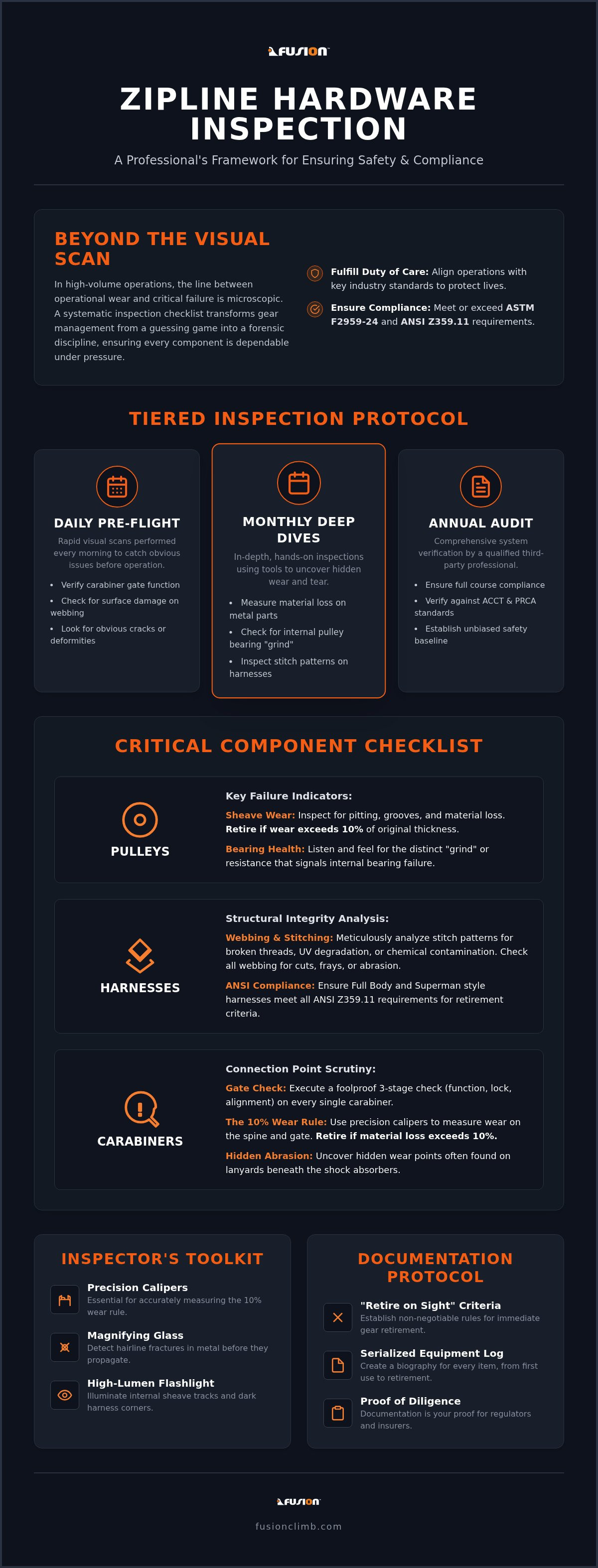
Effective safety management requires a tiered approach. You can't rely on a single annual check to catch daily friction damage or environmental degradation. A professional operation utilizes three distinct levels of scrutiny:
- Daily Pre-flight Checks: These are punchy, visual scans performed every morning. Staff must verify gate function on carabiners and look for obvious surface damage on harness webbing.
- Monthly Deep-dives: This is where you look beyond the surface. You're checking for internal bearing "grind" in pulleys and measuring metal loss with precision tools.
- Annual Professional Audits: A qualified third-party professional must verify your systems. This ensures compliance with ACCT and PRCA standards, providing an unbiased safety baseline for your entire course.
The Inspector's Toolkit: Tools for Success
You can't inspect what you can't see or measure accurately. A "Competent Person," as defined by industry standards, needs specialized equipment to perform a thorough zipline hardware inspection checklist. Relying on the naked eye alone is a recipe for oversight. Your toolkit should include:
- Precision Calipers: These are essential for measuring the 10% wear rule on carabiners and pulley side plates to determine retirement.
- High-Lumen Flashlights: You need to illuminate the internal tracks of sheaves and the dark corners of full body harnesses.
- Magnifying Glasses: These help detect hairline fractures in aluminum and steel components before they propagate into failures.
Every check must be logged in a serialized equipment log. This creates a biography for every piece of gear in your fleet, from its first use to its final retirement. Documentation is your proof of professional diligence. Without it, the inspection never happened in the eyes of regulatory bodies or insurance adjusters. Proper training ensures your team knows exactly what failure looks like, keeping your operation resilient and secure.
The Zipline Pulley Inspection Framework: Bearings and Sheaves
The pulley is the primary engine of any zipline run. It endures the highest friction and kinetic energy of any hardware component in your fleet. Because it's a moving part, it requires a more nuanced approach than static gear. A comprehensive zipline hardware inspection checklist must prioritize the mechanical health of the sheave and bearing assembly to prevent catastrophic failure. You aren't just looking for rust; you're looking for the subtle signs of metallurgical fatigue.
Safety is the baseline for every professional operator. Research into zipline safety and injury prevention highlights that equipment failure is often preventable through rigorous adherence to inspection protocols. When metal meets cable at high speeds, even a minor imperfection can escalate into a major hazard. Consistent monitoring ensures your hardware remains within the strict safety margins required for commercial use.
Evaluating Sheave and Cable Interaction
Inspect the sheave for pitting, grooves, or "bird-caging" damage transferred from the cable. Use precision calipers to measure material loss across the contact surface. If the wear exceeds 10% of the original sheave thickness, the unit is no longer mission-ready. High-speed commercial runs generate significant heat. Look for discoloration or "bluing" in the metal, which signals heat-induced fatigue that could compromise the structural integrity of the pulley.
Bearing and Rotation Diagnostics
Perform the "Spin Test" daily. Hold the pulley near your ear and spin the sheaves. You should hear a smooth, consistent hum. Any clicking, grinding, or uneven resistance indicates internal bearing failure. Check for lateral play by trying to wobble the sheave within the sideplates. If there's noticeable side-to-side movement, the bearings are shot. While some units allow for lubrication, most high-performance commercial zipline pulleys utilize sealed bearings that require full unit replacement once they begin to fail.
Trolley Body and Attachment Point Security
Examine the sideplates for warping, cracks, or deformation around the axle. Pay close attention to the carabiner attachment hole. Over time, heavy loading can cause this hole to elongate or develop sharp edges that could damage your connectors. Verify that all fasteners and nuts are secure and haven't vibrated loose during operation. If you notice any structural deformation, retire the hardware immediately. For operators committed to long-term safety, investing in high-quality zipline pulleys is the first step in maintaining a professional-grade course.
Evaluating Harness Integrity: Full Body and Superman Style Gear
The harness is the primary interface between the rider and the system. It's the most critical piece of personal protective equipment (PPE) in your fleet. While metal components show wear through friction and pitting, soft goods degrade through environmental exposure and mechanical stress. Your zipline hardware inspection checklist must account for the specific failure points of both standard full body harnesses and specialized Superman style gear. Consistency in these checks ensures that every rider is secured by gear that meets rigorous industrial standards.
Webbing and Textile Degradation
Textiles are vulnerable to UV radiation, chemical exposure, and abrasion. Use the "Bend Test" to identify damaged fibers. Fold the webbing into a tight "U" shape and look for stiffened or burnt areas that indicate heat or chemical damage. UV rays are a silent enemy; they can reduce the tensile strength of nylon and polyester significantly over a single season. If you find any nicks, cuts, or "fuzzy" structural threads, the harness is no longer fit for service. Any cut that exposes the internal core or exceeds a millimeter in depth is an immediate retirement criterion.
Structural Hardware and Buckle Security
The metal components of a harness, such as D-rings and quick-connect buckles, require their own diagnostic checks. Inspect D-rings for corrosion or deep scratching that could create sharp edges. These edges can slice through webbing under load. Test the spring tension of every auto-locking buckle. They must close and lock instantly without hesitation. If grit or salt air has slowed the mechanism, try cleaning it, but never compromise on locking speed. You can compare these requirements against other industry benchmarks in our ropes course safety equipment guide to ensure your fleet meets 2026 standards.
Superman Style Harness Specifics
Superman style harnesses for prone flight introduce unique load-bearing points that standard gear doesn't have. These harnesses utilize spreader bars and multiple torso attachment points to distribute weight horizontally. During your inspection, verify the integrity of the spreader bar welds and the security of the prone-position tethers. Check the leg loops and torso support for signs of uneven stretching. Prone flight gear often has more adjustment points than a standard harness; every buckle and strap must be checked for slip resistance. If the webbing slides through the buckle under manual pressure, the harness is unsafe for commercial use. Maintaining these specialized units requires a high level of technical precision to ensure rider comfort and safety during high-speed prone flight.
Critical Connection Points: Carabiners, Lanyards, and Tethers
Connectors are the high-stress bridge between the rider and the trolley. A professional zipline hardware inspection checklist must treat these components as critical failure points rather than simple accessories. Metal-on-metal friction at these interfaces leads to rapid material loss if hardware is mismatched or poorly maintained. Ensuring that your carabiners and lanyards are compatible and correctly oriented is non-negotiable for commercial safety. When connectors fail, they do so under peak load, making pre-operational verification your most important line of defense.
Professional Climbing Carabiner Diagnostics
A visual scan is insufficient for life-safety connectors. You must perform a 3-stage gate check on every carabiner: open the gate fully, allow it to snap shut, and verify that the locking mechanism engages without manual assistance. Grit, salt air, or oxidation often cause gate stickiness that prevents a full lock. Inspect the nose and pin area for burrs. These small metal protrusions can snag and fray harness webbing or lanyards during a transition. For deeper maintenance tips, read our full climbing carabiner guide.
Lanyard and Tether Integrity
Examine the termination points of every tether. Sewn eyes are standard in professional fleets because they offer predictable strength and easier inspection than knots. Look for "soft spots" or thinning in the lanyard body. This often indicates internal core damage from a fall or severe overload, even if the sheath looks intact. If the lanyard feels mushy or has a flat spot when pinched, retire it immediately. Review our zipline lanyards and tethers guide for more on material longevity and technical specifications.
Shock Absorber and Energy Limiter Checks
Shock packs must be protected from the elements to function correctly. Verify that the clear plastic cover is intact and free of trapped moisture or debris. Check the deployment indicator thread. This thread is designed to pop or tear if the lanyard has been subjected to a fall force. Ensure that the shock absorber is oriented correctly toward the harness as per manufacturer specifications. Hooking up an energy limiter in reverse can interfere with its deployment during an incident, compromising the safety of the rider.
Maintaining a fleet of reliable connectors is the foundation of a secure course. If your current gear shows signs of gate hesitation, burrs, or metal fatigue, it is time to upgrade your inventory. Shop our collection of high-strength carabiners to ensure your connections remain mission-ready for every guest.
Establishing Your Professional Retirement and Documentation Protocol
Safety is not a static condition. It's a continuous process of verification, documentation, and the courage to pull gear from service before it fails. A professional zipline hardware inspection checklist is only as effective as the retirement protocol that follows it. You must create a culture where documentation is as rigorous as the physical checks themselves. This ensures every pulley, harness, and carabiner has a traceable history from its first deployment to its final decommissioning.
The Lifecycle Management System
Every piece of hardware in your fleet requires a unique identifier. Serialized tracking allows you to monitor the high-volume wear of specific units and identify patterns across your inventory. When marking gear, never use metal stamps or etching on load-bearing frames; this creates stress risers. Use industrial-grade paint pens or specialized tape on non-structural areas instead. Transitioning to a digital log allows for instant safety audits and ensures your records are accessible during annual third-party inspections.
The Retirement Decision Matrix
Retirement decisions shouldn't be subjective. Use a clear matrix to determine when gear leaves the course. Non-negotiable failure points include:
- Visual Indicators: Metal components must be retired if they show material loss exceeding 10% of their original cross-sectional thickness.
- Temporal Indicators: Soft goods, like harnesses and lanyards, typically have a maximum service life of ten years from the date of manufacture, regardless of visual condition.
- Event-Based Indicators: Any hardware subjected to a significant shock load or dropped from height onto a hard surface must be retired immediately.
Once gear is retired, you must decommission it physically. Cut the webbing on harnesses and disable the gates on carabiners. This prevents retired equipment from accidentally being reintroduced into the active fleet.
Staff Accountability and Training
Your guides are your front-line inspectors. Empower them with a "Red Tag" system. Any staff member should have the authority to pull a piece of gear they find suspicious. Conduct regular gear-check drills to keep their eyes sharp for subtle wear patterns like glazing on webbing or hairline cracks in pulley sideplates. When your team understands the "why" behind the checklist, they become active guardians of your course integrity. Equip your team with Fusion Climb's professional zipline hardware for gear built to last through the most demanding commercial seasons.
Elevating Your Standard of Course Integrity
A professional zipline hardware inspection checklist is more than a daily chore; it's the heartbeat of a secure operation. You've moved beyond surface-level observations to master the forensic details of pulley bearing health and harness webbing integrity. By differentiating between standard full body gear and specialized Superman style harnesses, you ensure every rider's safety is backed by technical precision. Meticulous documentation and a strict retirement protocol transform your equipment management into a proactive shield against liability.
Consistency in safety requires gear that can handle the pressure. Fusion Climb manufactures hardware with industry-leading durability, specifically designed for the high-volume demands of commercial parks. Whether you're managing prone flight or upright transitions, our gear remains compliant with rigorous safety standards to give you and your guests total peace of mind. High-performance engineering ensures that your fleet stays operational through the most demanding seasons.
Upgrade your fleet with Fusion Climb's professional zipline hardware and lead the industry with a mission-ready course. Secure your legacy by choosing equipment built for the long haul and designed for absolute reliability.
Frequently Asked Questions
How often should zipline pulleys be inspected in a high-volume park?
High-volume parks must perform a visual and tactile scan of zipline pulleys every morning before the first rider. This daily check is the foundation of your zipline hardware inspection checklist. You should also conduct a monthly periodic review where you measure sheave wear with precision calipers. Annual audits by a qualified professional are required to meet ASTM F2959-24 standards. Consistent logging ensures you track the cumulative cycles of each unit accurately.
What are the most common signs of failure in a full body zipline harness?
Look for "fuzzy" or broken structural threads in the stitch patterns and glazing on the webbing surfaces. Chemical exposure or heat often causes the nylon to become brittle or stiff, which you can identify using the bend test. Any nicks or cuts in the load-bearing straps are immediate retirement criteria. If the auto-locking buckles hesitate or fail to engage instantly, the harness is no longer mission-ready for commercial use.
When should a professional climbing carabiner be retired from service?
Retire a carabiner if metal-on-metal friction has removed more than 10% of its original cross-sectional diameter. You must also decommission any connector if the gate fails to snap shut and lock automatically during your 3-stage check. Hairline cracks, deep gouges, or structural deformation are non-negotiable failure points. If a carabiner is dropped onto a hard surface from height, it must be removed from the active fleet immediately.
How do I identify UV damage on zipline lanyards and tethers?
UV degradation typically appears as significant color fading or a "chalky" appearance on the surface of the tether. The fibers may feel stiff or crunchy rather than supple when you manipulate the lanyard body. Because UV rays compromise the internal tensile strength of nylon, any visible surface degradation suggests the core is also weakened. Consistent exposure to direct sunlight accelerates this process, often requiring retirement after a single high-volume season.
Is it safe to use a zipline pulley if the bearings are making noise?
It's never safe to use a pulley if the bearings are clicking, grinding, or producing uneven resistance. These sounds signal internal mechanical failure or the presence of grit that can lead to a seizure during a high-speed run. A healthy sheave should produce a smooth, consistent hum when spun. If the rotation is compromised, the unit must be pulled from service and replaced to maintain course integrity and rider safety.
What is the difference between an ANSI-compliant harness and a standard one?
ANSI-compliant harnesses, specifically those meeting ANSI Z359.11, undergo rigorous dynamic drop tests and static load testing that standard recreational gear doesn't face. These standards ensure the hardware and webbing can withstand specific force thresholds during a fall. For commercial operators, using ANSI-compliant gear is a critical component of your professional zipline hardware inspection checklist and helps satisfy insurance requirements for high-stakes aerial adventure environments where safety is the priority.
Can I use WD-40 to lubricate my zipline pulley bearings?
Don't use WD-40 on your pulley bearings because it acts as a solvent and can strip away the internal factory grease. It also attracts dust and grit, which accelerates mechanical wear in high-volume environments. If your pulley allows for maintenance, use a manufacturer-recommended dry lubricant like Teflon or graphite-based sprays. However, many modern commercial pulleys use sealed bearings that shouldn't be lubricated and must be replaced if they become rough.
What should I do if a piece of hardware is dropped from a significant height?
Any piece of hardware dropped from a significant height onto a hard surface like rock or concrete must be retired immediately. Even if the exterior looks pristine, the impact can cause internal micro-fractures that compromise the structural integrity of the metal. These "silent" failures are impossible to detect without specialized non-destructive testing. It's always safer and more cost-effective to replace a dropped carabiner than to risk a catastrophic failure on the line.