



Types of Carabiner Locking Mechanisms: A Professional Guide to Gate Security
The difference between a secure anchor and a catastrophic gate roll-out often comes down to a few millimeters of machined alloy and the specific locking logic you choose. In high-stakes vertical environments, your hardware is the only thing standing between a successful operation and a critical failure. You understand that gear must perform flawlessly; however, the technical distinctions between various types of carabiner locking mechanisms often create unnecessary confusion on the job site.
Accidental openings in muddy conditions or the struggle to operate a gate with heavy gloves are risks you cannot afford. This professional guide will help you master the technical differences between manual and automatic hardware to ensure maximum safety in industrial rigging and climbing. We will provide a clear breakdown of gate mechanics, explain why the ANSI Z133-2026 standard now mandates triple-action locks for life support, and establish definitive criteria for when to retire your gear. You will gain the technical assurance needed to select the right tool for every high-tension scenario, moving from uncertainty to total operational confidence.
Key Takeaways
- Understand why every life-support connection must utilize a mechanical sleeve to prevent accidental gate opening.
- Compare the technical differences between various types of carabiner locking mechanisms to match the right tool to your specific rigging environment.
- Evaluate the advantages of manual screw-gates for permanent anchors versus the speed and redundancy provided by automatic systems.
- Learn how to identify and mitigate environmental risks like grit, mud, or ice that can compromise gate security.
- Master professional inspection and cleaning protocols to ensure your hardware meets rigorous safety standards throughout its service life.
Foundations of Gate Security: Non-Locking vs. Locking Carabiners
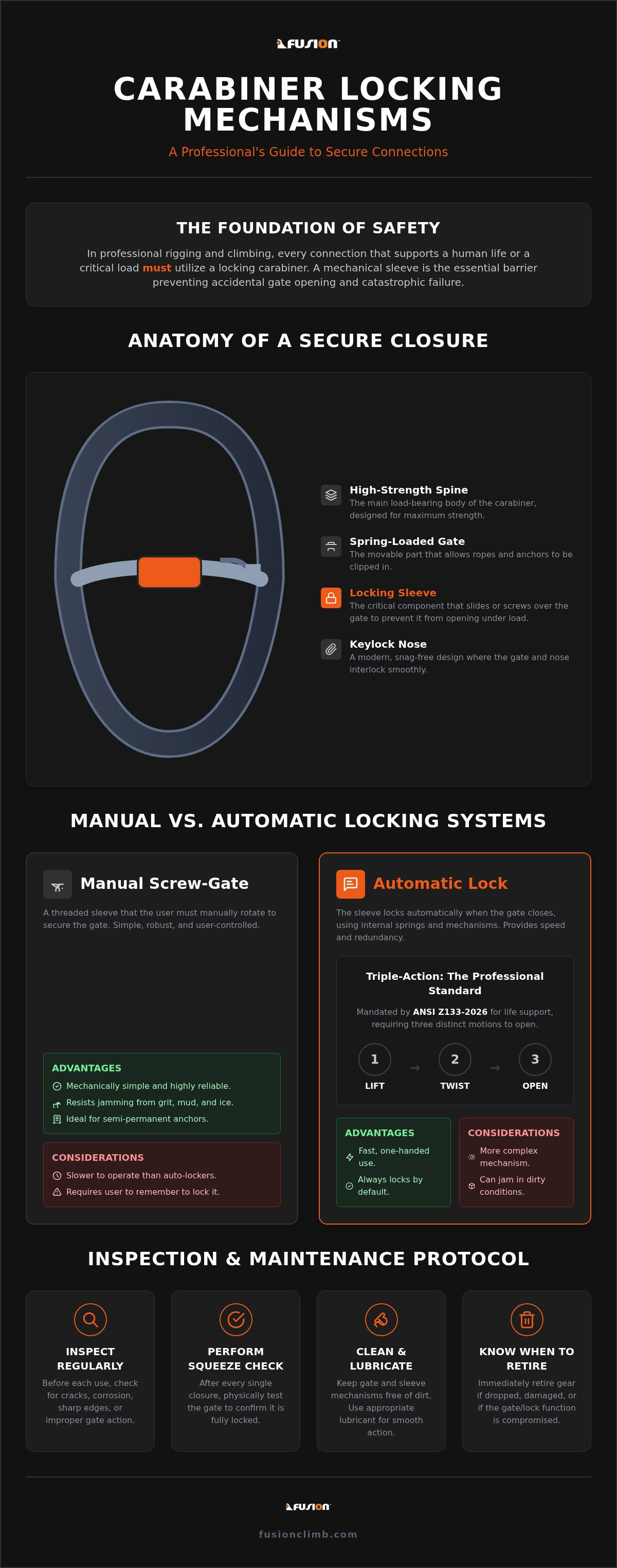
A Carabiner serves as the primary link in any vertical system. While non-locking versions exist for specific recreational tasks, a locking carabiner is defined by its mechanical sleeve, often called a barrel, which prevents the gate from opening accidentally. This sleeve is the physical manifestation of the "critical connection" principle. In professional rigging and climbing, any link that supports human life or critical loads must utilize a locking mechanism to mitigate the risks of human error or equipment interference. The structure consists of three primary components: the high-strength spine, the spring-loaded gate, and the locking sleeve that secures the closure.
It's vital to distinguish between professional Personal Protective Equipment (PPE) and non-load-bearing accessory clips. PPE-certified connectors undergo rigorous testing to meet ANSI or EN standards, ensuring they can withstand thousands of pounds of force. Accessory carabiners are intended for light utility only; they lack the structural integrity and locking security required for safety-critical applications. Understanding the different types of carabiner locking mechanisms begins with recognizing that security is a non-negotiable requirement for professional-grade hardware.
When to Use Non-Locking Gates
Non-locking gates prioritize speed and ease of clipping. You'll see them used in quickdraws or for racking gear on a harness where a sleeve would only cause delays. However, they carry inherent risks like "gate lash," where a sudden impact or vibration causes the gate to flutter open momentarily. This reduces the carabiner's strength to its "open-gate" rating, which is significantly lower than its rated closed-gate capacity. Professional industrial rigging almost exclusively relies on locking variations to eliminate this vulnerability and ensure a closed system at all times.
The Anatomy of a Secure Closure
The interface between the gate and the nose determines how smoothly the hardware operates. Modern designs utilize a "keylock" nose, which features a smooth, notched interface that prevents the carabiner from snagging on bolts or webbing. This is a significant upgrade over traditional hook-and-pin designs that often catch at the worst possible moment. The locking sleeve reinforces the gate against inward pressure, providing structural stability to the entire loop. The gate sleeve acts as the primary mechanical barrier that prevents the gate from moving out of the locked position during use.
Manual Locking Mechanisms: The Versatility of the Screw-Gate
Among the fundamental types of carabiner locking mechanisms, the manual screw-gate is the most enduring design. It relies on a threaded sleeve that you manually rotate to secure the gate against the nose. This simplicity is its greatest strength. While automatic systems provide speed, the screw-gate offers a level of mechanical reliability that is difficult to match in permanent or semi-permanent rigging. Professionals often prefer these for anchors because they don't rely on internal spring tension to maintain a locked state. Screw-gates endure where complexity fails.
Environmental resilience is a critical factor where manual locks outshine their complex counterparts. In desert environments or construction sites where fine grit and mud are prevalent, the open threads of a screw-gate are easier to clear and operate. Complex automatic mechanisms can seize when particles enter the internal tracks. For those managing life-safety carabiners in harsh conditions, the ability to physically see and feel the threads engage provides essential peace of mind. The threaded sleeve provides a mechanical lock that is resistant to the grit and sediment common in industrial rigging environments.
Operational Advantages of Manual Locks
Manual locks offer significant weight savings, making them ideal for long approaches or extensive gear hauls. Because they lack the multi-stage internal components of an auto-locker, they are lighter and less prone to mechanical fatigue over years of use. They also provide superior tactile feedback. You can feel the sleeve bottom out, confirming the gate is secure. This manual interaction encourages the "squeeze check" habit, a vital safety protocol where the user physically tests the gate after every closure. If you are building a complex system, choosing high-quality Professional Climbing Carabiners ensures your manual links are as dependable as your rigging requires.
Risks and Mitigation in Manual Systems
The primary risk with manual systems is human error, specifically forgetting to lock the sleeve. Some manufacturers mitigate this by painting a red warning stripe on the gate that is only visible when the sleeve is open. Another concern is "vibration loosening." In high-movement environments like ziplines or heavy industrial rigging, constant vibration can cause a loose sleeve to migrate down the threads. To prevent this, always ensure the sleeve is snug. However, never over-tighten a screw-gate while the connector is under a heavy load. This can cause the threads to bind, making it nearly impossible to unlock once the load is removed. For those looking to upgrade their kit, investing in professional rigging and safety hardware is the first step toward a more secure system.
Automatic Locking Systems: Speed, Security, and Redundancy
Automatic locking systems remove the critical variable of human forgetfulness from the safety equation. An auto-locking gate is engineered to return to a fully locked position the moment it snaps shut, requiring no secondary action from the user to secure the connection. This immediate redundancy is vital in fast-paced environments where a rigger might be managing multiple connection points simultaneously. While manual gates offer simplicity, these advanced types of carabiner locking mechanisms provide a necessary layer of protection against the "forgot-to-lock" errors that lead to catastrophic failures. They are the standard for high-frequency clipping and high-stakes rescue operations.
Modern hardware utilizes several sophisticated designs to achieve this security. The 2-stage mechanism, often called a twist-lock, requires two distinct actions: a rotation of the sleeve followed by a push to open the gate. For even higher security, the 3-stage or triple-action lock adds a third requirement, such as sliding the sleeve up or down before twisting. Beyond these, specialized mechanisms like magnetic locks use attractive forces in the carabiner nose to keep the gate arms closed, while directional locking gates are designed to prevent the connector from rotating and cross-loading during use.
2-Stage vs. 3-Stage: Choosing Your Security Level
Selecting between double-action and triple-action hardware depends entirely on the risk of accidental gate interference. 2-stage locks are often sufficient for work-positioning tasks where the connector remains in a predictable orientation. However, for fall arrest and life support, the industry has shifted toward higher redundancy. The ANSI Z133-2026 standard now mandates that carabiners used for life support in arboricultural operations must be auto-locking and require three consecutive, deliberate actions to open. This level of security is essential for Zipline Lanyards and Tethers, where equipment often rubs against cables or harnesses. Triple-action locks ensure that a stray branch or a shift in gear cannot accidentally trigger the opening sequence.
Ergonomics and One-Handed Operation
High-security hardware must still be functional in the field. Professionals master the "palm-and-twist" technique, using the base of the thumb to slide the sleeve while the fingers rotate and depress the gate. This allows for fluid, one-handed operation even when wearing gloves. While a 3-stage lock is inherently slower than a manual gate, the gain in security outweighs the fractional loss in speed for most industrial applications. In rescue scenarios, the mechanical assurance that the gate is locked the moment it clicks provides a psychological and physical safety net. 3-stage locks are the preferred choice for preventing accidental "gate-rub" openings. They provide the rugged reliability required when moving through complex vertical environments where gear contact is inevitable.
Operational Selection: Matching Mechanism to Environment
Selecting from the various types of carabiner locking mechanisms requires an honest assessment of your operating environment. In desert landscapes or heavy construction zones, dust and grit are your primary enemies. While automatic systems offer speed, their internal tracks are vulnerable to particulate infiltration. A jammed auto-locker is a liability. In these conditions, manual screw-gates are often the superior choice because their open threads are easily inspected and cleared of debris. Conversely, extreme cold presents a different challenge. Sub-zero rigging can cause moisture to freeze within the locking sleeve, potentially seizing the mechanism in either the open or closed position. Riggers must choose hardware with large, textured sleeves that can be operated with insulated gloves and cleared of ice buildup.
When your task involves hundreds of clips per shift, such as in a commercial aerial park, the risk of human error increases with fatigue. High-frequency use favors automatic locking systems. These mechanisms eliminate the repetitive motion of threading a sleeve, reducing hand strain and ensuring the gate is secured even when the operator is tired. Many commercial operators now move away from operator choice toward a strict company standard to ensure uniformity in safety protocols across the entire team. This standardization minimizes the training gap and ensures every rigger is using the most appropriate tool for the specific job site.
Industrial Standards and Compliance (ANSI/UIAA)
Professional rigging hardware must meet the ANSI Z359.12 mandate, which requires the gate and sleeve to withstand 3,600 lbs (16kN) of force. This is a significant leap over recreational standards. To achieve this, industrial-strength carabiners often utilize steel for the locking sleeves rather than aluminum. Steel provides the necessary hardness to resist deformation under load, ensuring the mechanism continues to function even after high-stress events. If you are building a professional system, pairing these connectors with Commercial Zipline Pulleys ensures your entire rig meets these rigorous engineering safety standards.
Mechanism Selection Framework
Before deploying gear, run through a mental checklist: Environment + User Skill + Frequency of Clipping. In commercial adventure parks, double-locking mechanisms are often non-negotiable for life-safety. They provide the redundancy needed to protect guests who may not have the technical skill to manage manual hardware. Fusion Climb designs for this dependable guardian role by subjecting every piece of hardware to rigorous testing that exceeds industry minimums. You can find our full range of ANSI-compliant carabiners to secure your next project with professional-grade hardware. Trust your equipment so you can focus on the mission.
Ensuring Reliability: Inspection and Maintenance of Locking Gates
High-performance hardware is only as reliable as your last inspection. Even the most advanced types of carabiner locking mechanisms can fail if they are neglected or contaminated by the environments described in previous sections. The "Function Test" is your primary defense against mechanical failure. To perform it, simply open the gate and release it. The gate should snap shut, and the locking sleeve must immediately return to the fully locked position without any manual assistance. If the sleeve hesitates, sticks, or requires a nudge to close, that carabiner is no longer fit for life-support applications.
Cleaning protocols are essential for maintaining the integrity of the locking barrel. Salt spray, fine sand, and even oxidized aluminum (the white powder that forms on weathered gear) can migrate into the internal springs of an auto-locker or the threads of a screw-gate. Use warm water and a soft brush to clear these contaminants. After cleaning, apply a dry-film lubricant such as graphite or PTFE-based sprays. Avoid using heavy oils or WD-40. These substances might provide a temporary fix, but they act as magnets for grit, eventually creating a grinding paste that accelerates internal wear.
Common Failure Modes of Locking Sleeves
Locking sleeves often fail due to internal spring fatigue or hidden corrosion. In manual carabiners, the most common issue is thread stripping. This typically occurs from over-tightening the sleeve while the connector is under load or from cross-loading the gate. Physical deformation is another critical risk. If a carabiner is dropped from height onto a hard surface, the frame can "ovalize." This subtle shift in geometry can jam the locking barrel, making it impossible to secure or open the gate. Any carabiner that has sustained a major impact or shows visible deformation must be retired immediately.
The Professional Inspection Routine
Commercial operators must go beyond daily pre-use checks. A professional safety program requires documented quarterly inspections by a competent person. During these reviews, look for "gate-play" and "sleeve-wobble." While a tiny amount of movement is normal, excessive lateral play in the gate indicates that the hinge pin is wearing out. If the locking sleeve feels loose or rattles when closed, the internal spring tension has likely diminished. Never compromise on your safety margins. For hardware that meets the highest manufacturing standards, trust your life to Fusion Climb’s industrial-grade hardware. Rig with confidence, knowing your gear is built to endure the most demanding vertical challenges.
Mastering Your Vertical Security
Building a failsafe rigging system begins with mastering the technical nuances of gate security. You now have the knowledge to evaluate different types of carabiner locking mechanisms based on specific environmental variables like abrasive grit or extreme cold. Whether you deploy the time-tested reliability of a manual screw-gate or the rapid redundancy of a triple-action auto-locker, your choice must always align with the demands of the task. Consistent inspection and proactive maintenance ensure that these tools remain life-safety assets rather than operational liabilities.
Professional operations require hardware that doesn't just meet minimums but exceeds them for industrial durability. Fusion Climb provides precision-engineered equipment trusted by commercial zipline operators nationwide. Our ANSI Z359.12 compliant options are built to withstand the most demanding vertical environments. Don't settle for recreational gear when lives are on the line. Equip your crew with Fusion Climb’s professional rigging hardware. Take command of your next project with the technical assurance that only professional-grade hardware can provide.
Frequently Asked Questions
What is the difference between a 2-stage and 3-stage locking carabiner?
A 2-stage (twist-lock) requires two actions: a rotation and a push. A 3-stage (triple-lock) adds a third movement, like sliding the sleeve vertically before twisting. The 3-stage design is now the mandatory standard for life support under ANSI Z133-2026. This extra step prevents accidental roll-out when gear rubs against branches or cables. Understanding these types of carabiner locking mechanisms is essential for selecting the correct redundancy for your safety system.
Are auto-locking carabiners safer than screw-gate carabiners?
Safety is relative to your environment and frequency of use. Auto-locking carabiners eliminate the risk of forgetting to lock the sleeve, which is vital in high-frequency clipping. However, screw-gates are often preferred for permanent anchors because they don't rely on internal spring tension to stay closed. Screw-gates also perform better in muddy or gritty conditions where complex automatic mechanisms might seize. You must match the mechanism to the specific task and environment.
What does ANSI Z359.12 compliance mean for carabiner locks?
ANSI Z359.12 compliance specifies that the carabiner gate and locking sleeve must withstand 3,600 lbs (16kN) of force. This is a rigorous industrial standard designed for fall arrest and rigging. In contrast, recreational hardware often only meets lower gate-strength requirements. If you are working in a commercial zipline or industrial setting, using ANSI-compliant hardware is a non-negotiable requirement for ensuring crew and participant safety across the entire country.
Can I use a climbing carabiner for industrial rigging or ziplining?
You shouldn't use standard recreational climbing carabiners for industrial rigging or commercial ziplining. Industrial applications demand hardware that meets specific ANSI standards for gate strength and locking redundancy. Recreational gear is often designed for lightness and may not survive the repetitive loading or environmental stress of a commercial operation. Always verify that your connectors are PPE-certified for the specific industrial or zipline tasks you are performing to ensure maximum reliability.
How do I clean a locking carabiner that is sticking?
Start by rinsing the hardware in warm, soapy water and using a soft brush to clear sand or salt from the threads and springs. Once dry, apply a dry-film lubricant like graphite or a PTFE-based spray to the internal components. Never use WD-40 or heavy oils. These lubricants attract dust and grit, which eventually forms a grinding paste that will permanently damage the internal types of carabiner locking mechanisms.
Why do some locking carabiners have a "keylock" nose?
The keylock nose replaces the traditional hook-and-pin design with a smooth, notched interface. This prevents the carabiner from snagging on bolts, slings, or steel cables during clipping and unclipping. Snagging isn't just a nuisance; it can lead to dangerous cross-loading where the carabiner is stressed across its weakest axis. A keylock nose ensures a cleaner, safer connection in high-pressure rigging or rescue scenarios where every second and every movement counts.
What is carabiner "gate lash" and how do locking gates prevent it?
Gate lash occurs when a sudden impact or vibration causes a non-locking gate to flutter open momentarily. This flutter drops the carabiner's strength to its "open-gate" rating, which is often 60% lower than its closed capacity. Locking gates prevent this by using a mechanical sleeve to keep the gate arm firmly seated against the nose. This ensures the connector maintains its full rated strength even during high-vibration events like zipline descents or heavy industrial loads.
When should I retire a locking carabiner?
Retire your hardware immediately if the gate fails the "function test" by not snapping shut or if the sleeve sticks. Look for visible deformation, such as "ovalization" from a drop, or more than 10% wear on the metal surface. Any carabiner involved in a major fall or significant impact must be removed from service. Documented quarterly inspections help identify these issues before they become life-safety liabilities on the job site or adventure park.