


Steel vs. Aluminum Carabiners: 2026 Professional Buying Guide
The lightest connector on your rack might be the very tool that compromises your long-term safety in a high-tension environment. Choosing between steel vs aluminum carabiners isn't just about weight; it's a calculated decision based on duty cycle and environmental exposure. You understand that every gram counts during a long day of rigging, but you also fear the abrasive wear that leads to premature hardware retirement. It's a difficult balance between the agility of a lightweight build and the raw, industrial durability required for heavy-duty hauling.
This 2026 professional buying guide will help you master the technical differences between these materials to ensure you choose the safest, most efficient connectors for your specific application. We'll examine critical safety standards like ANSI Z359.12 and compare the high-capacity breaking strength of hardware like the Tacoma Steel against the rapid-deployment features of aluminum models. You'll gain a clear decision matrix to optimize your rigging or sailing setup for maximum reliability and professional-grade performance.
Key Takeaways
- Identify the ideal duty cycle for your gear by prioritizing steel for high-wear static loads and aluminum for weight-sensitive dynamic movements.
- Compare critical breaking strengths to ensure your hardware meets industrial demands, such as the 50KN capacity found in heavy-duty steel connectors.
- Evaluate environmental factors like saltwater exposure and extreme temperatures to select the correct corrosion-resistant finishes for your rigging.
- Master the steel vs aluminum carabiners selection process to guarantee compliance with 2026 ANSI and NFPA safety regulations.
- Establish a precise inspection routine that targets material-specific wear patterns to prevent hardware failure and extend the life of your equipment.
Understanding the Fundamental Differences Between Steel and Aluminum
The choice between steel vs aluminum carabiners is a fundamental calculation of material science and mission requirements. It's not just about weight. It's about how the metal reacts under tension, friction, and environmental stress. Carbon steel is defined by its extreme surface hardness and resistance to abrasion. In contrast, 7075-T6 aluminum is an aerospace-grade alloy that utilizes zinc as its primary alloying element to balance structural integrity with minimal mass. Before selecting your hardware, it's vital to understand what is a carabiner in a technical context: a specialized shackle designed to connect components under load while maintaining a specific safety factor.
Professional riggers often face the "Strength-to-Weight" paradox. While steel is undeniably stronger in absolute terms, its density can become a liability in mobile systems. Heavy hardware increases system sag and operator fatigue. However, choosing a lighter material can lead to a shorter "Duty Cycle." We define the duty cycle as the frequency and intensity of use before a component requires retirement. High-wear applications, such as zip line trolleys or permanent anchors, demand the longevity of steel. Rapid response kits or sailing rigs, where speed and agility are paramount, rely on the performance of aluminum.
Steel: The Workhorse of Industrial Rigging
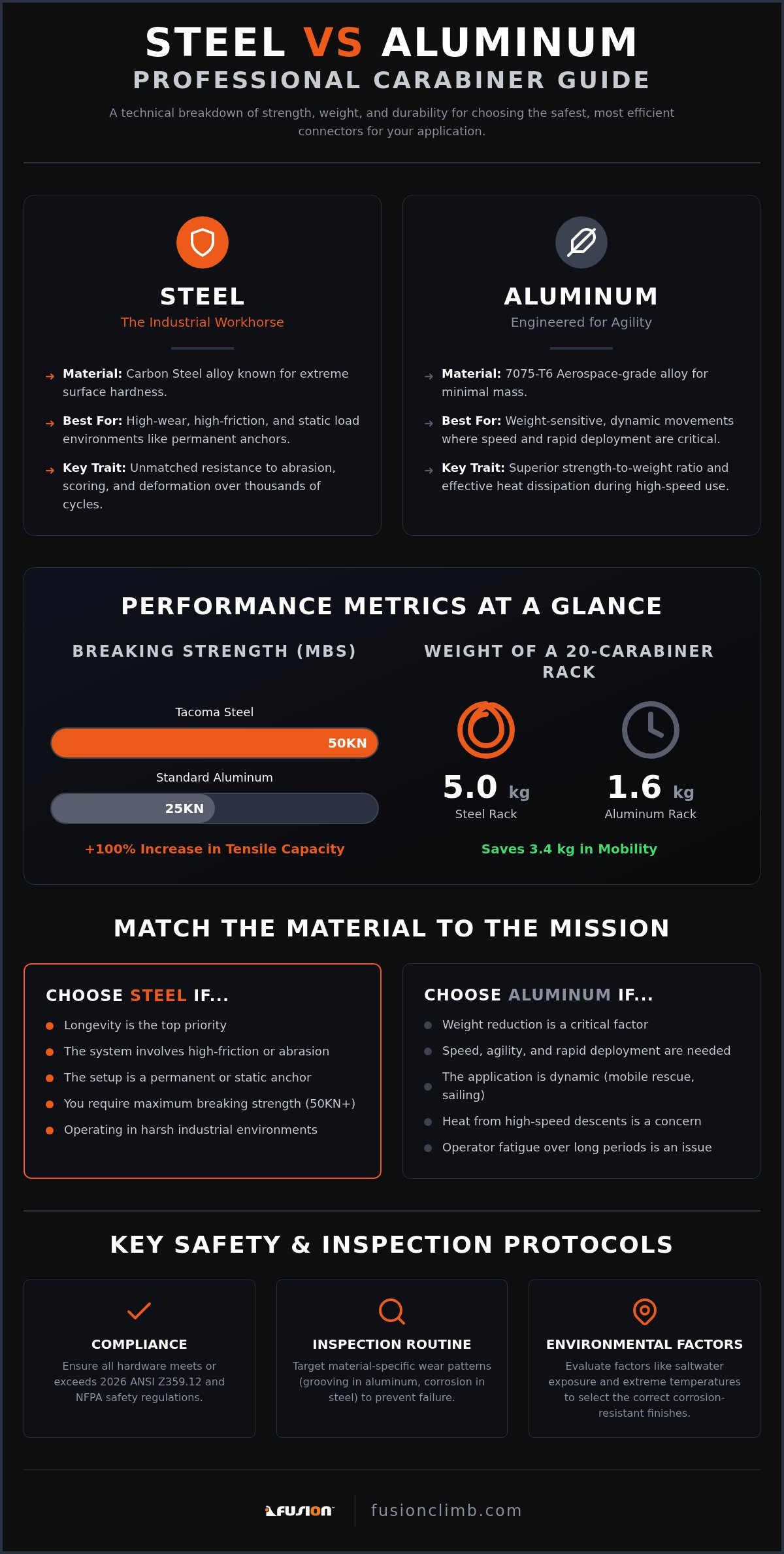
Steel dominates environments where durability is non-negotiable. It excels under high-friction conditions, specifically rope-on-metal wear that would quickly score or groove an aluminum frame. This material resists deformation and surface scratching even when subjected to the grit of industrial sites or the constant movement of rescue systems. Because steel maintains its structural integrity over thousands of loading cycles, it remains the industry standard for permanent anchors and heavy-duty hauling. Hardware like the Tacoma Steel provides a massive 50KN breaking strength, offering a safety margin that aluminum simply cannot match in high-tension rigging.
Aluminum: The Choice for Agility and Speed
Aluminum is built for movement. In mobile rescue operations or competitive sailing, every gram of weight saved translates to increased speed and reduced physical strain. 7075-T6 aluminum offers a high strength-to-weight ratio that allows for rapid deployment without compromising safety standards. Beyond weight, aluminum handles thermal stress differently. It dissipates heat more effectively than steel, which is a critical advantage during high-speed descents where friction generates significant heat. Most professional aluminum hardware, such as the Swift Aluminum series, features an anodized finish. This electrochemical process creates a hard, protective layer that prevents surface oxidation and increases the lifespan of the connector in damp environments.
Performance Comparison: Strength, Weight, and Durability
Precision engineering demands a clear look at the data. The choice between steel vs aluminum carabiners often comes down to raw numbers. A Tacoma Steel connector provides a 50KN Minimum Breaking Strength (MBS), while standard aluminum models typically hover around 25KN. This 100% increase in tensile capacity makes steel the only viable choice for high-tension industrial rigging. However, strength is only half of the equation. You must also account for the physical toll on the operator. Consider a standard kit containing 20 carabiners. A rack of heavy-duty steel connectors can weigh upwards of 5 kilograms, whereas an aluminum equivalent weighs approximately 1.6 kilograms. That 3.4-kilogram difference directly impacts mobility and endurance during long shifts in the field.
Fatigue life is the silent factor in hardware retirement. Aluminum alloys are more susceptible to microscopic stress fractures over repeated loading cycles. In contrast, steel offers a superior cost-to-life ratio. While the initial investment might be higher, a steel carabiner can remain in service for years of heavy use, whereas aluminum may require retirement after a single season of high-intensity work. You aren't just buying a connector; you're investing in the longevity of your entire safety system.
Tensile Strength and Load Ratings
Understanding professional climbing carabiners requires looking beyond the major axis rating. While steel handles massive loads, its minor axis and gate-open strengths are also significantly higher than aluminum. This provides a critical safety buffer if the hardware becomes cross-loaded during a dynamic event. Steel also absorbs shock loading with less permanent deformation. Aluminum is more brittle, meaning it can reach its elastic limit sooner when subjected to sudden, violent forces.
Wear Resistance and Rope Longevity
Material hardness dictates how your hardware interacts with soft goods. Aluminum is soft enough that dirt-impregnated ropes can act like sandpaper, creating deep "grooves" in the frame over time. These grooves eventually develop sharp edges that can shred your expensive zipline lanyards and tethers. Steel maintains a smooth, polished surface even after thousands of cycles. This preserves the integrity of your ropes and reduces friction in high-tension sailing setups. If your application involves constant rope movement, choosing steel is a proactive way to protect your other equipment investments. For those working in maritime environments, selecting specialized sailing hardware with the right finish is essential for preventing both material wear and environmental degradation.
Choosing the Right Material for Your Environment
Environment is the ultimate stress test for any rigging system. The debate of steel vs aluminum carabiners often shifts from load capacity to survival when salt, chemicals, or extreme temperatures enter the frame. Zinc-plated steel provides a cost-effective barrier against moisture, but it's a temporary defense. Once the plating is breached by surface scratches, the underlying carbon steel is vulnerable to rapid oxidation. Stainless steel offers deep-seated resistance throughout the metal, making it the premier choice for humid or saturated conditions. Aluminum relies on its anodized skin for protection. This electrochemical coating resists the elements well, but it's sensitive to strong alkaline or acidic cleaning agents. These chemicals can strip the finish and expose the reactive alloy beneath to pitting.
Temperature extremes also dictate material integrity in the field. Aluminum alloys begin to lose structural strength at lower temperatures than steel, making steel the safer option for industrial heat exposure or environments near active fire. Conversely, in sub-zero environments, certain grades of steel can become brittle. Modern high-performance alloys are engineered to mitigate this risk, but it remains a critical factor for hardware used in arctic rigging or high-altitude operations where metal fatigue can accelerate in the cold.
Sailing and Marine Applications
Saltwater acts as a relentless electrolyte that destroys hardware from the inside out. It specifically targets moving parts like gate springs and pins. If salt crystals build up within the mechanism, the gate may fail to close or lock, which compromises the entire safety chain. While aluminum is prized in competitive racing for its agility and weight savings, it requires rigorous maintenance and frequent fresh-water rinsing to prevent corrosion. For any hardware intended to remain on a deck or as part of a permanent dock setup, stainless steel is the only professional standard that ensures long-term reliability.
Industrial and Rescue Scenarios
Regulatory bodies like the NFPA distinguish between 'General Use' and 'Technical Use' hardware. Steel typically populates the 'General Use' category because it easily meets the higher Minimum Breaking Strength (MBS) requirements of 40kN or more. Aluminum often fills 'Technical Use' roles where a 20kN threshold is acceptable for personal mobility and speed. When you are setting up commercial zipline pulleys, the environmental footprint of the course dictates the material. A coastal zipline course demands the corrosion resistance of high-grade stainless steel to ensure the locking mechanisms don't seize during daily operation. Rescue professionals often bridge this gap by carrying a hybrid rack; they utilize steel for the main anchor points while relying on aluminum for their personal positioning lanyards to keep the total kit weight manageable.
Standout Hardware: Top Carabiners for Your 2026 Kit
Selecting the right hardware requires moving from metallurgical theory to field-ready solutions. The decision between steel vs aluminum carabiners becomes clear when you hold the specific tool designed for your task. Industrial rigging demands high-capacity anchors. Technical rescue requires rapid, snag-free movement. By matching the hardware to the mission, you ensure both operator safety and equipment longevity.
Professional Steel Connectors
For high-security distribution, the Ovatti Steel Auto Lock ($13.99-$15.99) stands as a primary choice. It is ANSI Z359.12 compliant and features a pin nose designed for secure loading. This level of compliance is critical for meeting modern safety regulations in commercial environments. If your mission involves extreme loads, the Tacoma Steel 50KN ($28.50) is the heavy-duty powerhouse you need. With a 50KN high-capacity breaking strength, it provides the ultimate safety margin for demanding rescue operations. Auto-locking gates are standard here because they eliminate the risk of human error in high-vibration industrial settings. They lock automatically upon closing, providing a sobering sense of security when you're working at height.
High-Performance Aluminum Connectors
When agility dominates the mission, aluminum offers the necessary speed. The Swift Auto Lock Modified D ($14.13) is a preferred choice for arborists and tree care professionals who need to move quickly through complex canopies. It utilizes a spring-loaded gate and a snag-free key nose for rapid deployment. This D-shape design maximizes gate opening clearance compared to traditional ovals, allowing for easier clipping to thick cables or ropes. For multi-point rigging where weight is a primary concern, the Supreme Oval ($8.51-$10.19) provides cost-effective performance for outdoor use. Oval connectors distribute load evenly across the spine. This makes them ideal for use with pulleys or in complex haul systems where alignment is essential for smooth operation.
Specialized Rigging Accessories
Complex systems often require more than just a simple connector. The Presto Delta Triangle Swing Swivel ($55.11) is an aluminum rotational device engineered to prevent rope twisting in high-performance setups. Integrating these carabiners correctly with ropes course safety equipment ensures that your entire system meets modern engineering standards. Choosing the right hardware is the first step toward a safer, more efficient season. You can browse our complete Sailing and Rigging collection to find the exact tools for your next challenge.
Safety Standards and Inspection: Getting the Most Out of Your Hardware
Safety isn't a suggestion. It's a protocol. Every professional connector features laser-etched markings that act as its technical resume. These etchings communicate the Minimum Breaking Strength (MBS) and confirm compliance with regulatory bodies like ANSI or NFPA. When evaluating steel vs aluminum carabiners, you must verify these markings before every mission. A faded or illegible marking is a signal for immediate retirement. You aren't just looking for a number; you're looking for the assurance that the tool was manufactured to survive the forces you intend to apply.
Perform a tactile and visual check before every shift. Test the gate. It should snap shut instantly without hesitation. Any "stickiness" in an aluminum gate often points to grit or salt crystallization, while a sluggish steel gate might indicate internal spring fatigue or surface oxidation. Check the alignment. The gate must seat perfectly into the nose; if it doesn't, the carabiner's structural integrity is compromised. Your connectors are only as strong as the system they join. Always match your hardware to ANSI compliant safety harnesses to maintain a unified safety factor across your entire rig.
The 10% Rule for Material Wear
Aluminum is especially susceptible to rope-induced wear. Use a caliper to measure the depth of any grooves formed by rope friction or pulley contact. The 10% rule dictates that any hardware must be removed from service if material wear or grooving exceeds 10% of the original metal thickness. Look for burrs or sharp edges. These surface defects act as blades against your soft goods, necessitating immediate retirement even if the structural integrity seems intact. Steel is more resistant to this grooving, but you must still inspect for "pitting" or deep scratches that could harbor corrosion and lead to stress fractures.
Maintenance and Care
Hardware longevity depends on your post-mission routine. For saltwater-exposed gear, rinse hardware thoroughly in lukewarm fresh water. Dry every component completely before storage to prevent galvanic corrosion. When lubricating gate hinges, use a dry-film lubricant. Avoid oil-based products. They attract dust and metal shavings that turn into an abrasive paste, which accelerates wear on the very parts you're trying to protect. Proper care ensures your hardware remains a dependable partner in the field. Upgrade your rigging kit with Fusion Climb’s professional hardware to ensure your gear meets the highest industrial standards for 2026.
Secure Your System for the 2026 Season
Mastering the technical nuances of steel vs aluminum carabiners ensures your rigging remains both efficient and uncompromisingly safe. You've seen that material selection isn't just a matter of preference; it's a direct response to your specific operational demands and environmental challenges. Prioritize professional grade forged steel with 50KN heavy duty load ratings for your permanent anchors and high-tension systems. For rapid deployment and mobile rescue missions, rely on the lightweight precision of 7075 aluminum to reduce operator fatigue without sacrificing structural integrity.
Every connection in your safety chain must meet the highest industrial standards. Whether you're navigating the corrosive salt spray of a marine environment or managing high-friction industrial loads, ensure your gear is ANSI Z359.12 compliant. This rigorous testing provides the sobering sense of security required for high-stakes vertical work. Ready to optimize your rack for the challenges ahead? Shop the Full Sailing & Rigging Collection to find specialized hardware built for the professional. Step into your next mission with the confidence that your equipment is as dependable as your expertise.
Frequently Asked Questions
Is a steel carabiner always stronger than an aluminum one?
Steel carabiners typically offer higher absolute breaking strengths, often reaching 50kN or more, while aluminum models usually max out around 25kN to 30kN. However, strength is application-specific. You must check the laser-etched markings for the major axis, minor axis, and gate-open ratings. In some technical applications, the strength-to-weight ratio of high-grade aluminum provides sufficient safety margins while reducing total system mass.
Can I use aluminum carabiners for permanent outdoor rigging?
Aluminum isn't the best choice for permanent outdoor installations. While anodized finishes provide initial protection, constant exposure to the elements leads to oxidation and gate mechanism failure. Steel, particularly stainless or galvanized options, handles long-term static loads and environmental stress much better. If you leave aluminum hardware outside, the duty cycle shortens significantly, necessitating frequent inspections and premature retirement to ensure operator safety.
How do I know if my carabiner is ANSI or NFPA compliant?
Compliance is verified by looking at the laser-etched markings on the carabiner's spine or frame. Look for specific codes like ANSI Z359.12 or NFPA 1983. These markings confirm the hardware passed rigorous third-party testing for tensile strength and gate functionality. If the markings are worn away or absent, you can't guarantee compliance. Always cross-reference the manufacturer's technical data sheet to confirm the rating for your specific rigging environment.
Why do steel carabiners cost more than aluminum models?
The price difference reflects the raw material costs and the intensive forging process required for high-carbon or stainless steel. While the initial investment is higher, steel offers a superior cost-to-life ratio. It resists the abrasive wear that creates sharp grooves in softer metals. When you compare steel vs aluminum carabiners over a five-year period, the steel option often proves more economical because it doesn't require the frequent replacement cycles common with aluminum gear.
What is the lifespan of an aluminum carabiner in a high-use zipline park?
In high-volume zipline environments, aluminum hardware often requires retirement within six to twelve months. The constant friction from trolleys and lanyards creates deep grooves that compromise the metal's integrity. If you notice wear exceeding 10% of the original material thickness, pull the unit immediately. Steel is the industrial standard for these high-wear scenarios because its surface hardness preserves the hardware and the life of your soft goods.
Does saltwater cause aluminum carabiners to corrode faster than steel?
Saltwater is exceptionally aggressive toward aluminum alloys. It triggers pitting corrosion that can hide beneath the anodized surface and seize internal gate springs. While carbon steel also rusts, stainless steel remains the most resilient choice for maritime applications. If you must use aluminum in sailing, you'll need to rinse it with fresh water after every use. Failure to maintain aluminum in salt-heavy air leads to rapid hardware degradation and unsafe locking mechanisms.
Can I mix steel and aluminum hardware in the same rigging system?
You can mix materials, but you must monitor the contact points. When steel and aluminum touch in damp environments, galvanic corrosion can occur, which weakens the aluminum component. Additionally, steel is much harder than aluminum. If a steel connector rubs against an aluminum one under load, the steel will eventually gouge the softer metal. Use specialized spacers or ensure these components don't stay in static contact for extended periods.
What should I do if I drop my aluminum carabiner on a hard surface?
A drop onto a hard surface requires a sober inspection. Aluminum is more brittle than steel and can develop internal micro-fractures that aren't visible to the naked eye. Check for surface burrs, gate sticking, or visible deformation. If the drop was from a significant height or onto concrete, the safest protocol is retirement. Don't gamble your safety on a dropped connector; the structural integrity may be compromised even if it looks functional.