



Rope Lanyards for Climbing Professionals: 2026 Guide
A lanyard’s category name can’t tell you whether it suits the task. Rope lanyards for climbing professionals must match the work function and the rest of the system, including the harness, connector, anchor, and method of use.
Positioning, restraint, and fall-arrest functions aren’t interchangeable. A product listing may not make the distinctions clear, and a lanyard suited to one application may not be compatible with another setup. Start by defining the task, then assess the equipment as a complete system.
This guide explains how to identify the required function and compare lanyard designs by intended use, reach, configuration, and compatibility. It covers fixed, adjustable, energy-absorbing, Y-style, and self-retracting categories, with practical checks to make before choosing. Fusion Climb offers specialized lanyards and tethers, along with harnesses and connectors, so you can compare relevant components while keeping the work method and product instructions in view.
Key Takeaways
- Start with the work task and identify whether the lanyard needs to support positioning, restraint, or fall protection.
- Compare fixed, adjustable, and energy-absorbing designs by intended function, configuration, and product documentation.
- Assess Rope lanyards for climbing professionals as part of a complete system, considering the harness, connectors, anchor, reach, and work method.
- Use a step-by-step buying checklist to record your task, required reach, attachment arrangement, and relevant site requirements.
- Explore Fusion Climb’s lanyard and tether categories through the task-first framework, then review the applicable product instructions before choosing.
Rope Lanyards for Climbing Professionals: Start With the Work Task
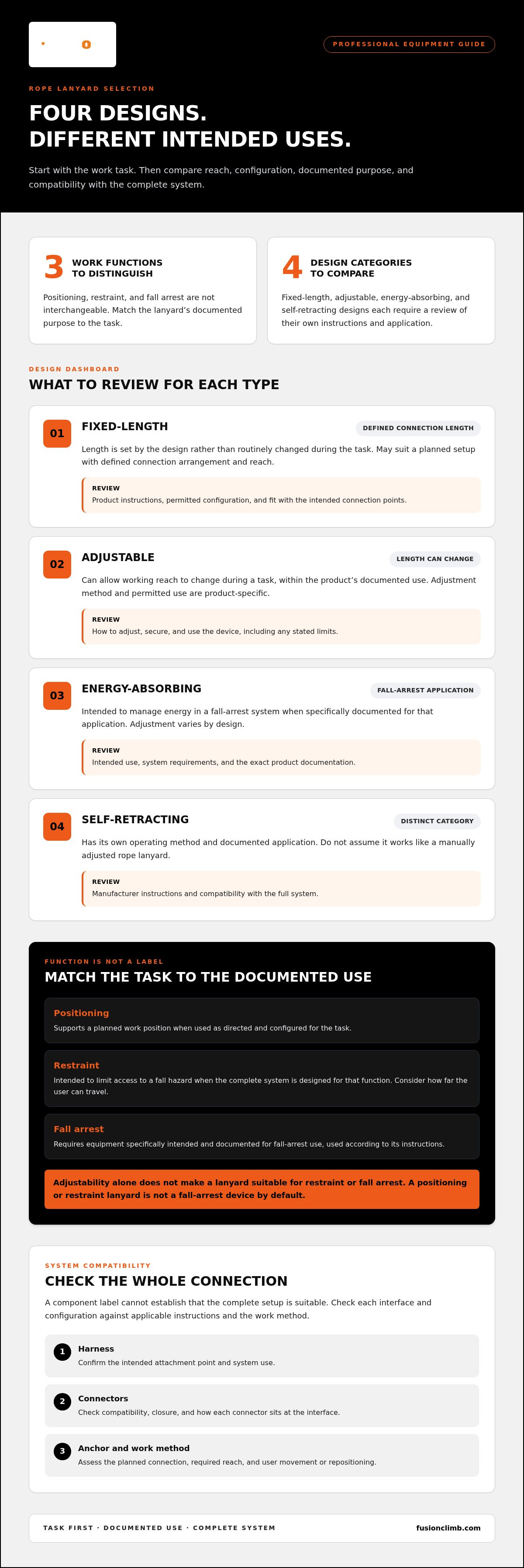
Before comparing rope construction, length, or adjustability, define what the lanyard needs to do. In climbing operations, rope access, and other work-at-height settings, the same broad product label can describe equipment for different tasks. A lanyard is a connection component, but its function depends on its design, documented use, and place in the overall system.
A rope lanyard is a connection component selected for a defined task and used as part of a compatible system. Begin with that task, rather than a category name or product photo.
Identify the lanyard function before comparing products
Positioning equipment supports a planned work position when used as directed and configured for the task. For example, a worker may need support while reaching a work area. Confirm that the lanyard’s stated purpose and instructions match the method. The word “positioning” alone doesn’t make a product suitable for every setup.
Restraint is intended to limit access to a fall hazard when the system is designed for that function. Suitability depends on the complete configuration, including how far the user can travel. Don’t treat a positioning or restraint lanyard as a fall-arrest device by default. Fall-arrest use requires equipment specifically intended and documented for that function, used according to its instructions.
These distinctions matter across professional applications. Climbing lanyards can serve different roles, including connection in climbing contexts where energy absorption may be relevant. Let the task determine the required function. Marketing shorthand doesn’t replace the manufacturer’s documented use.
Treat the lanyard as part of a connected system
Check the lanyard against the components and method it will be used with. Consider the harness attachment point, connector type and orientation, anchor arrangement, required reach, and how the user will move or reposition. A label on one component can’t establish that the complete setup is suitable. Each connection and configuration must align with the applicable instructions and work method.
- Harness: Confirm the intended attachment point and system use.
- Connectors: Check compatibility, closure, and how the connector sits at each interface.
- Anchor and method: Assess the planned connection, reach, and movement for the task.
Connector fit is part of the decision, not a final detail. The professional climbing carabiner guide adds context for evaluating connections. Once you’ve identified the task and system, compare lanyard designs using criteria that matter to the work.
Compare Rope Lanyard Designs: Fixed, Adjustable, and Energy-Absorbing
Once the work function is clear, compare designs by how they manage reach and by the purpose stated in their instructions. “Fixed,” “adjustable,” and “energy-absorbing” describe design characteristics, not interchangeable safety functions. Assess Rope lanyards for climbing professionals against the task and documented use, not the category name alone.
Fixed-length
Intended function: A defined connection length for a planned setup. Adjustment: Length is set by the design, rather than routinely changed during the task. Review: Product instructions, permitted configuration, and compatibility with the intended connection points.
Adjustable
Intended function: A working connection whose length can be changed within its documented use. Adjustment: Product-specific. Review: Instructions for adjusting, securing, and using the device, including any stated limits.
Energy-absorbing
Intended function: A design intended to manage energy in a fall-arrest system when specifically documented for that application. Adjustment: Varies by design. Review: Intended use, system requirements, and exact product documentation.
Self-retracting
Intended function: A distinct lanyard category with its own operating method and documented application. Adjustment: Don’t assume it works like a manually adjusted rope lanyard. Review: Manufacturer instructions and compatibility with the full system.
When a fixed or adjustable rope lanyard fits the task
A fixed-length design may suit a work position where the connection arrangement and required reach are already defined. Its predictable length can simplify planning, provided it fits the documented setup and doesn’t interfere with the work method. An adjustable design may allow working reach to change during a task. Check the product’s adjustment mechanism, operating steps, and permitted use.
Adjustability alone doesn’t make a lanyard suitable for restraint or fall arrest. Confirm the actual function in the manufacturer’s instructions, then check how the selected length works with the harness, connector, anchor, and intended movement.
How energy management changes the comparison
Energy-absorbing lanyards have a different role from ordinary positioning equipment. Don’t substitute a positioning lanyard for fall-arrest equipment, or assume every product described as a lanyard absorbs energy. Self-retracting devices are a distinct category, not a synonym for rope lanyards. Evaluate each design according to its documented purpose and system requirements.
For construction work, review the scope of OSHA’s lanyard regulations and determine whether they apply to the work and equipment in question. Requirements vary by application, so use current, applicable rules alongside product instructions. For zipline-specific systems, the zipline lanyards and tethers guide offers relevant category context. Fusion Climb’s lanyard and tether categories provide a place to compare available lanyard and tether options against a defined task.
Compare Professional Rope Lanyards by Compatibility and Work Method
After identifying the lanyard’s function, compare each option against the actual work sequence. A task from a stable, defined position may require a different length and attachment arrangement than one involving repeated repositioning. Record where the worker needs to reach, which harness connection points the instructions identify, and how movement changes during the task. This makes compatibility a practical check rather than a guess based on category.
Compatibility is determined by the complete system and its intended use, not by the lanyard alone.
| Comparison point | What to assess | What to verify |
|---|---|---|
| Intended task | Positioning, restraint, or another documented application | That the product instructions identify the intended use |
| Connection points | Harness attachment and anchor arrangement | Permitted attachment points and configuration in the relevant instructions |
| Length and reach | Distance needed to work and move through the task | Documented length, adjustment method, and any use limits |
| Connector interface | Connector shape, gate, orientation, and fit at each connection | Compatibility requirements in both the lanyard and connector instructions |
| Work method | Fixed position, controlled repositioning, or transitions | That the configuration is intended for the complete method |
Match work method to lanyard configuration
For a defined position, assess whether the planned reach can be achieved without changing the setup beyond what the instructions allow. If the task involves controlled repositioning, map where the worker will move, how the connection will be maintained, and whether the lanyard’s length and adjustment method suit those movements.
A Y-style configuration may support transitions in a system designed for that arrangement, but its shape alone doesn’t explain how it should be used. Match the configuration to the task, connection points, and manufacturer instructions. Sketching the work sequence can reveal where reach or attachment changes need closer review.
Check connectors, harness interfaces, and documentation
Check each connection as a physical interface. The connector must be compatible with the designated harness and anchor connections, and its gate and orientation must follow the equipment instructions. Review the lanyard and connector documentation together. One component’s label cannot establish that the assembled configuration is suitable. Compare stated applications and limitations, and don’t infer a rating or use that the documents don’t provide.
For work on an aerial adventure course, the rope-course safety equipment guide provides context for evaluating equipment in that operating environment. Across climbing operations and other work at height, document the task, attachment arrangement, required reach, and relevant instructions before settling on a configuration. These notes give buyers a clear basis for comparing professional lanyards and reviewing how each option fits the work method.
Use This Professional Rope Lanyard Buying Checklist
Turn the work plan into a short buying brief before comparing listings. For Rope lanyards for climbing professionals, use this sequence: define the task, establish the required function, then check whether the equipment and its instructions support the complete setup. Keep the notes with your procurement review so the decision reflects the actual work method, not just a product label.
Five questions to answer before purchase
- What task will the lanyard support? Describe the work activity and required safety function, such as positioning, restraint, or a specifically documented fall-arrest application. Include relevant site conditions and operating requirements that affect how the system will be used.
- What equipment will connect together? Record the harness, connector, anchor, and any other components in the planned system. Note their connection points and instructions so compatibility can be assessed across the interfaces, rather than inferred from one component’s description.
- What reach and adjustment does the work method require? State where the worker must reach, whether the work position is fixed or involves controlled repositioning, and whether the lanyard’s length needs to change. Check the device’s directions and limits before assuming adjustability suits the task.
- What documentation and requirements apply? Gather the model-specific instructions, labels, intended-use statements, and available technical documents. Identify relevant site requirements and applicable OSHA or ANSI/ASSP provisions, then verify the standards’ current editions and application through authoritative sources.
- Which configuration matches the documented task? Compare candidate designs against the recorded work method, reach, connections, and instructions. Keep the reason for selecting a configuration clear, and set aside any option whose stated use or system fit doesn’t align with the brief.
Review product documents and applicable requirements
Read the documents for the exact model under consideration. Look for intended use, permitted connection arrangement, adjustment directions, warnings, limitations, and any stated ratings or standards references. If a listing uses broad terms such as “professional” or “safety,” treat them as descriptions, not proof that the item performs a particular function.
Standards and regulations can differ by activity, workplace, and equipment type. Check the current source and confirm that a referenced requirement applies to the task. Don’t rely on an undated product description or assume a cited standard covers every component in the system. A product claim is not, by itself, a system-level compliance conclusion. Avoid applying a universal inspection interval or rating where the relevant instructions and requirements don’t establish one.
With your task brief and documents in hand, browse Fusion Climb lanyards and tethers to compare options against the use you’ve defined. Keep the checklist nearby as you evaluate the fit.
Choose Fusion Climb Rope Lanyards for a Defined Professional Application
A useful lanyard choice starts with a work requirement, not a product label. Once the task and required safety function are clear, Fusion Climb’s lanyard and tether offerings can help narrow the options. Fixed, adjustable, shock-absorbing, Y-style, and self-retracting designs are useful comparison points, but category names alone don’t establish that two designs serve the same purpose or work in the same system.
Navigate the range by function, not by name alone
Use a relevant category as a starting point for reading the product’s stated intended use. For a planned, stable connection, compare the documented use of fixed options. If the task requires changing working length, review the adjustment directions and limitations for adjustable options. For shock-absorbing, Y-style, and self-retracting designs, compare the application described in each product’s documentation rather than assuming the category name tells the whole story.
Keep the comparison specific. Read the product label and available technical documents, then note the function, configuration, and any stated limits for the exact model. Similar names don’t prove identical performance, compatibility, or intended use. Don’t choose a product because its category sounds close to the task. Choose only when its documented application aligns with the work plan.
This approach helps operations buyers compare options without treating different designs as interchangeable. If the work involves more than one method, assess each use case on its own. A lanyard suitable for one planned arrangement shouldn’t automatically be assumed suitable for another.
Make the final selection with the complete system in view
Before deciding, follow the same sequence: define the task, identify the required lanyard function, check connection compatibility, and review the instructions and relevant documents. Include the harness, connectors, anchor arrangement, required reach, and work method. Then compare the product details against the system you intend to use.
Operations buyers should also align equipment selection with established safety procedures and the requirements that apply to the work. A product description can help identify an option, but it can’t replace model-specific instructions or establish that a complete setup meets every applicable requirement. Ground the decision in documented use and the actual configuration.
That process makes Rope lanyards for climbing professionals easier to evaluate: match the task, verify the function, and select from documented options that fit the system. Explore Fusion Climb professional safety gear to compare lanyards and tethers for your defined application.
Put Your Lanyard Decision to Work
A sound gear decision should carry through to the way the task is planned and performed. Record why the selected configuration fits its intended application, keep the relevant product instructions accessible, and revisit the decision if the work method or system changes. That gives operations teams a practical reference for future gear reviews instead of relying on memory or a familiar category name.
Fusion Climb manufactures specialized climbing and zipline safety equipment, including lanyards and tethers, harnesses, pulleys, and carabiners. For Rope lanyards for climbing professionals, compare its professional gear against your defined application and the work ahead.
Explore Fusion Climb professional safety gear and compare equipment for your defined application.
Frequently Asked Questions
Can a rope lanyard be used for fall arrest?
Only if the specific lanyard is intended and documented for fall-arrest use as part of a compatible system. A rope lanyard used for positioning or restraint shouldn’t be assumed to arrest a fall. Before selecting fall-arrest equipment, review the product instructions and system requirements, including the harness and connection arrangement. Don’t repurpose a lanyard based on its material, appearance, or general category description.
How often should professional climbing lanyards be inspected?
There isn’t one inspection interval that applies to every lanyard and workplace. Follow the manufacturer’s instructions and the inspection procedures and requirements applicable to your operation. A team’s process can include checks before use and more detailed inspections at specified intervals, with the responsible person documenting results. After unusual loading, damage, or exposure, follow the product instructions before returning equipment to service.
Can one rope lanyard work with any climbing harness?
No. Compatibility depends on the lanyard’s documented use, the harness’s permitted attachment points, and the connector interface. A connection that appears to fit may still place the connector in an unintended orientation. Compare the lanyard and harness instructions, including diagrams and warnings, and make sure the attachment arrangement matches the work system. Don’t rely on a familiar connector shape alone.
What should a team do after a lanyard is involved in a fall?
Remove the lanyard from service immediately and identify it so it can’t be put back into use by mistake. Follow the manufacturer’s instructions and your organization’s procedures for equipment involved in a fall. Don’t assume a visual check makes it fit for reuse. Record the event and the item’s identifying details, then handle its return, evaluation, or retirement according to the applicable instructions and procedures.
Does rope lanyard material determine how much it stretches?
Material can influence stretch, but it doesn’t determine it by itself. Rope construction and product design also matter, so two lanyards made from similar materials shouldn’t be assumed to behave alike. If movement or reach is critical to the setup, use the model’s technical documents for any stated elongation or performance information. Don’t estimate stretch from a product photo or material name.
What equipment records should professional buyers keep?
Keep records that let your team identify each item and trace how it’s managed. Useful entries include the model or product identifier, purchase or in-service date, applicable instructions, inspection findings, and any incident, repair, or retirement decision. Retain the documentation used to assess compatibility and applicable requirements, too. Clear records help operations teams connect equipment in use to its instructions and safety procedures.