


Rope Access, Wind, and SAR Gear: A Professional Buying Guide (2026)
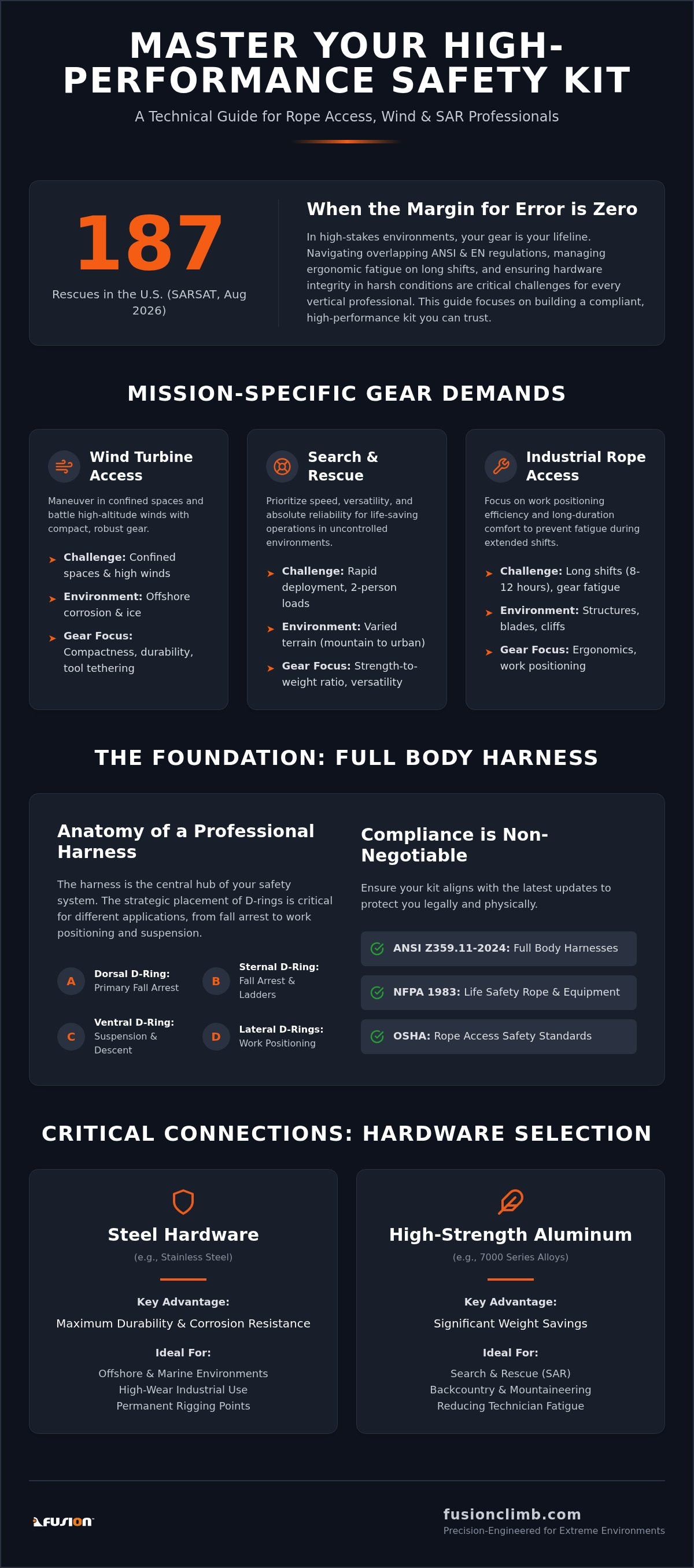
Your harness isn't just a piece of equipment. It's the only thing standing between a successful mission and a catastrophic failure when you're suspended three hundred feet up a turbine or dangling from a coastal cliff. As of August 2026, the SARSAT system has already recorded 187 rescues in the United States alone, proving that when the margin for error disappears, your hardware must be beyond reproach. You've likely felt the grinding fatigue of a twelve-hour shift in a kit that lacks proper ergonomics, or the frustration of trying to align your gear with the latest GWO V20 training standards. It's a high-stakes environment where confusion over overlapping ANSI and EN regulations can lead to dangerous gaps in safety.
We understand that navigating the technical overlap in rope access/ wind/ search & rescue operations is a constant challenge for vertical professionals. This guide will help you master the specific requirements for safety gear so you can build a high-performance, compliant kit. You'll learn how to balance hardware weight with high-load capacity and ensure your gear stands up to the punishing conditions of offshore environments. We'll examine the latest ANSI Z359.6-2026 updates and ergonomic designs that reduce physical strain, giving you the confidence to focus on the mission, not your equipment.
Key Takeaways
- Navigate the latest 2026 safety standards, including ANSI Z359.11 and NFPA 1983, to ensure your kit meets rigorous industrial and rescue compliance requirements.
- Identify the critical design features of a professional full body harness that balances long-shift ergonomics with the high-load capacity needed for vertical suspension.
- Select the optimal rigging hardware for rope access/ wind/ search & rescue missions by evaluating the durability of steel against the weight savings of high-strength aluminum.
- Understand the necessity of hardware redundancy through the use of specialized work positioning lanyards and shock-absorbing tethers to minimize fall impact forces.
- Build a more reliable gear system by choosing rugged, precision-engineered connectors and mountaineering equipment designed for extreme offshore and high-altitude environments.
Defining the Mission: Gear Demands for Rope Access, Wind, and SAR
Success in the vertical world requires more than just courage. It demands a technical understanding of how different missions dictate gear selection. In 2026, the vertical landscape has shifted as offshore wind capacity reached record levels, adding 165 GW globally last year. This expansion forces a clear distinction between the equipment used for industrial maintenance and the hardware required for a life-saving rope access/ wind/ search & rescue operation. Your gear system must be tailored to the specific physics of your environment, whether you're suspended from a turbine blade or hauling a litter up a mountain face.
Wind turbine access presents a unique set of hazards. Technicians must maneuver through cramped internal ladders and transition to external blade rigging while battling high-altitude winds. Gear for this sector must be compact enough for confined spaces yet robust enough to handle internal tower rigging. Every carabiner and pulley must provide absolute security while the technician remains suspended for hours. Reliability isn't just a goal; it's the baseline for every component in the system.
Search and rescue teams face different pressures. They need rapid deployment and the ability to manage multi-person carry capacities during complex 2-person rescue loads. In contrast, industrial rope access techniques prioritize work positioning and long-duration comfort. A technician performing blade repair needs a harness that prevents gear fatigue during a ten-hour shift. A rescuer needs hardware that transitions seamlessly from mountain to urban terrain without compromising on strength-to-weight ratios.
Environmental Challenges in Wind and Offshore Sectors
Offshore environments are brutal on hardware. Salt spray and constant moisture accelerate corrosion, making stainless steel or specialized coatings a requirement for carabiners and pulleys. High-wind zones also increase the risk of dropped objects. You need secure tethering systems for every tool to prevent catastrophic accidents below. Temperature extremes further test gear integrity. Freezing conditions can compromise technician dexterity and hardware performance, requiring gear that remains functional even when iced over.
SAR Priorities: Speed, Versatility, and Reliability
Rescuers don't have the luxury of a controlled environment. SAR gear must be versatile enough for backcountry approaches where every ounce counts. Minimizing the physical burden on a rescuer is critical during a long approach. High-strength hardware is non-negotiable for hauling systems that must support the weight of both the victim and the rescuer. Reliability is the silent partner in every mission. It ensures that when a high-load haul begins, the equipment performs without hesitation, regardless of the terrain or weather conditions.
Full Body Harnesses: Choosing the Right Foundation
Every vertical mission starts with the harness. It is the central hub of your safety system, connecting the technician to the rope and the environment. Choosing a full body climbing harness requires more than a casual glance at a spec sheet. You need a foundation that balances fall arrest capabilities with the high-load demands of suspension. In 2026, compliance is non-negotiable. Your kit must align with the updated ANSI Z359.11-2024 standards for full body harnesses and meet OSHA safety standards for rope access to ensure legal and physical protection. These regulations aren't just red tape; they are engineered benchmarks that save lives when gravity takes over.
Hardware interoperability begins with D-ring placement. Sternal D-rings are essential for fall arrest and ladder safety systems, while the dorsal D-ring serves as the primary connection for traditional fall arrest. For those performing rope access/ wind/ search & rescue tasks, lateral D-rings enable precise work positioning. The ventral D-ring is the workhorse for suspension, supporting the technician's weight during long descents. Beyond attachment points, ergonomics determine your operational longevity. Padding must be breathable and strategically placed to prevent pressure points during eight-hour shifts. If your gear causes fatigue by noon, your safety is already compromised.
Wind Turbine and Tower Climbing Harnesses
Tower work demands specialized support. Wind technician harnesses often feature integrated seats or enhanced lumbar support to manage the physical toll of hanging in a vertical shaft. You need a dorsal D-ring that remains accessible even when wearing a heavy parka or tool belt. Because turbine interiors are tight and abrasive, look for webbing made from high-tenacity, abrasion-resistant materials. This prevents the constant contact with steel tower walls from fraying your life-support system. For those seeking industrial-grade reliability, exploring a professionally engineered mountaineering collection can provide the rugged foundation needed for these environments.
Rescue-Specific Harness Features
Search and rescue missions require speed and versatility. Quick-connect buckles allow for rapid deployment when seconds matter, replacing the slower manual threading of traditional buckles. SAR harnesses must handle complex rigging, often requiring multi-point attachments for patient management and litter hauling. Some missions even necessitate specialized equipment like Superman style harnesses for prone maneuvers in tight industrial spaces or aerial rescues. Whether you're managing a two-person rescue load or performing a rapid extraction, your harness must provide the strength and mobility to move without restriction.
Rigging Hardware: Carabiners, Pulleys, and Secure Connections
Rigging hardware is the mechanical muscle of any vertical system. In the demanding fields of rope access/ wind/ search & rescue, your choice of connectors and pulleys determines the efficiency of a haul and the safety of a life-line. You must choose between the sheer durability of steel and the weight-saving benefits of high-strength aluminum. Steel remains the standard for permanent rigging and high-abrasion environments. Aluminum excels in rapid SAR deployments where every ounce affects rescuer stamina. Every component must perform under pressure without hesitation.
Gate security is your primary defense against accidental rollout. While screw-gates are reliable in frozen environments, professional standards increasingly favor 3-stage auto-locking mechanisms. These require three distinct actions to open, providing a higher level of security in complex industrial rigging. Understanding how to evaluate professional climbing carabiners is critical. It ensures your hardware meets the rigorous demands of the NFPA 2500 Standard, which governs life safety equipment for emergency services and technical rescue. Don't compromise on the integrity of your connections.
High-Strength Carabiners for Industrial Rigging
Always check the major axis strength marked on the spine. Loading a carabiner on its minor axis or against the gate can lead to catastrophic failure. D-shape carabiners are the preferred choice for general rigging. They naturally shift the load toward the stronger, non-gated side of the spine. Oval carabiners are superior when using pulleys. They provide better load alignment and prevent the hardware from shifting under tension. For offshore wind turbines, prioritize carabiners with corrosion-resistant coatings to survive constant salt spray and humidity.
Pulleys and Hauling Systems for SAR and Wind
Mechanical advantage is useless without pulley efficiency. High-efficiency pulleys utilize sealed ball bearings rather than simple bushings to reduce friction during heavy hauls. The same principles that govern commercial zipline pulleys apply directly to industrial hauling systems. In rescue scenarios, Prusik-minding pulleys are essential. Their square-sided design allows a progress-capture hitch to sit against the pulley without being pulled into the sheave. For specialized cable access on wind farms, dual-track pulleys offer enhanced stability on horizontal lines. This ensures smooth and controlled movement across the span, regardless of the load.
Lanyards and Tethers: Ensuring Redundancy at Height
Redundancy is the cornerstone of vertical safety. In professional rope access/ wind/ search & rescue, technicians follow the Two-Point Rule. This mandate requires two independent points of attachment at all times. While your primary rope or ladder system provides the first point, zipline lanyards and tethers often serve as the critical second connection. These components allow for precise work positioning and ensure that a single point of failure does not result in a fall. You must select tethers that match the specific physical demands of your environment, whether you're performing a mid-span blade repair or a complex rescue extraction.
Choosing between adjustable and fixed-length tethers depends on your mission profile. Fixed-length tethers provide simplicity and high-strength security for standard transitions. Adjustable tethers offer the versatility needed for variable distances during turbine maintenance or SAR maneuvers. Every connection must be deliberate. Every tether must be inspected before every shift. Your life depends on the integrity of these secondary lines just as much as the primary ones. For gear that meets these industrial standards, explore our high-performance lanyard and tether options.
Work Positioning Lanyards for Turbine Maintenance
Technical repairs on turbine blades require both hands. Work positioning lanyards allow you to lean back into your harness with confidence, creating a stable platform for precision tasks. Because turbine blades and tower steel have sharp edges, your lanyards must feature high-tenacity webbing or protective sleeves to resist abrasion. Integrating these lanyards with your full body harness ensures that your center of gravity remains optimal. This reduces physical strain during long hours of suspension. A stable technician is a safe technician, especially when battling high-wind conditions in the rope access/ wind/ search & rescue sector.
Shock Absorbers and Fall Arrest Systems
Fall arrest is a dynamic event. Shock-absorbing lanyards are engineered to deploy and dissipate the energy of a fall, keeping impact forces below the 1,800-pound limit required by OSHA. You must calculate your fall clearance accurately to avoid contact with the ground or lower structures. This calculation includes:
- The length of the lanyard and its connectors.
- The deceleration distance of the shock absorber (typically 3.5 to 4 feet).
- The height of the technician and a safety factor of at least 2 feet.
Use Y-lanyards for 100% tie-off when moving between anchor points on a tower. This ensures you are never disconnected from the structure during transitions. Inspect your tethers daily for deployment indicators. If the shock pack shows even slight tearing or the indicator is visible, remove it from service immediately. Reliability is not optional when you're working at height.
Top Gear Picks: Professional Mountaineering and Rescue Collection
Selecting the right mountaineering gear and equipment requires a deep understanding of your operational environment. Fusion Climb has specialized in high-performance engineering since 1998, positioning itself as a dependable guardian for those working in the rope access/ wind/ search & rescue sector. Our manufacturing process ensures that every stitch and connector meets rigorous quality control standards. When you build your kit, prioritize hardware interoperability. A system that works together reduces friction and increases speed when every second counts. Trust in gear that is built for the professional, not the hobbyist.
Bundling your equipment for mission-specific efficiency is the mark of a seasoned professional. A wind technician's kit should prioritize internal tower mobility, while a SAR technician requires a system capable of rapid transition between different terrains. Maintenance is the silent partner of safety. Inspect your gear before and after every mission. Meticulous care extends the life of your hardware, but you must know when to retire it. Safety always outweighs the cost of replacement.
Standout Full Body Harnesses for 2026
Technical search and rescue demands harnesses with high-weight capacities to manage multi-person loads during litter extractions. For wind turbine technicians, ergonomic designs with integrated lumbar support are essential for preventing gear fatigue during long shifts. You must also choose between tactical matte finishes for specialized operations or high-visibility industrial finishes for construction sites. If your mission requires prone specialized maneuvers in tight spaces, our Superman style harnesses provide the necessary range of motion without sacrificing security. Every full body harness in our collection is designed to meet the latest ANSI standards for 2026.
Essential Rigging Hardware for Your Kit
Your rigging kit is incomplete without auto-locking carabiners. These connectors eliminate the risk of human error in high-stress environments. High-efficiency pulleys are equally vital for building 3:1 or 5:1 hauling systems. These allow for smooth mechanical advantage during complex rescue extractions. Heavy-duty lanyards provide the necessary redundancy for industrial rope access, ensuring you remain tied off 100% of the time. Don't wait for a hardware failure to upgrade your system. Shop the full Mountaineering Gear Collection for Rope Access and SAR to secure your professional kit today.
Maintenance and Retirement Standards
Hardware isn't forever. Follow a strict retirement schedule based on manufacturer guidelines and real-world wear. Textile components like harnesses and lanyards typically require replacement every five to ten years depending on usage and UV exposure. Metal hardware should be retired if you notice deep scoring, gate sluggishness, or if it has been subjected to a significant fall or impact. If you're ever in doubt about the integrity of a connector, remove it from service immediately. In the vertical world, there is no room for "maybe."
Secure Your Future at Height
Operating in vertical environments requires more than technical skill; it demands a system of hardware that performs without compromise. We've explored how mission-specific ergonomics in full body harnesses and high-efficiency rigging hardware determine your operational speed and safety. Whether you're managing complex hauls or performing long-duration turbine maintenance, your gear must align with the latest ANSI Z359.11 standards to ensure total compliance. Reliability is the only metric that matters when you're suspended hundreds of feet above the ground.
Building a high-performance rope access/ wind/ search & rescue kit is a career-long investment in your own security. By prioritizing redundancy through shock-absorbing lanyards and choosing connectors with rugged USA-based manufacturing, you eliminate the variables that lead to failure. Fusion Climb has been a trusted partner to those who push physical limits since 1998, providing the industrial reliability needed for the most demanding missions. Don't settle for equipment that hasn't been tested in the real world.
Upgrade your professional kit with Fusion Climb Mountaineering Gear and experience the confidence of ANSI Z359.11 compliant hardware. Stay safe, stay focused, and keep climbing toward your next objective.
Frequently Asked Questions
What is the difference between an ANSI Z359.11 and an NFPA 1983 harness?
ANSI Z359.11 is the industrial benchmark for full body fall arrest harnesses used in general construction and maintenance. NFPA 1983, which is now consolidated under the NFPA 2500 standard, specifically governs life safety equipment for emergency services. While ANSI focuses on protecting workers from falls in general industry, NFPA standards are tailored for the high-load demands of technical rescue. Professional kits often utilize dual-certified hardware to ensure compliance across both mission profiles.
Can I use recreational climbing gear for professional rope access work?
You cannot substitute recreational gear for professional equipment. Professional rope access/ wind/ search & rescue operations require hardware that meets OSHA and ANSI standards for industrial durability. Recreational gear is designed for lower weight and different load profiles. It lacks the necessary certifications for workplace safety and legal compliance. Using non-certified gear in a professional environment creates unacceptable risks for both the technician and the employer.
How often should I inspect my wind turbine rescue harness?
You must perform a visual pre-use inspection before every shift to check for webbing fraying or hardware damage. Beyond this, a competent person must conduct a documented formal inspection at least every six months. If your harness is exposed to a fall or harsh chemicals, it must be removed from service immediately. Consistent monitoring is the only way to ensure that the integrity of your life-support system remains intact over time.
What are the requirements for a 100% tie-off in tower climbing?
Achieving 100% tie-off requires you to remain connected to an anchor point at all times while moving at height. This is usually managed with a Y-style lanyard. You must secure the second leg of the lanyard to a new anchor before disconnecting the first leg. This redundant system ensures that you are never unprotected during transitions. It is a mandatory safety practice for tower climbing and industrial maintenance to prevent accidental falls.
Why are steel carabiners preferred over aluminum for industrial rigging?
Steel carabiners are the preferred choice for industrial rigging because they offer unmatched durability and abrasion resistance. Aluminum is lighter, but it wears down quickly when in contact with steel cables or abrasive tower structures. Steel hardware also handles high-cycle loading more effectively over long periods. In environments where equipment is subjected to heavy use and rough handling, the longevity of steel provides a better margin of safety and industrial reliability.
What is a prusik-minding pulley and why is it used in SAR?
A prusik-minding pulley has flat, square-shaped side plates designed to manage a progress-capture hitch. In search and rescue hauling systems, this design prevents the prusik knot from being pulled into the pulley sheave. As you pull the rope, the hitch sits against the pulley. If the tension is released, the prusik immediately grips the rope to hold the load. This ensures that your haul system remains secure and efficient during complex extractions.
How do I calculate fall clearance for a shock-absorbing lanyard?
Calculating fall clearance is a critical safety step that determines the minimum distance needed to arrest a fall safely. You start with the length of the lanyard and add the deceleration distance of the shock absorber, which is typically 3.5 to 4 feet. Then, add the height of the worker and a safety factor of at least 2 feet. This total distance ensures the technician does not impact the ground or lower obstacles during a fall event.
What specific gear is needed for offshore wind turbine maintenance?
Offshore maintenance demands gear that can withstand constant exposure to salt spray and high-corrosion environments. You need hardware made from stainless steel or high-grade aluminum with specialized protective coatings. Tool tethers are also mandatory to prevent dropped objects in high-wind zones. Additionally, your harness should feature abrasion-resistant webbing and be compatible with personal flotation devices. Every component must be meticulously maintained to ensure reliability in extreme maritime conditions.