


Professional Guide to Steel Zipline Pulleys: Durability and Safety Standards
Choosing aluminum for a high-volume commercial run might save weight, but it's often a costly mistake for your bottom line. When steel cables meet aluminum sheaves at high speeds, the resulting friction creates heat that quickly degrades softer metals. You've likely seen the telltale signs of rapid wear or felt the vibration of a pulley reaching its limit. Operators who prioritize long-term reliability understand that steel zipline pulleys aren't just an upgrade; they're a necessity for maintaining safety and performance in demanding environments.
It's frustrating to pull gear from service prematurely because it couldn't handle the thermal load of a busy season. This guide provides the technical expertise you need to master equipment selection and maintenance. We'll examine the latest ASTM F2959-26a standards and the precision engineering behind high-performance hardware. You'll learn how to extend your equipment's lifespan, ensure compliance with rigorous safety protocols, and reduce the maintenance downtime that cuts into your operational efficiency. By the end of this article, you'll be able to identify the specific technical requirements that separate professional-grade steel trolleys from standard recreational hardware.
Key Takeaways
- Understand why matching sheave hardness to wire rope is critical for preventing premature equipment failure and abrasive wear.
- Evaluate the performance advantages of steel over aluminum, specifically regarding heat dissipation and durability during high-speed commercial runs.
- Learn to execute the 'Spin Test' and other daily inspection protocols to identify bearing fatigue before it compromises rider safety.
- Discover how to select professional-grade steel zipline pulleys that comply with the latest ASTM F2959-26a safety standards.
- Master the technical nuances of sheave groove design to ensure your hardware is perfectly paired with your specific cable diameter.
The Engineering Behind Steel Zipline Pulleys
Professional-grade steel zipline pulleys are specialized mechanical devices featuring sheaves precision-machined from hardened or stainless steel. Unlike recreational hardware, these units are specifically engineered to endure the extreme friction and pressure of wire rope operations. Understanding The Engineering Behind Pulleys is the first step in recognizing why material choice dictates the safety and longevity of your entire course. High-performance steel hardware ensures that the interface between the rolling component and the cable remains stable under high-velocity runs.
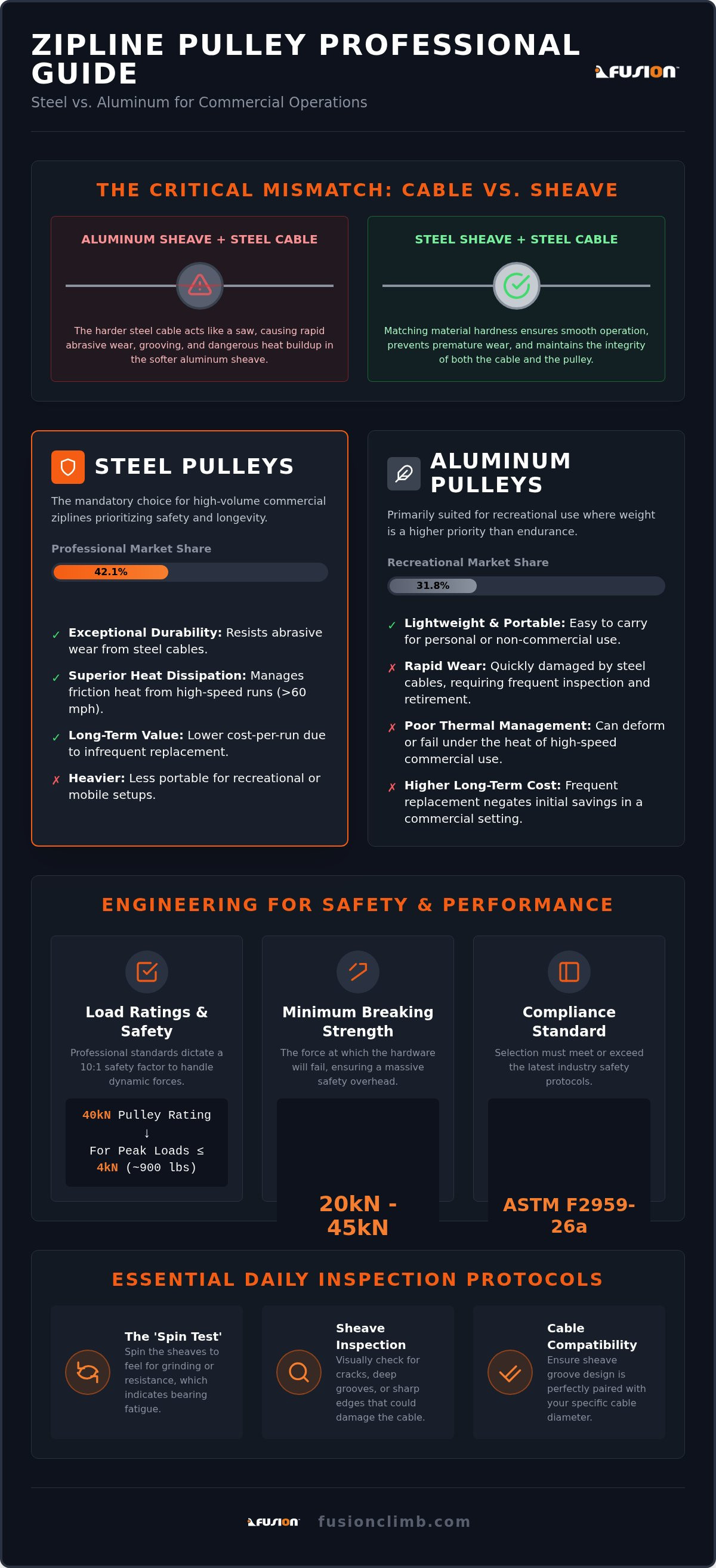
The science of material hardness is the primary driver behind this engineering choice. When two materials rub together, the softer one loses. Most commercial ziplines utilize 7x19 galvanized aircraft cable, which is significantly harder than standard aluminum. Using steel sheaves prevents the cable from "grooving" or carving a path into the pulley. This protection is vital. Grooved sheaves create sharp edges that can fray individual wire strands, leading to premature cable retirement and increased operational risk. Professional-grade hardware typically maintains a Minimum Breaking Strength (MBS) between 20kN and 45kN, providing the robust overhead required for commercial throughput.
Cable Compatibility and Material Hardness
Aluminum sheaves often fail prematurely when paired with 7x19 galvanized aircraft cables because the steel wire acts as a saw against the softer alloy. This interaction generates excessive heat and material deformation. Beyond hardness, the sheave diameter plays a critical role in cable health. A larger diameter reduces the "bending fatigue" placed on the cable strands as they transition over the pulley. The hardness ratio between the sheave and the cable should ideally be equal or biased toward the sheave to ensure the sacrificial wear occurs on the replaceable pulley component rather than the structural cable.
Load Ratings and Safety Factors
Commercial operators must understand kiloNewton (kN) ratings to manage dynamic loads effectively. One kN represents approximately 225 pounds of force, but static weight is only part of the equation. High-speed arrivals and rider movement create dynamic spikes that can double the effective load on the hardware. To account for these variables, professional standards often dictate a 10:1 safety factor. This means a pulley rated at 40kN is intended for use in systems where the anticipated peak load does not exceed 4kN. When rigging for high-capacity lines, tandem steel zipline pulleys are often preferred over single sheave models. Tandem designs distribute the rider's weight across two points, which reduces the thermal load on individual bearings and increases the overall stability of the trolley during the run.
Steel vs. Aluminum: Choosing the Right Pulley Material
Selecting the right material for your fleet is a decision that balances operational weight against industrial endurance. Aluminum pulleys are popular in recreational kits because they're lightweight and easy to carry. However, in a high-volume commercial environment, that weight savings comes at the cost of frequent replacements. High-performance steel zipline pulleys provide the ruggedness required for back-to-back runs where gear is under constant stress. While aluminum holds a 31.8% market share due to its portability, steel remains the dominant choice at 42.1% for professional operators who value substance over style.
The economic reality of zipline management favors steel when you conduct a cost-per-run analysis. Aluminum sheaves wear down quickly when exposed to the abrasive nature of steel cables, requiring more frequent gear retirement. Steel hardware maintains its profile longer, ensuring consistent friction management throughout the season. This durability is essential for meeting the stringent requirements found in commercial zipline regulations, which prioritize equipment integrity over weight reduction. For operators looking to maximize their investment, choosing stainless steel or high-strength alloys is the most reliable path to reducing long-term overhead.
Thermal Management in High-Speed Applications
Friction is the enemy of equipment longevity, especially during runs that exceed 60 mph. As the sheave spins at high RPMs, it generates intense heat that can cause softer metals to deform or "glaze" the cable surface. Steel's higher melting point and superior thermal mass allow it to absorb and dissipate this heat without compromising its structural temper. To further manage this energy, professional trolleys utilize sealed ball bearings. These components reduce internal friction, ensuring the pulley remains cool and functional even during the peak of the summer season.
Environmental Factors and Corrosion
Environment dictates your material grade. If your course is located in a coastal or high-humidity area, 316 stainless steel is the professional standard for maximum corrosion resistance. Standard alloy steel is exceptionally strong but requires more diligent maintenance to prevent oxidation. Guides must perform daily checks for early signs of pitting or surface rust, which can compromise the smooth interface between the sheave and the wire rope. Investing in high-quality commercial zipline pulleys ensures your hardware survives the elements as well as the riders. Precision-machined stainless steel remains the most dependable guardian against the salt and moisture that typically degrade lesser hardware.
Critical Components of Commercial Steel Trolleys
The structural integrity of a trolley starts with its housing. Commercial steel trolleys utilize reinforced side plates to resist the immense torsional forces generated during high-speed arrivals. If these plates flex even slightly, sheave alignment is compromised, leading to uneven cable wear and potential bearing failure. Professional steel zipline pulleys are built to act as a rigid chassis, ensuring the sheave stays perfectly centered on the cable through thousands of cycles. This rigidity prevents metal-on-metal contact between the cable and the frame, which is a common failure point in lighter, non-commercial hardware.
Precision sheave design further distinguishes professional hardware from entry-level gear. Operators must choose between U-grooves and V-grooves based on their specific rigging requirements. A U-groove provides a dedicated cradle for the wire rope, maximizing the contact area and reducing point-pressure on individual strands. For courses requiring active guide participation, handle integration becomes essential. Ergonomic handles allow guides to manage braking systems or position the trolley during recovery operations without compromising their own safety. These components must be seamlessly integrated into the frame to ensure they don't catch on other rigging elements during a run.
Bearing Technology: Sealed vs. High-Speed
Bearings are the heart of the trolley's performance. In outdoor commercial environments, sealed ball bearings are the industry standard for preventing the ingress of dust, moisture, and grit. While shielded bearings might offer slightly less rolling resistance, they invite contaminants that lead to catastrophic failure. High-efficiency bearings dictate the speed profile of your course. A well-maintained sealed system provides consistent friction management, ensuring that every rider reaches the landing platform at a predictable velocity. Most commercial designs favor these maintenance-free sealed systems because they eliminate the need for manual lubrication, which can attract more debris if performed incorrectly.
Attachment and Redundancy Features
Safety in the vertical environment relies on redundancy. Professional trolleys feature oversized attachment holes designed to accommodate multiple professional climbing carabiners. This allows for the simultaneous connection of a primary rider tether and a secondary backup lanyard. Secure connections are the foundation of rider confidence. These brackets must be compatible with heavy-duty zipline lanyards and tethers to ensure the entire safety chain remains intact. By designing for multi-point attachment, manufacturers provide the dependable guardian role that commercial operators demand for their guests. This redundancy isn't just a recommendation; it's a core requirement for meeting modern aerial adventure standards.
Inspection and Maintenance for Steel Pulleys
Before the first rider clips in for the day, your guides must perform a rigorous pre-flight assessment that goes beyond a casual glance. Maintaining steel zipline pulleys requires a methodical approach to ensure every component remains within its engineered tolerances. The most effective field diagnostic for identifying bearing fatigue is the "Spin Test." Hold the pulley firmly and give the sheave a sharp spin; it should rotate silently and smoothly. Any grinding sounds, clicking, or felt vibrations through the frame indicate that the internal bearings have reached the end of their service life and require immediate replacement.
Sheave wear patterns offer a visual history of the hardware's interaction with the cable. Over time, even hardened steel will show signs of the wire rope's profile. You must monitor these grooves closely because a deepened track can begin to "pinch" the cable, increasing friction and heat buildup. This transition from normal wear to a safety hazard happens slowly at first, then accelerates as the material thins. If you notice any sharp edges or "burrs" forming on the sheave flanges, the hardware must be pulled from service to prevent damage to your structural cables.
Daily and Monthly Inspection Checklists
Daily inspections should focus on the structural chassis of the trolley. Check the side plates for any signs of hairline cracks, deformation, or impact damage from landing area collisions. Ensure the axles are tight and that there is no lateral "wobble" in the sheaves, which suggests axle fatigue. For courses located in coastal or high-dust environments, monthly protocols must include a fresh-water rinse and thorough drying to remove salt crystals or grit that can bypass bearing seals. Consistent cleaning prevents the pitting and oxidation that can compromise the smooth operation of your steel zipline pulleys.
Understanding Retirement Standards
Compliance with ANSI and CE standards requires detailed logging of every piece of hardware in your fleet. Every drop matters. If a pulley suffers a "ground hit" from a significant height, it must be retired immediately regardless of its outward appearance. Internal fractures or axle misalignment from high-impact drops can lead to catastrophic failure under load. To maintain a clear safety margin, follow the 10% rule for material loss. Retire the hardware immediately if the sheave groove wear exceeds 10% of the original flange thickness. Keeping your course safe means having the discipline to decommission gear before it fails. To ensure your fleet meets these rigorous standards, invest in high-performance commercial zipline pulleys that are built for long-term industrial use.
Selecting Professional Hardware from Fusion Climb
Building a fleet that withstands the rigors of a commercial season requires more than just buying gear; it requires a partnership with an expert manufacturer. Fusion Climb acts as the silent partner in your operation, providing the technical assurance you need to focus on the rider's experience. Our steel zipline pulleys are designed with a rugged confidence that reflects our roots in tactical and safety equipment manufacturing since 1998. By prioritizing precision-machined sheaves and high-strength alloys, we ensure your equipment remains a dependable guardian for every guest who clips into your line.
The synergy between our hardware and your course design is critical for maintaining high-load performance. Every component we produce is a result of rigorous quality control and a commitment to industrial reliability. This sober approach to engineering means you don't have to worry about the "extreme" marketing fluff found elsewhere. Instead, you get hardware that values substance over style. Whether you're managing a high-throughput canopy tour or a specialized tactical training course, our equipment provides the sturdy foundation required for safe vertical exploration.
The Advent Series: Stainless Steel Excellence
The Advent series stands as a testament to our commitment to stainless steel excellence. These trolleys are specifically engineered for intensive use in professional park environments where speed and load capacity are non-negotiable. Compatible with 1/2-inch and 12mm steel cables, the Advent series provides consistent friction management that helps you maintain a predictable speed profile. This hardware doesn't just meet the current 2026 safety standards; it's built to exceed the expectations of operators who demand the best in durability and performance. Each unit features high-load ratings that ensure structural integrity even during peak operational cycles.
Building a Complete Safety System
Engineering a safe course means looking at the equipment as a cohesive unit. There is a direct synergy between our commercial zipline pulleys and our specialized rider gear. For example, pairing a high-speed steel trolley with our Superman style harnesses allows for a secure and exhilarating prone flight experience. This integration ensures that the attachment points, lanyards, and carabiners all function with the same industrial reliability. When you pair these pulleys with professional-grade ropes course safety equipment, you create a system that minimizes maintenance downtime and maximizes rider throughput. Using matching-grade carabiners and lanyards is essential; mixing high-performance steel with lower-grade alloy connectors can lead to accelerated wear at critical contact points. Every component we manufacture is tested to perform in the real world, providing the security required for high-stakes vertical environments.
Secure Your Course with Industrial Performance
Mastering the technical nuances of your hardware is the difference between a high-maintenance season and a seamless operation. As we've examined, the transition to steel zipline pulleys is a strategic move that addresses the abrasive reality of wire rope and the thermal demands of high-velocity runs. By matching sheave hardness to your cable and adhering to strict inspection protocols like the 10% wear rule, you ensure your equipment remains a dependable guardian for every rider.
Safety in the vertical environment is never accidental. It's the result of meticulous manufacturing and a commitment to rigorous quality control. Since 1998, commercial operators have trusted our hardware to meet the highest industrial and adventure park demands. Our equipment is manufactured to rigorous ANSI safety standards, providing the high-load performance required for intensive commercial use. It's time to elevate your safety standards and reduce operational downtime with hardware built for the challenge.
Equip Your Course with Fusion Climb Steel Pulleys and invest in a legacy of strength and precision engineering. Prepare your course for a season of safe, high-speed adventure with confidence in every connection.
Frequently Asked Questions
Can I use steel zipline pulleys on synthetic ropes?
You shouldn't use steel pulleys designed for wire rope on synthetic lines. The precision-machined sheaves often have sharper profiles or different groove depths that can abrade or melt synthetic fibers through friction. If your operation uses rope, select hardware specifically rated for textile use. Using steel zipline pulleys on anything other than their intended cable type compromises the integrity of the line and the safety of the rider.
How often should commercial zipline pulleys be replaced?
Replacement frequency depends on your daily rider volume and environmental conditions. While high-quality steel hardware can last several seasons, you must decommission gear based on physical wear rather than calendar dates. Follow the 10% wear rule for sheave thickness and retire any unit that fails the "Spin Test." Regular logging of cycles helps you predict when your fleet will reach its operational limit, ensuring you replace hardware before failure occurs.
Is 304 or 316 stainless steel better for zipline hardware?
316 stainless steel is the superior choice for coastal or highly humid environments. It contains molybdenum, which provides significantly better resistance to pitting and chloride-induced corrosion than 304. For inland parks with lower humidity, 304 stainless steel offers excellent durability and strength at a lower cost. Always assess your local micro-climate to determine if the additional corrosion resistance of 316 is necessary for your long-term safety strategy.
Do steel pulleys require regular lubrication of the bearings?
Most professional-grade trolleys utilize sealed ball bearings that don't require manual lubrication. These systems are designed to keep grit and moisture out while maintaining a consistent speed profile. Attempting to lubricate sealed bearings can actually attract more debris and lead to premature failure. If you use an older system with open bearings, follow the manufacturer's specific maintenance schedule. For modern commercial operations, sealed, maintenance-free bearings are the industry standard.
What is the maximum speed rating for a professional steel trolley?
High-performance steel trolleys, such as the Advent series, are often rated for speeds exceeding 60 mph. Some specialized models can handle velocities up to 100 mph depending on the bearing technology and thermal management features. You must always verify the specific rating of your hardware against your course's steepest descent. Exceeding these ratings leads to excessive heat buildup and potential bearing seizure, which endangers both the rider and the course infrastructure.
How do I know if my pulley sheave is too worn for safe use?
You know a sheave is too worn when it exhibits deep grooving, sharp edges, or material loss exceeding 10% of its original thickness. Inspect the contact surface for "stepping" or burrs that can snag cable strands. If the sheave no longer cradles the cable correctly, it creates uneven pressure that accelerates wire rope fatigue. Consistent use of steel zipline pulleys requires a vigilant eye for these visual cues during every pre-flight inspection.
Can steel pulleys be used with galvanized and stainless steel cables?
Yes, you can use steel pulleys with both galvanized aircraft cable and stainless steel wire rope. Hardened steel sheaves are designed to withstand the abrasive nature of these materials without significant deformation. However, ensure that the sheave material is at least as hard as the cable to prevent the wire rope from "sawing" into the pulley. Matching your hardware to your cable type is essential for managing friction and extending the lifespan of your entire rigging system.