


Industrial Full Body Harness Webbing: A Buying Guide
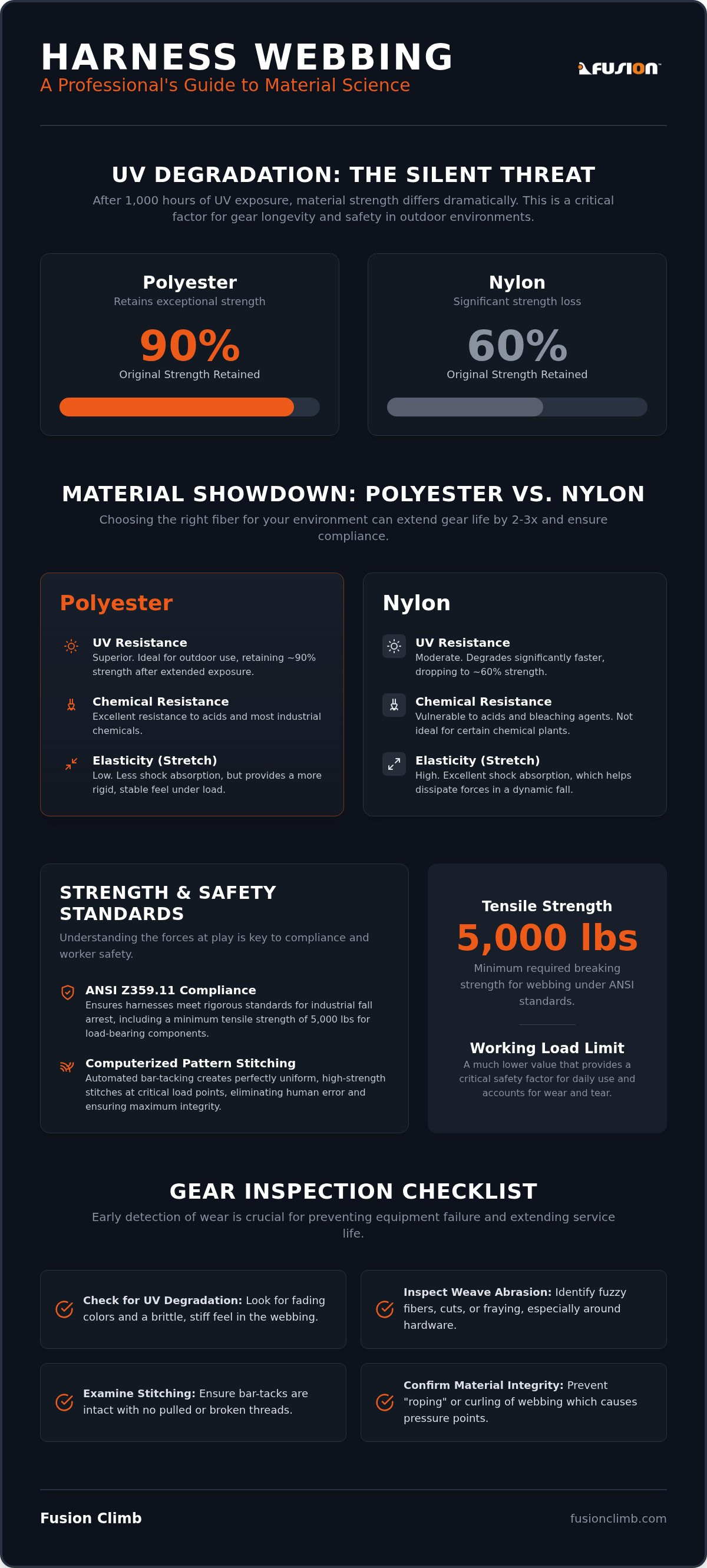
Did you know that polyester webbing retains approximately 90% of its original strength after 1,000 hours of UV exposure, while standard nylon drops to a mere 60%? You likely already know that in high-stakes industrial environments, your gear is more than just equipment. It is a critical lifeline that faces constant abuse from friction, chemicals, and the sun. It is frustrating to retire a harness early because the climbing harness webbing materials have frayed or faded before the job is done. High turnover for safety gear isn't just a budget drain; it's a sign that your equipment isn't matching the demands of your environment.
Mastering the technical specifications of your webbing ensures maximum safety and durability for your commercial operations. This guide will help you select gear that lasts two to three times longer than entry-level options while maintaining 100% compliance with current ANSI Z359.11 standards. We will explore the critical differences between MIL-SPEC polyester and nylon, explain how to justify the cost of professional-grade equipment to stakeholders, and provide a clear roadmap for reducing your gear retirement frequency through 2026 and beyond.
Key Takeaways
- Identify how high-tensile synthetic fibers distribute loads to meet 2026 safety standards during a critical fall event.
- Differentiate between climbing harness webbing materials like nylon and polyester to ensure your gear withstands specific chemical or high-impact environments.
- Recognize the early signs of UV degradation and weave abrasion to prevent structural failure and extend your equipment's service life.
- Understand the critical role of computerized pattern stitching and bar-tacking in maintaining the integrity of harness load points under industrial stress.
- Learn how professional-grade manufacturing standards in full body harnesses reduce gear retirement frequency and justify long-term safety investments to stakeholders.
Webbing Integrity: The Foundation of Industrial Full Body Harnesses
Industrial webbing is the primary load-bearing component of any fall arrest system. Unlike recreational gear, which focuses on lightweight agility, industrial-grade synthetic fibers are engineered for extreme durability and high-tensile strength. These materials must survive harsh environments while remaining flexible enough for daily use. A modern safety harness relies on this webbing to act as a shock absorber and a structural frame. It is the silent guardian that stands between a worker and a catastrophic impact. When evaluating climbing harness webbing materials, professionals must look beyond simple aesthetics to the chemical composition and weave density that define a product's life-saving potential.
In a 2026-standard fall event, the webbing is responsible for distributing thousands of pounds of force across the shoulders, chest, and thighs. This distribution prevents internal organ damage and skeletal fractures. Most industrial harnesses utilize a standard 1.75-inch width for their primary straps. This specific width is not arbitrary; it provides a larger surface area to dissipate energy against the body, which significantly increases user comfort during suspension. The primary synthetic fibers used in this sector include:
- Nylon: Valued for its high elasticity and shock-absorbing properties.
- Polyester: Preferred for its superior resistance to UV rays and chemical exposure.
- Kevlar Blends: Reserved for high-heat environments where standard synthetics would melt or degrade.
Tensile Strength vs. Working Load Limits
Under ANSI Z359.11 standards, tensile strength represents the maximum longitudinal stress a webbing component can withstand before catastrophic structural failure occurs. While a harness may be rated for a 5,000-pound tensile strength, its working load limit is much lower to account for a safety factor. This buffer ensures the gear remains functional even after minor wear. Mechanical fatigue is a constant threat. Every time the webbing flexes, rubs against a buckle, or stretches under a load, the individual fibers experience microscopic breaks. Over years of service, these small points of failure aggregate, which is why strict inspection protocols are mandatory for maintaining 100% compliance.
The Impact of Webbing on Harness Weight and Ergonomics
Heavy-duty durability often comes with a weight penalty that can lead to worker fatigue over a ten-hour shift. Manufacturers must balance the density of the climbing harness webbing materials with the need for ergonomic movement. If the webbing is too stiff, the donning process becomes a struggle, often leading to improperly fitted gear. Flexible, high-quality webbing allows the harness to contour to the user's body, which improves mobility in tight vertical spaces. For a deeper look at how these components integrate into a complete system, consult our Professional Guide to Full Body Climbing Harnesses. Selecting the right material density ensures that safety doesn't come at the cost of productivity.
The Core Materials: Nylon vs. Polyester in Professional Webbing
The choice between nylon and polyester is a decision based on the specific environmental hazards of your job site. While many assume all synthetic straps are equal, the molecular differences between these fibers dictate how a harness responds to a fall or a chemical spill. These climbing harness webbing materials serve as the primary interface between the worker and their anchor point. Choosing the wrong material can lead to premature gear retirement or increased injury risk during a fall arrest event.
Modern engineering in 2026 has introduced hybrid blends into the industrial market. These specialized webbings often incorporate Dyneema for its exceptional strength-to-weight ratio or Kevlar to provide superior edge protection against sharp steel beams. When evaluating climbing harness webbing materials, material memory is another critical factor for daily operations. High-quality fibers retain their flat, broad shape even after being compressed in gear bags or subjected to repeated buckle adjustments. This prevents the webbing from "roping" or curling. Curled webbing creates painful pressure points and can interfere with the proper function of adjustment hardware.
Nylon: The Shock-Absorbing Powerhouse
Nylon, or polyamide, remains a top choice for general fall protection due to its inherent elasticity. In a sudden fall, nylon webbing stretches to dissipate energy. This mechanical stretch reduces the peak impact force transmitted to the user's body, which can prevent internal injuries. However, professionals must account for its "wet strength" characteristics. When nylon becomes saturated with water, it can lose a portion of its rated tensile strength and become significantly heavier. It is the ideal solution for dry environments such as general construction where shock absorption is the primary safety concern.
Polyester: Rigidity and Chemical Stability
Polyester is the preferred choice for technical rigging and work positioning where stability is paramount. Its low-stretch nature ensures that once a worker is positioned, they stay at that exact height without the "bouncing" effect common with nylon. This lack of "creep" is essential for precision tasks in vertical environments. Polyester also offers superior resistance to acidic environments and common industrial solvents. If your crew operates in refineries or chemical processing plants, a full body harness built with high-tenacity polyester is the more reliable investment. It maintains its structural integrity where other fibers might soften or degrade.
Environmental Durability: UV, Chemical, and Abrasion Resistance
Environmental durability determines the true service life of your equipment. While tensile strength is a baseline, real-world factors like UV radiation and constant friction dictate how quickly a harness reaches its retirement date. Selecting the right climbing harness webbing materials requires an understanding of how these fibers interact with the elements over months of continuous outdoor use. In high-stakes environments, gear that looks fine on the surface can harbor hidden weaknesses caused by microscopic degradation.
In 2026, safety professionals are increasingly focused on the "silent killers" of safety gear. UV exposure and chemical contamination often don't show immediate signs of failure. However, they compromise the molecular structure of the webbing, which reduces its ability to hold a load during a fall. High-density weaves and specialized coatings are no longer optional features; they are essential requirements for any commercial operation that values worker safety and long-term ROI. We must look at how these materials survive the specific rigors of the job site.
Combating UV Degradation in Aerial Parks
UV radiation is a constant threat that compromises safety without visible warning. Many operators still rely on color-fastness as a proxy for safety, but this is a dangerous assumption. Ultraviolet rays trigger a chemical reaction that breaks the polymer chains within the webbing. This molecular breakdown reduces the energy-absorption capacity of the harness. For those managing vertical environments, our Professional Guide to Ropes Course Safety Equipment provides deeper insights into maintaining hardware standards under constant sun exposure. Even if a harness retains its factory color, the internal fibers may have already reached a critical level of degradation.
Abrasion Protection for High-Volume Use
Commercial zipline and aerial park operations subject gear to extreme friction. Unlike standard industrial fall arrest, these applications involve high-frequency movement that generates significant heat. Heat-resistant climbing harness webbing materials prevent the "glazing" effect where fibers melt together, which creates brittle spots. High weave density is your first line of defense against "fuzzing." When the surface fibers begin to fray, the structural integrity of the entire strap is at risk. Edge-testing is equally vital to ensure that webbing survives accidental contact with steel structures or abrasive concrete. In tubular webbing, the outer sheath acts as a sacrificial layer that protects the load-bearing core fibers from direct abrasive contact.
Hydrophobic treatments further enhance durability by preventing moisture absorption. Saturated webbing is not only heavier but also more susceptible to mold and internal fiber abrasion from trapped grit. Likewise, chemical exposure from industrial solvents can cause "invisible" damage. A single spill of a harsh cleaner can weaken the webbing without leaving a mark. Regular inspection and choosing fibers with high chemical resistance are the only ways to ensure your team remains protected in complex industrial settings.
Webbing Construction: Weave Patterns and Stitching Standards
Engineering a life-safety device requires more than just high-strength fibers. The way those fibers are woven and joined determines the ultimate reliability of the system. While we have discussed the chemical properties of climbing harness webbing materials, the physical construction provides the necessary interface for buckles, D-rings, and comfort components. Heavy-weight webbing, which is typically thicker than recreational versions, ensures that the strap maintains its profile when threaded through pass-through or friction buckles. This prevents the material from bunching or slipping under a load, which is a common failure point in inferior equipment.
Sub-webbing also plays a key role in professional gear. These secondary straps often utilize a softer, more flexible weave to provide padding or to secure accessory attachments without compromising the primary load-bearing structure. This dual-layer approach balances the need for industrial strength with the ergonomic requirements of a worker who spends hours in a vertical environment. It's a method that ensures the harness remains comfortable without sacrificing the 5,000-pound tensile strength required for the main frame.
Flat Webbing: The Industrial Standard
Flat webbing is the backbone of the industrial harness market. Unlike tubular webbing, which is essentially a hollow sleeve, flat webbing is a solid, dense weave. This density provides a consistent thickness that integrates perfectly with modern hardware. When you are suspended, flat webbing provides a broader surface area to distribute pressure across your thighs and shoulders, which reduces the risk of suspension trauma. It also resists "roping" better than tubular alternatives when pulled through a buckle. For those managing complex rigging, our Zipline Lanyards & Tethers Guide explains how these construction choices impact the entire safety chain.
Bar-Tack Stitching: The Critical Connection
The stitching is the weakest link if it's not executed with absolute precision. Modern manufacturing relies on computerized pattern stitching, also known as bar-tacking, to ensure that every load point meets 2026 safety standards. This process removes human error, providing a consistent stitch count and depth across every unit. To maintain chemical consistency, the thread material must match the webbing material. Using a polyester thread on a nylon strap could lead to uneven degradation or friction-induced heat damage at the stitch site.
Safety guardians should always look for contrast-color stitching. This design choice makes it easy to spot a popped or frayed stitch during a pre-shift inspection. If you see white thread against a black strap, any damage becomes immediately obvious, allowing you to retire the gear before a failure occurs. To ensure your team is equipped with these rigorous manufacturing standards, explore our selection of industrial full body harnesses today. Choosing the right construction is just as important as choosing the right fiber.
Selecting the Right Industrial Harness: Fusion Climb’s Engineering Standards
Fusion Climb has served the tactical and safety industry since 1998. We don't just assemble gear; we engineer it from the fiber up. Choosing the right climbing harness webbing materials for a professional environment requires a deep understanding of how specific weaves respond to unique mechanical stresses. Our manufacturing process prioritizes substance over style, ensuring every full body harness we produce acts as a silent partner in your safety journey. Whether you are rigging a high-rise construction site or managing a commercial aerial park, our equipment provides the technical assurance needed for high-stakes operations.
Commercial operators often face the difficulty of justifying the cost of professional-grade webbing to stakeholders. However, the investment pays for itself by reducing gear retirement frequency. Our industrial-grade webbing is designed to last two to three times longer than entry-level gear by utilizing high-tenacity fibers that resist the "fuzzing" and structural failure common in cheaper alternatives. We offer custom bulk solutions for commercial zipline and ropes course operators who require a uniform fleet that meets the rigorous demands of the 2026 professional landscape.
Specialized Webbing for Superman Prone Harnesses
Prone-flight ziplining introduces physical demands that standard upright harnesses cannot handle. In a Superman style harness, the load distribution shifts entirely to the belly and chest areas. This creates unique pressure points that require high-density, wide-profile climbing harness webbing materials to prevent bruising and discomfort during long flights. We utilize reinforced belly-point attachments that can withstand the constant cycle of loading and unloading typical in high-volume commercial operations. For operators looking to optimize their entire system, our Commercial Zipline Pulleys Guide provides the technical context needed to ensure your hardware and textiles work in perfect synchronization.
Compliance and Certification
Every piece of gear in our catalog meets or exceeds ANSI Z359.11 and OSHA 1926.502 requirements. We maintain strict US-based quality control to ensure that our webbing performs exactly as rated under extreme conditions. This manufacturer-direct expertise allows us to provide a sobering sense of security to riggers and guides alike. Reliability is not a marketing claim; it is a result of rigorous testing and meticulous craftsmanship.
Before you start your next season, use this final checklist to evaluate your industrial webbing gear:
- Check for "glazing" or melted fibers caused by high-friction heat on zipline runs.
- Inspect contrast stitching for any signs of thread breakage or chemical fading.
- Look for "roping" or curling in the webbing that might interfere with buckle security.
- Verify the manufacture date; retire any textile product that has exceeded its 10-year service life or 14-year shelf life.
- Ensure all reinforced D-rings are free of burrs that could snag and abrade the webbing fibers.
Fusion Climb remains committed to being the innovator that stays rooted in traditional values of strength and reliability. We provide the tools you need to push your physical limits while ensuring you return home safely every day.
Elevate Your Operational Safety for 2026
For professionals who also manage the secure transport of heavy equipment or site materials, you can learn more about CargoCare NZ to explore their range of industrial-grade cargo safety nets.
Selecting the right equipment is a decision that impacts every hour of your workday. You now understand that the difference between nylon and polyester isn't just technical jargon; it's a critical choice between superior shock absorption and maximum chemical resistance. High-tenacity climbing harness webbing materials, combined with computerized bar-tack stitching, ensure your gear survives the friction of a commercial zipline or the constant UV exposure of an industrial job site.
As specialized Superman style harness experts, we prioritize manufacturer-direct quality control to meet the most rigorous industrial demands. Every component in our catalog features ANSI-compliant hardware designed for long-term reliability. Don't settle for entry-level gear that forces early retirement and compromises your team's security. Invest in equipment that acts as a dependable guardian for your workforce.
Shop Industrial Full Body Harnesses Built for 2026 Standards
Stay safe, stay focused, and keep pushing the limits of your vertical environment with absolute confidence.
Frequently Asked Questions
What is the difference between Nylon and Polyester webbing in a climbing harness?
Nylon is the industry standard for shock absorption because it stretches under load to reduce impact forces during a fall. Polyester is the preferred choice for technical rigging where you need low-stretch stability and higher resistance to chemicals or acids. While nylon is a powerhouse for fall arrest, polyester holds its shape better in wet conditions. Choosing the right climbing harness webbing materials depends on whether you prioritize energy dissipation or environmental stability.
How long does industrial harness webbing typically last before retirement?
Fusion Climb textiles have a maximum service life of 10 years from the date of first use and a total shelf life of 14 years. However, this is a maximum limit. You must retire a harness immediately if it fails a pre-use inspection or is involved in a fall event. Environmental factors like constant sun exposure or chemical contact can shorten this lifespan significantly. Always follow the manufacturer's specific retirement criteria to ensure safety.
Does UV exposure really weaken my climbing harness?
Yes, ultraviolet radiation is a silent killer of synthetic fibers. Polyester webbing is more resilient, retaining about 90% of its original strength after 1,000 hours of exposure. Nylon is more vulnerable, often losing 30% to 40% of its tensile strength in the same timeframe. Because this damage isn't always visible as fading, you should track the time your gear spends in direct sunlight to ensure it remains within safe, compliant operating limits.
Can I use a recreational climbing harness for industrial work?
No, you shouldn't use recreational gear for industrial applications. Industrial full body harnesses must meet specific ANSI Z359.11 and OSHA 1926.502 standards that recreational equipment doesn't cover. These standards require higher breaking strengths and specific load distribution patterns designed for workplace fall arrest. Recreational harnesses lack the industrial-grade webbing and reinforced attachment points necessary to protect workers in commercial vertical environments or during long periods of suspension that occur on job sites.
What are the signs that my harness webbing has been compromised by chemicals?
Chemical damage often appears as localized discoloration, "scorched" spots, or a change in the webbing's texture. If the fibers feel unusually brittle, stiff, or gummy, the material's molecular structure is likely compromised. Some industrial solvents cause invisible damage that weakens the climbing harness webbing materials without changing their appearance. If you know a spill occurred, retire the harness immediately. Never risk a life on gear that has contacted unknown or harsh industrial chemicals.
Why is flat webbing used more often than tubular webbing in full body harnesses?
Flat webbing is the industrial standard because it integrates more reliably with friction buckles and pass-through hardware. Its dense, solid construction resists bunching and roping, which ensures the harness stays properly adjusted during movement. Flat webbing also provides a wider surface area for load distribution across the thighs and shoulders. This reduces pressure points and the risk of suspension trauma compared to the narrower, more flexible profile typically found in tubular webbing designs.
How do I clean industrial harness webbing without damaging the fibers?
Clean your webbing using only mild soap and warm water. Avoid bleach, chlorine, or abrasive detergents, as these chemicals can degrade the synthetic polymers and weaken the harness. Scrub gently with a soft-bristle brush to remove grit that can cause internal fiber abrasion over time. Always air dry the gear in a well-ventilated area away from direct sunlight or high-heat sources. Proper maintenance ensures your equipment remains compliant and safe for its full service life.
What does ANSI Z359.11-2026 compliance mean for my equipment?
ANSI Z359.11-2026 compliance ensures your harness meets the most current safety requirements for performance, design, and testing in the United States. This standard mandates that dorsal and sternal attachment points withstand a static strength test of 3,600 pounds for one minute. Using compliant gear means your equipment has undergone rigorous qualification to manage fall arrest forces safely. It provides the technical assurance that your gear is engineered to protect users within the 130 to 310-pound capacity range.