



Heavy Duty Carabiners: The Professional Guide to Industrial Rigging Safety
In industrial rigging, "heavy duty" is a quantifiable engineering standard rather than a marketing label. You understand that the hardware securing a commercial zipline or a high-load work site must do more than just hold weight; it must withstand the rigorous demands of constant use and environmental stress. Choosing the wrong connector isn't a simple mistake. It's a compromise on safety that your operation cannot afford. Distinguishing between recreational gear and professional-grade heavy duty carabiners is the first step in building a system that protects both your crew and your reputation.
We'll help you master the technical specifications and material science required to select the right hardware for any vertical environment. You'll gain a clear understanding of the latest ANSI/ASSP Z359.1-2024 standards and the critical 3,600-pound gate strength requirements mandated by ANSI Z359.12. This guide covers when to prioritize the durability of steel over the weight savings of aluminum, how to interpret kilonewton ratings with precision, and how to procure compliant hardware that meets OSHA 1910.140 tensile strength mandates. By the end, you'll have the technical assurance to make procurement decisions with total confidence.
Key Takeaways
- Distinguish between marketing labels and engineering reality by identifying the specific 23kN to 50kN ratings required for industrial life-safety applications.
- Evaluate the critical trade-offs between zinc-plated steel and anodized aluminum to ensure your hardware survives the environmental demands of your specific rigging site.
- Master the hierarchy of security for heavy duty carabiners, emphasizing why commercial operators prioritize triple-action locking gates to eliminate accidental opening.
- Establish a rigorous inspection and retirement schedule using the "10% Rule" to identify material loss and mechanical fatigue before hardware integrity is compromised.
- Ensure total system compatibility by selecting carabiner shapes that align perfectly with zipline pulleys and harness D-rings to prevent dangerous cross-loading.
What Defines a Heavy Duty Carabiner? Engineering vs. Marketing
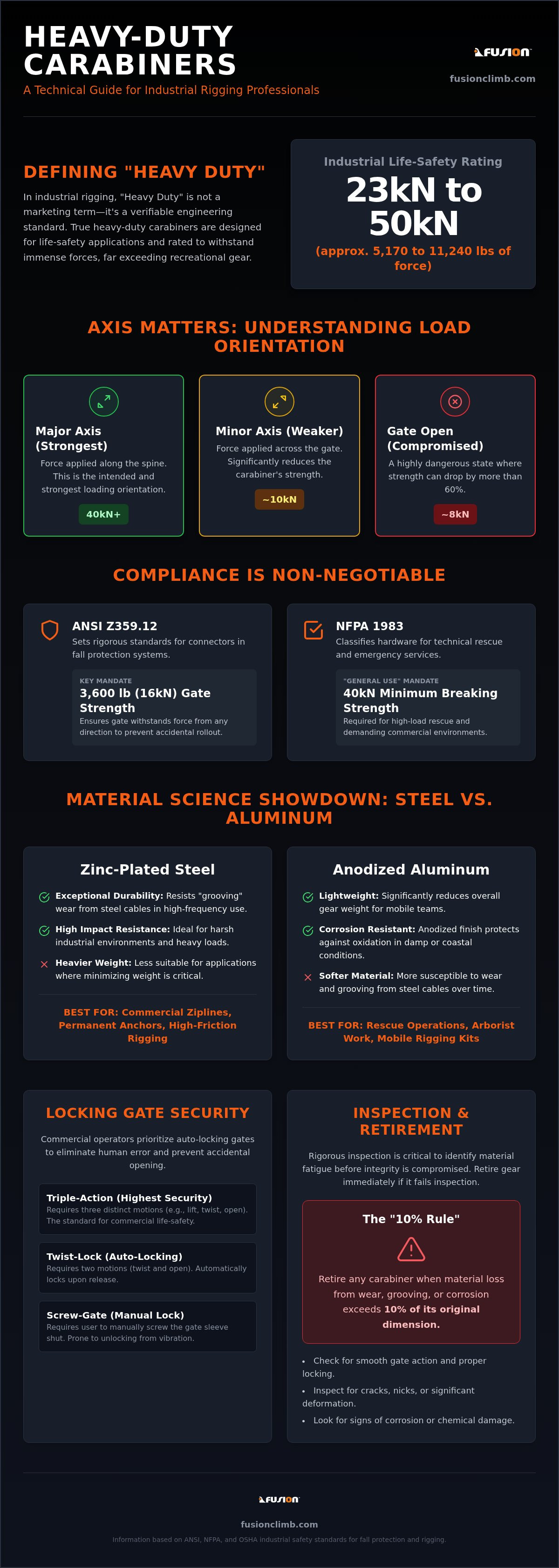
Industrial safety isn't built on labels; it's built on measurable performance. Marketing teams frequently use the term "heavy duty" to describe any large connector, but for a rigger, that phrase must represent a verifiable engineering standard. True heavy duty carabiners are specialized tools designed to handle forces between 23kN and 50kN without compromise. This isn't just about size; it's about the precision of the alloy and the integrity of the manufacturing process that ensures the hardware won't fail under extreme tension.
The fundamental Carabiner has transitioned from a simple mountain climbing tool into a highly engineered industrial component. Professional rigging relies on the kilonewton (kN) metric to measure force rather than static weight. While a static load is a constant weight, a dynamic load occurs during a fall or sudden shift, multiplying the force exerted on the hardware. To maintain safety, you must understand how these forces interact with different loading orientations:
- Major Axis: The strongest orientation, where force is applied along the spine of the connector.
- Minor Axis: Loading across the gate, where the strength of the hardware is significantly reduced.
- Gate-Open: A dangerous state where the carabiner's structural integrity is compromised, often dropping strength by more than 60%.
The Threshold of Strength: Decoding kN Ratings
The industry baseline for life-safety hardware is 23kN, which is roughly 5,170 pounds of force. This threshold ensures that the equipment can handle the peak impact forces of a fall while maintaining a significant safety factor. Beyond the initial break strength, professional operators must consider hardware fatigue. Repeated high-load cycles can create microscopic stress fractures in the metal over time. Minimum Breaking Strength (MBS) is the statistically determined force at which a component is guaranteed not to fail during initial testing, providing the foundation for all safe working load calculations.
Industrial Standards: ANSI Z359.12 and NFPA 1983
Relying on generic hardware in a commercial zipline or rigging environment is a liability. The ANSI Z359.12 standard sets a rigorous requirement for gate strength, mandating that the gate must withstand 3,600 pounds of force from any direction to prevent accidental rollout. Similarly, NFPA 1983 classifies hardware into "Technical Use" and "General Use" categories. General Use connectors must meet a minimum breaking strength of 40kN, making them the standard for rescue operations and high-volume commercial environments. Procuring certified heavy duty carabiners ensures your operation meets the latest ANSI/ASSP Z359.1-2024 framework for managed fall protection programs.
Material Science: Steel vs. Aluminum for Rigging
Selection of material determines the operational lifespan of your rigging system. While recreational users prioritize weight, industrial professionals evaluate hardware based on its resistance to friction, impact, and environmental degradation. Zinc-plated steel and anodized aluminum represent the two primary choices for heavy duty carabiners, each serving a distinct role in the safety chain. Choosing the wrong material isn't just a matter of convenience; it's a decision that impacts the replacement frequency and long-term safety of your entire setup.
Environmental factors like salt air, high humidity, and abrasive contact with grit dictate the maintenance cycle of your gear. Zinc-plated steel provides a sacrificial layer of protection that is ideal for dry, high-friction environments where physical durability is paramount. In contrast, anodized aluminum creates a hard surface finish that resists oxidation in damp or coastal conditions. Without the correct finish, hardware can suffer from accelerated corrosion, which eventually compromises gate action and structural integrity. Understanding these metallurgical properties allows you to predict when hardware will reach its fatigue limit before it becomes a hazard.
The Case for Steel in Commercial Ziplines
Steel is the gold standard for permanent or semi-permanent anchor points. Its primary advantage is resistance to "grooving," a common failure mode where steel cables wear deep channels into the connector body through repeated use. In high-frequency commercial operations, aluminum connectors would be decimated by the abrasive nature of wire rope within a single season. When integrated with commercial zipline pulleys, steel hardware provides the necessary density to withstand constant metal-on-metal contact. This material choice ensures that the anchor points remain stable and secure despite the thousands of cycles they endure annually.
High-Strength Aluminum: When Weight Matters
Aluminum is the preferred choice for rescue operations and personal fall arrest where technician mobility is the priority. Modern 7075-T6 aircraft-grade aluminum offers a strength-to-weight ratio that allows operators to carry a full rack of connectors without excessive physical fatigue. However, this alloy is more susceptible to internal hairline fractures if dropped onto hard surfaces. A rigorous carabiner inspection and safety guide is essential for these components to detect stress marks that are often invisible to the untrained eye. If your operation requires rapid movement or frequent climbing, selecting high-performance industrial-grade carabiners made of aluminum ensures your team stays agile without sacrificing security.
Locking Mechanisms for High-Stakes Security
A locking mechanism is the final line of defense in any rigging system. In high-load environments, the security of your connector is just as critical as its tensile strength. Industrial heavy duty carabiners utilize a hierarchy of security designed to eliminate the risk of accidental opening. While recreational users might prioritize ease of use, professional operators focus on vibration resistance and mechanical redundancy to ensure the gate remains closed under the most chaotic conditions.
Commercial rigging often involves complex configurations where the risk of "roll-out" is a constant threat. Roll-out occurs when a rope, lanyard, or another piece of hardware twists against the carabiner gate, exerting enough pressure to force it open. This danger is amplified in industrial settings where heavy machinery or high-tension lines create persistent vibrations. These micro-movements can cause manual locking sleeves to unscrew over time, leaving the system vulnerable. To combat this, many commercial safety protocols mandate the use of auto-locking hardware to mitigate human error and environmental interference.
Auto-Locking Precision: 2-Stage and 3-Stage Gates
Auto-locking carabiners provide an immediate layer of security by automatically returning to a locked position once released. A 2-stage or "twist-lock" gate requires the user to rotate the sleeve before opening, while a 3-stage or "triple-action" gate adds a third movement, such as pulling the sleeve down or pushing it up, before the rotation. This double locking carabiner guide explains the mechanical nuances that make these connectors essential for life-safety. Because triple-action gates are nearly impossible to open accidentally, they're the preferred choice for commercial zipline harnesses and rescue lanyards. However, the added complexity requires specific staff training to ensure smooth operation during high-pressure maneuvers.
Screw-Gate Reliability for Static Rigging
Manual screw-gates still hold a vital place in professional rigging, particularly for semi-permanent installations. When a connector will remain in place for an extended period without being moved or subjected to significant vibration, a screw-gate offers a simple, reliable lock. The industry follows the "screw down so you don't screw up" rule; gravity should help keep the sleeve closed rather than work against it. In extreme outdoor environments, manual gates are often less prone to seizing from grit or freezing than complex spring-loaded mechanisms. If your operation involves static anchor points that aren't frequently adjusted, these heavy duty carabiners provide a sturdy, cost-effective solution that is easy to inspect at a glance.
Inspection and Retirement: When to Pull Gear from Service
Safety protocols are only as effective as the inspection routines that support them. In a high-stakes industrial environment, "looking the gear over" is insufficient. Professional operators must implement a three-tiered inspection schedule: pre-use checks by the technician, monthly documented inspections by a site supervisor, and comprehensive annual reviews by a qualified professional. This structured approach ensures that heavy duty carabiners are evaluated for mechanical fatigue and environmental damage before a failure occurs. Hardware that secures a life-safety system requires a zero-tolerance policy regarding wear and tear.
Identifying critical wear points starts with the "10% Rule." If a carabiner shows material loss greater than 10% of its original cross-sectional dimensions at any point, it must be retired immediately. This wear often occurs at the rope-bearing surfaces or the apex of the curve where friction is highest. Beyond visible metal loss, you must account for the hidden danger of micro-fractures. If a connector is dropped from a significant height onto a hard surface, internal stress fractures can develop that are invisible to the naked eye. Similarly, chemical exposure from cleaning agents or industrial runoff can degrade gate tension springs and cause hydrogen embrittlement in certain alloys, compromising the hardware's tensile integrity.
Visual and Functional Red Flags
Surface damage is a primary indicator of hardware health. You must detect burrs, sharp edges, and deep scoring that can snag and damage zipline lanyards and tethers. A compromised gate spring often emits a dry, metallic grating sound or feels sluggish, lacking the crisp "snap" required for immediate closure. Testing gate alignment is equally vital; if the gate does not seat perfectly into the nose of the carabiner, the major axis strength is effectively halved. Any hardware that fails to lock automatically or exhibits a "sticky" sleeve should be removed from the active rack without hesitation.
Record Keeping and Hardware Logging
Liability management relies on meticulous documentation. Every piece of hardware in your inventory should be tracked by its unique serial number to create a clear lifecycle history. This logging process is essential for compliance with ropes course safety equipment standards, which mandate rigorous oversight of all life-safety components. When a piece of gear is suspected of failure, it must enter a formal "quarantine" protocol. Physically mark the item as "DO NOT USE" and store it in a locked container until a final retirement decision is made. This prevents accidental re-integration into your safety system. Ensure your facility is fully equipped by sourcing ANSI-compliant heavy duty carabiners that feature permanent, legible serial numbers for easier tracking.
Integrating Heavy Duty Carabiners into Your Safety System
A safety system is only as robust as its weakest connection. In industrial rigging and commercial zipline operations, heavy duty carabiners serve as the critical interface between the worker, the harness, and the anchor point. Proper integration requires more than just clipping into a loop; it demands a thorough understanding of how different hardware components interact under tension. When you pair a high-speed pulley with a connector, you must ensure the geometry of both devices allows for a clean, centered pull that maintains the integrity of the entire assembly.
One of the most dangerous oversights in complex rigging is the phenomenon of cross-loading or tri-axial loading. Cross-loading occurs when the carabiner rotates during a transition, causing the load to pull against the gate or the minor axis rather than the reinforced spine. Tri-axial loading happens when force is applied in three different directions simultaneously, which can cause the frame to twist and fail at significantly lower thresholds than its rated kilonewton capacity. To mitigate these risks, riggers must select the correct hardware shape for each specific application within the safety chain.
Optimizing the Connection Point
D-shaped carabiners are engineered to be the workhorses of directional loading. Their asymmetrical design naturally shifts the weight toward the solid spine, which is the strongest part of the frame. This makes them the ideal choice for primary attachment points on Superman style zipline harnesses, where maintaining a consistent orientation is vital for prone flight operations. Conversely, oval-shaped connectors are indispensable for centering pulleys and distributing loads evenly in multi-point rigging systems. Because ovals lack a distinct "side," they prevent the "shifting" that can occur with asymmetrical shapes, ensuring that trolleys and pulleys remain perfectly aligned during high-speed descents.
The Fusion Climb Advantage
Fusion Climb has manufactured specialized rigging hardware since 1998, focusing on the rigorous demands of industrial environments. Every connector in the lineup undergoes meticulous testing to ensure total compliance with ANSI and NFPA standards. We don't just sell components; we provide integrated safety solutions that are built to withstand the harshest commercial conditions. By prioritizing rugged reliability and precision engineering, we act as a dependable guardian for operators who refuse to compromise on hardware integrity. Whether you're managing a national adventure park or a complex industrial site, our heavy duty carabiners offer the technical assurance required to push physical limits safely.
Secure Your Rigging Future with Professional Standards
Mastering the technical nuances of industrial hardware is more than a professional requirement; it's a commitment to every person who trusts your system. You now understand that heavy duty carabiners are defined by rigorous ANSI Z359.12 gate strength and quantifiable kilonewton ratings rather than simple marketing labels. Whether you're selecting zinc-plated steel for permanent zipline anchors or high-strength aluminum for rescue mobility, your choices must be rooted in engineering reality. Establishing a strict inspection cycle and a zero-tolerance retirement policy ensures that your gear remains a dependable guardian in high-stakes environments.
Fusion Climb has been manufacturing specialized safety gear since 1998, providing commercial operators and industrial riggers with hardware that exceeds the most demanding industry standards. Our commitment to ANSI and NFPA compliance means you can focus on the adventure while we handle the technical assurance of your connectors. Take the next step in fortifying your safety system with hardware built for the long haul. Browse Fusion Climb’s ANSI-Compliant Heavy Duty Carabiners today and equip your team with the precision they deserve. Stay safe and keep pushing the limits of your vertical world.
Frequently Asked Questions
How many kilonewtons (kN) should a heavy-duty carabiner be rated for?
A professional life-safety carabiner should have a minimum major axis rating of 23kN to comply with OSHA 1910.140 standards. For high-volume commercial environments or technical rescue, ratings often reach 40kN to 50kN. These higher thresholds provide an essential safety factor when managing dynamic loads. Always verify the etched rating on the spine of your heavy duty carabiners to ensure they meet the specific force requirements of your rigging system.
Is a steel carabiner always safer than an aluminum one for industrial work?
Steel is not inherently safer than aluminum; however, it's significantly more durable in high-friction environments. Steel connectors resist the abrasive "grooving" caused by contact with wire rope or grit, making them ideal for permanent zipline anchors. Aluminum is the better choice for personal fall arrest where technician mobility is the priority. Your choice should depend on whether your primary concern is the weight of the gear or the long-term wear resistance of the metal.
What is the difference between ANSI Z359.12 and CE EN 362 standards?
The primary difference lies in gate strength requirements. The American ANSI Z359.12 standard mandates that the gate must withstand 3,600 pounds of force from any direction to prevent accidental roll-out. The European CE EN 362 standard typically has lower gate strength requirements for specific categories. For US-based industrial operations, prioritizing ANSI-compliant hardware ensures you meet the most rigorous domestic safety regulations for managed fall protection programs.
How often should commercial zipline carabiners be inspected for safety?
Commercial operators must implement a three-tiered inspection schedule to maintain hardware integrity. This includes a visual check before every use, a documented inspection every month by a supervisor, and a comprehensive annual review by a qualified competent person. Frequent inspections are vital for detecting mechanical fatigue or chemical degradation in heavy duty carabiners before they reach their failure point. Hardware used in high-cycle environments requires consistent logging to track its operational lifespan.
Can I use a climbing carabiner for industrial rigging applications?
You should not use recreational climbing carabiners for industrial applications unless they are specifically certified to ANSI or NFPA standards. Most recreational gear is designed for lower cycle counts and lacks the 3,600-pound gate strength required by industrial fall protection codes. Using uncertified hardware in a commercial setting creates significant liability and increases the risk of mechanical failure. Always source connectors that are purpose-built for the rigorous demands of professional rigging.
What should I do if I drop a heavy-duty carabiner from a significant height?
If you drop a connector from a significant height onto a hard surface, you must retire it from service immediately. Even if the hardware looks perfect, internal micro-fractures can develop that compromise the structural integrity of the alloy. These fractures are invisible to the naked eye but can lead to catastrophic failure under a high-load event. Physically mark the dropped item as "DO NOT USE" and place it in a locked quarantine bin for permanent disposal.
Why do professional operators prefer triple-action locking carabiners?
Triple-action locking mechanisms are preferred because they provide the highest level of security against accidental opening. These gates require three distinct motions, such as pulling down, twisting, and pushing, before the gate will open. This redundancy virtually eliminates the risk of roll-out or vibration-induced opening in complex rigging systems. While they require more training to operate fluently, the added safety margin is essential for commercial operators who prioritize the safety of their clients and crew.
What is cross-loading and how does it affect carabiner strength?
Cross-loading occurs when a load is applied to the minor axis or the gate of the carabiner rather than along the reinforced spine. This orientation is dangerous because it forces the metal to bend in a way it was not designed to handle. A connector rated for 23kN on its major axis might fail at only 7kN or 9kN when cross-loaded. Proper rigging techniques, such as using ovals for pulley centering, help maintain the correct loading alignment throughout the descent.