



Full Body Harness for Challenge Courses: Fit and Movement
Fit and movement determine whether a harness suits the course. A full body harness for challenge courses should support the participant’s intended movement while keeping its attachment points compatible with the course’s setup. According to the U.S. Government Publishing Office, OSHA defines a body harness as straps that distribute fall-arrest forces over at least the thighs, pelvis, waist, chest, and shoulders, and attach to other personal fall-arrest system components.
Choosing a full body harness for challenge courses involves more than adjusting the straps. Consider how the attachment-point position affects body posture, whether the design allows participants to move through obstacles, and how the equipment suits the course’s use. This guide explains those factors and how tree-climbing work-positioning harnesses differ from fall-arrest harnesses, which add upper-body support through suspenders or an attached chest harness, according to the U.S. Forest Service. Use these points to assess fit and movement before selecting equipment.
Key Takeaways
- Match attachment-point placement to the participant’s position and the course’s intended connection setup.
- Assess how the harness moves during reaching, stepping, and transitions between obstacles, not just while standing still.
- Choose equipment around the course activity and how it connects with the rest of the fall-arrest system.
- Adjust the harness so it sits securely without restricting movement, then reassess the fit in the positions participants will use.
Attachment-point height
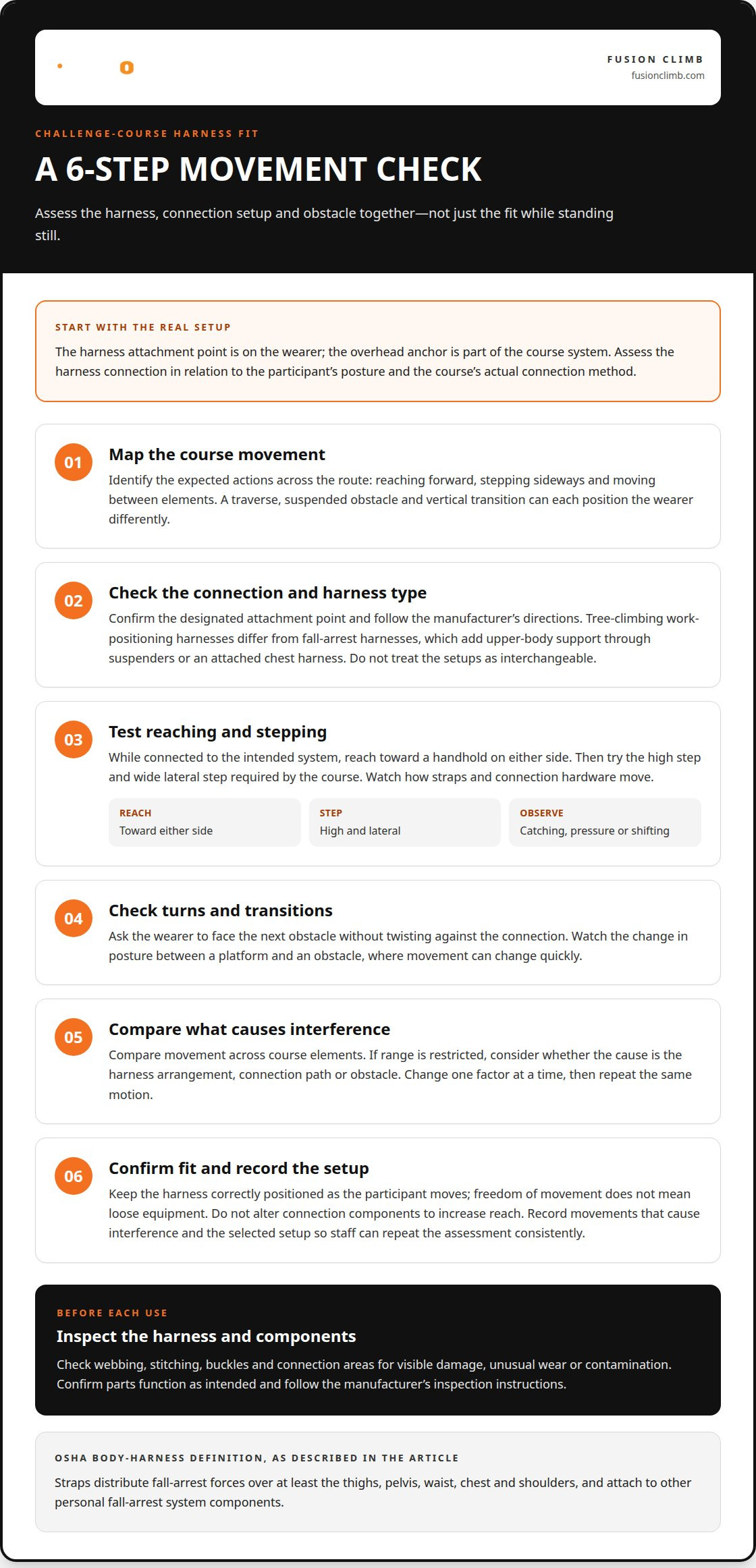
Distinguish the harness attachment point from the overhead anchor. The harness point is on the wearer; the anchor is part of the course system. A participant connected to an overhead line, for example, may move differently from someone connected at another position. Assess the harness connection in relation to the participant’s posture and the course’s connection method.
Start with the activity. A traverse, suspended obstacle, and vertical transition can each position the wearer differently. Map the expected movements, including reaching forward, stepping sideways, and moving between elements. Then identify where the system connects to the harness and whether that position supports the intended posture without forcing the participant to twist or lean.
Harness type matters. According to the U.S. Forest Service, tree-climbing work-positioning harnesses differ from fall-arrest harnesses, which add upper-body support through suspenders or an attached chest harness. This distinction clarifies what each type is designed to support. Don’t treat work-positioning and fall-arrest setups as interchangeable just because both connect the wearer to a system.
Review fit before selecting a setup. With the harness adjusted, observe the connection point as the participant stands, reaches, and takes the position expected on the course. For example, check whether reaching for a handhold pulls the connection area out of alignment or affects balance. Repeat the review using the course’s actual connection arrangement.
Compare the harness instructions with the course system’s intended use. Confirm which attachment point is designated for the connection and follow the manufacturer’s directions. Don’t choose based on point height alone: body position, activity, harness design, and system connection all matter. Record the selected setup so staff can apply the fitting process consistently.
Freedom of movement
Participants move in several directions on a course, not simply stand upright. A low traverse may call for a long sideways step, while a suspended bridge requires controlled weight shifts. Test movement on the actual obstacles: a harness that feels unobtrusive while standing may restrict a reach or turn.
Use a consistent movement check before choosing a setup. Have the participant perform the course’s required actions while remaining connected to the intended system. Observe how the straps and connection hardware move as the wearer reaches overhead, bends their knees, steps across, and rotates their torso. Note where equipment catches, presses, or shifts enough to interrupt movement.
- Reach: Ask the participant to extend toward a handhold on either side.
- Step: Observe a high step and a wide lateral step, as the course requires.
- Turn: Check whether the wearer can face the next obstacle without twisting against the connection.
- Transition: Watch movement between a platform and an obstacle, where posture changes quickly.
Compare movement across different course elements. A participant may reach freely on a straight walkway but have less range when turning toward a cargo net. This helps identify whether the restriction comes from the harness arrangement, connection path, or obstacle. Change one factor at a time, then repeat the same motion to make the comparison useful.
Freedom of movement doesn’t mean loose equipment. The harness must stay correctly positioned as the participant moves; excess slack or displaced straps can create a separate concern. Keep the system configured for its intended use, and don’t alter connection components to increase reach. Assess the obstacle sequence, wearer’s range of motion, and harness behavior together. Record any movements that cause interference so staff can repeat the assessment across participants and course setups.
Full-body harness use at high ropes courses and adventure parks
At a high ropes course, choose a harness suited to the participant’s task and the course’s connection system. A climbing harness, industrial fall-protection harness, and course harness may serve different purposes, so don’t assume they are interchangeable. Compare intended use, attachment arrangement, and movement demands before choosing. Just as outdoor travelers preparing for mountain trekking or wilderness excursions with Victory Rental & Safaris must select gear built for the terrain, ropes course operators must tailor equipment directly to the activity.
In the United States, applicable requirements depend on intended use and system design. The U.S. Government Publishing Office states that OSHA defines a body harness as straps that distribute fall-arrest forces over at least the thighs, pelvis, waist, chest, and shoulders, and that attach to other personal fall-arrest system components.
No single retirement interval is right for every harness. Follow the manufacturer’s retirement criteria and consider the harness’s condition, wear, and incident history when deciding whether it remains in service.
Harness prices vary by design, fit range, intended course use, and included components. Compare equipment against those requirements instead of choosing by price alone.
Inspect the harness and its components before each use. Check webbing, stitching, buckles, and connection areas for visible damage, unusual wear, or contamination. Confirm that parts function as intended and follow the manufacturer’s inspection instructions. A damaged seam or buckle that won’t close correctly, for example, needs attention before use.
Organizations in the United States can source course equipment from manufacturers or safety-equipment distributors. Choose equipment intended for the course activity and connection system, and align staff inspection and fitting procedures with the manufacturer’s instructions. For athletic departments and recreational facilities outfitting broader sports programs alongside challenge courses, specialty suppliers like FiberSport USA provide competition-grade track and field gear.
Harness adjustment and fit
Fit each participant in the clothing they’ll wear on the course. A jacket over a shirt can change how straps sit, and loose layers may bunch beneath webbing. Follow the harness manufacturer’s instructions, then check that the waist, shoulder, and leg straps sit correctly against the wearer’s body.
A poorly fitting harness can shift during movement, create pressure points, or interfere with the intended connection. A damaged harness may not perform as designed. Remove visibly damaged equipment from use and follow the manufacturer’s inspection and retirement directions.
Use a consistent fitting sequence for each participant:
- Position: Put the harness on as instructed, with its designated front and back correctly oriented.
- Adjust: Tighten the straps evenly, following the manufacturer’s guidance for each buckle and adjustment point.
- Check: Examine strap placement and closures; look for twisted webbing, unsecured buckles, or straps that have slipped.
- Move: Ask the participant to bend, step, and reach as the course requires. Recheck the fit if a strap shifts.
Assess the fit while the participant stands and moves naturally. A strap that appears aligned at rest, for example, may ride upward during a step or reach. Adjust it according to the manufacturer’s method, then repeat the movement. Don’t compensate for poor fit by changing the intended connection point or altering system components.
Record the fitting procedure and recurring adjustment issues, such as a buckle that loosens during a particular movement. These notes help staff apply the same method consistently and identify equipment that needs closer inspection. Recheck fit whenever the clothing, participant, or harness changes, and before connecting the wearer to the course system.
For equipment suited to course use, explore full-body harness options and compare fit requirements with your course procedures.
Fusion Climb: Full Body Harnesses
Fusion Climb offers Full Body Harnesses for organizations assessing equipment for challenge-course use. Use your course’s fit, movement, and connection requirements to narrow the options suited to its setup. For aerial activities involving a different body position, Superman Style Harnesses may also be relevant. Zipline Pulleys and Lanyard and tether are additional equipment categories to consider when planning compatible system components.
Before selecting equipment, define the course activity, intended connection method, and participants’ movement needs. Compare those requirements with the product’s intended use and manufacturer instructions. This grounds the decision in how participants move through your course, rather than appearance alone.
Contact Fusion Climb to discuss harness options for your course.
Set Your Course Up for the Next Step
A harness decision is useful when it becomes a clear equipment plan for the route, participants, and connection system. Keep these requirements together as you evaluate options, and apply the same criteria when course elements or operating procedures change. This helps your team make consistent choices instead of treating each harness as an isolated purchase.
A full body harness for challenge courses is one part of the equipment plan. Fusion Climb offers Full Body Harnesses, Superman Style Harnesses, and Zipline Pulleys for organizations evaluating aerial course setups. Focus on equipment suited to your activity and intended system connections.
Ready to discuss harness options for your course? Contact Fusion Climb about harnesses and take the next step toward a deliberate equipment plan. Keep the course moving with choices grounded in fit, function, and the demands of real movement.
Frequently Asked Questions
What type of full-body harness is required for challenge courses and ropes courses?
A full body harness for challenge courses should suit the activity and work with the course’s fall-arrest system. The right design depends on how participants connect, move, and position themselves along the route. Suspended elements, for example, may have different requirements from a climbing task. Match the harness’s intended use to the course setup and follow the manufacturer’s instructions.
Which brands make full-body harnesses for challenge courses?
Fusion Climb offers Full Body Harnesses and Superman Style Harnesses for aerial adventure applications. Compare each option with your course’s movement demands, participant fit needs, and connection arrangement instead of relying on a brand name alone. If your setup includes zipline components, consider how the harness works with the other system equipment and its instructions for use.
How do you choose the correct harness size and fit?
Choose a full body harness for challenge courses using the specific model’s sizing instructions and measurements, not general clothing size. Measure the wearer as directed and compare the result with that model’s size guide. For a practical fit check, have the participant wear the clothing planned for the course. Confirm that the selected size allows the manufacturer’s intended adjustment range without forcing straps to their limits.
How do you put on and adjust a challenge course full-body harness correctly?
Follow the model’s instructions in order: identify the front and back, put on the harness, fasten each buckle, and adjust each strap as directed. Before connecting, check that buckles are closed, webbing isn’t twisted, and loose strap ends are managed as the manual directs. Have the wearer take a step and reach, then recheck the adjustments before starting.