



Double Locking Safety Carabiner: The Professional Guide to Secure Connections
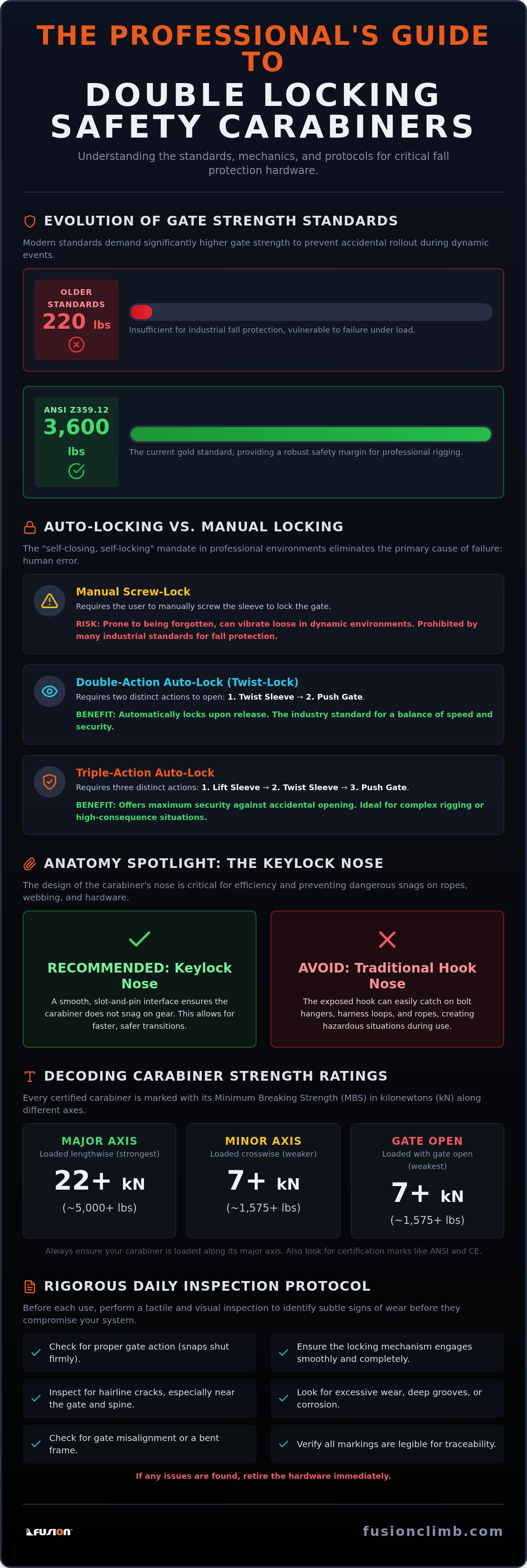
Did you know that older safety standards once allowed carabiner gates to fail at just 220 pounds of pressure? Today, the ANSI Z359.12 standard demands a minimum gate strength of 3,600 pounds to prevent accidental rollout in high-stakes environments. When you're suspended hundreds of feet in the air or securing a critical load, you can't afford to guess about your hardware. Choosing the right double locking safety carabiner is more than a preference; it's a fundamental requirement for industrial safety and professional fall protection.
You likely recognize that terminology in this industry can be confusing, especially when trying to distinguish between auto-locking and manual mechanisms. It's frustrating to feel uncertain when choosing between the lightweight agility of aluminum and the sheer durability of steel for specific dynamic loads. This guide provides a clear path through the noise. You'll master the technical specifications, safety standards, and selection criteria necessary for professional rigging. We'll examine ANSI compliance, gate mechanics, and practical maintenance to ensure your connections remain secure for the long haul.
Key Takeaways
- Learn why the "self-closing, self-locking" mandate is non-negotiable for professional safety and how it prevents accidental rollout.
- Understand the critical engineering differences that define a double locking safety carabiner and why ANSI Z359.12 compliance is the gold standard for fall protection.
- Evaluate the mechanical differences between double-action and triple-action gates to determine the optimal security level for your specific rigging environment.
- Establish a rigorous daily inspection protocol to identify subtle signs of wear, such as gate misalignment or hairline cracks, before they compromise your system.
- Discover how to integrate high-strength connectors with specialized hardware like commercial pulleys and full-body harnesses for a unified safety solution.
The Engineering Behind Double Locking Safety Carabiners
A double locking safety carabiner serves as the primary fail-safe in any professional vertical system. Unlike basic hardware, these connectors utilize a mechanism that requires two distinct, deliberate actions to open. Usually, this involves a rotational twist of the sleeve followed by a physical press on the gate. This design adheres to the "self-closing, self-locking" mandate essential for industrial safety. It ensures that the moment a technician releases the gate, the internal spring forces the sleeve back into a locked position without further intervention.
While the History of the Carabiner began with simple manual links, modern commercial rigging has moved away from manual screw-gates. These older systems rely entirely on the operator to remember to secure the lock. In high-vibration environments, manual sleeves can vibrate loose, creating a catastrophic failure point. Because of this human error factor, many industrial standards now prohibit manual locking systems in favor of auto-locking hardware that remains closed by default.
Anatomy of a Professional Safety Connector
Precision engineering defines every millimeter of a professional connector. The spine bears the majority of the load, while the gate and nose provide the secure interface for ropes and hardware. Choosing a keylock design over a traditional hook-nose is vital for efficiency. Keylock noses feature a smooth, slot-and-pin interface that prevents the carabiner from snagging on webbing or bolt hangers during high-speed transitions. Gate lash refers to the temporary opening of the gate caused by the vibration of a sudden impact, which can reduce the carabiner’s breaking strength by more than half.
Double-Action vs. Manual Locking Systems
The transition from manual to auto-locking systems marks a significant shift in safety philosophy. Manual carabiners are prone to "the forgotten lock," where a tired operator fails to screw the sleeve shut. Double-action sleeves mitigate this risk by engaging automatically. For commercial zipline operators, this level of security is mandatory. These professionals often pair their connectors with specialized commercial zipline pulleys to ensure a closed-loop system that resists the constant vibration of high-speed travel. Using hardware that locks itself isn't just about convenience; it's about eliminating the most common point of failure in the safety chain.
Safety Standards and Compliance: ANSI Z359.1 and Beyond
Compliance is the bedrock of professional rigging. ANSI Z359.12 stands as the definitive standard for connectors used in personal fall arrest systems. This standard requires a minimum gate strength of 3,600 pounds (16kN) to resist rollout and accidental opening. This is a massive leap from older requirements that permitted much lower tolerances. It ensures that even if a connector is loaded against its gate during a dynamic event, the system remains secure. You cannot gamble with unrated hardware when lives are on the line.
International standards like CE EN 362 provide similar oversight, but they often differ in specific testing protocols. In the United States, adhering to OSHA personal fall protection standards is mandatory for industrial work. Understanding the difference between Minimum Breaking Strain (MBS) and Working Load Limit (WLL) is vital for any operator. MBS represents the point of absolute failure in a controlled test, whereas WLL accounts for a safety factor and determines the maximum weight you should actually apply during daily use.
Reading the Markings on Your Hardware
Look at the spine of your hardware. Every professional double locking safety carabiner must display its strength ratings in kilonewtons (kN). You'll see figures for the major axis, minor axis, and open-gate strength. Major axis ratings typically reach 5,000 pounds (22.2kN). Minor axis and open-gate ratings are significantly lower, often dropping below 10kN. Traceability is equally important for fleet management. Batch numbers and manufacturing dates allow for precise equipment tracking and retirement schedules. For a deeper look at these stamps, review this guide on Safety Markings: How to Read a Climbing Carabiner.
Material Selection: Steel vs. Aluminum
Material selection dictates the longevity of your system. Steel carabiners are the workhorses of industrial rigging. They offer superior durability for high-cycle environments where friction and abrasion are constant. Using a high-strength double locking safety carabiner made of zinc-plated steel ensures your gear resists the abrasive forces of cable-based systems. Aluminum alloys provide a lightweight alternative for personal climbing systems where weight reduction is the priority. While aluminum is easier to handle during long shifts, steel remains the choice for permanent installations due to its resistance to surface wear. Consider your environment before choosing. Saltwater or humid conditions require specific coatings to prevent corrosion and maintain mechanical integrity.
Understanding these rigorous benchmarks allows you to build a gear cache that functions as a dependable guardian in vertical environments. Selecting hardware that meets these standards ensures your team remains focused on the task, not the equipment.
Double Action vs. Triple Action: Choosing Your Security Level
Selecting the right security level requires a deep understanding of mechanical sequences. A double-action mechanism, commonly known as a "twist-lock," requires two distinct movements: a rotation of the sleeve followed by a gate press. In contrast, a triple-action mechanism adds a third layer of complexity, typically a "lift-twist-open" or "pull-twist-open" sequence. This subtle addition significantly reduces the risk of accidental gate opening. Professional operators must weigh the speed of operation against the potential hazards of the environment. A comprehensive life-safety carabiner analysis suggests that the choice should always favor the highest level of security that the task permits without compromising the technician's ability to work efficiently.
When Double-Action is the Right Choice
A double-action double locking safety carabiner provides an excellent balance of security and speed for standard work-positioning. In industrial settings where technicians wear thick, protective gloves, the two-step process is often easier to manipulate repeatedly. These systems are ideal for low-vibration rigging where the connector isn't in constant contact with moving ropes or adjacent hardware. For large-scale commercial installations, such as fixed-point anchors in a warehouse, the double-action design offers a cost-effective solution without compromising core safety mandates. It remains a reliable, sturdy baseline for any professional gear cache that demands industrial reliability.
The Case for Triple-Action Security
Triple-action hardware is the gold standard for high-consequence dynamic environments. These connectors are specifically designed to prevent "rope-drag" or hardware-rub, where a moving line could inadvertently rotate and depress a standard double-action sleeve. This is a critical consideration for ropes course safety equipment, where participants move in unpredictable ways. The three-stage opening sequence ensures that accidental contact with the sleeve won't result in a gate failure. Many modern aerial parks now mandate triple-action connectors for all life-safety points to eliminate any margin for error. While the third action takes more practice to master with one hand, the added security in a high-risk scenario is indispensable. It's a small mechanical change that provides a sobering sense of security when you're pushing physical limits in vertical environments.
Inspection and Maintenance: Ensuring Rigging Reliability
Hardware is only as good as its last inspection. A double locking safety carabiner is a precision instrument, and its reliability depends entirely on rigorous, scheduled oversight. A "Pre-Flight" check isn't a suggestion; it's a mandatory protocol for every professional operator before they leave the ground. You need to look for hairline cracks that often hide near the gate pivot or the nose. These tiny fractures can expand under load, leading to catastrophic failure. Corrosion is another silent killer, particularly in humid or coastal environments, where it can seize the locking sleeve and turn a high-tech connector into a safety liability.
The Daily Inspection Checklist
Every shift must begin with a hands-on evaluation of your connectors. Start by testing the self-closing and self-locking speed. The gate must snap shut instantly when released, and the sleeve must engage without hesitation. If the movement feels sluggish, grit or internal spring fatigue may be the cause. Check for excessive gate play or "slop" by wiggling the gate while it's open. A gate that doesn't align perfectly with the nose when closed is compromised and must be removed from service. Finally, run your fingers along the load-bearing surfaces. Any grooves deeper than 1mm or 10% of the material thickness indicate significant wear from rope friction or hardware-on-hardware contact.
Long-Term Care and Lubrication
Maintaining smooth action requires more than just a quick wipe. Remove accumulated grit, salt, and dust using mild soap and warm water. For lubrication, use a dry lubricant like graphite or a specialized Teflon-based spray that won't attract dirt. Avoid heavy oils or WD-40, as these can gum up the internal springs over time. Environmental storage is equally critical. Keep your gear in a cool, dry place away from battery acid, bleach, or extreme heat, which can degrade the integrity of the metal over time. For commercial operators, maintaining a detailed safety log is essential. Documenting the purchase date, inspection history, and any "near-miss" events ensures a clear chain of traceability for your entire fleet.
Retirement criteria are non-negotiable. If a carabiner is dropped from a significant height onto a hard surface, retire it immediately, even if it looks fine. Micro-fractures aren't always visible to the naked eye. When you invest in your safety, you're investing in the longevity of your career. Keep your rigging system in peak condition by sourcing your gear from a trusted safety hardware manufacturer that understands the demands of the vertical world.
Professional Hardware Solutions from Fusion Climb
Fusion Climb operates as a dedicated manufacturer of high-strength rigging hardware, not merely a reseller of third-party gear. Since 1998, the company has focused on the precision engineering required for commercial zipline operators and industrial fall protection professionals. Every double locking safety carabiner in the lineup undergoes rigorous testing protocols to ensure it meets the current ANSI Z359.12 gate strength requirements. This commitment to industrial reliability ensures that each connector functions as a dependable guardian in high-stakes environments. By controlling the manufacturing process from origin to final assembly, Fusion delivers a level of consistency that third-party distributors simply cannot match.
Built for the Rigors of Aerial Adventure
Commercial environments demand hardware that withstands constant cycles and environmental stress. Fusion provides both heat-treated steel and high-strength aluminum options to suit different rigging needs. Steel options offer the durability needed for permanent installations, while aluminum provides the lightweight agility required for personal climbing systems. These connectors are designed to integrate perfectly with commercial zipline pulleys and full-body harnesses. The ergonomic gate designs facilitate high-frequency use in adventure parks, allowing guides to work efficiently without compromising security. Beyond this, the seamless compatibility with zipline lanyards and tethers creates a closed-loop safety system where every component is built to the same exacting standards.
Why Industry Professionals Trust Fusion Hardware
Professional trust is built on decades of substance and real-world performance. Fusion Climb avoids the "extreme" marketing fluff common in the industry, opting instead for a sturdy, no-nonsense delivery of technical facts and engineering data. Commercial operators benefit from direct-to-operator support and technical guidance that helps them select the right gate mechanisms for their specific risks. This manufacturer-direct relationship allows for bulk hardware solutions that keep large fleets compliant and safe without unnecessary overhead. Choosing Fusion means partnering with a bold innovator that remains rooted in traditional values of strength and meticulous manufacturing. It's about having the technical assurance that your hardware will perform exactly as expected when the load is dynamic and the consequences are high.
Elevate Your Rigging Standards
Mastering your hardware is the difference between a system that merely works and one that provides absolute security. You now understand that ANSI Z359.12 isn't just a label; it's a rigorous benchmark for gate strength that protects against rollout in dynamic environments. Selecting the correct double locking safety carabiner requires you to balance the mechanical speed of double-action sleeves with the high-consequence security of triple-action systems. Rigorous daily inspections and proper lubrication remain your primary defense against wear, ensuring every connector in your fleet stays operational. This methodical approach to safety allows you to focus on the challenge ahead with complete confidence in your gear.
As a manufacturer-direct partner since 1998, Fusion Climb provides the technical expertise and rugged hardware needed for high-cycle commercial use. Our gear serves as a dependable guardian for professionals who push their limits every day in vertical environments. Browse Fusion Climb’s Professional Carabiner Collection to find ANSI Z359.12 compliant options backed by manufacturer-direct expert support. Take command of your vertical environment with hardware built for the most demanding industrial applications. Stay safe, stay focused, and keep climbing.
Frequently Asked Questions
What is the difference between an auto-locking and a double locking carabiner?
Auto-locking is a broad category, while double-locking specifically describes the number of actions required to open the gate. An auto-locking sleeve closes and locks automatically when released. A double locking safety carabiner requires two distinct actions to open, such as a twist and a push. This terminology often overlaps in professional catalogs, but the key is the "self-closing, self-locking" function. Triple-action models are also auto-locking but require three movements for enhanced security.
Are double locking carabiners required by ANSI for fall protection?
Yes, ANSI Z359.12 requires connectors in personal fall arrest systems to be self-closing and self-locking. This mandate ensures the gate cannot be left open by human error. The standard also specifies a gate strength of 3,600 pounds to prevent rollout. While older standards allowed manual screw-gates, modern industrial regulations prioritize the fail-safe nature of double-locking mechanisms. Always verify the ANSI stamp on the spine to ensure compliance for professional work.
How much weight can a professional double locking carabiner hold?
Most professional carabiners have a major axis breaking strength of at least 5,000 pounds (22.2kN). This Minimum Breaking Strain (MBS) is a requirement for ANSI Z359.12 compliance. However, the Working Load Limit (WLL) is much lower, typically calculated with a safety factor of 5:1 or 10:1 depending on the application. Always distinguish between the major axis, minor axis, and open-gate ratings, as strength drops significantly if the gate is not fully locked.
Can I use an aluminum double locking carabiner for industrial rigging?
You can use aluminum if the specific hardware meets the required ANSI strength ratings for your task. High-strength aluminum alloys are common in personal fall arrest systems because they reduce weight for the climber. However, for high-cycle rigging or permanent installations, steel is often preferred due to its superior abrasion resistance. Aluminum tends to wear faster when in constant contact with steel cables or abrasive ropes. Evaluate your environment's vibration levels before deciding.
How often should I replace my safety carabiners?
Replace your carabiners immediately if they show signs of physical damage or fail a functional test. There is no fixed expiration date for metal hardware, but many professionals retire gear after 10 years of use. You must pull a double locking safety carabiner from service if you notice deep grooves, hairline cracks, or a sluggish gate. If a connector survives a significant drop onto a hard surface, retire it immediately. Hidden micro-fractures can compromise structural integrity.
What should I do if my carabiner gate is sticking?
Clean the mechanism with mild soap and warm water to remove grit and salt. After washing, dry the hardware thoroughly and apply a small amount of dry, Teflon-based lubricant to the pivot point and internal spring. Avoid heavy oils that attract dirt. If the gate continues to stick or fails to snap shut instantly after cleaning, the internal spring is likely fatigued. In this scenario, the hardware is no longer safe and must be retired from your fleet.
Are triple-action carabiners safer than double-action ones?
Triple-action carabiners provide a higher level of security by requiring three distinct movements to open. This "lift, twist, and push" sequence significantly reduces the risk of accidental gate opening caused by rope-drag or hardware-rub. While they are technically "safer" in high-consequence environments like aerial adventure parks, they can be more difficult to operate with one hand or thick gloves. Choose the security level that matches the specific hazards of your rigging environment and operator experience.
Can I use a climbing carabiner for zipline operations?
Only use carabiners that are specifically rated for the loads and standards of commercial zipline systems. Many recreational climbing carabiners lack the ANSI Z359.12 gate strength required for professional fall protection. Zipline operations involve high speeds and constant vibration, which demand rugged, industrial-grade hardware. Ensure your connectors are compatible with your zipline pulleys and lanyards. Using unrated gear in a commercial setting can lead to catastrophic failure and significant legal liability for the operator.