



Double Leg Lanyards for Continuous Connection During Anchor Transfers
During an anchor transfer, continuous connection means keeping one lanyard leg attached while moving the other to the next anchor. Double-leg lanyards for continuous connection support this transfer with two hooks, helping workers remain connected as they move between anchor points.
A lanyard connects a harness to an anchor, and the right design depends on the task. This guide explains how double-leg lanyards work, what to consider during anchor transfers, and how fall-arrest, restraint, and positioning lanyards differ. It also covers connection methods, anchor suitability, and fall clearance, all of which matter when selecting equipment for work at height.
Key Takeaways
- Understand how energy-absorbing and non-energy-absorbing lanyards serve different fall-protection needs.
- Learn how to maintain a connection while transferring between anchor points and what connection details matter.
- Recognize the distinct roles of fall arrest, restraint, and positioning systems before selecting equipment.
- See how lanyard design, anchor compatibility, and fall clearance influence equipment choices for work at height.
Energy-absorbing and non-energy-absorbing lanyards
Energy-absorbing lanyards are designed to control energy transfer and reduce forces during a fall. Non-energy-absorbing restraint lanyards serve another purpose: limiting access to a fall hazard.
Energy Absorption and Fall-Force Reduction
A shock absorber reduces fall impact force by deploying in a controlled way, extending the arrest process rather than stopping a worker abruptly. This matters because fall protection depends on the complete system, not just the lanyard. Dual-leg lanyards are designed to limit arrest forces to around 900 lbs, so the specified absorber and compatible connections matter.
An energy absorber may be internal, enclosed within the lanyard assembly, or external, housed in a visible pack. Its placement describes the design, not whether the lanyard is suitable for a particular task. Before use, inspect the webbing, absorber, stitching, and connectors for cuts, deformation, wear, or connection problems.
Lanyard Length and Absorber Design
Lanyard length and absorber design work together: the length affects fall distance, while the absorber needs room to deploy during arrest. A 6-foot free-fall lanyard is designed to arrest a fall when anchored at or above the dorsal D-ring; a 12-foot free-fall lanyard is engineered for scenarios with an anchor below that D-ring.
These examples show why lanyard length should not be chosen by reach alone. Fall-clearance planning accounts for lanyard length, anchor location, absorber deployment, worker height, and fall-arrest system design. A longer lanyard may allow more movement but needs more clearance; a shorter one may limit work.
For restraint, a non-energy-absorbing lanyard limits travel to prevent the worker from reaching a fall hazard. It is not a substitute for an energy-absorbing fall-arrest system. Match the lanyard’s function to the task, anchor, and available clearance, and follow the manufacturer’s instructions for the absorber design and connection method.
Continuous connection during anchor-point transfer
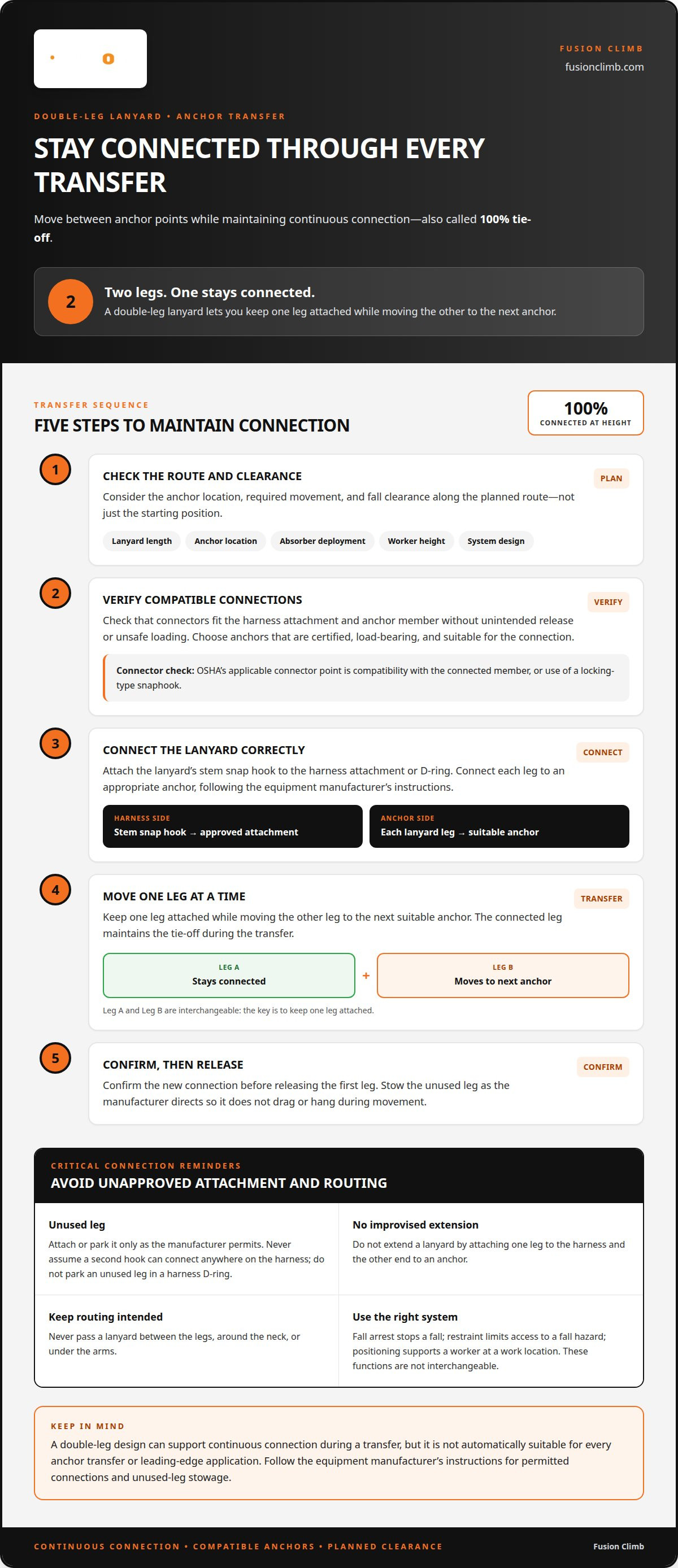
During an anchor transfer, a double-leg lanyard lets a worker keep one leg attached while moving the other. This supports continuous connection, also called 100% tie-off, while progressing between anchor points.
Harness and Anchor Compatibility
Compatibility means each connector fits its harness attachment and anchor member without creating an unintended release or unsafe loading. A secure connection depends on the components working together, not simply on having two hooks.
Choose anchor points that are certified, load-bearing, and suitable for the intended connection. Match each hook to the anchor’s shape and the harness connection. According to the Occupational Safety and Health Administration, snaphooks must be compatible with the connected member or be locking type to prevent unintentional disengagement.
Choosing Lanyard Length and Connectors
Choose lanyard length based on anchor location, required movement, and fall clearance. Select connectors that fit both the anchor and harness. This helps prevent restricted reach and inadequate clearance if a fall occurs.
In the United States, 100% tie-off means staying connected 100% of the time while working at height. A double-leg design can support that transfer, but the unused leg should attach only to a harness point the manufacturer approves for that use.
During a transfer, keep one leg connected while moving the other to the next suitable anchor. Confirm the new connection before releasing the first leg. The lanyard’s stem snap hook attaches to the harness attachment or D-ring, and each leg connects to an appropriate anchor.
OSHA’s applicable connector point is compatibility or a locking-type snaphook; the facts here do not establish a separate OSHA rule requiring double-leg lanyards for every transfer. The manufacturer’s instructions specify permitted attachment methods, including where to park an unused leg. Never assume a second hook can be connected anywhere on the harness.
For equipment selection, a lanyard and tether can be considered alongside the harness connection and anchor arrangement for the task.
Fall arrest, restraint, and positioning
Fall arrest stops a fall, restraint limits access to a fall hazard, and positioning supports a worker at a work location. Tying back or connecting lanyard legs in an unapproved way can compromise the system, so follow the equipment manufacturer’s connection instructions.
Repositioning Risks and Fall Clearance
Repositioning changes a worker’s location relative to the anchor, which can change fall distance and available clearance. A 6-foot free-fall lanyard is designed for an anchor at or above the dorsal D-ring; a 12-foot free-fall lanyard is engineered for an anchor below it. These descriptions don’t replace site-specific clearance planning.
Plan for lanyard length, anchor location, absorber deployment, worker height, and fall-arrest system design. A longer lanyard allows more movement but requires more clearance; a shorter one can restrict reach. Consider the route between anchor points, not just the initial work position.
Risks of Incorrect Lanyard Use
Incorrect attachment can change how the lanyard and harness interact during a fall. Do not extend a lanyard by attaching one leg to the harness and the other end to an anchor. Do not park an unused leg in a harness D-ring, as it can add to the body’s load during a fall.
Stow the unused leg as the manufacturer directs so it does not drag or hang during movement. Never pass a lanyard between the legs, around the neck, or under the arms. These routing choices can put the connection in an unintended position during a fall or repositioning.
Fall arrest, restraint, and positioning are not interchangeable. A restraint system uses a lanyard without an energy absorber to prevent reaching a hazard; a shock-absorbing lanyard is used as part of a fall-arrest system. For positioning, use only equipment and a connection method intended for that task.
Before moving, account for the anchor, lanyard length, and clearance along the planned route. A double-leg lanyard is not automatically suitable for every anchor transfer or leading-edge application. Permitted connection methods, instructions for the unused leg, anchor suitability, and required clearance all affect whether the setup fits the work.
Double-leg lanyard design and continuous connection
A double-leg shock-absorbing lanyard has two connection legs and is also called a twin-leg or Y-lanyard. Its three connection points serve the worker and two anchor connections, supporting movement between anchors while maintaining a connection.
During a transfer, one leg can remain connected while the other moves to a separate anchor. This supports work at height when the route requires repositioning, but does not make every anchor transfer suitable. The permitted connection method, anchor suitability, and fall clearance still determine whether it fits the task.
Design also affects handling. Compared with a single-leg lanyard, a double-leg model is usually heavier, more expensive, and has more components to manage. For example, workers transferring between anchors must handle the second leg without letting it drag, snag, or connect to an unapproved harness point.
Inspect each leg, connector, stitching, and absorber before use. Look for wear, deformation, cuts, or connection problems. Follow the manufacturer’s instructions for inspection, care, and retirement, including the criteria for removing equipment from service.
Continuous connection depends on correct use, not simply on having two hooks. The stem snap hook attaches to the harness attachment or D-ring, and the unused leg connects only to a harness point approved for that purpose. During movement, connect the free leg to a suitable anchor before releasing the attached leg.
Keep the lanyard’s function and working conditions in mind. A double-leg design is not automatically suitable for leading-edge work or every anchor arrangement; the system must fit the task, clearance, and permitted attachment method. Its extra components can also affect movement, so the setup should support the route without creating a snagging hazard.
For a lanyard setup that supports anchor transfers, explore equipment options suited to the work and connection arrangement.
Fusion Climb: Lanyard and tether
Fusion Climb offers lanyards and tethers for connecting a harness to an anchor. Consider this equipment when planning anchor transfers, and match its intended use to the harness, connector, anchor arrangement, and manufacturer’s instructions.
A lanyard is one part of a fall-protection system, not a substitute for suitable anchors or clearance planning. When planning a complete setup, consider how the connection works with Full Body Harnesses, Superman Style Harnesses, or Zipline Pulleys where relevant. Every component must suit the task and work as intended with the rest of the system.
Keep working conditions and permitted attachment methods central to equipment selection. Contact Fusion Climb to discuss lanyards and tethers for your application.
Plan the Next Move With Confidence
Make equipment selection part of the work plan, not an afterthought. Before choosing a setup, define the route workers will take, the available connection points, and the movement the task requires. This helps determine whether double-leg lanyards for continuous connection fit the application or another fall-protection approach better suits the work.
Consider the full system. The lanyard, harness, connectors, and anchor arrangement need to work together for the task. A clear plan also helps workers understand how the equipment is intended to be used, so movement between work positions does not depend on guesswork.
When you’re ready to discuss equipment for your application, contact Fusion Climb. Choose the right setup, then move forward with purpose.
Frequently Asked Questions
What is a Lanyard?
A lanyard connects a worker’s harness to an anchor or another compatible attachment point. Its function depends on its design: it may arrest a fall, limit access to a hazard, or support positioning. For example, shock-absorbing and restraint lanyards serve different purposes and are not interchangeable.
In Which Sectors Is It Used?
Lanyards are used in work and recreation settings that involve height, access, or fall-protection needs. Examples include construction, industrial maintenance, rescue operations, adventure parks, ziplines, and high-ropes courses. Equipment and connection methods depend on the task: a worker moving between structural anchors has different needs from a participant using a zipline system.
What is a double-leg lanyard for continuous connection?
A double-leg lanyard has two legs connected to a shared attachment point, allowing a worker to transfer between anchors while remaining connected. Double-leg lanyards for continuous connection are useful when the work route requires successive anchor changes. The setup still depends on compatible harness connections, suitable anchors, and following the manufacturer’s instructions for the lanyard legs.
How do you use a double-leg lanyard to maintain 100% tie-off?
Maintain 100% tie-off by keeping one permitted lanyard leg connected while moving the other to the next suitable anchor. Confirm that the new connection is secure before releasing the first. For example, on a route with separate anchors, transfer one leg at a time. Attach an unused leg only to a harness point approved by its manufacturer.
What types of double-leg lanyards are available, including energy-absorbing and self-retracting models?
Double-leg lanyards include shock-absorbing designs, often called twin-leg or Y-lanyards. Their absorber is part of the lanyard system and controls energy during fall arrest. A self-retracting lifeline is a different equipment design, not another name for a double-leg lanyard. Choose equipment based on the work, anchorage, and manufacturer’s stated use.
What fall-clearance distance is needed when using a double-leg lanyard?
There isn’t one clearance distance for every double-leg lanyard setup. The required space depends on lanyard length, anchor position, absorber deployment, worker height, and the overall fall-arrest system. For example, moving an anchor below the harness attachment changes the fall scenario. Plan clearance for the actual work position and route, accounting for each system component.