


Commercial Zipline Equipment: The 2026 Operator’s Guide to Safety and Performance
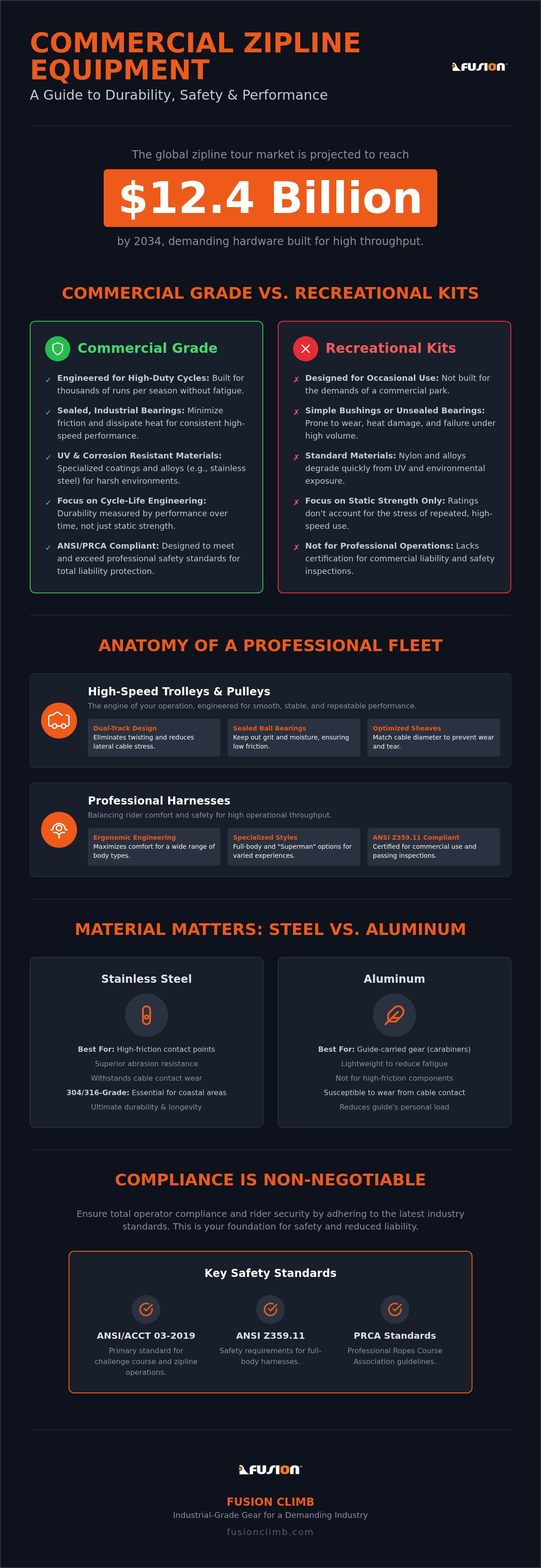
With the global zipline tour market projected to reach $12.4 billion by 2034, operators are facing unprecedented throughput demands that standard hardware simply wasn't built to handle. You know the cost of high equipment turnover. It isn't just the price of a new trolley; it's the lost revenue and the nagging worry about wear and tear during a peak season. Selecting the right commercial zipline equipment is no longer just about meeting a budget. It's about navigating the complexities of ANSI/ACCT 03-2019 standards while balancing rider comfort with the high-speed efficiency your bottom line requires.
We understand that safety is your foundation. This guide empowers you to master the technical requirements and safety standards for high-cycle hardware to ensure total operator compliance and rider security. You'll learn how to select gear based on cycle-life engineering rather than just static strength. We will break down the essential components of a professional fleet, from ANSI-compliant full body harnesses to high-strength dual-track pulleys. By the end, you'll have a clear roadmap to extend your hardware's lifespan and reduce liability through certified, industrial-grade gear.
Key Takeaways
- Differentiate between recreational kits and high-duty cycle hardware by focusing on cycle-life engineering for high-volume parks.
- Identify the technical advantages of dual-track trolleys and sealed bearing systems for consistent performance during back-to-back runs.
- Master the latest ANSI Z359.11 and PRCA compliance standards to ensure your commercial zipline equipment passes every inspection with confidence.
- Evaluate the ergonomic benefits of specialized harness designs, including Superman style options, to balance rider comfort with operational throughput.
- Learn how integrating US-manufactured tethers and lanyards into your safety system extends the total lifespan of your fleet hardware.
Defining Commercial Grade: Duty Cycles and Durability Standards
Commercial grade isn't a marketing label; it's a rigorous engineering requirement. While the history of zip-lines shows humble beginnings with basic ropes and pulleys, modern adventure parks demand much more. Recreational kits are built for occasional use by a single family. In contrast, commercial zipline equipment must endure thousands of cycles annually without structural fatigue. Static strength ratings, such as a carabiner rated for 5,000 lbs, are just the entry fee. They don't tell you how the gear performs after the 1,000th rider of the month. True commercial hardware is defined by its cycle-life, the number of times a component can be loaded and unloaded before its integrity is compromised.
The High-Cycle Reality of Adventure Parks
Calculate your duty cycle to avoid unexpected failures. If you run 50 riders a day for 200 days, that's 10,000 cycles on a single trolley. Friction generates intense heat during high-speed descents. This thermal energy degrades standard seals and bearings quickly. High-volume parks require hardware that dissipates heat efficiently and utilizes sealed, industrial-grade bearings. Investing in high-cycle components reduces your cost-per-ride by extending the replacement interval from months to years. Don't let a low initial price tag mask high long-term overhead. Durability is the only way to protect your bottom line.
Environmental stressors also dictate your equipment choice. UV exposure degrades nylon webbing in harnesses, while high humidity can weaken non-treated alloys. Commercial gear uses UV-stabilized materials and specialized coatings to resist the elements. In coastal environments, salt air acts as a constant abrasive. Hardware that lacks professional-grade corrosion resistance will fail long before its mechanical cycle-life is reached. Reliability in the field requires gear that stands up to both the rider and the environment.
Just as your hardware must resist corrosion, your facility's boundaries require similar durability; park operators in coastal regions like Northeast Florida can explore Project-based fence installation and repair fees to maintain secure and weather-resistant perimeters.
Material Selection: Steel vs. Aluminum Hardware
Aluminum is the standard for carabiners used by guides who carry heavy racks. It's lightweight and reduces fatigue during long shifts. However, for high-friction contact points, stainless steel is essential. Steel withstands the abrasive nature of cable contact far better than aluminum ever could. If your course sits near a coast, standard carbon steel will oxidize in weeks. Use 304 or 316-grade stainless steel for commercial zipline equipment in these areas. This ensures your safety margins remain intact despite constant exposure to salt and moisture. Choose the material that matches the specific demands of your site's geography.
Essential Hardware: Professional Pulleys and High-Speed Trolleys
Precision engineering dictates the rider experience. A jerky ride isn't just uncomfortable; it's a sign of hardware fatigue. High-performance commercial zipline equipment relies on dual-bearing systems to ensure a smooth, stable descent. Unlike recreational pulleys that use simple bushings, professional trolleys utilize high-speed ball bearings that minimize friction and manage heat build-up. When evaluating commercial zipline pulleys, the bearing seal is your first line of defense. These specialized seals keep out dust, moisture, and grit, which are the primary causes of bearing failure in outdoor environments. Without them, your throughput slows down, and your maintenance costs skyrocket.
Sheave design is equally critical for cable longevity. A pulley sheave must be perfectly matched to the cable diameter to prevent "bird-caging" or excessive wire wear. When the sheave is too narrow, it pinches the cable. If it's too wide, the trolley wobbles. Optimized sheaves distribute the load evenly across the cable surface, extending the life of your most expensive infrastructure. It's a silent partnership between the trolley and the line that keeps your operation running safely day after day.
Dual-Track Pulleys and High-Speed Performance
Stability is safety. Dual-track trolleys eliminate the "twisting" or yaw that occurs with single-wheel designs. By utilizing two wheels in tandem, the trolley remains locked in a straight path, reducing lateral stress on the cable. You must match your pulley's speed rating to the specific incline of your course. Using a low-speed trolley on a steep, high-velocity line leads to rapid bearing degradation and potential failure. Maintenance for these high-speed units requires regular inspection of the axle bolts and a strict cleaning schedule to ensure the seals remain intact and functional.
Integrated Braking Systems for Operators
Controlled descents are non-negotiable. Braking-specific trolleys are engineered to interface with your course's arrest system, whether you utilize active or passive components. These units often feature specialized attachment points for bungee brake zipline kit hardware, ensuring that the impact force is distributed through the trolley frame rather than the rider's harness. By selecting pulleys designed for braking compatibility, you reduce the physical shock to the system during the landing phase. This integrated approach protects your gear and provides a more reassuring experience for the rider. If you're looking to upgrade your fleet, consider exploring professional-grade options that prioritize this seamless braking integration.
Professional Harness Engineering: From Full-Body to Superman Styles
The harness is the most critical interface between your guest and your commercial zipline equipment. While recreational users might settle for simple seat harnesses, professional operators require industrial-grade systems built for high-frequency use and total body support. Modern commercial standards have shifted toward full-body configurations to eliminate the risk of inversion and provide superior fall arrest capabilities. These systems aren't just about safety; they're about distributing the physical forces of a high-speed stop across the rider's entire frame. This reduces the risk of injury and ensures that every guest, regardless of their physical stature, remains in a secure, upright position throughout the experience.
Superman Style Harnesses: Prone Flight Mechanics
Prone flight gear, often called "Superman style" harnesses, has transformed the industry by offering a head-first experience that mimics actual flight. Beyond the thrill, these harnesses provide significant ergonomic advantages for long-distance lines. By supporting the rider in a horizontal position, the harness reduces strain on the lower back and hips that often occurs during long hangs in traditional upright seats. Safety is maintained through sophisticated multi-point attachment systems that secure the shoulders, waist, and legs simultaneously. For the operator, these designs often feature color-coded webbing and quick-connect buckles. This streamlines the "clip-in" process, allowing your staff to move more riders through the gate without compromising safety checks.
Full Body and Fall Arrest Systems
Compliance with ANSI Z359.11 is the benchmark for any professional fleet. This standard ensures that the harness has undergone rigorous testing for dynamic drops and static strength. A truly commercial full-body harness features reinforced dorsal and sternal attachment points. These points allow for versatile rigging options and secondary safety backups. When managing a diverse guest list, adjustability is your greatest asset. High-quality harnesses utilize friction-buckle systems that allow guides to quickly resize the gear for different body types, ensuring a snug, safe fit every time.
Guest comfort directly impacts your reviews. While the primary function of the webbing is strength, industrial-grade padding on the leg loops and shoulder straps is essential for high-volume parks. Riders often spend significant time in their gear while waiting on platforms or during orientation. Padding prevents the webbing from "biting" into the skin, maintaining a positive experience from the moment they suit up until they unclip at the finish. Investing in ergonomically designed commercial zipline equipment ensures that your guests focus on the adventure rather than their physical discomfort.
Safety Standards and Compliance: Navigating ANSI and PRCA
Safety isn't a feeling; it's a documented process. In high-volume environments, your compliance with industry standards is the only shield against liability. Understanding the nuances of ropes course safety equipment is vital for every operator. The ANSI Z359.11 standard is the rigorous benchmark for harness manufacturing. It mandates specific testing for dynamic drops and static loads. While organizations like ACCT and PRCA provide the operational framework for inspections, the hardware itself must meet these industrial-grade specifications to be considered legitimate commercial zipline equipment.
Traceability is the hallmark of a professional operation. Every piece of gear should have a unique identifier, allowing you to track its age and cycle history. A robust safety log isn't just paperwork. It's a living record of your commitment to user safety. If a piece of equipment doesn't have a clear history, it doesn't belong on your line. Standardizing your documentation ensures that you're always ready for an annual inspection or a regulatory audit.
Reading Strength Ratings and Safety Markings
Precision matters when reading hardware specs. Minimum Breaking Strength (MBS) represents the point of total failure under laboratory conditions. In contrast, the Working Load Limit (WLL) is the maximum weight you should actually apply during daily operations. This is typically a fraction of the MBS to provide a necessary safety buffer. Look for laser-etched markings on professional climbing carabiners. These markings should include the strength ratings and batch numbers. Batch testing is essential in commercial manufacturing because it ensures that every production run meets the same uncompromising standards as the initial prototypes.
The Operator’s Inspection Checklist
Consistency is your best defense. Perform daily pre-flight inspections on all commercial zipline equipment. Look for "hot spots" on metal hardware where friction has worn down the finish. Check webbing for fraying, discoloration, or glazing, which indicates heat damage. These are sober signs that the material's integrity is compromised.
Conduct monthly deep-dives into your fleet. This involves testing the gate-locking mechanisms on every carabiner and checking for axial play in pulley bearings. Establish strict retirement criteria. Gear must be pulled from service if it shows structural damage, but you should also retire items based on age or cycle count regardless of their appearance. When in doubt, take it out. Protecting your riders is worth more than the cost of a replacement component. To ensure your fleet meets these rigorous standards, source your hardware from a manufacturer committed to industrial testing.
Optimizing Your Fleet: Why Fusion Climb Hardware Leads the Industry
Operational success in the aerial adventure industry is built on the reliability of your hardware. Fusion Climb, a US-based manufacturer founded in 1998, understands that commercial zipline equipment must perform without compromise. By maintaining direct control over the manufacturing process, we ensure that every component meets the rigorous demands of high-volume parks. This domestic production allows for meticulous industrial testing and a level of quality control that overseas "kit" suppliers simply cannot match. When you source directly from a manufacturer, you're investing in a shorter supply chain and a deeper level of technical accountability.
Customization is the key to a truly efficient safety system. Beyond the primary trolley and harness, your secondary connections define your throughput speed. Integrating high-performance zipline lanyards and tethers into your fleet allows for a more seamless rider transition at the platforms. These components are engineered to work in tandem with our pulleys and carabiners, reducing the risk of gear interference and snagging. For large-scale installers and park owners, we provide bulk hardware solutions that ensure consistency across every line in your park.
Rugged Reliability for Aerial Parks
Professional riggers choose Fusion Climb because our gear is built for the most demanding vertical environments. We operate under a "silent partner" philosophy. Our hardware works quietly and reliably in the background, allowing your guides to focus entirely on the guest experience rather than worrying about gear fatigue. This rugged reliability is the result of decades of engineering focused on high-stakes connectivity. Whether it's the precision of our dual-track trolleys or the industrial-grade webbing in our harnesses, every detail is designed to withstand the abrasive reality of daily commercial use.
Next Steps for Commercial Operators
Transitioning from recreational gear to professional-grade commercial zipline equipment is a critical step in scaling your business. It requires moving away from generic solutions and toward hardware that is specifically rated for high-cycle duty. If you're designing a new course or upgrading an existing fleet, consulting with a manufacturer can help you identify the specific hardware configurations that match your course's unique incline and speed requirements.
Securing Your Season with Industrial Precision
Operational excellence depends on the integrity of your hardware. Moving beyond recreational standards to true commercial zipline equipment requires a focus on cycle-life engineering and meticulous maintenance. From the thermal management of dual-track trolleys to the specialized ergonomics of Superman style harnesses, every component must be selected for its ability to withstand thousands of high-speed runs. Compliance with ANSI Z359.11 is the foundation of a safe park, providing the technical assurance needed to reduce liability and protect your guests.
Fusion Climb has served as a direct manufacturer of industrial-grade aerial safety gear since 1998. We specialize in ANSI-compliant harnesses and high-strength pulleys designed for the most demanding vertical environments. By choosing hardware built for the rigors of high-cycle use, you ensure your fleet remains a dependable asset rather than a recurring overhead cost. Don't leave your safety standards to chance when you can partner with a seasoned guardian of the industry. Explore the 2026 Fusion Climb Commercial Zipline Collection to find the precision-engineered gear your operation deserves. Build your legacy on strength and reliability.
Frequently Asked Questions
What is the difference between a commercial and a backyard zipline pulley?
Commercial pulleys are engineered for thousands of duty cycles and high-speed descents, while backyard versions are built for occasional light use. Professional commercial zipline equipment features sealed ball bearings that prevent grit and moisture from destroying internal mechanics. Backyard pulleys often use simple bushings that generate excessive heat and friction. Choosing industrial-grade trolleys ensures a smoother ride and prevents premature cable wear on high-throughput lines.
How often should commercial zipline harnesses be replaced?
Most commercial harnesses have a maximum service life of five to ten years from the date of manufacture, provided they pass all inspections. However, you must retire gear immediately if it shows signs of webbing fraying, UV discoloration, or chemical exposure. High-volume parks often choose to replace soft goods every two to three seasons to maintain peak safety margins and ensure a fresh guest experience.
Are ANSI compliant harnesses required for all commercial zipline operations?
While specific state laws vary, most insurance providers and industry bodies like the ACCT require ANSI Z359.11 compliance for commercial zipline equipment. Using ANSI-compliant harnesses demonstrates a commitment to industrial safety standards and significantly reduces legal liability. These harnesses undergo rigorous dynamic drop testing that recreational gear doesn't face, ensuring they can handle the high forces of a professional environment.
What are the benefits of a Superman style zipline harness for guests?
Superman style harnesses provide a unique prone flight experience that mimics the sensation of head-first soaring. This configuration is a significant draw for guests seeking a more adventurous perspective than a traditional seated ride. Ergonomically, these harnesses distribute weight across the torso and legs. This reduces lower back strain on long-distance cables and keeps the guest in a stable, aerodynamic position throughout the flight.
Can I use aluminum carabiners for high-volume commercial ziplining?
Aluminum carabiners are ideal for guides who need to reduce the weight of their personal gear racks during long shifts. However, you should prioritize stainless steel carabiners for guest connections and high-friction contact points. Steel is far more resistant to the abrasive wear caused by constant contact with trolleys and cables. This choice ensures a longer service life and maintains higher safety margins for your fleet.
What maintenance is required for dual-bearing zipline trolleys?
Maintenance for dual-bearing trolleys involves regular cleaning to remove metallic dust and inspecting the bearing seals for integrity. You must check for axial play in the wheels and ensure that all axle bolts remain torqued to the manufacturer's specific settings. If a bearing sounds gritty or shows any resistance when spun by hand, the unit should be removed from the line immediately for professional service.
How do I calculate the weight capacity for a commercial zipline system?
You determine capacity by identifying the Working Load Limit (WLL) of the weakest component, which is typically a fraction of its Minimum Breaking Strength (MBS). Most commercial operations apply a safety factor of at least 5:1. If a component is rated for 5,000 lbs MBS, its operational capacity is 1,000 lbs. Always consult a qualified engineer to calculate the specific tension loads for your course incline.
What is the role of a shock-absorbing tether in commercial ziplining?
A shock-absorbing tether acts as a critical safety link that reduces impact forces on the rider during an abrupt stop or fall. These tethers are essential during platform transitions and at the braking phase of the line. By utilizing specialized webbing that elongates under load, the tether protects both the rider and the anchor point from the violent energy of a dynamic event.