


Commercial Zipline Equipment List: The 2026 Operator’s Buying Guide
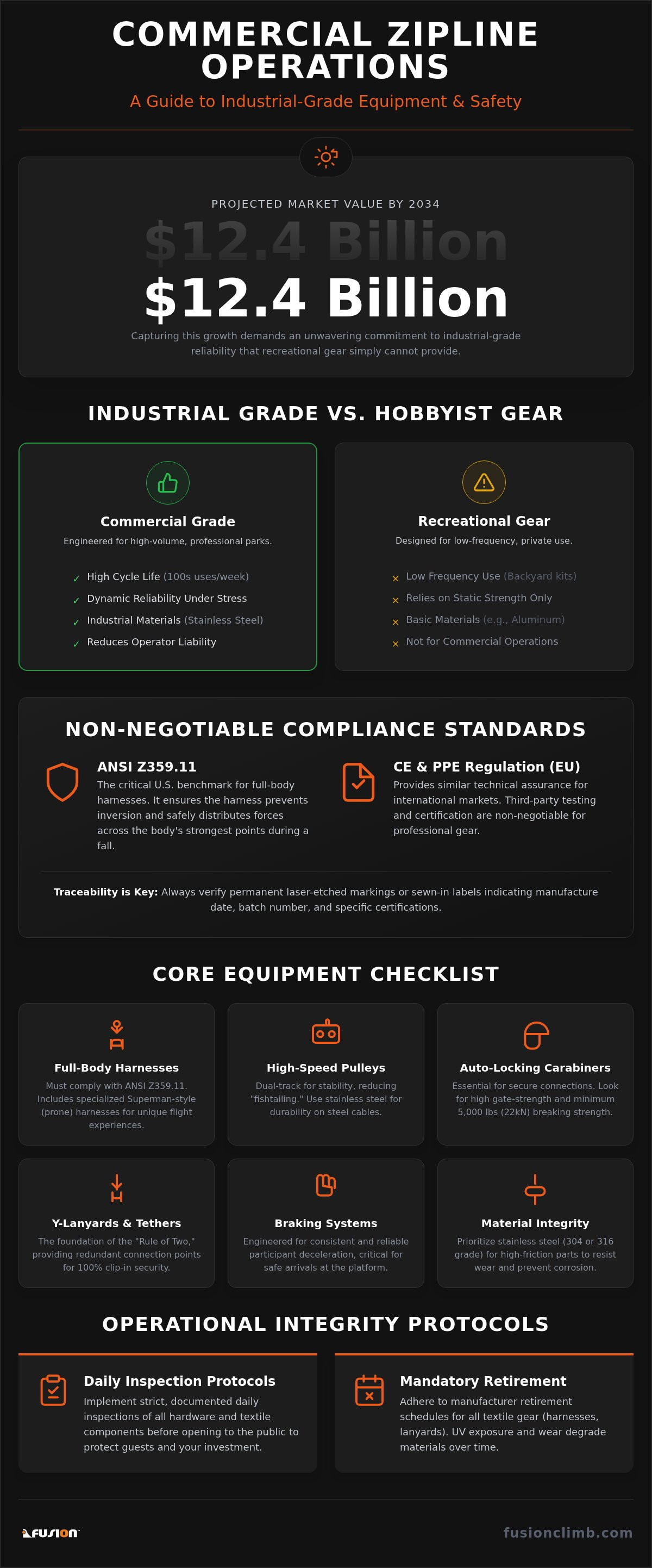
By 2034, the global zipline tour market is projected to reach a staggering $12.4 billion. However, capturing your share of this growth requires more than just a scenic view. It demands a commitment to industrial-grade reliability that recreational gear simply cannot provide. You understand the pressure of balancing high-volume throughput with the sobering responsibility of participant safety. Compliance with the latest ANSI/ACCT 03-2019 standards and ANSI Z359.11 requirements for harnesses is likely at the top of your priority list as you prepare for the 2026 season.
This guide provides a comprehensive commercial zipline equipment list to help you source hardware that withstands the brutal cycle-life of a professional park. We'll show you how to equip your course with professional-grade Superman-style harnesses, high-speed pulleys, and 5,000-pound MBS connectors that meet rigorous national standards. You will gain the technical clarity needed to eliminate compliance anxiety and improve operational efficiency. We'll explore everything from the essential redundancy systems to the specific stainless steel hardware required for high-friction contact points, ensuring your gear is as dependable as your reputation.
Key Takeaways
- Identify the critical role of ANSI Z359.11 standards in selecting full-body harnesses that prevent inversion and maximize participant safety.
- Navigate the essential commercial zipline equipment list to source high-cycle pulleys and hardware engineered specifically for the demands of steel cables.
- Master the "Rule of Two" by utilizing redundant connection chains and professional carabiners to ensure 100 percent clip-in security.
- Protect your investment and your guests by implementing strict daily inspection protocols and adhering to mandatory textile retirement schedules.
- Learn how to elevate your guest experience with specialized Superman-style harnesses that provide a unique prone flight sensation while maintaining industrial strength.
Defining Commercial Grade: Standards for Professional Zipline Gear
The term "commercial grade" is often misused as a marketing buzzword, but for a park operator, it represents a specific threshold of industrial engineering. It isn't just about weight capacity; it's about cycle life. While a recreational zip-line might see a dozen uses a month, a professional installation handles hundreds of participants every week. This high-frequency environment demands hardware that can withstand repetitive stress without compromising structural integrity. A comprehensive commercial zipline equipment list serves as your primary defense against equipment failure and operational downtime.
When building your gear inventory, you must distinguish between "heavy-duty" hobbyist gear and industrial-grade rigging. Backyard kits rely on static strength, but professional gear relies on dynamic reliability. Investing in professional gear is a strategic move to reduce liability. It provides a sobering sense of security that allows operators to focus on the participant experience rather than worrying about the integrity of their connection points.
ANSI Z359.11 and CE Compliance
ANSI Z359.11 is the critical benchmark for full-body harnesses in the adventure park industry. This standard ensures that if a fall occurs, the harness prevents inversion and distributes forces safely across the body's strongest points. CE compliance and PPE Regulation (EU) 2016/425 provide similar technical assurance for international markets. Third-party testing is a non-negotiable requirement for any professional commercial zipline equipment list. You should always look for permanent laser-etched markings or sewn-in labels that indicate the manufacture date, batch number, and specific certification standards. If the markings aren't there, the gear doesn't belong on your course.
Durability and Cycle Life Requirements
Cycle life refers to the number of times a component can be loaded and unloaded before metal fatigue or wear sets in. High-frequency commercial use necessitates specialized materials. For example, stainless steel is essential for pulleys that contact steel cables. It resists the abrasive wear that quickly destroys aluminum alternatives. Environmental factors also play a role in your selection process. In coastal environments, 304 or 316-grade stainless steel is the only way to prevent salt-air corrosion. Choosing the right materials ensures that your gear doesn't just pass an inspection on day one; it remains safe for thousands of cycles.
- Industrial Materials: Prioritize stainless steel over aluminum for high-friction contact points.
- Testing Protocols: Ensure all hardware has undergone rigorous third-party destructive testing.
- Traceability: Maintain records of batch numbers to track the history of every component in your park.
Essential Hardware: The Core Commercial Zipline Equipment List
Building a compliant course starts with selecting hardware that prioritizes industrial reliability over recreational convenience. Your commercial zipline equipment list must account for every link in the safety chain, from the participant's harness to the pulley that traverses the cable. In a high-volume park, these components face constant friction and load cycles. Selecting gear that meets the standards of the Association for Challenge Course Technology (ACCT) ensures your operation remains safe, efficient, and profitable through the 2026 season and beyond.
A complete commercial setup typically requires the following core components:
- High-speed pulleys engineered for permanent steel cable.
- Full-body harnesses and specialized prone-flight harnesses.
- Auto-locking carabiners with high gate-strength ratings.
- Y-lanyards and tethers for redundant connection points.
- Braking systems designed for consistent participant deceleration.
High-Speed Commercial Zipline Pulleys
Stability is the foundation of participant comfort and safety. Dual-track pulleys offer a significantly more stable ride than traditional single-wheel trolleys, reducing the "fishtailing" effect that can occur on long-distance lines. When choosing commercial zipline pulleys, you must prioritize stainless steel sheaves. Aluminum sheaves wear down rapidly against steel cable, leading to metal shavings and compromised performance. Professional-grade pulleys often feature integrated handle attachments, giving participants a sense of control while maintaining a safe orientation during flight. High-speed performance pulleys are essential for lines exceeding 500 feet to ensure consistent throughput without stalling.
Full Body and Superman Style Harnesses
Modern safety protocols have made full body climbing harnesses the industry standard for commercial operations. These designs eliminate the risk of inversion and provide superior fall arrest capabilities compared to waist-only models. However, operators looking to differentiate their park should consider Superman-style harnesses. These specialized prone harnesses allow guests to experience "prone flight," soaring head-first for a more immersive adventure. Providing a variety of sizes and styles is critical for maximizing throughput. You need a versatile inventory that can accommodate diverse participant demographics, from children to larger adults, without slowing down the harnessing process. For parks ready to upgrade their inventory, exploring a professional adventure park gear collection is the most efficient way to ensure all hardware meets the necessary industrial specifications.
Secure Connections: Ensuring Redundant Safety Systems
Safety in a high-stakes vertical environment is built on the foundation of redundancy. Professional operators adhere to the "Rule of Two," which dictates that every participant must be secured by both a primary and a backup connection point. This dual-link system ensures that even if one component fails, the secondary connection prevents a catastrophic event. When finalizing your commercial zipline equipment list, you must prioritize connectors and tethers that are engineered to work in tandem within this redundant framework.
Human error is a constant variable in park operations. To mitigate this risk, commercial environments rely heavily on auto-locking hardware. These components automatically engage the locking mechanism as soon as the gate is released, removing the danger of an operator or participant forgetting to manually lock a screw-gate. This technical assurance is a non-negotiable requirement for modern aerial adventure parks.
Industrial Strength Carabiners and Rigging
Selecting the right professional climbing carabiners requires a deep understanding of material properties and gate mechanics. While aluminum carabiners are popular for their lightweight profile, commercial rigging often demands the rugged durability of steel, especially for permanent anchor points or high-wear areas. Double-locking and triple-locking gates provide an extra layer of security against accidental opening during participant movement. According to ANSI Z359.12 standards, commercial-grade connectors must feature a gate strength capable of withstanding a 3,600-pound load, ensuring the gate itself doesn't become the weak link in your safety chain.
Zipline Lanyards and Shock-Absorbing Tethers
The connection between the participant's harness and the trolley is maintained by zipline lanyards and tethers. These components must possess a Minimum Breaking Strength (MBS) of 5,000 lbs, or approximately 23kN, to meet current safety mandates. Adjustable tethers are particularly valuable for accommodating participants of varying heights, allowing guides to maintain optimal positioning for every guest. In courses where high-velocity arrivals are common, shock-absorbing lanyards are required to dissipate kinetic energy and prevent jarring impacts. Operators must also look for integrated wear-indicators. These internal colored threads become visible only when the textile has reached its limit, providing a clear, visual signal that the equipment must be retired immediately.
Operational Integrity: Maintenance and Inspection Protocols
Safety is never a static achievement. It's a daily practice of technical vigilance. Every component on your commercial zipline equipment list is a high-cycle industrial tool that eventually reaches its mechanical limit. While high-grade hardware is built for durability, its integrity depends entirely on a rigorous maintenance schedule. Operators must implement a three-tier inspection hierarchy: daily pre-operational checks, monthly periodic reviews, and annual audits by a qualified professional. Detailed record-keeping of these inspections is your primary protection against liability and the only way to ensure your park remains compliant with 2026 safety mandates.
Hardware Inspection and Retirement
Metal components like trolleys and carabiners require a keen eye for subtle signs of fatigue. You must inspect pulley sheaves for scoring or sharp edges caused by cable contact. Bearings should rotate silently and without resistance. If you notice any "play" or wobbling in the wheel, decommission the unit immediately. Rigging hardware is also subject to the "drop rule." If a carabiner or pulley is dropped from height onto a hard surface, it must be retired. Micro-fractures can compromise the internal structure without leaving a visible mark. Regular maintenance includes cleaning high-cycle trolleys with compressed air and applying approved lubricants to keep the bearings performing at peak efficiency.
Textile Safety and Ropes Course Standards
Textile components are the most vulnerable links in your safety chain. Harnesses and lanyards are subject to strict "retire-by" dates, typically five to ten years from the date of manufacture, regardless of their visual condition. However, environmental factors often shorten this lifespan. UV exposure is a silent killer of nylon and polyester webbing, causing the fibers to become brittle and lose their energy-absorbing properties. When selecting ropes course safety equipment, look for integrated wear-indicators that signal when the webbing has been compromised. Staff training is the final piece of the puzzle. Your team must be professionally trained to recognize the difference between cosmetic "fuzzing" and structural abrasion that necessitates immediate gear replacement.
Equipping your course with hardware designed for high-frequency use is the first step toward long-term operational success. Explore our rugged, industrial-grade solutions and upgrade your park with professional adventure gear today.
Equipping Your Course with Fusion Climb Adventure Park Gear
Selecting the right hardware partner is as critical as the course installation itself. Since 1998, Fusion Climb has manufactured specialized, industrial-grade zipline hardware that defines the current market standard. Our Adventure Park Collection represents a deep commitment to meticulous manufacturing and real-world application. By choosing gear designed in the USA, operators gain a silent partner in their safety mission. This collection provides the technical foundation for a compliant commercial zipline equipment list, ensuring your park is ready for the high-cycle rigors of the 2026 season.
Why Professional Operators Choose Fusion Climb
Professional operators choose our gear because it embodies rugged confidence. We focus on the technical assurance of every connector, pulley, and harness we produce. We don't just meet standards; we build for the high-stakes reality of vertical environments. Our ANSI Z359.11 compliant full-body harnesses provide the industrial reliability needed for high-frequency commercial use. This focus on strength and precision allows you to inspire adventure while maintaining a sobering sense of security for every guest who clips in. It's about substance over style, providing a dependable guardian for your participants' journey.
Top Picks for Commercial Zipline Operations
To truly differentiate your park, you should look toward specialized equipment that enhances the participant experience. Our Superman-style harnesses are the industry standard for prone flight, offering a unique sensation that keeps guests returning for more. Beyond specialized flight, our core hardware includes high-weight capacity harnesses and dual-track pulleys engineered for maximum stability. Integrated handle pulleys are a top pick for many operators. They provide participants with a stable point of contact and increased comfort during high-speed traverses. These components are essential additions to any professional commercial zipline equipment list looking to maximize throughput without sacrificing safety.
Ready to source your hardware from a bold innovator with traditional values of strength? You can browse the full Adventure Park Gear & Equipment Collection to find industrial-grade solutions tailored specifically for professional park operators.
Securing Your Operation for the 2026 Season
Success in the aerial adventure industry depends on the technical integrity of your hardware. You've learned that commercial-grade gear isn't just about weight capacity; it's about the industrial cycle-life required for high-volume parks. Prioritizing ANSI Z359.11 compliant harnesses and industrial-grade stainless steel pulleys ensures your course remains safe and efficient under constant use. By integrating specialized Superman-style prone flight gear, you don't just meet standards; you create a premium experience that sets your park apart from the competition.
Refining your commercial zipline equipment list is a continuous process of inspection and technical upgrades. Investing in hardware engineered for professional standards reduces liability and empowers your team to operate with rugged confidence. It's time to transition from basic compliance to operational excellence by sourcing hardware from a dependable guardian of vertical safety. Upgrade your course with professional-grade Adventure Park Gear and prepare your park for a record-breaking year. Build with strength, lead with safety, and let the adventure begin.
Frequently Asked Questions
What is the difference between backyard and commercial zipline equipment?
Commercial equipment is defined by its cycle-life and engineering for high-frequency use. Unlike recreational gear, every item on a commercial zipline equipment list must withstand hundreds of load cycles per week without structural degradation. Professional hardware is manufactured from durable materials like stainless steel to resist cable abrasion. It also undergoes rigorous third-party testing to meet industrial safety standards, providing the technical assurance necessary for public operations and liability protection.
Does commercial zipline gear need to be ANSI compliant?
Yes, commercial zipline gear must meet specific industrial standards to ensure participant safety and operational compliance. The ANSI Z359.11 standard is the current benchmark for full-body harnesses, while ASTM F2959-24 governs hardware inspection. Adhering to these certifications is a non-negotiable requirement for professional parks. It ensures that every component in your system has been tested for the high-stakes environments of commercial aerial adventure courses.
How often should commercial zipline harnesses be replaced?
Commercial zipline harnesses typically have a maximum service life of five to ten years from the date of manufacture. However, this lifespan is often shortened by environmental factors like UV exposure and abrasive wear. You must perform daily inspections to identify fraying, sun damage, or compromised stitching. If the integrated wear-indicators become visible or the textile reaches its mandatory retirement date, the harness must be decommissioned immediately to maintain safety standards.
Can I use aluminum carabiners for commercial zipline rigging?
Steel carabiners are the preferred choice for commercial rigging due to their superior durability and resistance to metal fatigue. While aluminum carabiners are lighter for participant use, they wear down quickly when used for permanent anchor points or high-friction rigging. For industrial applications, you should prioritize steel connectors with a gate strength of 3,600 pounds to meet ANSI Z359.12 requirements. This ensures the hardware can withstand the repetitive stress of a high-volume park.
What is a Superman style zipline harness, and is it safe for commercial use?
A Superman style harness allows participants to experience "prone flight" by soaring head-first in a horizontal position. These specialized harnesses are perfectly safe for commercial use when they're engineered to professional standards. They provide a unique way to differentiate your park's experience while maintaining the same rigorous safety benchmarks as traditional full-body models. Fusion Climb specializes in these prone-flight designs, ensuring they meet the high-cycle demands of modern adventure parks.
What type of pulley is best for high-speed commercial ziplines?
Dual-track pulleys with stainless steel sheaves are the gold standard for high-speed commercial lines. These trolleys provide superior stability by utilizing two wheels, which significantly reduces the fishtailing effect on long-distance traverses. Stainless steel is essential because it resists the abrasive wear caused by steel cables. Many operators prefer integrated handle pulleys, as they give participants a secure point of contact and improve overall comfort during high-velocity arrivals.
How do I determine the weight capacity needed for my park’s harnesses?
You must consult the manufacturer's technical specifications to determine the weight capacity for your park's harnesses. Most ANSI Z359.11 compliant full-body harnesses are tested for a standard user weight range, often between 130 and 310 pounds. It's critical to maintain a diverse inventory of harness sizes to accommodate children and larger adults safely. Always verify that the harness capacity aligns with the specific load requirements of your course's braking and cable systems.
Are shock-absorbing tethers required for all zipline participants?
Shock-absorbing tethers aren't required for every participant, but they are essential for courses with high-velocity arrival zones. These specialized lanyards dissipate kinetic energy during the braking process, protecting the participant from jarring impacts. Whether you need them depends on your specific course design and the expected arrival speeds. Referring to the latest ACCT standards will help you determine if shock-absorbers are a necessary addition to your commercial zipline equipment list.