



Comfort Zipline Harnesses: Professional Safety Guide
True zipline comfort isn't found in the thickness of the foam; it's engineered into the geometry of the load-bearing webbing. Most operators and enthusiasts have felt the biting pinch of a leg loop during a long descent or the stifling heat of a bulky, non-breathable vest. These pains often stem from a misunderstanding of how weight should be distributed across the human frame. You shouldn't have to choose between a secure fit and a pleasant experience. In this guide, you'll discover how specialized harness geometry and industrial-grade materials transform comfort harnesses for ziplining into high-performance tools that never compromise on professional safety standards.
We will explore the technical differences between sit and full-body designs while examining the impact of the latest ASTM F2959-26a standards on ergonomic padding. You'll also learn to identify the hardware features, such as 1.75-inch webbing and reinforced attachment points, that ensure long-term durability for commercial use. Whether you're managing a high-volume course or seeking a personal upgrade, understanding these engineering principles is the first step toward a superior, safer flight.
Key Takeaways
- Learn how load-bearing geometry prevents "harness bite" by distributing weight across large muscle groups rather than thin pressure points.
- Identify the essential role of moisture-wicking linings and multi-layer padding in maintaining breathability during high-volume commercial use.
- Evaluate the ergonomic differences between sit, full-body, and Superman style comfort harnesses for ziplining based on your specific flight orientation.
- Recognize the vital connection between precise harness sizing and the prevention of hazardous chafing, slippage, or improper suspension.
- Understand why industrial-grade materials like 1.75-inch webbing are necessary for both rigorous safety compliance and long-term user comfort.
The Science of Comfort: Why Your Zipline Harness Design Matters
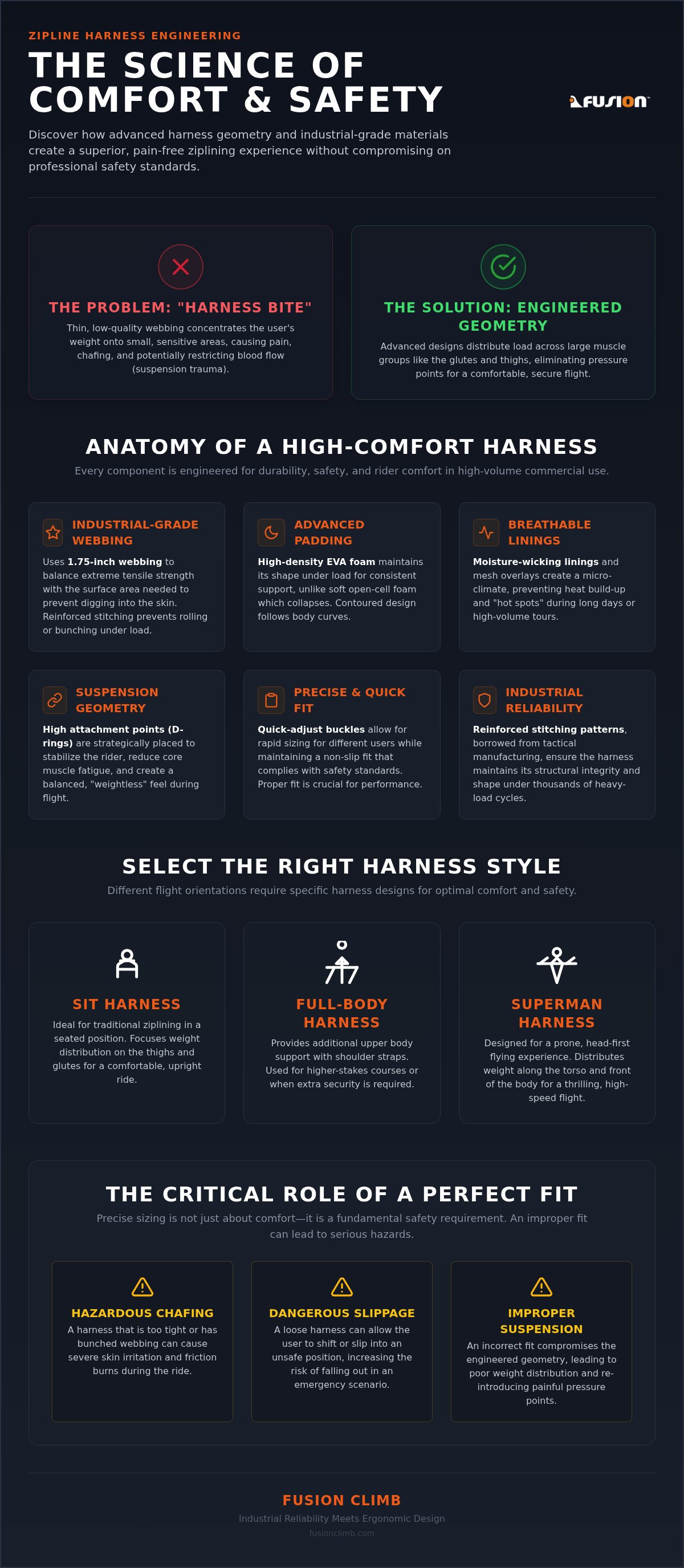
A professional comfort zipline harness functions as a specialized weight distribution system rather than a simple restraint. It's an engineered assembly designed to spread body weight across large muscle groups like the glutes and thighs. When you're suspended hundreds of feet in the air, a standard safety harness can often feel like it's cutting into your skin. This is known as the "harness bite" phenomenon. It occurs when thin, low-quality webbing concentrates force on small, sensitive areas of the body. High-performance comfort harnesses for ziplining eliminate this pain through advanced load-bearing geometry. This design doesn't just improve the ride; it helps prevent suspension trauma by ensuring blood flow remains unrestricted during extended aerial stays. Specialized tethers further enhance the experience by maintaining a stable, low-effort riding position, allowing the user to enjoy the flight without fighting the equipment.
Pressure Distribution and Webbing Width
Reliability in the field starts with material choice. Industrial standards for professional gear favor 1.75-inch webbing because it balances extreme tensile strength with the surface area needed to prevent skin digging. Reinforced stitching patterns, often borrowed from tactical manufacturing, ensure the harness maintains its structural shape even under heavy loads. Without this rigidity, webbing tends to roll or bunch, creating intense friction points and chafing. Wider leg loops are particularly critical for commercial operations. They mitigate pressure on the femoral artery, which maintains healthy circulation while the rider is suspended. This focus on width and reinforcement transforms a basic safety strap into a professional-grade tool for long-term use.
Suspension Geometry: Center of Gravity vs. Comfort
The physics of a comfortable flight depends heavily on the center of gravity. High-attachment points are utilized to stabilize the rider, which significantly reduces core muscle fatigue. While climbing harnesses are built for vertical movement, zipline suspension must account for the unique forces of an angled, high-speed trajectory. A balanced center of gravity creates a "weightless" flight feel. It prevents the rider from spinning or tipping backward, making the transition from the platform to the cable feel effortless. When the harness geometry is aligned with human anatomy, the rider stays centered and secure. This stability is what allows for a truly immersive experience, turning a high-stakes descent into a smooth and controlled adventure. Trust the engineering behind the gear to handle the heavy lifting.
Anatomy of a High-Comfort Zipline Harness
High-comfort harnesses are more than just safety straps with extra padding. They represent a complex integration of textiles and hardware designed to withstand repetitive industrial use. In commercial environments, gear must endure extreme heat and moisture while maintaining structural integrity. Professional manufacturers utilize multi-layer systems that pair high-density support with soft contact points. This ensures the harness remains comfortable during an eight-hour shift or a high-volume tour. Quick-adjust buckles are vital here; they allow for rapid sizing changes without sacrificing the non-slip fit required by OSHA personal fall protection standards. Reliability is built into every stitch.
Advanced Padding Materials
The choice between EVA foam and open-cell padding determines how the gear performs over time. While open-cell padding feels soft initially, it often collapses under sustained body weight, leading to localized pressure. High-density EVA foam provides superior long-term support by maintaining its shape under load. Modern comfort harnesses for ziplining feature contoured designs that follow the natural curves of the waist and legs. These are typically finished with breathable mesh overlays. This mesh creates a micro-climate between the user and the harness. It prevents "hot spots" and heat build-up that can lead to skin irritation during long days on the course. For active users who want to maximize moisture control beneath their gear, visit Fairtex to discover how professional compression baselayers can further enhance comfort.
Hardware Integration for Seamless Movement
Hardware placement is just as critical as the padding itself. The location of the D-ring attachment point dictates the rider's posture and overall comfort level. If the point is too low, the rider may feel unstable; if too high, it can restrict movement. For a truly professional setup, integrating professional climbing carabiners ensures connections remain secure and rattle-free throughout the descent. Operators can further customize the experience using specialized zipline lanyards and tethers to fine-tune the rider's angle relative to the cable. Using lightweight aluminum hardware instead of heavy steel reduces the overall drag. It makes the gear feel like a natural extension of the body. You can explore our range of engineered flight hardware to see these anatomical principles in action.
Selecting the Right Style: Full Body vs. Superman vs. Sit Harnesses
Modern zipline parks utilize three primary configurations to match specific course profiles and participant needs. Choosing between these styles isn't just about preference; it's about matching the equipment to the physics of the line. The Association for Challenge Course Technology (ACCT) sets the professional standards for how these systems should be deployed in commercial settings. When evaluating the best comfort harnesses for ziplining, you must consider whether the rider will be upright or prone. Each position shifts the load to different anatomical points. Commercial operators often maintain a fleet of various styles to accommodate different guest demographics, from small children to thrill-seeking adults.
Full Body Harnesses: Maximum Security and Support
Full-body systems offer the highest safety-to-comfort ratio for high-velocity lines. They are the gold standard for children or participants who feel less secure in a vertical environment. By distributing force across the shoulders, chest, and hips, these harnesses prevent the rider from tipping or slipping. This multi-point suspension provides a sobering sense of security that allows nervous riders to relax and enjoy the descent. They are the primary choice for vertical drops where a stable, upright posture is mandatory for safety and proper landing alignment.
Superman Style: The Prone Flight Experience
Superman style harnesses are specifically engineered for the prone, head-first flight experience, making them some of the most specialized comfort harnesses for ziplining available today. Unlike upright models, these support the entire torso to maintain a horizontal profile. Pressure is distributed evenly across the chest and thighs. This prevents the "folding" sensation that can occur in less specialized gear. For riders seeking the ultimate sensation of "flight," this configuration provides the most immersive experience. It's built for speed and comfort, allowing the user to focus on the horizon rather than the gear holding them in place. Those who enjoy this level of aerial immersion may also want to learn more about UK Skydiving to discover how professional-grade harnesses are utilized in even more extreme descent scenarios.
Seat and Sit Harnesses: Minimalist Freedom
Sit harnesses offer minimalist freedom for courses requiring active movement. They are best for low-speed lines or challenge courses where agility is more important than total suspension support. A well-designed sit harness relies on a thick, padded waist belt to handle the majority of the load. This style is the easiest to put on and take off, making it a favorite for high-volume parks with shorter lines. While they offer less torso support than full-body models, their lightweight nature makes them ideal for environments where the participant needs to climb or navigate obstacles between zips.
Achieving the Perfect Fit: Sizing for Safety and Ease
A harness is a precision tool, but its performance depends entirely on how it sits on the rider's frame. Even the most advanced comfort harnesses for ziplining will fail to provide relief if they are improperly sized. When gear is too loose, the resulting friction leads to painful chafing and hazardous slippage during the descent. Conversely, over-tightening can restrict circulation and cause premature fatigue. A professional fit ensures that the weight is caught by the skeletal structure rather than soft tissue. This alignment is also critical for maintaining a stable connection to commercial zipline pulleys, ensuring the rider stays centered and the hardware remains rattle-free.
The Step-by-Step Fitting Process
Adjusting a professional-grade full body harness requires a methodical approach. Follow this sequence to ensure total security:
- Orient the gear: Hold the harness by the primary dorsal D-ring and shake it out to ensure no straps are twisted.
- Secure the waist: Tighten the waist belt until it rests firmly above the iliac crest. Use the "two-finger" rule; you should only be able to fit two fingers between the webbing and the body.
- Adjust leg loops: Pull the leg straps snug. These must be tight enough to prevent "riding up" during flight but loose enough to allow a full range of motion on the platform.
- Tension the chest: For full-body models, the chest strap should be centered and tightened to keep the shoulder straps from sliding off without restricting breathing.
Sizing for Commercial Diversity
Commercial operators face the challenge of fitting a wide range of body types throughout a single day. Most professional comfort harnesses for ziplining utilize "one-size-fits-most" designs with extended webbing lengths. This versatility allows for rapid adjustments between different guests. During these high-frequency changes, it's vital to check for "wear indicators" on adjustable straps. These are often contrasting thread colors that become visible if the webbing is compromised. For a deeper look at maintaining these standards across an entire park, refer to our ropes course safety equipment guide. Ensuring every participant has a tailored fit is the hallmark of a professional operation. Explore our full inventory of adjustable harnesses to find the right fit for your course.
Industrial Reliability Meets Ergonomic Design: The Fusion Climb Difference
Fusion Climb's manufacturing philosophy is rooted in the high-stakes world of tactical and industrial safety. Since 1998, we've applied these rigorous standards to the recreational adventure industry to bridge the gap between thrill and security. When gear is "made for the pro," it inherently provides a higher level of comfort for the recreational user. Professional-grade equipment is designed to withstand thousands of cycles without losing its structural integrity or padding density. This means the ergonomic support you feel on your first zip is exactly what you'll feel after a full season of use. Every design we produce maintains a strict commitment to ANSI Z359.11-2021 and CE EN12277:2015 standards. We don't just build for comfort; we build for the sobriety of real-world safety.
The Manufacturing Edge
Our manufacturing process is defined by precision and over-engineering. We utilize high-tensile, 5,000 lb test webbing as the backbone for our comfort harnesses for ziplining. This material provides an immense margin of safety while remaining flexible enough for all-day wear. To ensure these components never fail under stress, we use reinforced bartack stitching at every critical high-stress point. This isn't just a safety feature; it's a comfort feature. It prevents the harness from shifting or sagging when the rider is suspended. Every unit undergoes meticulous quality control to ensure it meets the exact specifications required for commercial adventure parks. We believe that professional reliability is the only foundation for true peace of mind in the air.
Beyond the Harness: The Full Safety Ecosystem
A harness is only one part of a unified safety system. Fusion Climb integrates Full Body Harnesses and Superman Style Harnesses with high-performance Zipline Pulleys and Carabiners. This ecosystem approach ensures that every piece of hardware works in harmony to reduce noise, vibration, and drag. For commercial operators, we provide custom solutions that address the demands of high-volume parks, including gear designed for rapid turnover and long-term durability in harsh environments. Don't settle for equipment that barely meets the minimum requirements. You can upgrade your flight experience with professional-grade gear that puts your safety and comfort first.
Elevate Your Flight Experience with Professional Standards
Selecting the right equipment transforms a high-altitude descent from a test of endurance into a seamless adventure. True comfort isn't a luxury; it's a byproduct of precision engineering and correct weight distribution. By prioritizing load-bearing geometry and moisture-wicking materials, you eliminate the physical distractions of "harness bite" and heat build-up. Whether you're configuring a commercial course or seeking the ultimate prone flight, understanding the technical differences between harness styles ensures you never have to compromise on safety for the sake of a better ride.
Fusion Climb has been a trusted partner for commercial operators since 1998. We manufacture ANSI Z359.11 compliant designs using rugged 1.75-inch high-tensile webbing to ensure every component exceeds industry expectations. Our comfort harnesses for ziplining are built to withstand the most demanding aerial park environments while providing the ergonomic support required for a weightless feel. Don't settle for gear that merely meets the minimum. Explore the Fusion Climb collection of professional zipline harnesses today. Secure your equipment and prepare for a superior flight experience. The horizon is waiting.
Frequently Asked Questions
What makes a zipline harness 'comfort-rated' compared to a standard climbing harness?
Comfort-rated harnesses use wider webbing and multi-layer padding specifically designed for long-duration suspension rather than the intermittent falls of rock climbing. Climbing gear is built for vertical mobility and weight reduction. In contrast, comfort harnesses for ziplining prioritize pressure distribution across the thighs and waist to prevent "harness bite" during the steady, seated position of a zip descent.
Is a full-body harness more comfortable than a sit harness for long ziplines?
A full-body harness is typically more comfortable for longer zips because it shares the load across the shoulders and chest, preventing the rider from tipping backward. While a sit harness allows for more leg agility, a full-body system reduces core muscle strain. It provides a more stable, upright posture that feels more secure during high-speed arrivals and long periods of suspension.
How do Superman style harnesses stay comfortable while flying prone?
Superman style harnesses utilize a specialized torso cradle and leg support system that distributes body weight horizontally across the chest and thighs. This configuration prevents the "folding" effect seen in standard gear. These specialized comfort harnesses for ziplining ensure the rider's center of gravity remains balanced, allowing for a head-first flight experience without putting excessive pressure on the abdomen or neck.
Can I use a padded climbing harness for commercial ziplining?
No, you shouldn't use a standard climbing harness for commercial ziplining unless it specifically meets ANSI Z359.11 or ACCT standards for aerial adventure courses. Recreational climbing gear is not tested for the high-frequency, industrial-scale use seen in professional parks. Commercial operations require hardware with higher tensile strength and reinforced attachment points to ensure long-term durability and guest safety.
What padding materials offer the best durability for high-volume adventure parks?
High-density EVA foam combined with a moisture-wicking mesh overlay provides the best balance of long-term support and durability for commercial use. Unlike soft open-cell foam that collapses over time, EVA foam maintains its shape under repetitive loads. This ensures the padding continues to distribute pressure effectively even after hundreds of participants have used the gear throughout a busy season.
How often should I inspect my comfort harness for wear and tear?
You must perform a visual inspection before every use and conduct a documented, thorough inspection at least once every six months. Check for frayed webbing, broken stitching, or "wear indicators" on the straps. Any harness involved in a significant impact or showing signs of chemical contamination should be retired immediately to maintain professional safety standards and user confidence.
Does extra padding in a harness affect its safety rating or weight capacity?
Padding doesn't contribute to the structural weight capacity; however, it can affect the safety rating if it interferes with the proper function of buckles or D-rings. The safety rating is determined by the high-tensile webbing and hardware. A properly designed comfort harness ensures the padding is integrated so that it doesn't obscure critical inspection points or hinder the rider's ability to achieve a secure fit.
What is the weight limit for a professional-grade comfort zipline harness?
Most professional-grade harnesses are rated for a maximum user weight of 310 to 400 pounds, depending on the specific ANSI or CE certification. Always check the manufacturer's tag for the exact limit of your specific model. Exceeding these limits can compromise the harness geometry and reduce the effectiveness of the padding, leading to both safety risks and significant physical discomfort during flight.