



Zipline Tether with Shock Absorber: The Professional Safety Guide
A zipline stop isn't just the end of a ride. It's a high-stakes physics event where your equipment must manage hundreds of pounds of force in a fraction of a second. Choosing a high-performance zipline tether with shock absorber is the difference between a controlled deceleration and a dangerous impact. You understand that in a vertical environment, "good enough" is a liability. You need gear that's been tested to the limit because the safety of every rider depends on the integrity of your rigging.
With the global zipline market projected to reach 6.3 billion dollars in 2026, the industry is under more scrutiny than ever. You might feel overwhelmed by the transition from the ANSI/ACCT 03-2019 standard to the new 2026 revisions, or perhaps you're struggling to match the correct tether length to your specific trolley setup. It's a heavy responsibility, but you don't have to guess. This guide will help you master the technical specifications and safety standards required for professional operations. We'll explore the physics of shock absorption, identify hardware that meets both ANSI and CE requirements, and provide a clear inspection schedule to ensure your equipment remains a dependable guardian for every guest.
Key Takeaways
- Master the physics of energy dissipation by understanding how a professional zipline tether with shock absorber protects riders during high-speed stops.
- Identify superior construction materials like MIL-SPEC 5,000 lb rated webbing and T-131 nylon bonded threading that define industrial-grade durability.
- Determine the ideal tether length for your specific course configuration to ensure riders remain upright and stable throughout the entire run.
- Implement a methodical inspection routine to catch webbing wear and premature shock pack deployment before equipment failure occurs.
- Align your gear choices with the latest ANSI and CE standards to maintain a professional, compliant, and secure aerial adventure operation.
What is a Zipline Tether with Shock Absorber?
A zipline tether with shock absorber serves as the vital connection between a rider's harness and the trolley. It isn't just a piece of webbing; it's an engineered component designed to manage energy. In professional environments, especially those utilizing bungee braking or high-speed arrivals, this equipment acts as a personal fall arrest system adapted for horizontal and inclined travel. Its primary job is to dissipate kinetic energy that would otherwise be absorbed by the rider's body. For commercial operators, these tethers are mandatory safety gear. They provide a predictable response during emergency stops or sudden decelerations.
Static vs. Shock-Absorbing Tethers
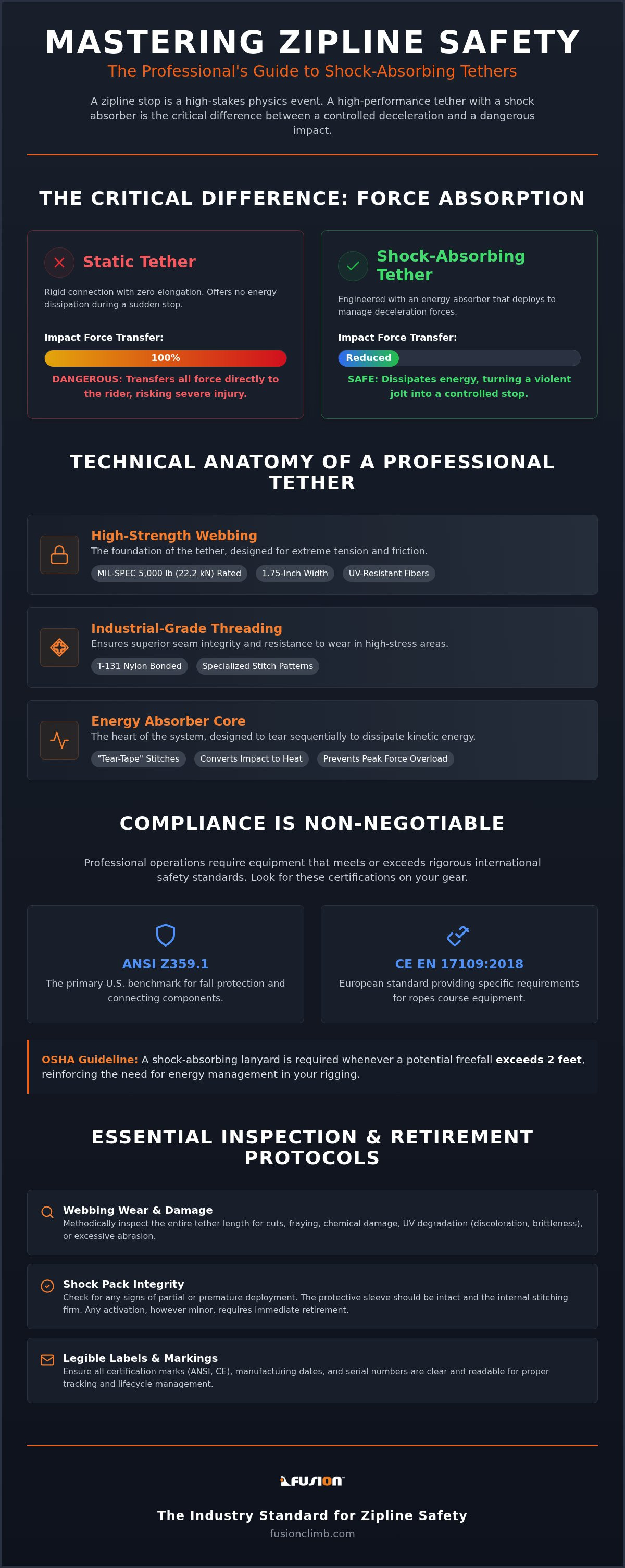
The differences between static and dynamic equipment are stark. Static tethers are rigid and offer zero elongation. If a rider hits a brake at 30 mph, a static tether transfers 100% of that impact force directly to the harness. This sudden jolt can lead to severe skeletal injury or catastrophic equipment failure. Shock-absorbing models utilize "tear-tape" or dynamic cores to manage these forces. These materials are built to stretch or peel apart under specific loads, which controlledly decelerates the rider. Using static lanyards in high-velocity zipline environments is a risk that modern safety standards, including ANSI Z359.1, aim to eliminate. A professional zipline tether with shock absorber ensures that the equipment, not the human body, takes the brunt of the stop.
The Role of the Energy Absorber
The energy absorber is the heart of the system. Inside the protective sleeve, specialized webbing is folded and stitched in a precise pattern using industrial grade T-131 nylon bonded threading. When a threshold of force is reached, these stitches "tear" in a sequential manner. This process increases the stopping distance at a micro-level, turning a violent jolt into a managed stop. It effectively converts kinetic energy into heat and mechanical work through the destruction of the internal stitching. This prevents the peak force from reaching dangerous levels. Impact force reduction is the primary safety metric used to evaluate the effectiveness of these devices. Without this mechanical intervention, the margin for error in high-speed ziplining becomes dangerously thin.
Technical Anatomy of Professional Zipline Lanyards
Professional safety equipment isn't built by accident. It's the result of precise engineering and high-performance materials designed to survive extreme environments. A professional zipline tether with shock absorber starts with a core of high-strength MIL-SPEC nylon or polyester webbing. This 1.75-inch wide material provides a foundational strength that withstands consistent friction and tension. To hold these components together, manufacturers use industrial-grade T-131 nylon bonded threading. This specific thread is chosen for its superior seam integrity and resistance to the typical wear found in high-volume commercial courses. Every stitch is a calculated layer of protection.
Material Strength and Durability
In the aerial adventure industry, 5,000 lb (22.2 kN) rated webbing is the non-negotiable benchmark for commercial use. This rating ensures that even under the most violent deceleration events, the tether remains intact. It's not just about raw strength; it's about longevity. Outdoor adventure parks subject gear to constant solar radiation and moisture. High-quality tethers feature UV-resistant coatings to prevent the nylon fibers from becoming brittle over time. Fusion Climb reinforces these designs with specialized stitching patterns in high-stress areas to distribute loads evenly. To keep the energy-dissipating core safe from the elements, a protective sleeve encases the shock pack, shielding it from abrasion and direct sunlight.
Understanding Safety Standards
Compliance isn't a suggestion; it's a requirement for operational security. The primary benchmark for fall protection and connecting components in the United States is ANSI Z359.1. For those operating under international guidelines, CE EN 17109:2018 provides specific standards for individual safety equipment used in ropes courses. These certifications prove that the gear has undergone rigorous destructive testing to verify its performance. According to OSHA zip-line safety standards, a shock-absorbing lanyard is required whenever a potential freefall exceeds 2 feet, reinforcing the need for energy management in your rigging setup.
When inspecting your gear, look for permanent labels or laser-etched markings that indicate these certifications. If the compliance data is missing or unreadable, the equipment must be retired immediately. For operators looking to upgrade their fleet, choosing a certified zipline tether with shock absorber ensures your equipment meets these strict industrial benchmarks. Beyond the webbing, integrated gear loops offer essential versatility for secondary attachments and backup carabiners, allowing for a more organized and secure rigging system. This technical foundation is what makes a piece of equipment a dependable guardian in the field.
Selecting the Right Tether: Length and Configuration
Choosing a zipline tether with shock absorber is a decision that dictates a rider's physical orientation as much as their safety. It's not just about reach; it's about maintaining a stable center of gravity throughout the ride. Professional operators must select a configuration that matches the specific geometry of their course and the trolley models they deploy. A mismatched tether can cause a rider to pitch forward or rotate during deceleration, increasing the risk of injury even if the hardware holds. Whether you're rigging a high-speed commercial line or a technical canopy tour, the tether length must be calculated to keep the rider in a secure, upright position.
Matching Tether Length to Your Course
Standard length options typically range from 24 to 60 inches. Short tethers, usually between 24 and 30 inches, are ideal for high-tension lines and setups with low-clearance trolleys. These shorter lengths minimize the pendulum effect, preventing the rider from swinging excessively during the start and stop. Longer tethers, ranging from 48 to 60 inches, are required for specific applications like "Superman style" prone harnesses. These deep-seated rides need the extra length to ensure the rider remains clear of the cable and trolley housing. To find the ideal distance, measure from the harness D-ring to the pulley attachment point while the system is under tension. This ensures the rider's center of gravity remains low enough for stability but high enough to avoid striking any course obstacles.
Configuration and Redundancy
Operators must choose between single-leg and dual-leg configurations based on their safety protocols. Single-leg tethers are streamlined and reduce weight, making them popular for recreational use. However, dual-leg configurations are the professional standard for redundant safety systems. These setups provide two independent paths from the harness to the trolley, ensuring that if one carabiner or attachment point is compromised, the second remains engaged. This level of redundancy is a hallmark of industrial-grade safety and provides a sobering sense of security for both the operator and the participant.
Specialized Features for Operators
Commercial parks require gear that facilitates high-volume throughput without sacrificing integrity. Integrated gear loops are essential for clip-in efficiency, allowing guides to manage secondary attachments and backup carabiners without tangling. Many professional parks also implement color-coding for their tethers. Using specific colors for different lengths, such as red for 36 inch and blue for 48 inch models, allows staff to identify the correct gear at a glance during the gear-up process. This methodical approach reduces human error and speeds up operations. To find the right fit for your rigging needs, explore Fusion Climb’s range of professional zipline tethers.
Inspection, Maintenance, and Retirement Protocols
Rigorous oversight is the backbone of any professional zipline operation. Your zipline tether with shock absorber is a complex safety device that requires more than a casual glance before use. Everyday wear and tear can compromise the energy-dissipating core without showing obvious signs of failure. Operators must establish a methodical inspection culture to catch issues before they escalate into incidents. Safety isn't a one-time purchase; it's a daily commitment to equipment integrity.
Synthetic materials like nylon and polyester are vulnerable to the elements. Salt air in coastal parks can leave abrasive crystals between fibers, while extreme heat and moisture cause internal degradation. UV exposure is a silent killer of webbing strength. If your course is located in a high-UV or maritime environment, your inspection frequency must increase to compensate for these stressors. You're the dependable guardian of your riders, and that starts with knowing exactly when a piece of gear has reached its limit.
The 5-Point Inspection Checklist
A professional inspection must be both visual and tactile. Follow this systematic approach for every tether in your fleet:
- Tactile check: Run your hands along the entire length of the webbing. Feel for "crunchy," stiff, or hard spots that indicate chemical contamination or heat damage.
- Visual check: Identify "glazing" or melted fibers caused by high-friction events. Look for any discoloration that might signal UV rot.
- Stitching check: Examine the industrial-grade T-131 nylon bonded threading for broken, pulled, or fuzzy stitches.
- Hardware check: Inspect carabiner gates for smooth operation and ensure integrated gear loops haven't suffered deformation or stretching.
- Shock pack check: Verify the protective sleeve is intact and the energy-absorbing core hasn't been disturbed.
Any zipline tether with shock absorber that shows signs of even partial deployment must be retired from service immediately.
Storage and Cleaning Best Practices
Dirt and grit act like sandpaper inside the webbing, cutting through fibers at a microscopic level. Clean your gear using mild soap and lukewarm water to remove these contaminants. Avoid harsh solvents or petroleum-based products that can dissolve synthetic bonds. After washing, dry the equipment in a well-ventilated area away from direct sunlight. Never store damp gear in a closed container, as this encourages mildew and fiber rot. Most synthetic safety gear requires mandatory retirement within 5 to 10 years, regardless of its visual condition. If your equipment is nearing this limit or fails any part of your checklist, you should replace your zipline tether with shock absorber to maintain a professional safety standard.
Why Fusion Climb is the Industry Standard for Zipline Safety
Safety in a vertical environment requires more than just meeting a checklist. It demands a commitment to meticulous manufacturing and rigorous quality control. Fusion Climb has operated as a seasoned expert in the USA since 1998, producing professional-grade equipment that serves as a dependable guardian for riders. This brand doesn't rely on "extreme" marketing fluff. Instead, it focuses on industrial reliability and traditional values of strength. Commercial operators and ropes courses across the country choose a Fusion Climb zipline tether with shock absorber because they know every component has been tested to survive the most demanding conditions. The manufacturing process utilizes MIL-SPEC webbing and industrial-grade threading to ensure full compliance with ANSI Z359.1 and CE EN 17109:2018 standards.
Engineered for Commercial Longevity
Standard recreational gear often fails to withstand the high-cycle use of a busy commercial park. Fusion Climb addresses this by using industrial stitching patterns and materials that prioritize durability over weight savings. Purchasing directly from a specialized manufacturer offers significant advantages for professional riggers. Most products are made to order with a typical manufacturing time of 1 to 2 weeks, ensuring you receive fresh gear that hasn't been sitting in a warehouse. For large-scale commercial operations, this direct relationship allows for customization options that off-the-shelf products cannot match. It’s a professional-grade solution built for the long haul, designed to handle thousands of cycles without compromising integrity.
The Complete Safety System
A safety chain is only as strong as its weakest link. A zipline tether with shock absorber is most effective when it’s part of a comprehensive ecosystem. Fusion Climb designs its hardware to work in unison, from full body harnesses to specialized Superman style harnesses. When you pair a shock-absorbing tether with high-speed dual track pulleys and industrial-rated carabiners, you eliminate the guesswork associated with mixing brands. This integrated approach ensures that every attachment point and connector shares the same engineering DNA. It provides a sobering sense of security for guides and guests alike. Whether you're rigging a new canopy tour or upgrading an existing ropes course, using a unified system simplifies maintenance and inspection. For those managing high-volume parks, contact our experts for bulk commercial rigging solutions to ensure your entire fleet meets these uncompromising standards.
Rig Your Course for Maximum Security
Professional zipline operations demand equipment that manages energy without compromise. You've learned that the physics of deceleration require more than just strength; they require precision engineering. By mastering the technical anatomy of your gear and adhering to strict inspection protocols, you ensure that every ride ends safely. A high-performance zipline tether with shock absorber isn't just a component. It's the final failsafe in a complex system designed to protect human life at high velocities.
Choosing the right gear means looking for ANSI Z359.1 compliance and MIL-SPEC 5,000 lb rated webbing. These aren't just labels. They're benchmarks of industrial reliability that have defined USA-based manufacturing since 1998. When you prioritize these standards, you build a reputation for safety that guests and guides can trust. Don't leave your rigging to chance when professional-grade solutions are within reach. It's time to verify your current fleet and retire any hardware that no longer meets these rigorous demands.
Upgrade Your Safety Gear with Fusion Climb Tethers today. Your commitment to excellence keeps the adventure going.
Frequently Asked Questions
Can I use a climbing lanyard instead of a specialized zipline tether?
No, you shouldn't swap a standard climbing lanyard for a specialized zipline tether with shock absorber. Climbing gear is often designed for vertical fall arrest, whereas zipline tethers are engineered to manage horizontal impact forces and integrate with trolley housings. Using the wrong equipment can cause the rider to pitch incorrectly or result in equipment interference during high-speed stops.
How much weight can a shock-absorbing zipline tether handle?
Most professional tethers feature a breaking strength of 5,000 lbs (22.2 kN). However, the shock absorber component is calibrated for a specific rider weight range, typically between 130 and 310 lbs. If a rider is too light, the shock pack won't deploy. If they're too heavy, it may bottom out, transferring dangerous force to the harness.
How do I know if my shock-absorbing tether has been deployed?
You can identify a deployed tether by checking the shock pack's protective sleeve and warning labels. Most models include a deployment indicator stitch that breaks when exposed to significant force. If the internal webbing is visible, unraveled, or the pack feels elongated compared to a new unit, the device is compromised and must be retired immediately.
What is the lifespan of a zipline tether in a commercial environment?
The maximum lifespan for synthetic safety gear is generally 10 years from the date of manufacture. In high-volume commercial parks, this window often shrinks to 5 years due to constant friction, UV exposure, and mechanical wear. Always follow the specific retirement schedule provided by the manufacturer and pull gear from service if it fails a daily tactile or visual inspection.
Are Fusion Climb tethers ANSI and CE compliant?
Yes, Fusion Climb gear meets rigorous industrial benchmarks. Our tethers are manufactured to comply with ANSI Z359.1 for fall protection and CE EN 17109:2018 for ropes course safety. These certifications ensure that every zipline tether with shock absorber we produce has undergone destructive testing to verify its performance in real-world scenarios.
Do I need a dual-leg tether for a standard ropes course?
A dual-leg tether isn't always mandatory by law, but it's the professional choice for redundancy. These systems allow participants to remain connected to a safety line while transitioning between elements. In commercial parks, this redundancy provides a crucial safety margin if one connection point is accidentally disengaged or suffers a mechanical failure during a ride.
What happens if a shock absorber gets wet or freezes?
Moisture and ice can temporarily change the performance characteristics of nylon webbing. Wet fibers are heavier and may stretch differently, while frozen webbing becomes stiff and difficult to inspect. If a shock pack becomes saturated, the water can affect the friction of the tear-tape. Always allow gear to air dry completely in a ventilated area before returning it to service.
Can I wash my zipline tether in a washing machine?
Never use a washing machine to clean your safety equipment. The mechanical agitation and high-speed spin cycles can damage the internal energy-absorbing fibers. Instead, hand wash the webbing with mild soap and lukewarm water. Avoid harsh detergents or bleach, as these chemicals can dissolve the synthetic bonds that provide the tether's industrial strength.