



Zipline Pulley with Self-Lubricating Bearings: Inspection Checklist
A quiet, freely turning sheave is only a starting point. Before use, inspect a zipline pulley with self-lubricating bearings. Remove it from service if a hand-spun wheel sounds unusually noisy, feels gritty, or won’t turn freely. Do the same if the sheave shifts side to side, twists out of plane, or the housing is cracked.
Low friction can support efficient travel, but it doesn’t replace condition checks or a stable setup. This checklist covers how to inspect sheaves, bearings, housings, and wheel alignment; identify wear that calls for replacement; and compare bearing and bushing options. It also explains how wheel configuration can affect stability and efficiency, so you can assess the pulley as part of the full zipline system rather than judging it by smooth rotation alone. Work through each check methodically and remove worn or damaged equipment from service before the next run.
Key Takeaways
- Use a consistent inspection routine to assess sheave condition, bearing movement, and housing integrity before operation.
- Evaluate wheel configuration and alignment together to understand how the pulley contributes to a stable ride.
- Compare bearing and bushing designs by efficiency and wear considerations, not by low friction alone.
- Understand how self-lubricating bearings reduce reliance on added lubricant and what signs can indicate it’s time to replace a pulley.
Inspecting zipline trolley sheaves and bearings
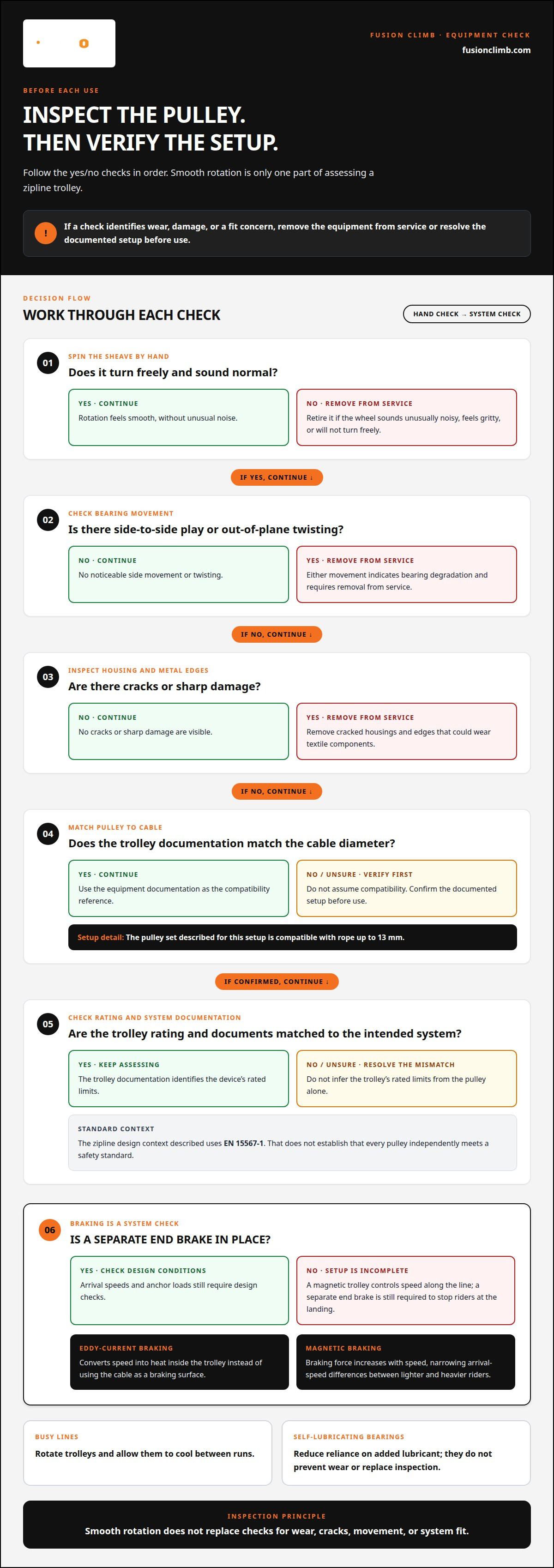
Before each use, spin the sheave by hand and inspect the trolley. Smooth rotation is useful, but it doesn’t replace checks for wear, cracks, or movement across the axle.
- Spin the sheave and listen for excessive noise. Retire it if rotation feels gritty or doesn’t move freely.
- Check for side-to-side play and out-of-plane twisting. Either movement indicates bearing degradation and requires removal from service.
- Inspect the housing and metal edges for cracks or sharp damage. Remove cracked housings and edges that could wear textile components.
- Compare the trolley’s documentation with the cable diameter. The pulley set described for this setup is compatible with rope up to 13 mm.
Trolleys carry the manufacturer’s load rating and documentation, which identify the device’s rated limits. Zipline design in the context described uses EN 15567-1; this doesn’t establish that every pulley independently meets a safety standard. Match the trolley rating and documentation to the intended system.
For braking, a magnetic trolley controls speed along the line, but a separate end brake is still required to stop riders at the landing. Eddy-current braking converts speed into heat inside the trolley instead of using the cable as a braking surface. Magnetic braking force increases with speed, narrowing arrival-speed differences between lighter and heavier riders. It may also allow a steeper or longer line with the same end brake, subject to design checks for arrival speeds and anchor loads.
How much do pulleys with self-lubricating bearings cost? The cost depends on the pulley configuration, materials, and whether you’re buying a complete trolley or a replacement component.
On busy lines, rotate trolleys and allow them to cool between runs. A self-lubricating bearing reduces reliance on added lubricant, but doesn’t prevent wear or eliminate the need for inspection.
Pulley wheels and stability
Assess wheel configuration as a system, not as an isolated part. Wheel diameter, bearing arrangement, axle, and alignment all affect how the trolley tracks and carries its load. One homemade setup describes a two-wheel pulley as the minimum for stability, but that example isn’t a universal specification for every zipline trolley.
- Check that the wheels sit squarely on their axles. Misalignment can make a trolley track unevenly and affect its stability on the cable.
- Identify whether each wheel uses one bearing set or two. A double-bearing wheel uses two sets rather than one, changing the bearing arrangement.
- Compare wheel diameter and bearing configuration together. A listed estimate says 2-inch wheel bearings outlast smaller 1-1/2-inch wheel bearings by a factor of 10.
- Inspect the axle and wheel for movement or damage. For example, the Fusion Advent Speed Trolley has 2-inch wheels and a 3/8-inch single-bearing axle.
Diameter alone doesn’t establish suitability. The 10-factor lifespan estimate applies to the stated comparison, not every wheel, material, or operating condition. A 1-1/4-inch wheel appears in a separate homemade pulley design, which also describes adding wheels as a way to reduce friction. Treat those details as characteristics of that particular design, not instructions to alter a manufactured trolley.
Use the equipment’s documented configuration as your reference. Don’t add wheels, change axle spacing, or substitute bearings based only on a stability comparison. For example, a two-wheel design with a single-bearing axle differs from a double-bearing arrangement, so don’t assume they’re interchangeable. Check that the wheels stay aligned and turn without visible wobble. Remove components from service if damage or looseness compromises their condition. A pulley’s stability depends on the complete assembly, including how the wheels, bearings, and axle work together.
Bearing and bushing efficiency
A self-lubricating bearing reduces reliance on added lubricant, while a sealed bearing is enclosed. These terms describe different features, so “sealed” alone doesn’t establish efficiency. Available efficiency comparisons distinguish bearing wheels from bushing wheels, not sealed bearings from self-lubricating bearings.
Use wheel size and bearing type as comparison points. The listed figures put 1-1/2-inch trolley wheels above 90% efficiency, while most 2-inch trolley wheels exceed 85%. Bushing wheels are estimated at 50%-70% of bearing-wheel efficiency. These figures describe different wheel categories, so don’t treat them as a direct test of every pulley model.
Can self-lubricating bearings be lubricated? Don’t add grease or oil unless the pulley manufacturer’s instructions call for it. Avoid unapproved lubricants, solvents, and cleaners, which may interfere with the bearing design or introduce contamination.
- Identify whether the wheel uses a bearing or bushing before comparing efficiency; the listed bushing range is lower than the bearing-wheel figures.
- Compare the same wheel diameter and bearing arrangement when reviewing specifications; a 1-1/2-inch wheel and a 2-inch wheel aren’t equivalent comparisons.
- Follow the manufacturer’s maintenance instructions for the specific pulley; don’t assume a self-lubricating design needs routine grease.
- Remove a pulley from service if its bearing feels gritty or fails to rotate freely; lubrication can’t correct mechanical wear.
A zipline pulley with self-lubricating bearings may reduce routine lubrication needs, but still requires condition checks. Efficiency describes how effectively a wheel moves under its test conditions; it doesn’t establish load capacity, stability, or suitability for a particular line. Treat an efficiency percentage as one comparison point. Before returning equipment to service, assess the manufacturer’s documentation, intended use, and the bearing’s actual condition.
How do self-lubricating bearings work in zipline pulleys?
A self-lubricating bearing is designed to reduce friction during wheel rotation without relying on routine added lubricant. In a zipline pulley, the bearing supports the wheel as it turns around its axle, helping the sheave move along the cable. The exact bearing construction varies by pulley, so the manufacturer’s documentation is the guide to its materials and maintenance.
“Self-lubricating” doesn’t mean “maintenance-free.” Bearings still wear, and smooth movement alone can’t confirm that a pulley is fit for use. Inspect the wheel and axle together, then assess the bearing with a hand-spin check.
- Spin the wheel and listen for unusual noise, which can signal a change in bearing condition.
- Notice whether rotation feels gritty or catches, rather than moving freely.
- Check for side-to-side movement or twisting, which can indicate bearing degradation.
- Review the manufacturer’s care instructions before cleaning or applying any lubricant.
Don’t assume grease or oil improves every self-lubricating bearing. Use only products and maintenance methods permitted by the pulley manufacturer; an unsuitable lubricant or cleaner may affect the bearing. If the wheel no longer turns freely or feels loose, lubrication is no substitute for removing worn equipment from service.
Compare replacement options by bearing type, pulley configuration, and the manufacturer’s maintenance instructions. A self-lubricating design reduces friction and dependence on added lubricant. A sealed bearing is enclosed, but the term alone doesn’t establish efficiency or maintenance requirements. Review the specific product documentation instead of treating “sealed” and “self-lubricating” as interchangeable.
For a replacement, match the pulley to the intended cable and system, then follow its documentation for inspection and care. Explore zipline pulley options when selecting hardware for your setup.
Fusion Climb: Zipline Pulleys
Fusion Climb offers zipline pulleys for those choosing or replacing trolley hardware after inspecting their current setup. Consider how the pulley fits your zipline system and intended use. Review its documentation for specifications, load rating, and maintenance instructions, then compare those details with the requirements identified during your inspection.
For a complete equipment setup, Fusion Climb also offers full body harnesses, Superman style harnesses, lanyards, and tethers. These are distinct components, so choose each for its role in the system rather than treating one as a substitute for another. Keep the pulley, harness, and connection hardware compatible with the intended configuration.
Contact Fusion Climb to discuss Zipline Pulleys for your equipment needs.
Make Your Next Equipment Decision with Confidence
Use your inspection findings to guide your next equipment decision. A zipline pulley with self-lubricating bearings remains one part of a complete setup, so choose hardware with its intended use and system compatibility in mind. Keep the equipment documentation available and include condition checks in ongoing maintenance.
When selecting equipment, Fusion Climb offers zipline pulleys, full body harnesses, and Superman style harnesses. Choose each component for its role in your setup, and follow the manufacturer’s documentation for compatibility and care. Sound decisions come from matching equipment to the system, not relying on a single feature.
Contact Fusion Climb for pulley help and take the next step toward a well-considered zipline setup.
Frequently Asked Questions
What is a zipline pulley with self-lubricating bearings?
It’s a trolley pulley with a bearing design that reduces reliance on added lubricant as the wheel turns. The bearing supports rotation around the axle, while the sheave travels along the cable. “Self-lubricating” describes a design feature, not a guarantee against wear or a reason to skip maintenance. The pulley still needs to be assessed according to the manufacturer’s care instructions.
What cable diameters and zipline speeds are compatible with these pulleys?
The pulley set described is compatible with rope up to 13 mm in diameter. That figure applies to that set, not every pulley, so match the cable to the specific device documentation. No single speed applies across zipline setups: line profile, rider weight, trolley braking, and the end-brake design influence travel and arrival speed. Treat speed as a system-design consideration, not a bearing specification.
How do you inspect and maintain a zipline pulley with self-lubricating bearings?
Follow the pulley manufacturer’s inspection and care instructions, and record your observations during the regular maintenance cycle. A useful record identifies the trolley, inspection date, observed wheel or housing condition, and whether it remains in service. This history can help reveal changes over time. Don’t add lubricant or cleaning products unless the manufacturer’s instructions permit them, and retire components that fail inspection.
What are common failure risks and warning signs for zipline pulleys?
Wear, impact damage, and sharp metal edges can compromise a pulley or damage connected textile equipment. A dented impact surface or a burr near a lanyard contact point deserves attention, even if the wheel still turns. Cracks, unusual looseness, noise, or restricted rotation are warning signs. Remove damaged equipment from service rather than relying on appearance or a single smooth spin.
How much do zipline pulleys with self-lubricating bearings cost?
A listed set of two pulleys has a regular price of 49.98. Costs vary with configuration, materials, and whether you buy a complete trolley or a replacement component.
What materials and bearing types are used in zipline pulleys?
The housings are aluminum, described as lightweight and corrosion resistant. Pulley wheels may use self-lubricating bearings, sealed bearings, or bushings. A double-bearing wheel uses two bearing sets instead of one.