



Zipline Lanyards & Tethers: 2026 Professional Safety Guide
A single stitch pattern or a subtle change in webbing density can be the difference between industrial reliability and gear failure. You aren't just buying equipment; you're investing in the critical link that secures every rider to the line. Selecting the right zipline lanyards and tethers requires more than a glance at a catalog. It demands a deep understanding of Minimum Breaking Strength and the current ANSI/ACCT 03-2019 standards that are currently undergoing vital revisions for 2026.
You recognize that in high-use commercial environments, your gear must be beyond reproach. This professional guide provides the technical clarity you need to navigate the evolving safety landscape with absolute certainty. We'll break down the specific ratings you need to look for, such as the 23KN breaking strength found in high-performance hardware. You'll learn exactly how to identify when a lanyard has reached its retirement point and how to ensure seamless compatibility between your harness and trolley brands. We move from the technical "why" of manufacturing standards to the practical "how" of gear selection, giving you the tools to maintain a world-class safety margin on every run.
Key Takeaways
- Define the lanyard's role as the vital secondary link responsible for load distribution and rider security during cable transitions.
- Navigate evolving 2026 safety standards with a clear breakdown of ANSI Z359.11 and CE certifications for professional zipline lanyards and tethers.
- Compare the utility of fixed-length runners against adjustable tethers to optimize your setup for varying rider heights and specialized course elements.
- Implement a rigorous "pre-flight" inspection routine to detect subtle red flags like webbing glazing or fiber degradation before they compromise safety.
- Gain confidence in your gear selection by understanding how industrial-grade manufacturing and material science impact long-term equipment reliability.
Understanding the Critical Role of Zipline Lanyards and Tethers
The zipline lanyard and tether serve as the indispensable bridge between a rider's harness and the trolley system. This secondary safety link acts as more than just a piece of webbing; it's a precision-engineered component designed to manage the forces of gravity and velocity. In a professional setting, zipline lanyards and tethers are the primary means of load distribution. They ensure that during the critical transition from the launch platform to the cable, the rider remains securely oriented and safely connected. When selecting zipline lanyards and tethers, operators must prioritize materials that resist UV degradation and high-frequency friction.
Safety is never accidental. These components function as a specialized personal fall arrest system tailored specifically for high-speed aerial environments. The length of this connection dictates the rider’s center of gravity throughout the flight. A connection that's too long can cause the rider to pitch backward or spin uncontrollably. Conversely, one that's too short may restrict movement and make the ride uncomfortable or difficult to brake. Getting this measurement right is vital for both mechanical safety and the overall guest experience.
Lanyard vs. Tether: Is There a Difference?
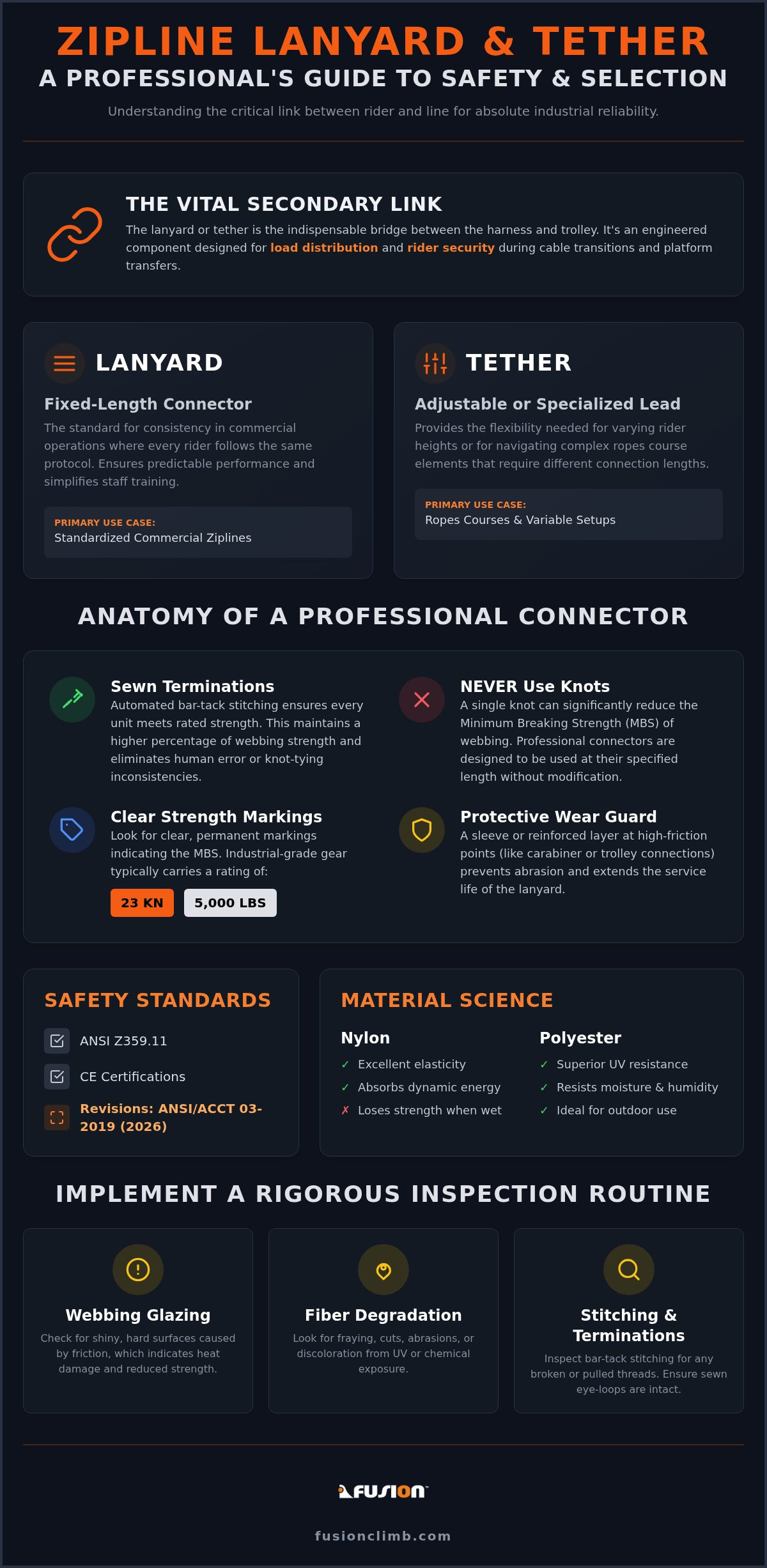
While professionals often use these terms interchangeably, distinct rigging contexts exist. A lanyard generally refers to a fixed-length connector. These are the standard for consistency in commercial zipline operations where every rider follows the same protocol. A tether frequently describes an adjustable or specialized lead. Tethers provide the flexibility needed for varying rider heights or complex ropes course elements. Understanding this distinction prevents critical rigging errors. It ensures that the specific equipment matches the operational requirements of the course without compromise.
The Anatomy of a Professional Safety Connector
A professional-grade connector is easily identified by its construction. Look for sewn terminations rather than knotted ends. Sewn eye-loops maintain a higher percentage of the webbing's original strength; they also eliminate the risk of knots slipping or being tied incorrectly by staff. High-friction areas should feature a wear guard or protective sleeve to prevent abrasion from the carabiner or trolley body. Every reliable piece of gear will also feature clear strength rating markings. For example, industrial-grade webbing often carries a Minimum Breaking Strength (MBS) of 23KN. These markings are a manufacturer's promise of industrial reliability and rigorous quality control.
Engineering and Safety Standards for Aerial Connection Systems
Engineering isn't just about survival; it's about precision. Adhering to ACCT safety standards ensures that every component in your course meets rigorous testing criteria. Professional zipline lanyards and tethers must comply with ANSI Z359.11 or equivalent CE certifications to guarantee they withstand the repetitive stresses of commercial use. These standards aren't suggestions. They are the baseline for industrial reliability. As of 2026, the industry continues to move toward the revised ANSI/ACCT 03-2019 standards, emphasizing even tighter tolerances for hardware and textile integration.
Material choice defines the lifespan of your gear. Nylon offers excellent elasticity, which helps absorb energy during sudden stops. However, it absorbs moisture and can lose strength when wet. Polyester stands up better to UV rays and humidity, making it the superior choice for high-sun or coastal environments. Manufacturers use high-tenacity specialized fibers to ensure the webbing maintains its 5,000 lb rating over years of service. Consistency comes from automated bar-tack stitch patterns. Unlike manual stitching, these patterns are programmed to ensure every lanyard meets its rated break strength. This precision eliminates human error in the manufacturing process.
Breaking Down the Strength Ratings (MBS)
Minimum Breaking Strength (MBS) represents the force at which a component is guaranteed to fail under laboratory conditions. For a 5,000 lb rated lanyard, this typically equates to approximately 23KN. It's critical to distinguish between static load capacity and dynamic impact force. A fall creates dynamic forces that far exceed the rider's weight. Never use knots to shorten a line. A single knot can reduce the strength of zipline lanyards and tethers by up to 50% compared to factory-sewn eyes.
Environmental Resistance and Durability
Moisture is a silent enemy. Polyester handles humidity better than Nylon because it resists water absorption and maintains its dimensional stability. In salt-air environments, look for hardware-integrated lanyards with corrosion-resistant coatings. Tensile strength is the maximum amount of longitudinal stress a material can resist before failing or breaking. If you need components that meet these industrial benchmarks, explore ANSI-compliant safety hardware designed for rigorous aerial use.
Choosing the Right Tether: Fixed, Adjustable, and Shock-Absorbing Options
Rigging requirements vary by course architecture. Fixed-length runners provide the most consistent rider positioning. They are the standard for commercial operations where predictability is paramount. However, when your course features varying cable heights or complex transitions, zipline lanyards and tethers with adjustable features become necessary. These allow operators to fine-tune the rider's center of gravity on the fly. This adjustability is particularly useful when handling a wide range of rider sizes on the same line. Precision in length ensures that the rider remains in the optimal "power position" for both safety and speed.
In professional environments, these components must align with OSHA fall protection standards. These regulations ensure that zipline lanyards and tethers meet the 5,000 lb breaking strength required for personal fall arrest systems. Shock-absorbing lanyards are critical when there's a risk of sudden deceleration or a short fall. They utilize internal webbing that intentionally tears under specific loads to dissipate energy. This protects the rider's body from high G-forces during an abrupt stop. Daisy chain lanyards offer multiple loops for versatile attachment points. This versatility is invaluable during rescue scenarios or when transitioning between different ropes course elements.
Specialized Tethers for Superman Style Prone Flight
Prone flight changes the physics of the connection entirely. Unlike upright harnesses, Superman style harnesses require multiple attachment points to maintain a stable horizontal position. This configuration demands specialized tethers that distribute the rider's weight evenly across the torso and legs. Fusion Climb has pioneered this prone flight gear since 1998. We ensure that the connection points provide both aerodynamic efficiency and redundant safety. Proper weight distribution prevents the rider from pitching during high-speed runs, which is essential for maintaining control and comfort throughout the flight.
Y-Lanyards and "Lobster Claws" for Ropes Courses
The 100% clip-in rule is the gold standard for safety on challenge courses. Y-lanyards feature two legs, allowing a user to move from one anchor to another while always remaining connected to at least one point. Elasticized tethers are often preferred here. They stay retracted and out of the way when not in use but stretch to provide a full range of motion. When selecting these, pay close attention to the carabiner gate. Auto-locking carabiners are essential for preventing accidental detachment in high-stress aerial environments.
Inspection and Maintenance: Ensuring Lanyard Integrity
Inspection isn't a formality; it's a life-saving protocol that must be performed with industrial precision. Every operator should conduct a "first-light" check before any guest clips into the system. This process involves a tactile and visual assessment of the entire length of your zipline lanyards and tethers. You are looking for more than just obvious holes. Run your hands along the webbing to feel for internal bunching or stiff spots that indicate core damage. If the textile feels "crunchy" or unusually rigid, the internal fibers may have been compromised by over-tensioning or environmental exposure.
Identifying red flags early prevents catastrophic failure. Fraying is the most common sign of wear, but you must also watch for chemical discoloration and glazing. Glazing is a physical transformation where high-speed friction or extreme heat melts the surface fibers of the webbing into a hard, shiny patch. This effect significantly reduces the elasticity and strength of the material. Pay close attention to the areas where the webbing meets metal. Hardware friction near carabiner loops and pulley attachment points often causes "invisible" wear. If you find deep grooves or significant burrs on the hardware, it's likely the textile has suffered internal fiber damage that isn't visible to the naked eye.
Proper storage is the silent partner of gear longevity. Heat and UV rays are the primary catalysts for premature aging in safety tethers. Never leave gear in the back of a hot vehicle or hanging in direct sunlight between seasons. Consistent exposure to temperatures above 120 degrees Fahrenheit can degrade the chemical bonds in polyester and nylon webbing. To maintain the highest safety margins, you should inspect and upgrade your zipline hardware regularly to ensure no sharp edges are compromising your textile components.
The 5-Year Rule and Retirement Criteria
Understanding the difference between shelf-life and service-life is vital for commercial compliance. Most manufacturers recommend a maximum service life of five years for textile components, even if they appear pristine. However, a lanyard involved in a significant fall or a high-impact event must be retired immediately. There is no room for "one more run" after a gear-stressing incident. Maintain a detailed gear log for every component. This documentation tracks the date of first use, inspection history, and any exposure to harsh conditions, providing a paper trail that is essential for insurance and safety audits.
Cleaning and Care for Industrial Webbing
Keep your gear clean to prevent grit from acting like sandpaper inside the fibers. Use a mild, neutral detergent and cool water for washing. Avoid high-heat drying at all costs; instead, hang the lanyards in a well-ventilated, shaded area to air dry. Proper drying prevents the growth of mildew and fiber rot, which can occur if gear is stored while damp. Glazing occurs when high-speed friction or intense heat melts the surface fibers of the webbing into a smooth, brittle crust. By following these maintenance steps, you ensure your equipment remains a dependable guardian for every rider on your course.
Industrial-Grade Reliability: The Fusion Climb Manufacturing Approach
Reliability isn't a marketing claim; it's an engineering requirement. At Fusion Climb, we approach the manufacturing of zipline lanyards and tethers with a sobering sense of security. Since our founding in 1998, we've prioritized professional safety over industry trends. Our US-based manufacturing facility allows for meticulous quality control that simply isn't possible with outsourced production. This oversight ensures that every stitch and every bar-tack meets the high-performance standards required for commercial aerial adventure.
We design our gear to act as a dependable guardian for every user. This philosophy means our equipment empowers adventure by removing the fear of gear failure. We focus on seamless system integration. Our lanyards are engineered to work in perfect harmony with Fusion pulleys and full-body harnesses. When you use components designed by the same engineering team, you eliminate the uncertainty of brand-to-brand compatibility. This creates a cohesive safety system that riggers can trust for high-use, high-stakes environments.
From Design to Deployment: The Fusion Testing Process
Our commitment to substance over style is evident in our testing lab. We don't just test a prototype; we conduct rigorous testing on every batch of safety webbing that enters our facility. This ensures that the zipline lanyards and tethers leaving our warehouse meet or exceed their rated Minimum Breaking Strength every single time. We utilize industrial-grade hardware and high-tenacity fibers that stand up to the most demanding vertical challenges. To see our engineering in action, you can explore the full range of Fusion Climb lanyards and tethers designed for professional use.
Equipping Commercial Operators Nationally
Fusion Climb supports zipline parks and climbing gyms across the United States with a robust national distribution network. We understand that every course has unique rigging requirements. That's why we offer customized solutions for operators who need specialized lengths or attachment configurations. Professional riggers choose Fusion because they know our gear is built for the long haul. We provide the rugged confidence needed to operate demanding courses season after season. Our goal is to remain the silent partner in your success, providing the industrial reliability that keeps your guests safe and your operation running smoothly.
Securing Every Run with Industrial Precision
The safety of your zipline operation depends on the integrity of your connection points. Choosing high-performance zipline lanyards and tethers is about more than just checking a box; it's about understanding the synergy between material science and rigorous manufacturing standards. You now have the tools to identify critical wear patterns and select the specific hardware configurations needed for both upright and Superman style flight. Adhering to the latest ANSI-compliant manufacturing standards ensures your course remains a leader in safety and guest confidence.
Don't leave your safety margins to chance. Since 1998, Fusion Climb has been a trusted manufacturer specialized in commercial-grade aerial hardware. We build gear that stands up to the most demanding environments, providing the rugged reliability you need to push your limits. It's time to upgrade your safety gear with Fusion Climb’s professional lanyards and experience the difference that industrial-grade craftsmanship makes. Your next adventure starts with a secure connection.
Frequently Asked Questions
How often should zipline lanyards be replaced?
Replace your lanyards every five years of service life or immediately if they sustain a significant impact. Even if the gear looks pristine, textile fibers degrade over time due to UV exposure and internal friction. Operators must track the date of first use in a gear log to ensure compliance with manufacturer recommendations. Daily inspections are the only way to catch early signs of degradation before they become safety hazards.
Can I use a standard climbing sling as a zipline tether?
You shouldn't use standard climbing slings as a substitute for professional zipline lanyards and tethers. Climbing slings lack the reinforced wear guards and specific bar-tack stitching required for high-frequency trolley connections. Using unrated gear in a commercial aerial park violates ACCT safety standards and increases the risk of premature failure. Professional tethers are engineered specifically for the unique friction and load distribution of zipline systems.
What is the minimum breaking strength (MBS) required for a commercial zipline lanyard?
Commercial zipline lanyards must have a Minimum Breaking Strength (MBS) of 5,000 lbs, which is approximately 23KN. This rating ensures the component can handle dynamic impact forces that far exceed the rider's static weight. Always verify the MBS rating on the manufacturer's label before deploying gear in a professional environment. This industrial benchmark is a core requirement for components used in personal fall arrest systems.
Are adjustable tethers as safe as fixed-length lanyards?
Adjustable tethers are just as safe as fixed-length lanyards provided they carry the same industrial safety ratings and certifications. The primary difference is operational; adjustable options allow you to manage a rider's center of gravity across different course elements and heights. You must ensure the adjustment mechanism is fully locked and inspected for webbing wear at the friction points before every use to maintain safety.
How do I know if my lanyard is ANSI Z359.11 compliant?
Look for the permanent manufacturer's label sewn into the webbing to verify ANSI Z359.11 compliance. This label should clearly state the standard met, the date of manufacture, and the rated strength. If the label is missing or illegible, the gear must be retired immediately because its safety status can't be confirmed. Fusion Climb ensures all professional gear is clearly marked for easy compliance audits.
What happens if a zipline lanyard gets wet or frozen?
Wet or frozen zipline lanyards and tethers experience a temporary reduction in strength and should be handled with extreme care. Water absorption can make nylon fibers more susceptible to abrasion, while ice crystals can cause internal micro-tears during use. Always air-dry your gear in a shaded, well-ventilated area before returning it to service. Never use high heat to dry wet webbing as it can melt the fibers.
Can I wash my zipline tether in a standard washing machine?
Never wash your zipline tether in a standard washing machine. The mechanical agitation and high-speed spin cycles can damage the internal structure of the webbing and degrade the stitch patterns. Use a mild, neutral detergent and hand wash in cool water to remove grit and salt without compromising the material's integrity. Rinse thoroughly and allow it to air dry away from direct sunlight to prevent UV damage.
Is a shock-absorbing lanyard necessary for all zipline setups?
Shock-absorbing lanyards aren't required for every setup, but they're essential if your course design includes potential fall distances or abrupt deceleration zones. These specialized components dissipate energy to protect the rider's body from high G-forces during a sudden stop. Consult your course engineer to determine if your specific rigging requires energy-absorbing textiles. Most standard commercial runs with smooth braking systems utilize static lanyards for consistent rider positioning.