


Zipline Braking Pulleys: A Professional Reference for Speed Control
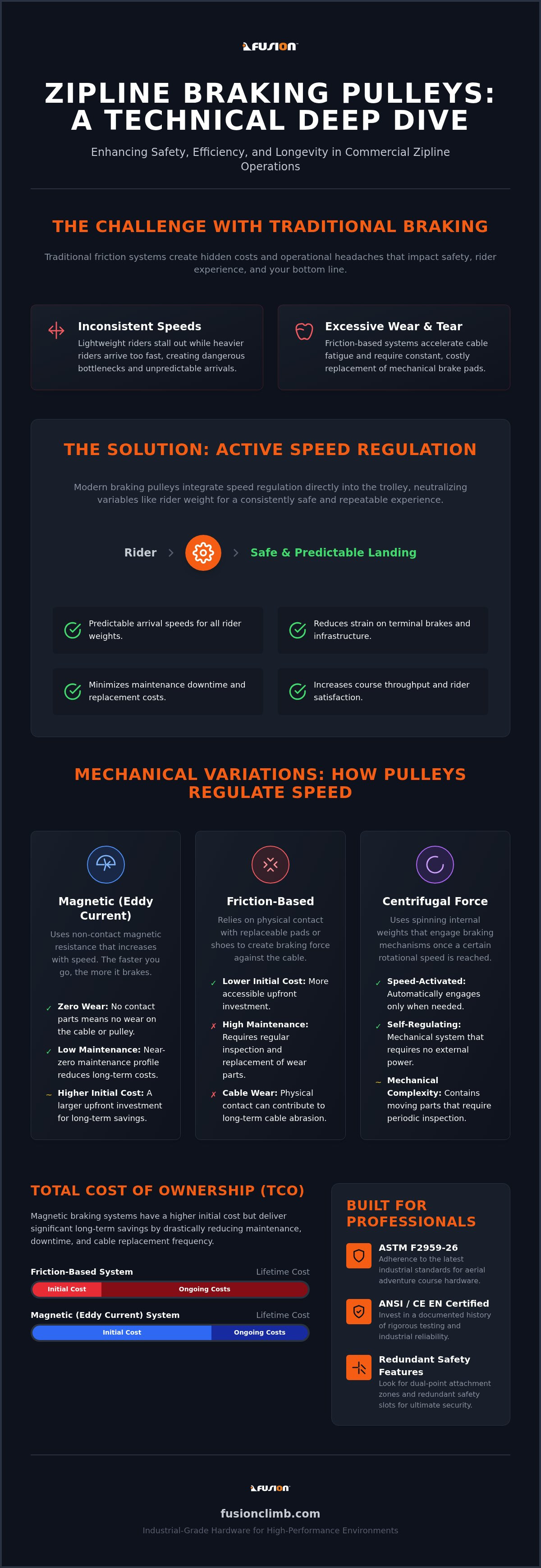
Your braking system isn't just a safety net; it's the primary engine of your operation's longevity and rider satisfaction. Most commercial operators struggle with the hidden costs of traditional friction braking, from excessive cable wear to the constant replacement of expensive mechanical pads. You know the frustration of watching a lightweight rider stall out while a heavier guest comes in too fast. It creates a logistical bottleneck and a safety headache that eats into your margins. This inconsistency doesn't just annoy guests; it accelerates equipment fatigue and pushes maintenance budgets to the limit.
Selecting the right zipline braking pulleys allows you to master the technical mechanics and safety standards required for precise speed regulation on any commercial line. By focusing on professional-grade rigging and industrial reliability, you can transform your course from a high-maintenance chore into a streamlined, high-throughput asset. This guide examines how to integrate durable hardware with the latest ASTM F2959-26 standards. We will provide a technical roadmap to help you achieve predictable arrival speeds, reduce your maintenance intervals, and maintain a sobering sense of security for every rider who steps off the platform.
Key Takeaways
- Differentiate between terminal braking and active trolley-based regulation to enhance rider safety and operational efficiency.
- Analyze the mechanical advantages of magnetic, friction, and centrifugal systems to ensure consistent speed for riders of all weights.
- Calculate the total cost of ownership for zipline braking pulleys by factoring in cable longevity and reduced maintenance downtime.
- Implement a professional inspection cadence and installation protocol to maintain compliance with updated industrial safety standards.
- Optimize your rigging strategy by integrating rugged, industrial-grade hardware designed for high-performance commercial environments.
The Role of Braking Pulleys in Modern Zipline Safety
Braking pulleys are not merely wheels on a cable. They are precision-engineered speed regulators designed to manage kinetic energy in real time. Unlike standard trolleys that offer zero resistance, these specialized units incorporate internal mechanisms to dictate the rider's velocity from start to finish. This shift in technology marks a critical advancement in course design. It moves the responsibility of speed control away from the landing platform and places it directly into the hands of the rigging hardware. By neutralizing the variables of rider mass and wind resistance, zipline braking pulleys provide a predictable, repeatable experience for every guest on the line.
The primary objective is the reduction of impact force. When a rider arrives at the terminal platform with excessive speed, the strain on the secondary braking system and the rider’s body increases exponentially. By regulating speed throughout the descent, these pulleys ensure that the terminal brake only needs to perform a final, gentle arrest rather than a high-energy emergency stop. This protects your infrastructure and your guests simultaneously.
Passive vs. Active Speed Regulation
Traditional zipline design often relies on passive speed regulation. These systems use gravity-based sags or terminal spring buffers to slow a rider down. While functional for short, flat lines, passive methods struggle with inconsistency. A lightweight rider might stall before reaching the platform, while a heavier rider might hit the terminal springs with dangerous velocity. While various zipline braking methods exist, the industry is increasingly moving toward active regulation. Active systems utilize the pulley itself to manage kinetic energy. This is essential for steep commercial lines where gravity alone cannot be trusted to manage rider safety. Active pulleys ensure that regardless of the rider's weight, the arrival speed remains within a tight, safe margin.
Safety Standards and Certifications
Commercial operations require hardware that exceeds recreational expectations. "Backyard" grade pulleys lack the heat dissipation and material density required for high-frequency use. Professional zipline braking pulleys must adhere to rigorous industrial benchmarks. The ASTM F2959-26 standard, updated in June 2026, provides the current framework for aerial adventure course requirements. Compliance with this standard ensures that the hardware can withstand the mechanical stresses of a high-throughput environment. Furthermore, professional units often feature redundant safety slots and dual-point attachment zones. These features provide a secondary connection point for lanyards, ensuring that even in the event of a primary component failure, the rider remains securely attached to the cable. When you choose hardware certified to ANSI or CE EN standards, you are investing in a documented history of testing and reliability.
Mechanical Variations: How Braking Pulleys Regulate Speed
Speed regulation in commercial ziplining is achieved through three primary mechanical avenues: magnetic resistance, friction, and centrifugal force. Each technology offers a specific set of advantages tailored to different course profiles. While standard trolleys rely on the technician's rigging to manage speed, zipline braking pulleys integrate these physical principles directly into the housing. This allows for a more controlled descent that accounts for environmental variables like wind and ambient temperature. Understanding these variations is essential for operators looking to balance rider experience with equipment longevity.
Magnetic (Eddy Current) Pulleys
Magnetic pulleys utilize Eddy Current technology to provide a smooth, non-contact braking experience. As the pulley moves along the cable, internal magnets interact with a conductive housing to create a drag force. This resistance is proportional to speed. The faster a rider goes, the more the pulley resists. Because there are no contacting parts, these units eliminate wear on the cable and the internal components. This near-zero maintenance profile makes them a staple for high-volume commercial parks with long, fast lines. While the initial investment is higher than mechanical alternatives, the reduction in long-term labor and cable replacement costs often justifies the expense. These systems provide a consistent arrival speed for a 60lb child and a 250lb adult alike, removing the guesswork from platform operations.
Friction-Based Braking Systems
Friction-based systems rely on replaceable brake pads that apply pressure to the cable or an internal drum. These pads are engineered with specific friction coefficients to deliver a predictable rate of deceleration. Many professional trolleys feature "pull-to-brake" handles, allowing for manual speed adjustments during the ride. Heat dissipation is the primary challenge here. During peak operation, stainless steel cables can reach high temperatures. Heavy-duty zipline braking pulleys utilize ventilated housings and heat-sink materials to manage this thermal buildup. Without proper heat management, brake pads can glaze, leading to inconsistent performance and increased maintenance intervals. Operators must monitor pad thickness daily to ensure compliance with OSHA safety standards for ziplines.
Centrifugal pulleys offer a third alternative, using internal weighted arms that expand as the wheel spins. This creates resistance against an outer drum, effectively governing the maximum speed of the trolley. These are often used as a fail-safe or a secondary speed limiter on steep lines. Regardless of the mechanism you choose, the reliability of your system depends on the quality of your core components. Choosing industrial-grade zipline pulleys ensures that your braking strategy is supported by hardware built for rugged, high-use environments. Professional rigging requires a cohesive system where the pulley, cable, and braking mechanism work in perfect synchronization.
Evaluating Braking Pulleys for Commercial Operations
Choosing the right hardware requires looking beyond the initial purchase price. For a commercial operator, the total cost of ownership includes replacement parts, labor for inspections, and the lifespan of the cable itself. High-performance zipline braking pulleys are an investment in operational stability. They must handle a wide spectrum of rider weights, from a 60lb child to a 250lb adult, without requiring manual adjustments between every zip. This versatility ensures your line stays moving and your guests stay satisfied. When your equipment regulates speed automatically, you reduce the risk of human error and maximize your daily throughput.
Weather resistance is another non-negotiable factor. Commercial parks operate in rain, high humidity, and extreme heat. Hardware must maintain consistent braking force regardless of the environment. A pulley that slips in the rain or seizes in the heat is a liability. Stability is equally vital. Tandem wheel configurations are superior to single-wheel designs for commercial use. They distribute the load across two points, reducing the "wobble" that causes uneven wear on both the pulley and the line. This dual-point contact provides a smoother ride and protects the integrity of your infrastructure over thousands of cycles.
Cable Compatibility and Wear
Cable health is often overlooked until it becomes a safety risk. Most professional pulleys are designed for specific diameters, typically 3/8" or 1/2" galvanized or stainless steel. Using mismatched hardware leads to "burnishing," a process where the cable surface becomes polished and hardened, eventually leading to brittleness and strand failure. Quality zipline braking pulleys minimize this friction-induced fatigue by maintaining a precise interface with the cable. During your routine inspections, look for signs of "bird-caging" or flattened wires, which often signal that your pulley isn't tracking correctly or is creating excessive heat. Adhering to guidelines from the Association for Challenge Course Technology (ACCT) will help you establish a baseline for cable retirement and pulley maintenance.
Operational Throughput and Efficiency
Efficiency dictates your daily revenue. Self-regulating pulleys speed up the reset process by eliminating the need for staff to manually adjust brakes for different rider profiles. This simplicity reduces training requirements for new guides and minimizes the learning curve for seasonal staff. When the "hook-on" and "take-off" procedures are streamlined, you can move more guests through the course with fewer bottlenecks. Choose hardware that features intuitive attachment points and clear orientation markings. This reduces human error and ensures that the focus remains on the guest's adventure, backed by a sobering sense of technical security and industrial reliability.
Installation and Maintenance of Braking Pulley Systems
Professional installation of zipline braking pulleys is a high-stakes task that demands technical precision. It begins long before a rider ever clips in. You must verify that your cable grade and tension are compatible with the specific resistance profile of your hardware. A system that is too loose will cause the trolley to drag, while over-tensioned lines can lead to excessive speed that overwhelms the internal braking mechanism. Meticulous setup is the only way to guarantee that the physics of the descent match the engineering of the pulley.
Rigorous maintenance is the backbone of operational safety. You need a structured cadence that includes daily visual checks, monthly deep dives, and annual certifications. For non-magnetic systems, lubrication of the bearings is a critical variable. Use only manufacturer-approved lubricants to prevent debris buildup that can seize a wheel mid-flight. Retirement criteria must be absolute. If a component shows signs of deformation, excessive heat discoloration, or structural cracks, it must be pulled from service immediately. Maintaining a "safety-first" culture means prioritizing equipment integrity over-extended part life.
Step-by-Step Rigging for Braking Pulleys
Correct orientation is the most common failure point during installation. Many zipline braking pulleys are directional; reversing them can result in zero braking force or catastrophic hardware failure. Always check the laser-etched directional arrows on the housing before deployment. Once mounted, perform a series of tests with weighted dummies that simulate your course's maximum weight capacity. This allows you to observe the braking curve and arrival speed in a controlled environment. Never clear a line for human flight until you have documented consistent results from these weighted trials.
Inspection Checklist for Professional Operators
Your daily inspection is the first line of defense against equipment fatigue. Use the following checklist to maintain a professional standard of care:
- Wheel Integrity: Rotate wheels manually to check for flat spots, bearing resistance, or unusual noise.
- Groove Patterns: Inspect the contact surface for "V-shaping" or uneven wear that suggests cable misalignment.
- Braking Elements: Clear any dust or debris from magnetic fins or friction pads to ensure consistent resistance.
- Attachment Points: Verify that carabiner slots and safety gates are free of burrs and show no signs of elongation.
- Fasteners: Ensure all bolts and pins are torqued to specification and that locking mechanisms are engaged.
Reliability starts with the quality of your core components. Equip your course with industrial-grade zipline pulleys to ensure your maintenance protocols are backed by hardware built for the long haul. When you invest in rugged, professional-grade equipment, you reduce the frequency of part replacements and provide a more stable experience for your guests.
Integrating Fusion Climb Hardware into Your Braking Strategy
A high-performance braking system is only as strong as its weakest link. While zipline braking pulleys manage the physics of the descent, the rest of your rigging must be equally robust to handle the resulting forces. Professional operators understand that safety requires a cohesive ecosystem of hardware. This includes everything from the trolley to the carabiners, lanyards, and harnesses used by the rider. Sourcing your equipment from a dedicated, US-based manufacturer ensures that every component is engineered to a singular standard of industrial reliability.
Fusion Climb brings decades of expertise in tactical and safety-grade manufacturing to the commercial zipline industry. Since 1998, we have focused on creating hardware that thrives in high-use, rugged environments. When you pair speed regulation technology with our specialized harnesses and lanyards, you create a fail-safe environment for your guests. High-weight capacity harnesses, such as full body or superman style models, are essential for maintaining rider stability during deceleration. These components work together to absorb energy and distribute weight, ensuring that the transition from high-speed flight to a controlled stop is smooth and secure.
System Synergy: Pulleys and Tethers
Deceleration creates mechanical stress that travels through the entire gear chain. Shock-absorbing tethers and lanyards are critical partners for zipline braking pulleys. These components act as a buffer, mitigating the impact that can occur when a braking mechanism engages. Selecting the right carabiners is equally vital. In high-vibration environments, you need locking gates that won't vibrate open or suffer from metal fatigue. Every carabiner and tether in your fleet should meet or exceed the breaking strength of your primary pulley to maintain a consistent safety margin. This methodical approach to rigging protects your guests and extends the life of your equipment.
The Fusion Advantage for Operators
Commercial parks face unique logistical challenges that recreational setups never encounter. You need access to bulk hardware solutions and a partner who understands the sobriety of technical specifications. Our commitment to meticulous manufacturing means that every piece of gear, from our zipline harnesses to our precision carabiners, is built for the long haul. You aren't just buying parts; you are investing in a documented history of safety and performance. We provide the substance over style that professional operators demand. It is time to elevate your course standards with hardware that reflects your commitment to excellence. Equip your course with Fusion Climb’s professional zipline hardware and ensure your braking strategy is backed by industrial strength.
Master Your Course Dynamics
Mastering speed regulation is the difference between an operational headache and a high-performance commercial asset. By transitioning to active speed control, you eliminate the inconsistencies of gravity-based systems and protect your infrastructure from excessive wear. We've explored how zipline braking pulleys serve as the primary engine for rider safety, ensuring that every guest arrives at the platform with predictable velocity regardless of their weight. This technical precision reduces maintenance intervals and keeps your throughput at peak levels during your busiest seasons.
Your course deserves hardware that matches the high stakes of the industry. Since 1998, Fusion Climb has provided industrial-grade reliability for operators who value substance over style. Our rugged designs are tested for extreme aerial environments, giving you the technical assurance needed to push physical limits safely. Don't settle for recreational gear when the integrity of your rigging is on the line. Every component must work in synergy to provide a sobering sense of security for your guests and your staff.
Explore Fusion Climb’s Professional Zipline Pulleys and Hardware to build a system that stands the test of time. Your next season of adventure starts with a foundation of industrial strength and meticulous manufacturing.
Frequently Asked Questions
Do I need a braking pulley if I already have a bungee brake system?
Yes, integrating a braking pulley provides a primary layer of speed regulation that complements your bungee system. While a bungee acts as a secondary terminal brake to stop the rider at the platform, the pulley manages velocity throughout the descent. This reduces the energy load on your terminal infrastructure, extending the life of your bungees and providing a smoother arrest for the rider.
How long do the friction pads last on a zipline braking pulley?
Friction pads typically last between 3 and 6 months in a standard commercial environment. This interval depends heavily on your daily rider volume and the length of your lines. You must perform daily inspections to check for pad thickness and glazing. If the pads show significant wear or reduced stopping power, they should be replaced immediately to maintain consistent speed control.
Can magnetic braking pulleys be used on all types of zipline cables?
Magnetic pulleys are designed for use on standard 3/8 inch or 1/2 inch galvanized and stainless steel cables. The internal Eddy Current technology requires a conductive metallic interface to generate resistance. These systems are not compatible with plastic-coated cables or synthetic ropes, as the magnetic field cannot interact with non-conductive materials to slow the trolley down.
What is the maximum speed rating for a professional braking pulley?
Professional-grade zipline braking pulleys are generally rated for top speeds between 60 and 75 miles per hour. Always verify the specific rating of your hardware before installation. Operating a pulley beyond its engineered speed limit can lead to catastrophic thermal failure or mechanical seizing. Ensure your course design keeps maximum rider velocity well within these documented safety parameters.
How do I know if my zipline grade is too steep for manual braking?
Any zipline with a grade exceeding 6% typically requires an automated braking solution rather than manual hand braking. Manual methods rely on rider or guide intervention, which introduces human error and physical fatigue into the safety equation. If your topography creates high-velocity descents, automated pulleys are necessary to ensure every arrival is predictable and stays within safe impact limits.
Are braking pulleys compatible with Superman-style prone harnesses?
Yes, professional braking pulleys are fully compatible with Superman-style harnesses. Because prone flying is more aerodynamic than a seated position, riders often reach higher velocities on the same line. Using a regulated pulley is critical in these setups to manage the increased kinetic energy. Ensure your rigging provides enough clearance for the harness tethers to move freely during the braking phase.
What maintenance is required for a magnetic zipline trolley?
Magnetic trolleys require very little maintenance because they have no contacting wear parts like friction pads. Your primary task is to keep the magnetic fins clear of metallic debris and dust. Inspect the bearings regularly for smooth rotation and check the housing for structural integrity. Most manufacturers also require an annual professional recertification to ensure the internal magnets are performing to specification.
Do braking pulleys work differently for lightweight riders?
Self-regulating zipline braking pulleys adjust their resistance based on the rider's velocity. A lightweight rider typically moves slower and carries less momentum, so the pulley applies less braking force. This prevents smaller guests from stalling before they reach the platform. Conversely, heavier riders who move faster trigger more resistance, ensuring they are slowed down effectively regardless of their mass.