



Safety Lanyards: Fall Protection Hardware Guide
A safety lanyard is not just a simple connector; it is a meticulously engineered energy management system designed to bridge the gap between a secure anchor and your life. When you're working at elevation, the difference between a controlled arrest and a catastrophic failure often comes down to a few inches of webbing and the integrity of a shock absorber. It's understandable why many professionals feel a sense of unease when navigating the complex web of ANSI versus OSHA compliance. You want gear that doesn't just meet a baseline but exceeds the demands of rugged, real-world use. Selecting the right safety lanyards for heights requires more than a casual glance at a spec sheet.
This guide provides the technical clarity you need to eliminate guesswork from your fall protection plan. You'll master the specific selection criteria for energy-absorbing mechanisms and learn how to calculate fall clearance distances with absolute precision. We'll break down the 2026 standards, including the mandatory PPE fit rules and the latest ANSI Z359.13 impact force limits. By the end of this article, you'll have the confidence to choose hardware that stands up to the most demanding high-angle environments. We're moving past the marketing fluff to focus on the industrial-grade reliability that keeps you secure when the stakes are at their highest.
Key Takeaways
- Learn why the deceleration distance of shock-absorbing hardware is the critical factor in preventing serious injury during a fall.
- Gain clarity on the legal differences between OSHA regulations and the rigorous ANSI Z359.13 standards for energy management.
- Master the selection criteria for safety lanyards for heights by evaluating anchor point location and specific environmental hazards.
- Identify the specialized requirements for diverse applications, ranging from industrial rigging to professional zipline operations.
- Build confidence in calculating fall clearance to ensure your personal fall arrest system functions with absolute precision.
Understanding Safety Lanyards for Heights: The Critical Link
A safety lanyard serves as the vital, flexible component within a fall arrest system, acting as the bridge between your full body harness and a secure anchor point. In the high-stakes environment of vertical work, this equipment functions as your silent partner. It remains unobtrusive during standard operations but stands ready to perform instantly when gravity takes over. While some view it as a simple strap, it's actually a sophisticated piece of hardware designed to manage kinetic energy. A safety lanyard is a precisely engineered link designed to limit the impact forces transmitted to the body during a fall event.
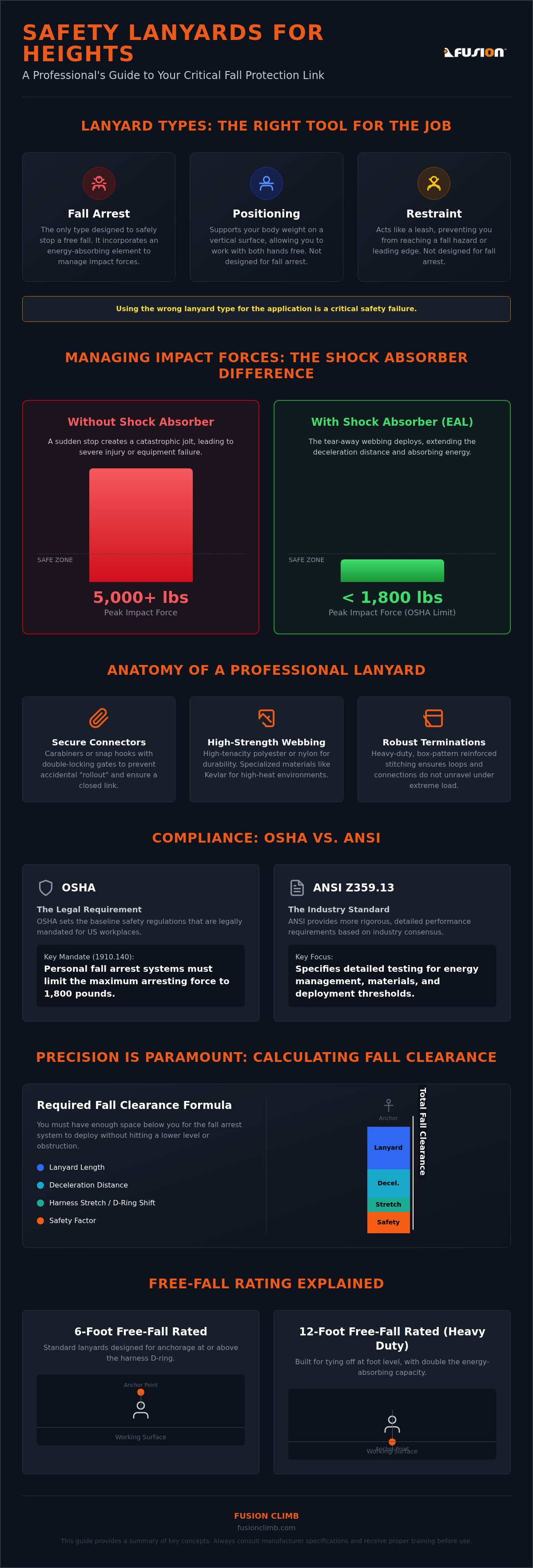
Not all safety lanyards for heights are built for the same task. You must distinguish between restraint, positioning, and fall arrest applications. Restraint lanyards act as a leash to prevent you from reaching a leading edge. Positioning lanyards allow you to work hands-free on a vertical surface by supporting your weight. Fall arrest lanyards, however, are the only type designed to stop a free fall safely. Using the wrong tool for the job isn't just a mistake; it's a critical safety failure that compromises your security.
The Anatomy of a Professional Lanyard
Professional-grade lanyards consist of three primary elements: high-strength webbing, secure connectors, and robust terminations. Manufacturers utilize high-tenacity polyester and nylon to ensure the core material withstands extreme tension without losing its structural integrity. Look closely at the terminations; reinforced stitching, often applied in a heavy-duty box pattern, ensures the loops don't unravel under load. Connectors like carabiners or snap hooks must feature double-locking gates to prevent accidental rollout, ensuring the link remains closed until you intentionally move it.
Material Science: Webbing vs. Synthetic Rope
Choosing between flat webbing and synthetic rope depends on your specific work environment. Flat webbing offers a wide surface area that resists twisting and provides excellent durability against flat surfaces. In contrast, synthetic kernmantle rope offers superior flexibility, making it a favorite for technical rigging and complex movements. For rugged industrial sites, prioritize high abrasion resistance to protect against sharp steel edges or concrete corners. If your work involves welding or high-heat environments, specialized materials like Kevlar become mandatory to prevent the lanyard from charring. For those in the aerial adventure industry, selecting specialized zipline lanyards and tethers ensures the gear matches the unique friction and speed requirements of the course while maintaining absolute reliability for safety lanyards for heights.
Shock-Absorbing vs. Non-Shock Lanyards: Managing Impact
Managing impact forces is the primary function of professional safety lanyards for heights. When a worker falls, the body rapidly gains kinetic energy that must be dissipated to prevent catastrophic injury. A sudden stop without an energy-absorbing element can generate forces exceeding 5,000 pounds. This is enough to cause severe internal trauma or total equipment failure. According to OSHA 1910.140, personal fall arrest systems must limit the maximum arresting force to 1,800 pounds. Deceleration distance is the critical variable; it's the difference between a controlled arrest and a bone-shattering jolt.
A common but dangerous misconception is the objection: "I don't need a shock absorber because I'm only 6 feet up." In reality, a non-shock lanyard used in a fall arrest scenario can result in permanent injury regardless of the height. Energy-absorbing lanyards (EAL) are engineered to deploy at a specific force threshold, usually around 450 to 900 pounds. It's also vital to distinguish between 6-foot and 12-foot free-fall rated gear. A 6-foot rated lanyard is designed for anchors at or above the D-ring. A 12-foot rated lanyard is built for "Heavy Duty" applications where the anchor is at foot level, providing double the energy-absorbing capacity to handle the increased velocity.
How Energy Absorbers Work: Internal vs. External
External shock packs utilize a "tear-away" webbing mechanism. As the fall occurs, the internal stitching rips at a controlled rate to slow the descent. This visual deployment makes post-fall inspections straightforward. Conversely, internal bungee-style absorbers house the energy-dissipating material within the tubular webbing itself. These are ideal for reducing snag hazards in tight spaces. Regardless of the absorber type, these systems rely on professional climbing carabiners to maintain a secure, high-strength connection between the worker and the link.
The Math of Fall Clearance
Calculating clearance is a non-negotiable step in your safety plan. If you miscalculate, you risk "bottoming out" against the ground or an obstruction before the lanyard fully deploys. The standard formula is: Lanyard Length + Deceleration Distance + Height of Worker + Safety Factor. For a typical 6-foot lanyard, you often need at least 18.5 feet of clear space below the anchor point. In variable environments, using adjustable tethers allows you to shorten the connection and minimize potential fall distance. Selecting industrial-grade lanyards that match your specific clearance requirements is the only way to ensure absolute security at the job site.
Application-Specific Lanyards: From Industrial Sites to Ziplines
The environment dictates the hardware. A tower climber scaling a telecommunications mast requires a vastly different setup than a guest on a commercial zipline. For the industrial professional, 100% tie-off is the non-negotiable standard. This is achieved through dual-leg or "Y-lanyards," which allow the user to remain connected to one anchor while transitioning to the next. In contrast, recreational safety lanyards for heights focus on maintaining rider orientation and providing a secondary backup to primary trolley systems. While both applications prioritize security, the industrial worker moves with methodical precision, while the recreational user relies on gear that facilitates a seamless, intuitive experience.
Zipline Tethers and Ropes Course Safety
In aerial adventure parks, zipline lanyards and tethers serve as the critical connection between the rider's harness and the commercial zipline pulleys. Length is a precision factor here; a tether that is too long can cause the rider to spin or lose stability, while one that is too short restricts movement. Operators must adhere to strict ropes course safety equipment standards to ensure every component survives the high-cycle wear typical of commercial use. The choice of hardware directly impacts the rider's sense of security, making professional-grade craftsmanship essential for commercial success.
Industrial Fall Arrest and Positioning
It's vital to separate fall arrest from work positioning. Positioning lanyards, such as rebar chain assemblies, allow workers to lean back and use both hands for tasks like tying rebar or inspecting steel. However, these are not designed to stop a free fall. Under OSHA 1926.104, any positioning system must be backed up by a separate fall arrest lanyard if a fall hazard exists. This "hands-free" capability significantly increases efficiency on the job site, provided the operator understands the limits of their hardware. Choosing the correct safety lanyards for heights means matching the material and configuration to the specific demands of the vertical environment, whether that involves steel rigging or concrete forms.
Compliance and Standards: ANSI Z359 and OSHA
Understanding the legal and technical landscape is vital for anyone deploying safety lanyards for heights. OSHA regulations represent the law; they're the minimum legal requirements employers must follow to avoid federal penalties. In contrast, ANSI standards are voluntary consensus guidelines that represent industry best practices. While OSHA provides the baseline, ANSI provides the technical blueprint for excellence. For shock-absorbing gear, ANSI Z359.13 is the gold standard. It mandates rigorous manufacturing protocols to ensure that energy absorbers perform predictably under stress. To achieve ANSI compliance, a lanyard must undergo dynamic drop testing with a 282-lb test weight to verify its deceleration capabilities. Additionally, every safety connector in the system must meet a minimum 5,000-pound tensile strength requirement to prevent hardware failure during a sudden arrest.
Deciphering Safety Labels and Markings
Don't ignore the fine print. Every professional lanyard features a durable label that lists its maximum capacity, manufacture date, and compliance certifications. You'll often find integrated "Warning" tags near the shock pack. These tags deploy or reveal a "void" message if the lanyard has been subjected to a fall. If a label is missing, torn, or simply illegible, you must retire the gear immediately. Without a clear record of the lanyard's history and specifications, you cannot guarantee its performance in a crisis.
Inspection Protocols: When to Retire Your Gear
Daily inspections are your first line of defense for safety lanyards for heights. Before every shift, run the webbing through your hands to feel for cuts, burns, or hard spots caused by chemical exposure. Check the connectors for smooth gate operation and signs of corrosion. While some follow a "5-year rule" for synthetic lanyards, actual retirement should be condition-based. Harsh environments involving UV exposure or abrasive dust can shorten a product's lifespan significantly. Most importantly, any lanyard involved in a fall event must be removed from service immediately and destroyed. It's done its job; it won't do it again. Ensure your team is equipped with the highest standard of protection by selecting ANSI-compliant safety hardware from a manufacturer committed to industrial-grade reliability.
Selecting the Right Lanyard: A Professional Framework
Selecting safety lanyards for heights requires a methodical evaluation of your specific vertical environment. This process begins with the geometry of your workspace, specifically the relationship between your anchor point and the D-ring on your harness. If your anchor is positioned below the D-ring, you must select a lanyard rated for a 12-foot free fall to accommodate the increased velocity and impact forces. Conversely, an overhead anchor allows for a standard 6-foot rated lanyard. You should also determine the minimum length required for your task; while mobility is important, every extra foot of webbing increases your potential fall distance and the clearance required below you.
Environmental factors are equally critical in your selection framework. If your site features sharp steel beams or concrete edges, you'll need leading-edge lanyards with reinforced materials to prevent shearing. For electrical utility work, prioritize dielectric hardware that provides insulation against conductivity. In high-heat environments like welding or torch cutting, synthetic materials like Kevlar are necessary to maintain structural integrity. Never assume a standard lanyard is a universal solution; matching the hardware to the hazard is the only way to ensure absolute security.
Matching Connectors to the Task
The connector is your primary interface with the anchor, and its design must match the structure you're climbing. Large-gate rebar hooks are essential for scaffolding and structural steel where a standard snap hook cannot fully close around the member. For high-movement scenarios where the lanyard might twist or rotate, triple-action locking carabiners provide the highest level of security against accidental rollout. Modern safety standards require these connectors to have a gate-strength rating of at least 3,600 lbs. This ensures the gate won't fail even if it's subjected to side-loading during a fall arrest event.
The Fusion Climb Advantage: Rugged Reliability
Fusion Climb stands as an authoritative manufacturer of industrial-grade adventure gear. Since our founding in 1998, we've maintained a commitment to professional-grade craftsmanship and a "substance over style" philosophy. We don't focus on marketing fluff; we focus on the rigorous quality control required for commercial rigging and high-angle environments. Our lanyards and tethers are built with heavy-duty webbing and stainless steel components to act as a dependable guardian for workers and adventurers alike. If you're facing a complex rigging configuration or a unique aerial park challenge, consult with our safety experts to ensure your gear selection meets the most demanding national standards.
Securing Your Vertical Future with Precision Hardware
Mastering the technical nuances of fall protection is about more than just checking a box for compliance; it's about ensuring your equipment performs exactly when it's needed. You now understand that the physics of deceleration and the rigor of ANSI Z359.13 testing are what separate a standard connector from a life-saving system. By matching your hardware to the specific demands of your environment, you eliminate the risks of gear failure. Choosing the right safety lanyards for heights is a decision that impacts every moment spent at elevation.
Fusion Climb has provided industrial-grade hardware trusted by zipline operators nationwide since 1998. Our ANSI-compliant designs are engineered for maximum durability and real-world reliability. Don't leave your security to chance. Explore Fusion Climb’s Professional Lanyards and Tethers to find the dependable gear your team deserves. Stay focused, stay secure, and keep pushing the limits of what's possible in the vertical world.
Frequently Asked Questions
What is the difference between a safety lanyard and a tether?
A safety lanyard is a critical component of a fall arrest system designed specifically to manage kinetic energy and limit impact forces on the body. A tether is often used for work positioning or tool retention and may not possess the same energy-absorbing properties. While both serve as connectors, lanyards are engineered to save lives during a free fall, whereas tethers generally keep you in place or secure your equipment.
Can I use a climbing lanyard for industrial fall protection?
You shouldn't use recreational climbing lanyards for industrial applications unless the hardware explicitly meets OSHA and ANSI Z359 standards. Industrial environments demand higher durability and specific energy-absorbing mechanisms that standard climbing gear often lacks. Using non-compliant equipment in a professional setting is a violation of safety regulations and puts you at risk of gear failure. Always select hardware specifically rated for industrial-grade reliability and workplace compliance.
How much fall clearance do I need for a 6-foot shock-absorbing lanyard?
You typically need approximately 17.5 to 18.5 feet of clearance below your anchor point. This calculation accounts for the 6-foot lanyard length, a 3.5-foot deceleration distance, the 6-foot height of the worker, and a 2-foot safety factor. Miscalculating this distance leads to the risk of bottoming out before the shock absorber fully deploys. Always verify the clear space to the nearest obstruction before you begin any work at elevation.
What does it mean if a lanyard is ANSI Z359.13 compliant?
Compliance with ANSI Z359.13 indicates the lanyard has passed rigorous dynamic drop testing using a 282-lb test weight. This standard ensures the energy absorber limits the maximum arresting force to 1,800 lbs or less, which is the benchmark for professional safety. It signals that the manufacturer has followed strict quality control protocols. Relying on ANSI-compliant gear ensures your hardware meets the highest engineering standards for modern fall protection and energy management.
How often should I inspect my safety lanyards for heights?
Perform a thorough pre-use inspection of your safety lanyards for heights before every single shift. You must look for signs of webbing abrasion, chemical burns, or frayed stitching that could compromise structural integrity. Additionally, a competent person must conduct a documented formal inspection at least once every six months. If you work in harsh environments with high UV exposure or abrasive dust, increase the frequency of these formal inspections to ensure absolute security.
Can I tie a knot in my lanyard to make it shorter?
Never tie a knot in a safety lanyard to adjust its length. Knots create severe weak points in the synthetic fibers that can reduce the overall strength of the webbing by more than 50%. This drastically increases the likelihood of the lanyard snapping during a fall arrest event. If your workspace requires a shorter connection, you should use an adjustable tether or a fixed-length lanyard designed specifically for low-clearance scenarios to maintain your safety.
What happens to a shock absorber during a fall?
During a fall, the shock absorber deploys by gradually ripping apart internal or external "tear-away" stitching. This mechanical process converts the kinetic energy of your descent into heat, which significantly reduces the impact force transmitted to your body and the anchor. Once this deployment occurs, the equipment has served its purpose and must be retired. Most absorbers feature a warning tag that becomes visible after a fall, indicating the gear is no longer safe.
When should I choose a dual-leg Y-lanyard over a single-leg model?
Choose a dual-leg Y-lanyard when your task requires 100% tie-off while moving between anchor points. This configuration allows you to stay connected to one anchor while you transition your second leg to a new point, which is essential for tower climbing and scaffolding work. A single-leg model is appropriate only when you're working from a fixed position or using a continuous lifeline where you don't need to disconnect to move along the structure.