


Professional Guide to Ropes Course Safety Equipment: Standards and Hardware (2026)
A single hairline fracture in a pulley or a misunderstood safety standard can ground an entire operation. You understand that in the aerial adventure industry, there's no margin for error when it comes to participant security. Interpreting the friction between ANSI Z359.11 requirements and ASTM standards often feels like a technical hurdle that distracts from the daily thrill of the course. It's a heavy burden to carry, especially when liability and equipment longevity are constantly on your mind.
This guide provides the technical clarity you need to master your ropes course safety equipment inventory for the 2026 season. We'll strip away the confusion surrounding industrial-grade hardware and provide a clear framework for identifying high-wear components before they become hazards. You'll learn the specific differences between recreational gear and professional-grade steel, alongside a methodical system for equipment inspection and retirement that keeps your park compliant and your climbers safe.
Key Takeaways
- Navigate the critical intersection of ANSI Z359.11 and ASTM standards to ensure every component meets rigorous industrial benchmarks.
- Differentiate between full body and specialized Superman style harnesses to optimize both participant security and flight performance.
- Master the material science of connectors by learning when to deploy heavy-duty steel for rigging versus lightweight aluminum for high-movement applications.
- Implement a professional maintenance framework for your ropes course safety equipment that prioritizes serialized tracking and proactive hardware retirement.
- Evaluate the engineering behind high-speed pulleys and lanyards to ensure superior heat dissipation and reliable fall arrest across your entire course.
Essential Standards for Ropes Course Safety Equipment (ANSI & ASTM)
In the vertical environment of a Ropes course, professional ropes course safety equipment functions as a cohesive life-support system. This equipment encompasses the specialized personal protective equipment (PPE) and hardware designed to mitigate fall risks and manage kinetic energy in aerial adventure parks. Unlike general mountaineering gear, these components must withstand the relentless cycle counts of a high-volume commercial operation. Relying on uncertified hardware isn't just a liability; it's a fundamental failure of professional duty. You need gear that's engineered for the grit of daily use.
ANSI vs. ASTM: Navigating Regulatory Compliance
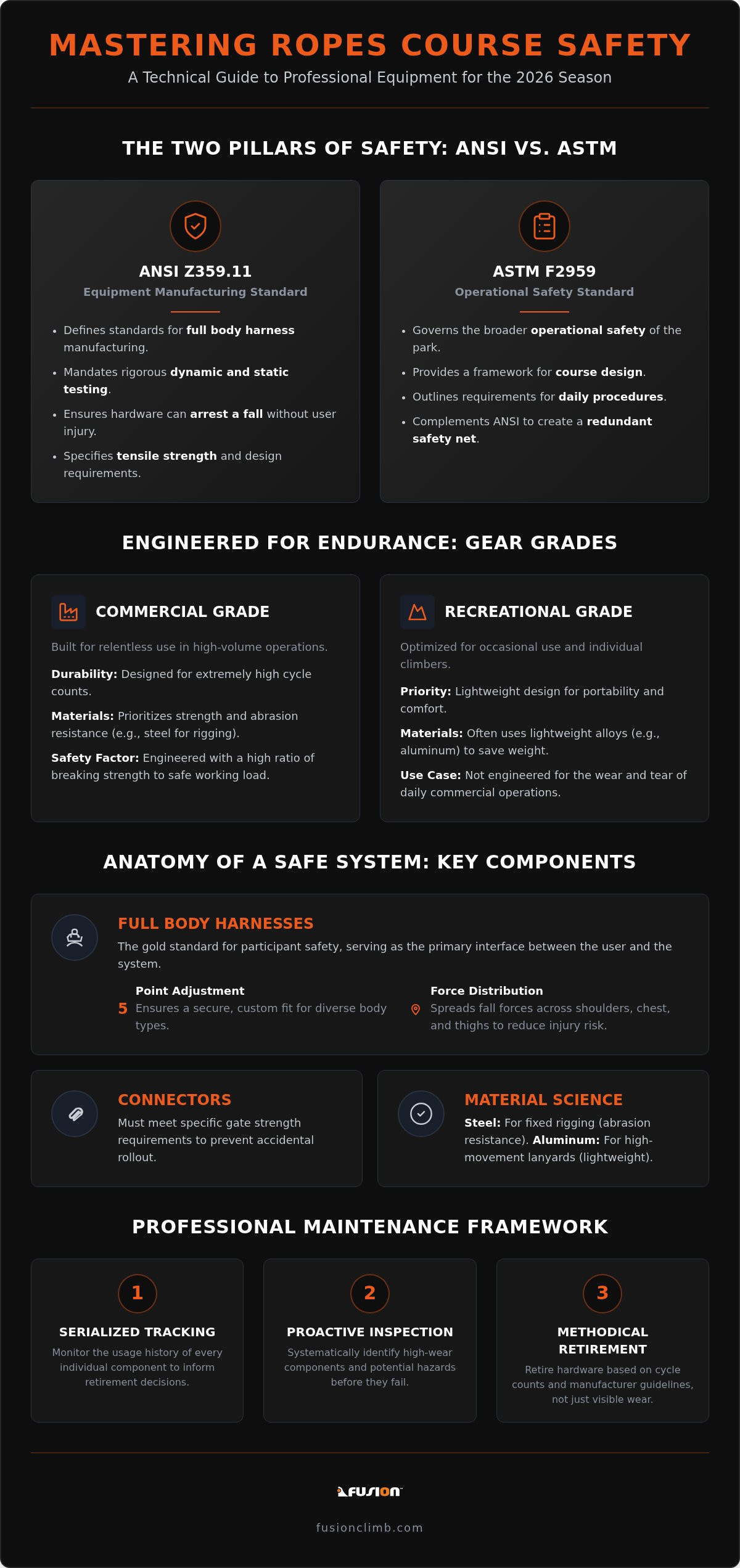
Safety in 2026 relies on two primary pillars of regulation. ANSI Z359.11 serves as the definitive standard for full body harness manufacturing. It mandates rigorous dynamic and static testing to ensure that a harness can arrest a fall without causing catastrophic injury to the user. While ANSI focuses on the hardware's tensile strength and design, ASTM F2959 governs the broader operational safety of the park itself. The intersection of these standards creates a redundant safety net that protects both the participant and the business.
Professional operators must prioritize labeled, third-party tested hardware to secure their liability. ANSI standards dictate that safety connectors must meet specific gate strength requirements to prevent accidental rollout. ASTM standards complement this by providing a framework for course design and daily operational procedures. Using equipment that carries these certifications signals to your insurers and participants that your facility prioritizes industrial reliability over cost-cutting.
Commercial Grade vs. Recreational Equipment
The distinction between recreational climbing gear and commercial ropes course safety equipment is found in the engineering. Recreational gear is designed for occasional use and prioritized for weight. Commercial gear is built for endurance. It must support significantly higher cycle counts. This means the equipment can be donned, adjusted, and loaded thousands of times before reaching its retirement criteria. High-performance engineering ensures that hardware doesn't just work; it lasts.
Material durability is a critical factor in this environment. Aluminum carabiners offer weight savings for participant lanyards, but steel carabiners are the industrial standard for fixed rigging points due to their superior abrasion resistance. You also need to understand the safety factor. Technically, the safety factor is defined as the ratio of breaking strength to safe working load. In a commercial setting, maintaining a high safety factor ensures that the hardware can handle unexpected dynamic loads without compromising the integrity of the system. Don't settle for gear that meets the minimum; choose hardware that exceeds the demand.
Selecting the Right Harnesses: Full Body vs. Specialized Designs
The harness is the most intimate component of any safety system. It serves as the primary interface between the participant and the life-critical hardware above. In a commercial environment, ropes course safety equipment must do more than just meet minimum break strengths; it must accommodate a vast range of body types while maintaining strict adherence to ropes course safety standards. Choosing the wrong design doesn't just compromise safety. It slows down your throughput and diminishes the participant's experience through discomfort.
Professional operators prioritize gear that balances industrial reliability with ergonomic efficiency. This means looking for hardware that features rapid-fit buckles and breathable padding. When your staff can harness a group of twenty in half the time, your park's profitability increases. High-use gear must withstand the friction of constant adjustment and the sweat of daily operation without losing its structural integrity.
Full Body Harnesses for Maximum Fall Protection
Full body harnesses are the gold standard for participant safety. They utilize 5-point adjustment systems to ensure a secure, customized fit for diverse body shapes. This design is critical because it distributes the force of a fall across the shoulders, chest, and thighs, significantly reducing the risk of internal injury. When selecting gear, consider the placement of attachment points. Dorsal (back) D-rings are ideal for fall arrest, keeping the participant upright after a slip, while sternal (chest) points are better suited for assisted belays or specific elements.
Commercial parks require equipment that can handle thousands of cycles. Fusion Climb full body harnesses are engineered specifically for this high-volume throughput. They provide the rugged confidence needed for back-to-back sessions while ensuring the wearer remains secure in a vertical environment. It's about providing a sobering sense of security that allows the climber to focus on the challenge at hand.
Superman Style Harnesses for Prone Flight Experiences
Prone flight ziplines require a specialized engineering approach. A standard upright harness cannot safely manage a face-down orientation. Superman style harnesses solve this by shifting the center of gravity. They manage weight distribution to prevent "head-heavy" tipping, which is a common hazard in poorly designed flight systems. This specialized gear ensures the participant remains in a stable, horizontal position throughout the descent.
Safety redundancies are non-negotiable for prone flight. These systems often require multiple attachment points and secondary tethers to ensure that even a single-point failure cannot lead to a catastrophic release. If you're looking to upgrade your aerial adventure park's capability, exploring the industrial reliability of American-made harnesses is a logical next step for any serious operator.
Carabiners and Connectors: Ensuring Secure Rigging Points
Connectors are the critical links in your safety chain. In a professional aerial park, every carabiner represents a potential single point of failure that can compromise the entire system. You don't just need hardware that fits; you need hardware engineered for the specific stresses of high-altitude environments. Selecting the right ropes course safety equipment requires a deep understanding of material science. Aluminum carabiners are the preferred choice for participant lanyards due to their lightweight profile and ease of handling. Conversely, steel carabiners are the industrial workhorse for fixed rigging points and high-friction applications where abrasion resistance is paramount. Don't compromise on materials. Use steel where the gear stays put and aluminum where it moves.
Following the rigorous guidelines established by the Professional Ropes Course Association ensures your facility remains compliant with modern safety expectations. This compliance starts with reading the markings on your hardware. Every professional connector must display its kiloNewton (kN) rating and batch coding. These aren't just numbers; they're a guarantee of industrial reliability. If the markings are worn or missing, the gear is retired. It's that simple.
Gate Security: The Case for Auto-Locking Hardware
Human error is the primary threat to course safety. Participants often forget to engage manual screw-gates, especially during high-adrenaline transitions. Auto-locking carabiners solve this problem by ensuring the gate is always secure upon closure. A 3-stage locking mechanism, which requires the user to pull, turn, and then open, provides the maximum level of security for high-risk areas. This design prevents accidental gate opening from rope drag or contact with course elements. Maintain these moving parts with regular lubrication and spring tension checks to ensure the mechanism never hesitates. A sticky gate is a failed gate.
Strength Ratings and Orientation
Strength ratings only matter if the hardware is oriented correctly. Most carabiners are designed to handle their maximum load along the major axis. A standard 23kN rating means the connector can withstand approximately 5,170 pounds of force when loaded properly. However, cross-loading along the minor axis or loading against the gate drastically reduces this capacity. Train your staff to recognize and prevent these dangerous scenarios during every inspection. Each component features unique batch coding that allows operators to track the manufacturing origin and service lifespan of every individual connector. This level of granular tracking is what separates a professional operation from a recreational one. Know your gear's history to ensure its future performance.
Pulleys, Lanyards, and Tethers: Hardware for Movement and Fall Arrest
Dynamic elements demand hardware that can handle heat, friction, and constant motion. While the harness and carabiners provide the foundation, your pulleys and tethers are the components that actually facilitate the experience. High-performance ropes course safety equipment must be engineered to dissipate heat during high-speed zipline descents. Without proper thermal management, friction can compromise the cable's integrity and cause premature wear on the trolley wheels. You need hardware that prioritizes cable longevity as much as participant safety. It's about ensuring the ride is as smooth as it is secure.
Lanyards and tethers act as the vital bridge between the participant and the safety line. In elements where a fall could result in significant dynamic loading, shock-absorbing lanyards are essential. These components utilize specialized webbing to limit the impact force on the climber's body during a fall arrest event. For standard traversing, fixed or adjustable tethers provide the necessary positioning to keep participants centered. Every connection point must be intuitive for the user and easily verifiable for the facilitator. When the gear is easy to use, the safety of the entire park improves.
Commercial Zipline Pulleys and Trolleys
Stability is the hallmark of a professional trolley. Dual-track designs distribute the load across multiple points, which prevents the trolley from twisting and reduces erratic cable wear. When choosing between sealed ball bearings and bushings, consider your maintenance cycle. Sealed bearings offer superior speed and a smoother ride, but they require a higher level of scrutiny in dusty environments. Safety features like integrated finger guards and secondary attachment points are non-negotiable for commercial operations. These redundancies ensure that even if a primary component fails, the participant remains connected to the line. Upgrade your course with commercial-grade zipline pulleys that withstand the rigors of high-volume operation.
Industrial Safety Lanyards and Tethers
Durability in webbing is just as important as the strength of the metal hardware. Facilitators need to perform rapid visual inspections between every use. High-visibility webbing makes it easier to spot nicks, fraying, or UV damage that might otherwise go unnoticed. Whether you're using fixed-length tethers for zipline platforms or adjustable versions for varied course elements, the material must resist abrasion from constant contact with cables and hardware. Fusion Climb’s heavy-duty zipline tethers are built for this exact purpose, providing a rugged connection that stands up to the grit of outdoor environments. Equip your staff with the confidence that comes from using industrial-grade tethers and lanyards designed for maximum security.
Establishing a Professional Gear Inspection and Maintenance Protocol
Owning high-performance gear is only half the battle. A professional operation lives or dies by its maintenance protocol. You must foster a culture where safety isn't just a checklist; it's a mindset. Facilitators serve as the first line of defense, performing daily inspections on every piece of ropes course safety equipment before the first participant leaves the ground. This process requires meticulous documentation. Every carabiner, pulley, and harness must be serialized and logged. If you can't track a component's history, you can't guarantee its integrity.
Environmental stressors are silent killers of equipment longevity. UV exposure degrades nylon fibers over time, while moisture and salt air accelerate corrosion in metal hardware. In coastal or high-altitude environments, these factors can cut a product's lifespan in half. You need to establish a "When in Doubt, Throw it Out" policy. It's a sobering rule, but it's the only way to eliminate the anxiety of liability. If a piece of gear looks questionable, its service life is over.
The Daily Inspection Checklist
Facilitators must perform a tactile inspection of all webbing daily. Run your hands along the lanyards to feel for "fuzziness" or stiff spots that indicate internal fiber damage. Look for chemical burns or cuts that compromise tensile strength. Hardware function checks are equally critical. Gates must snap shut instantly. Pulleys must spin freely without grinding. Watch for "glazing" on ropes and lanyards. This shiny, melted appearance is caused by excessive heat from friction and signals a critical loss of elasticity.
Retirement and Replacement Cycles
Soft goods like harnesses, tethers, and lanyards typically follow a strict 5-year retirement rule in high-volume commercial settings. Even if the gear looks pristine, the internal fibers degrade from repeated loading and environmental exposure. Hard goods like pulleys and carabiners don't have a fixed expiration date but require inspection for grooving, cracks, or deformation. Once a metal component shows more than 10% wear in its cross-section, it's a hazard. Proper disposal requires you to physically destroy retired gear by cutting webbing and disabling hardware to ensure it is never reused in a vertical environment.
Securing the Future of Your Aerial Park
Operating a high-performance adventure park requires more than just a passion for the vertical environment; it demands a relentless commitment to technical integrity. You now have the framework to navigate complex ANSI and ASTM standards while selecting hardware that withstands the grit of daily commercial use. From the material science of your carabiners to the specialized engineering of Superman style harnesses, every choice you make reinforces the safety net for your participants. Maintaining a rigorous inspection protocol ensures that your ropes course safety equipment remains a dependable partner in every climb and flight.
Don't leave your operation's security to chance or uncertified gear. Since 1998, commercial operators have relied on specialized industrial safety hardware to protect their assets and their guests. Invest in gear that offers ANSI Z359.11 compliant manufacturing and the rugged durability required for high-volume throughput. Equip your course with professional-grade safety hardware from Fusion Climb to ensure your facility remains a leader in aerial adventure. Build your legacy on a foundation of strength and precision. The next season is calling. Make sure your gear is ready to meet the challenge.
Frequently Asked Questions
What is the difference between ANSI and ASTM standards for ropes courses?
ANSI standards govern the manufacturing and performance requirements of the hardware itself, while ASTM standards focus on the broader design, operation, and maintenance of the aerial adventure park. For example, ANSI/PRCA 1.0-.3-2024 provides the benchmarks for equipment tensile strength and testing. ASTM F2959 ensures that the park environment and operational procedures meet specific safety criteria to protect the public. ANSI ensures the gear is built to last; ASTM ensures the park is run correctly.
How often should ropes course harnesses be replaced?
Commercial ropes course harnesses generally require retirement every five years, though this lifespan can be significantly shorter in high-volume environments. Daily tactile and visual inspections are the only way to determine if a harness is still fit for service. If you identify frayed webbing, compromised stitching, or significant UV damage, the gear must be retired immediately. Environmental factors like salt air or moisture can accelerate the degradation of soft goods, making proactive replacement essential.
Can I use recreational climbing carabiners for a commercial ropes course?
You shouldn't use recreational climbing carabiners for commercial operations because they lack the industrial durability and specific gate-locking strengths required for professional use. Commercial-grade ropes course safety equipment must meet ANSI Z359.12 standards, which mandate a minimum gate strength of 3,600 pounds. Recreational carabiners are designed for lower cycle counts and often feature lighter gates that can fail under the constant friction and loading of a busy adventure park.
What are the benefits of using a full body harness over a seat harness?
Full body harnesses provide superior fall protection by distributing impact forces across the shoulders, chest, and thighs, which significantly reduces the risk of internal injury. This design keeps the participant in an upright position after a fall and prevents them from slipping out of the harness if they become inverted. Seat harnesses lack the necessary dorsal attachment points required for many commercial safety systems and don't provide the same level of security for inexperienced participants.
How do I know if a zipline pulley is worn out?
A zipline pulley is worn out when the wheel shows visible grooving, the side plates are deformed, or the bearings no longer spin smoothly without grinding. You should also check for heat-induced discoloration on the trolley wheels, which indicates excessive friction during high-speed descents. If the metal thickness of the wheel or side plates has worn down by more than 10%, the pulley has reached its retirement criteria and must be permanently disabled.
What markings should I look for on professional climbing hardware?
Professional hardware must display a clear kiloNewton (kN) strength rating, the manufacturer's name, and a unique serial or batch code for documentation. You should also look for specific certification stamps, such as ANSI Z359.12 or CE, which prove the gear has passed third-party testing. These markings allow operators to track the service history of their ropes course safety equipment and ensure every connector meets the industrial reliability required for a commercial park.
Why is a Superman style harness used on some ziplines?
Superman style harnesses are engineered for prone zipline flight, allowing participants to travel in a stable, horizontal position. This specialized design manages weight distribution across the torso and legs to prevent "head-heavy" tipping, a hazard that standard upright harnesses cannot address in a face-down orientation. These harnesses feature redundant attachment points and heavy-duty webbing to ensure maximum security during high-speed, high-adrenaline flight experiences.
What is the weight capacity of a standard commercial safety harness?
A standard commercial safety harness is typically rated for a maximum capacity of 310 pounds, which includes the combined weight of the participant and their clothing. This rating is the industrial benchmark for fall arrest systems under ANSI Z359.11 guidelines. While some specialized hardware may support up to 400 pounds, you must always verify the specific rating on the manufacturer's label to ensure the gear is appropriate for your park's participant demographics.