


Petzl vs Fusion Climb Harness: Choosing Between Industrial Strength and Sport Agility
The lightweight harness that feels like a dream at the local crag might be the very thing that fails you in a high-volume commercial environment. Choosing the wrong gear for your specific vertical challenge does more than waste money; it compromises your confidence and safety. You need equipment that withstands the rigors of your environment, yet the industry jargon surrounding safety ratings often makes the choice harder than the climb itself.
It is common to feel torn between the sleek, recreational reputation of one brand and the heavy-duty, industrial promise of another. This comparison of the Petzl vs Fusion Climb harness settles the debate by examining how industrial-grade durability stacks up against recreational sport agility. You will learn whether the ANSI Z359.11-2022 standards of Fusion Climb or the UIAA-certified lightweight designs of Petzl align with your professional liability or personal adventure needs. We will break down the technical differences in hardware, weight, and long-term hanging comfort to ensure your next high-stakes purchase is the right one.
Key Takeaways
- Understand the fundamental design philosophy of the Petzl vs Fusion Climb harness to determine if you need recreational agility or commercial-grade endurance.
- Identify the critical differences between ANSI Z359.11 and UIAA standards to ensure your equipment meets professional liability and insurance requirements.
- Compare the durability of high-tensile reinforced polyester against high-modulus polyethylene to find a harness that survives high-frequency use.
- Explore specialized hardware solutions, including why specialized Superman style harnesses are the gold standard for professional zipline operations.
- Gain a clear decision framework to select the right brand based on your specific role as a commercial operator or a recreational climber.
Fusion Climb vs Petzl: Commercial Utility vs Recreational Agility
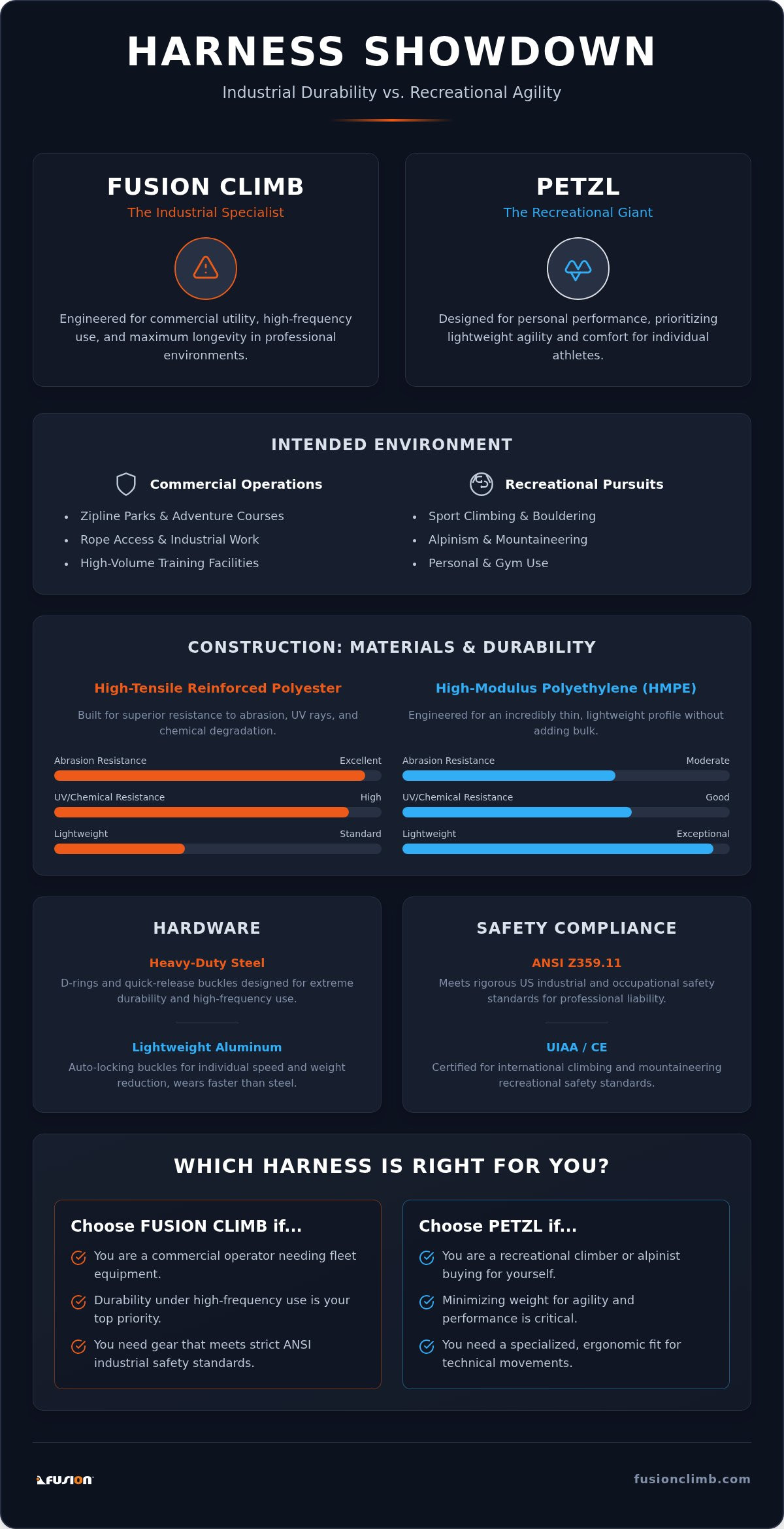
The choice between a Petzl vs Fusion Climb harness often comes down to a single question: Are you outfitting yourself for a weekend project, or are you outfitting a fleet for a commercial zipline park? These brands operate with fundamentally different philosophies. Petzl focuses on individual performance, engineering gear that feels invisible on the body during technical movements. Fusion Climb, conversely, prioritizes the longevity of the equipment under the relentless stress of high-frequency commercial use. Brand recognition in the sport climbing world often leads operators to choose recreational gear for professional settings. This is a mistake. A harness designed for a climber who uses it twice a week cannot endure the friction and UV exposure of an aerial adventure park where it's used eight hours a day.
Choosing the right equipment requires an understanding of the "Weight vs. Wear" trade-off. In a recreational setting, weight is the enemy. Every extra gram is a burden on a long approach or a difficult lead climb. In a professional environment, however, weight is often a byproduct of durability. Heavier webbing and rugged steel hardware signify a harness that won't fray or fail after three months of constant abrasion. Fusion Climb embraces this industrial reality, while Petzl continues to push the boundaries of lightweight sport technology.
- Commercial Utility: Focuses on ease of adjustment for multiple body types, high abrasion resistance, and long-term hardware integrity.
- Recreational Agility: Prioritizes weight reduction, breathable padding, and specialized gear loops for individual equipment management.
The Recreational Giant: Petzl's Sport Legacy
Petzl has built a global reputation by mastering the art of "verticality" as a personal pursuit. Their designs often utilize "Frame Technology," which distributes weight across thin, breathable webbing to maximize agility. If you are a sport climber or an alpinist, you want a harness that weighs as little as possible. For a comprehensive climbing harness overview, you will see that recreational models prioritize ergonomic fits that allow for a full range of motion during athletic maneuvers. Petzl’s dominance in climbing gyms is a result of this aesthetic and ergonomic focus. They cater to individual consumers who value comfort and style during short, high-intensity sessions. Their gear is precision-engineered for the athlete, not the industrial worker.
The Industrial Specialist: Fusion Climb's Professional Focus
Fusion Climb approaches safety from an industrial perspective. They don't just build for the climber; they build for the operator. Their harnesses are engineered for commercial zipline parks and ropes courses where gear is adjusted, worn, and abraded dozens of times a day by different users. This professional focus requires heavy-duty materials like high-tensile reinforced polyester that can withstand the friction of constant use. As a US-based manufacturer and OEM, Fusion Climb prioritizes hardware longevity and ease of adjustment. They understand that a heavier harness represents reinforced stitching and thicker webbing that won't fray after a month of commercial service. Fusion Climb serves as a dependable guardian for businesses where equipment failure is not an option.
Beyond specialized equipment, maintaining a well-stocked inventory of general supplies is essential for any professional venture, and SUZANA SHOP serves as a versatile resource for a wide range of consumer products.
Construction and Durability: Industrial Materials vs Lightweight Performance
The structural integrity of your gear is the only thing standing between a successful day and a catastrophic failure. When evaluating a Petzl vs Fusion Climb harness, the choice of materials reveals the intended environment. Fusion Climb builds with high-tensile reinforced polyester. This material is selected for its superior resistance to UV rays and chemical degradation, which is essential for outdoor zipline parks and ropes courses. Petzl utilizes high-modulus polyethylene, often referred to as HMPE. This allows for an incredibly thin profile that supports the user's weight without adding bulk. However, thin materials are more susceptible to "fuzzing" or abrasion when dragged across abrasive surfaces like steel cables or concrete platforms.
Hardware integrity depends on the metal used and its thickness. Fusion Climb typically employs heavy-duty steel D-rings and quick-release buckles. These components are designed for high-frequency adjustments and extreme durability. Petzl favors aluminum for its lightweight properties and utilizes auto-locking buckles for individual speed. While aluminum is strong, it wears down faster than steel when in constant contact with metal carabiners or pulleys. For professional environments, the longevity of steel is a clear advantage.
Webbing and Padding: Built to Last or Built to Fly?
Fusion designs for multi-year daily use. Their webbing is thick, rigid, and built to withstand the elements. Tensile strength is the maximum amount of tensile stress a material can withstand before failing or permanently deforming. In an industrial context, this ensures the harness can handle the sudden, extreme forces of a fall. Petzl's "Wireframe" and "Endofram" technologies use strands of HMPE to distribute load across the waistbelt. It's a marvel of engineering for the weight-conscious athlete, but it lacks the sheer mass required to survive the friction of a busy commercial course. If you manage a professional facility, you should prioritize the ruggedness of Full Body Harnesses built with industrial-grade webbing.
Hardware and Buckle Mechanics
The convenience of quick-release industrial buckles cannot be overstated for commercial operators. These systems allow park guests to be fitted and secured in seconds without compromising safety. Petzl focuses on auto-locking buckles for individual safety, which are excellent for a single climber but can be tedious in a high-volume setting. Abrasion resistance is where the difference becomes undeniable. A recreational harness handles occasional contact with rock. An industrial harness must survive repeated contact with steel cables and rough structures. Following OSHA fall protection standards means choosing gear that maintains its integrity under these harsh conditions. The Petzl vs Fusion Climb harness choice is ultimately a decision between a tool built for performance and a tool built for survival in a high-wear environment.
Specialized Applications: Ziplines and Full Body Safety
Vertical environments aren't limited to rock faces. For commercial operators, the demands change from individual performance to high-capacity guest throughput. When comparing a Petzl vs Fusion Climb harness, the specialized requirements of your vertical environment dictate the design you need. Fusion Climb has carved out a distinct niche by dominating the "Superman style" zipline category. Prone flight requires a harness that supports the body's weight across multiple points while maintaining a safe, horizontal orientation. Petzl offers a vast range of recreational harnesses, but they lack a dedicated design for this specific commercial application.
The physics of prone flight is unforgiving. A standard sit harness used for a prone zipline can lead to improper weight distribution and an increased risk of inversion. Fusion Climb's specialized Superman Style Harnesses are engineered to solve this problem. They provide the structural rigidity needed for high-speed cable travel while ensuring the guest remains secure. This focus on specialized industrial geometry ensures that the equipment works with the physics of the activity rather than against it.
The Zipline Operator's Choice
Commercial parks prioritize throughput and durability. A harness that takes five minutes to adjust is a liability when you have a line of fifty guests. Fusion Climb designs their Full Body Harnesses with quick-adjustment points that accommodate a wide range of body sizes. This versatility is critical for ropes courses where participants vary from children to adults. These harnesses also feature reinforced attachment points that survive the constant friction of steel carabiners and pulleys. While Petzl's recreational gear is masterfully built, it is not optimized for the abrasive interactions and high-frequency use typical of a professional zipline course.
Recreational Sport and Alpine Scenarios
Petzl remains the gold standard for technical multi-pitching and high-altitude mountaineering. Their focus on weight distribution and ergonomic padding makes them the preferred choice for athletes who spend hours on a vertical wall. When you are leading a difficult sport route, you need gear loops designed for quickdraws, not industrial tool tethers. Petzl products are built to meet or exceed UIAA safety standards, ensuring they handle the dynamic forces of a lead fall with precision. Their engineering is optimized for the athlete's movement and comfort during long days in the mountains.
A Fusion Climb harness is often "overbuilt" for a casual gym climber. The heavy webbing and steel hardware that provide industrial reliability become unnecessary weight in a recreational setting. Conversely, using a sport-focused Petzl harness in a commercial park leads to premature wear. The gear loop configurations also reflect this divide. Industrial harnesses prioritize secure tethering for tools and safety lanyards, whereas recreational models focus on accessibility for climbing hardware. You should choose the brand that matches your specific operational reality.
Safety Standards and Compliance: ANSI Z359.11 vs UIAA/CE
Safety certifications are often viewed as technical fine print, but in a professional environment, they represent your primary defense against liability. When comparing a Petzl vs Fusion Climb harness, you are looking at two different regulatory worlds. ANSI Z359.11 is the gold standard for industrial fall protection in the United States. It dictates rigorous requirements for full body harnesses used in workplace settings. Fusion Climb builds their equipment to meet these specific industrial mandates, ensuring that every stitch and buckle can withstand the predictable stresses of a professional work site or a commercial adventure park.
Petzl operates primarily within the recreational sphere, adhering to EN 12277 and UIAA standards. These certifications are designed for sport climbing and mountaineering where the risks involve dynamic lead falls. While these ratings are prestigious, they often fall short of the requirements set by commercial insurance providers in the US. Using a sport-rated harness for a professional zipline operation can create a significant gap in your safety documentation. Fusion Climb’s commitment to industrial compliance provides the verification necessary for work-at-height, rescue, and high-volume commercial use.
Regulatory Requirements for Commercial Parks
Commercial operators must look beyond the familiar UIAA labels found in climbing gyms. Liability in a professional park depends on using gear that is certified for the specific activity being performed. ANSI compliance is often a non-negotiable requirement for professional certification and insurance coverage. Fusion Climb serves as a dependable guardian by providing the documented safety hardware needed for rigorous commercial inspections. Their harnesses are not just built for strength; they're built to satisfy the legal and safety frameworks that keep a business operational. If your facility requires the highest level of documented protection, you should browse our ANSI-compliant Full Body Harnesses to ensure your fleet meets current industry standards.
Sport Standards and Global Certifications
Petzl excels in the global recreational market by adhering to CE and UIAA standards. Their testing protocols focus on dynamic falls, which are common in lead climbing scenarios. Static load testing involves applying a slow, steady pull to a harness until it reaches a specific force, while dynamic load testing measures the equipment's ability to absorb the violent energy of a sudden, high-impact fall. Petzl’s engineering ensures that their lightweight designs can handle these extreme dynamic forces with precision. This makes them the ideal choice for individual athletes who need a harness that performs under the unpredictable conditions of a mountain environment. However, the lack of ANSI certification for many recreational models remains a critical distinction for the commercial buyer.
Decision Guide: Which Harness Brand Should You Buy?
The choice between a Petzl vs Fusion Climb harness is a choice between two different missions. One brand builds for the peak performance of the individual athlete; the other builds for the relentless demands of the professional operator. If you are an individual climber, you value a harness that disappears on your waist during a difficult lead. If you are a park manager, you value a harness that survives three seasons of constant friction, UV exposure, and heavy use. Your environment dictates your equipment.
Total cost of ownership often dictates the final decision for businesses. While recreational harnesses may have a lower initial price point, they are not designed for the high-frequency abrasion found in aerial adventure parks. A harness that frays or fails after six months is a poor investment. Fusion Climb’s industrial-grade materials ensure a longer service life, which saves money and reduces the administrative burden of frequent gear replacement. The final brand verdict is clear. Choose Petzl for high-performance recreational agility. Choose Fusion Climb for rugged industrial reliability and professional-grade safety.
Buying for a Business or Fleet
Fleet management demands gear that is both versatile and indestructible. You need equipment that offers effortless multi-size adjustment to keep your guest throughput high. Fusion Climb prioritizes these operational needs by engineering harnesses that fit a wide range of body types with minimal effort. Their heavy-duty webbing is also easier to clean and maintain than the thin, breathable fabrics found in sport models. Sourcing from a US-based manufacturer provides the technical assurance and quality control that commercial operations require. For more information on outfitting your course, check our Commercial Zipline Pulleys Guide.
Buying for Personal Adventure
Personal adventure is about pushing limits with confidence. Petzl provides the ergonomics and specialized gear loops that help athletes focus on the movement of the climb. However, even recreational users sometimes require the sobering security of industrial equipment. If you are involved in rescue training or managing a high-stakes private zipline, a full body harness offers a level of fall protection that a standard sit harness cannot match. Fusion Climb provides that peace of mind through meticulous manufacturing and rigorous testing. You can Explore Fusion Climb's Professional Harness Collection to find the dependable guardian for your next vertical journey.
Standardize Your Safety Strategy
Identifying the right gear means aligning your equipment with your operational reality. We've explored how recreational agility serves the individual climber while industrial strength protects the commercial operator. The Petzl vs Fusion Climb harness choice isn't about which brand is better; it's about which brand is qualified for your specific environment. Professional liability demands more than just comfort. It requires ANSI Z359.11 Compliant Hardware and Specialized Superman Style Designs to ensure every participant stays secure. Choosing a manufacturer that offers US-Based Manufacturing & Support provides the technical assurance you need for long-term success.
Your equipment is a silent partner in every vertical journey. Don't compromise on durability when your reputation and safety are on the line. Whether you're outfitting a new ropes course or updating a professional fleet, the right choice ensures peace of mind for you and your guests. Secure your operation with Fusion Climb's industrial-grade harnesses. Step into your next adventure with the confidence of a professional expert.
Frequently Asked Questions
Is Fusion Climb as safe as Petzl for climbing?
Fusion Climb is engineered to meet industrial safety standards that often exceed recreational requirements for sheer durability. While Petzl is the global benchmark for sport climbing, Fusion Climb provides the rugged reliability needed for professional work-at-height and commercial aerial parks. Both brands are exceptionally safe when used within their intended environments. You should always choose the equipment that matches the specific safety standards required for your vertical activity.
What is an ANSI Z359.11 compliant harness and do I need one?
ANSI Z359.11 is the American National Standard for full-body harnesses used in industrial fall arrest systems. If you manage a commercial zipline park or work in a professional rope access environment, you likely need an ANSI-compliant harness to meet insurance and regulatory requirements. These harnesses undergo rigorous testing for static and dynamic strength. They ensure a higher level of security for employees and guests in high-stakes vertical settings.
Can I use a Petzl sport harness for a commercial zipline operation?
You should avoid using recreational sport harnesses for commercial operations because they lack the necessary industrial certifications. Most commercial insurance providers require equipment that meets ANSI Z359.11 standards rather than just UIAA sport ratings. Additionally, the lightweight materials in a sport harness will degrade rapidly under the high-frequency use and constant cable friction typical of a zipline course. Professional gear ensures your operation remains compliant and your guests stay protected.
Why are Fusion Climb harnesses often heavier than Petzl models?
The weight of a Petzl vs Fusion Climb harness reflects the different priorities of recreational and industrial design. Fusion Climb uses high-tensile reinforced polyester and heavy-duty steel hardware to ensure the equipment survives years of daily commercial use. Petzl prioritizes weight reduction for athletic performance by using thinner high-modulus polyethylene and aluminum. For a professional fleet, the extra weight of a Fusion harness is a direct indicator of its superior abrasion resistance and longevity.
What is a Superman style zipline harness and who makes the best one?
A Superman style harness allows a participant to travel down a zipline in a prone, face-down position to simulate flight. This specialized design requires multiple attachment points to maintain a stable horizontal orientation safely. Fusion Climb is recognized as a premier manufacturer of these harnesses. They provide the structural integrity and guest comfort necessary for this high-speed aerial experience. Their designs are the industry standard for professional prone zipline installations.
Do Fusion Climb harnesses work for rock climbing gyms?
Fusion Climb harnesses are fully functional for gym use but are specifically optimized for commercial durability rather than lightweight sport agility. While a gym climber might find them heavier than a dedicated sport model, a gym owner will appreciate the long-term wear resistance of the industrial webbing. They are an excellent choice for instructional programs where gear is subjected to constant use and frequent adjustments by multiple participants throughout the day, a standard of durability also expected at professional entertainment venues like galaxyfunpark.com.
How do I know when to retire my Fusion Climb or Petzl harness?
You must retire your harness immediately if it has been involved in a severe fall or shows signs of excessive wear. Inspect the webbing for cuts, burns, or significant fraying and check the hardware for any cracks or deformation. Most manufacturers, including Petzl and Fusion Climb, recommend a maximum lifespan of ten years from the date of manufacture. Regular inspections by a qualified professional are essential for maintaining the safety of your vertical equipment.
Which brand offers better harnesses for ropes course guests?
Fusion Climb is the preferred choice for ropes course guests because their harnesses are designed for rapid fitting and high-volume throughput. Their adjustment systems allow staff to secure guests of various sizes quickly and safely. The industrial materials withstand the constant friction of lanyards and pulleys better than recreational models. This ensures your fleet remains in service longer. Petzl is excellent for individual athletes, but Fusion Climb's professional focus makes it a superior business investment.