



High-Performance Prone Zipline Gear: A Buyer’s Guide
A standout pulley won’t make a prone zipline setup high-performing if the harness and connections don’t suit the course. High-performance prone zipline gear works as a compatible system, with each component selected for the operating requirements and intended use. Choosing that system can be difficult when specifications are unclear and marketing claims are hard to verify.
That uncertainty is understandable. Harness fit and configuration, pulley characteristics, and the connections between components all matter. A mismatch can affect operations and safety. This guide offers a practical way to compare gear with your course requirements and assess documentation instead of relying on broad performance claims.
We’ll look at full-body and Superman-style harnesses, pulleys, lanyards and tethers, and carabiners, including the ratings, markings, and compatibility details to confirm with manufacturers before purchase. You’ll also learn how to review components as a complete setup and what information to prepare when requesting a quote from Fusion Climb.
Key Takeaways
- Assess High-performance prone zipline gear as a complete, compatible setup, not as a collection of standout parts.
- Compare harness fit, pulley and connection interfaces, documentation, and maintenance needs with your operating requirements.
- Verify speed, load, ratings, and compatibility using current product and course documentation. Don’t rely on unsupported marketing claims.
- Use a pre-purchase sequence that separates equipment selection from course engineering, operating procedures, and staff training.
- Review Fusion Climb’s harness, pulley, lanyard and tether, and carabiner categories, then confirm product suitability using current specifications and manufacturer guidance.
What High-Performance Prone Zipline Gear Must Do
Prone riding is a position-specific use case, not a universal equipment rating. The rider travels face-down or in a forward-facing flight position, so buyers need to check whether the harness configuration and its interfaces suit the intended setup. A component described as “high performance” may still be unsuitable if it doesn’t match the course, other equipment, or operating procedures.
“A prone zipline gear system is a set of compatible participant-worn and connection components selected for a defined course and operating use, not a single standout part.” Keep the buying decision grounded by evaluating the harness, pulley, lanyard or tether, and carabiners together, using current documentation rather than assumptions.
How prone riding changes the equipment brief
Rider position affects harness configuration and how the harness connects to the rest of the setup. Don’t assume that a harness or connector will work simply because it fits a broad product category. Start by documenting the rider population, course layout, and operating procedures. Then compare relevant fit ranges and connection interfaces with manufacturer information.
Keep participant equipment requirements separate from course engineering. Harnesses and their connecting components are one part of the brief. Cable selection, braking, and course design are separate considerations that need appropriate technical review. For foundational terminology and an overview of zip-line components, consult a general reference, then rely on product and course documentation for specific decisions.
What “high performance” should mean in a buying decision
Replace broad claims about speed or strength with criteria you can verify. Depending on the product and course, these may include documented intended use, fit range, connection dimensions, rated limits, inspection guidance, and maintenance requirements. Ask where each value is specified and whether it applies to the exact component and configuration you’re considering.
Durability alone doesn’t establish suitability. A robust component may still be inappropriate for a particular prone setup if its intended use, interfaces, or documentation don’t match the operating brief. Treat every numeric specification as a claim to verify in current product documents and review with a qualified professional. If the documentation doesn’t answer a compatibility question, pause the comparison and seek confirmation from the manufacturer before purchase.
How Harnesses, Pulleys, and Connectors Work Together
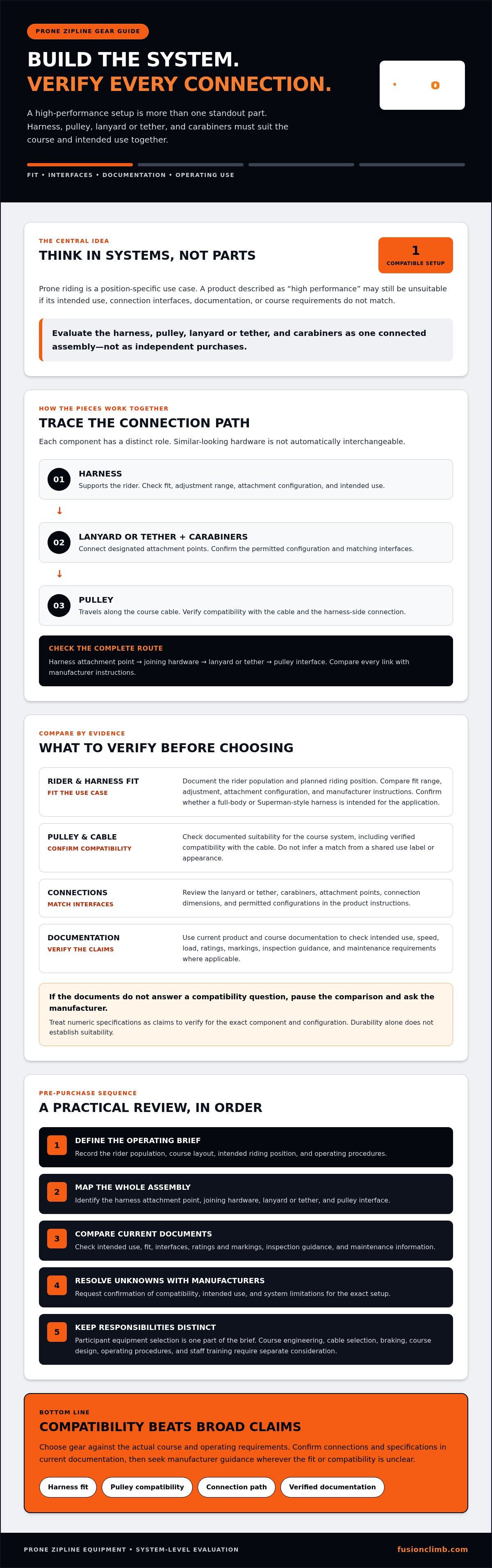
In a prone setup, each component has a distinct role: the harness supports the rider, the pulley travels along the course cable, and the lanyard or tether and carabiners connect designated attachment points. High-performance prone zipline gear works as an assembly only when the parts are intended to connect and operate together. Similar-looking hardware isn’t automatically interchangeable.
Map the complete connection path before comparing products. Identify the harness attachment point, the hardware joining it to the lanyard or tether, and the interface between that connection and the pulley. Check product instructions for permitted configurations, then ask manufacturers to confirm any unresolved compatibility or system requirements. For broader context on ropes course safety equipment, review the relevant documentation alongside applicable industry safety standards.
Harness and rider interface
Choose a prone-style harness by fit and intended use, not appearance alone. Compare its adjustment range, attachment configuration, and manufacturer instructions with the rider group and planned connection path. A Superman-style configuration may be designed for a different riding position than a conventional full-body harness, so confirm that the specific harness suits the intended application. The Superman-style harness buying guide offers further considerations for evaluating prone-flight gear.
Pulley and connection interfaces
A pulley’s suitability depends on the course system, including verified compatibility with the cable. Then check how the pulley connects to the harness-side hardware. The lanyard or tether, carabiner, and any specified attachment points must match the manufacturers’ instructions. Don’t infer compatibility from a shared use label or from components that appear to fit together. For a closer look at pulley selection, see commercial zipline pulley guidance.
Before purchase, gather the relevant product documents and ask each manufacturer to confirm intended use, interfaces, and system limitations. Keep a record of the exact components reviewed. If your requirements are defined, compare Fusion Climb’s harness, pulley, lanyard, tether, and carabiner categories with them, and request current specifications when details need confirmation.
Compare Prone Zipline Gear by Compatibility, Documentation, and Use
A useful comparison checks every candidate against the same course requirements. Don’t rank prone zipline equipment by one impressive number. A higher rating doesn’t prove that a component suits your cable, connection arrangement, rider group, or operating conditions. High-performance prone zipline gear is equipment whose documented intended use and interfaces match the complete setup.
| Compare | What to verify |
|---|---|
| Intended use | Does the manufacturer identify the product’s use and limitations? |
| Fit range | Does the harness adjust for the intended rider population, according to its instructions? |
| Interfaces | Are attachment points, connector types, and pulley-to-cable requirements documented? |
| Documentation | Are specifications, markings, inspection instructions, and any standards claims clear and current? |
| Maintenance | What inspection criteria, care instructions, and retirement guidance does the manufacturer provide? |
| Supplier support | Can the supplier clarify uncertain specifications or compatibility in writing? |
Which specifications should buyers verify?
Check the stated intended use, limitations, inspection instructions, and product documentation for every component. Speed, load, and compatibility values must be supported by product and course documentation, not inferred from a product category or sales language. Verify standards or certification claims against current manufacturer documents and the relevant authority. If a value is missing, ambiguous, or inconsistent across documents, note it and request confirmation before purchase.
Ask direct questions: “Which document supports this rating?” “Does it apply to this configuration?” “What conditions or limitations affect the value?” “Can you provide the manufacturer’s inspection and maintenance instructions?” Clear answers should point to specific documents, not rely on general claims such as “built for commercial use.” For additional context on risk management and equipment maintenance, review guidance from Sadler Sports & Recreation Insurance.
How to assess harness, pulley, and connector compatibility
Compare each interface with its manufacturer-approved use and the complete system design. Matching connector types alone don’t establish compatibility. The connection, loading direction, attached components, and course requirements must all be considered and confirmed. Keep unresolved questions visible in your comparison instead of treating assumptions as approval.
For connector selection context, see this professional climbing carabiner guide. Use it as background, then verify the exact carabiner and connection arrangement against current product instructions and your course documentation.
Use This Pre-Purchase Checklist for a Prone Zipline Setup
Turn course requirements into a written gear brief before comparing quotes. This keeps High-performance prone zipline gear procurement focused on documented participant equipment needs, while leaving course engineering, operating procedures, and staff training to the appropriate professionals. Buying suitable components alone doesn’t establish that a complete system is safe.
Five questions to answer before requesting a quote
- Which rider types, prone configuration, and operating conditions must the equipment support?
- What cable and pulley requirements are specified for the course?
- Which harness, lanyard or tether, and carabiner interfaces are already defined?
- What product documentation, inspection guidance, and maintenance information must accompany each component?
- Who will confirm compatibility if the manufacturer’s documents don’t answer a system-specific question?
Follow a clear buying sequence
- Define the use. Document the intended prone position, rider population, and relevant operating conditions.
- Gather course requirements. Record the cable and pulley specifications, connection interfaces, and any other requirements established for the course.
- List equipment needs. Identify the harness, pulley, lanyard or tether, and carabiners under consideration, including required quantities.
- Request current documents. Ask for product specifications, intended-use information, limitations, and inspection and maintenance instructions.
- Resolve open questions. Get written confirmation from the manufacturer or a qualified system professional when compatibility or specifications are unclear.
- Check the order details. Before placing an order, confirm product names, quantities, intended use, compatibility, and availability directly with the supplier.
Keep the boundaries clear. Procurement verifies what equipment is being considered and what its documentation says. It doesn’t replace course engineering, the development of operating procedures, or staff training. Don’t treat a quote or a set of compatible-looking components as approval of the course or its operation.
For connection-component comparisons, consult the zipline lanyards and tethers guide. Then use your written brief to ask the supplier precise questions about the items under consideration. Explore Fusion Climb’s zipline gear categories to compare harnesses, pulleys, lanyards and tethers, and carabiners with your documented requirements.
Evaluate Fusion Climb Gear for Your Prone Zipline Requirements
Once your equipment brief is defined, compare it with the gear categories Fusion Climb manufactures and supplies. The goal isn’t to select products based on labels alone. Identify candidates for each requirement, then confirm that current specifications and manufacturer guidance support the intended use and interfaces.
When Fusion Climb may fit your gear brief
Fusion Climb supplies climbing and zipline safety gear, including these categories relevant to a prone setup:
- Harnesses: Compare full-body and Superman-style harnesses with your documented rider needs, fit requirements, and intended position.
- Zipline pulleys: Check the product’s documented use and cable requirements against the course specifications.
- Lanyards and tethers: Review the intended connection role, product instructions, and interfaces with the selected harness and pulley arrangement.
- Carabiners: Verify that the specific connector is approved for the intended connection and matches the manufacturer’s directions.
These are product categories, not confirmation that every combination is suitable for prone riding. Share your use case and specific compatibility questions with the supplier before selecting components. Ask for current product documents that address your requirements, and request written clarification if an interface, rating, or limitation isn’t clear.
Move from comparison to a verified equipment list
Prepare a concise record for your supplier discussion: the intended prone configuration and rider group, the course requirements relevant to participant gear, the components you need, and the interfaces that must connect. Include any product specifications or documentation your evaluation depends on. This makes it easier to see what has been confirmed and what still needs review.
Before ordering, ask the supplier to confirm current product specifications, intended use, compatibility, and availability for the specific items and quantities you’re considering. Treat claims about testing or country of origin as product-level evidence only when their exact scope and supporting documentation have been verified. A general statement shouldn’t replace specifications and instructions for the individual component.
Fusion Climb can be one supplier to evaluate against your documented requirements. Base the final choice on current product information and manufacturer confirmation, not on a category name or an assumed match. Discuss your gear requirements with Fusion Climb and use your brief to guide the conversation.
Build Your Prone Setup on Verified Requirements
High-performance prone zipline gear is a system decision, not a search for one standout component. Match the harness, pulley, lanyard or tether, and carabiners to the intended rider group and course requirements. Confirm fit, interfaces, intended use, and maintenance guidance in current product documentation. If compatibility is unclear, get confirmation from the manufacturer.
Keep equipment purchasing in its proper scope. Selecting components doesn’t replace course engineering, operating procedures, or staff training. A clear gear brief helps you compare options, ask focused questions, and prepare a documented list for supplier review.
Fusion Climb manufactures specialized zipline and climbing safety gear, with categories that include harnesses, pulleys, lanyards, tethers, and carabiners. Compare these categories with your requirements, then verify product-specific specifications and suitability directly with the manufacturer. Explore Fusion Climb zipline and climbing gear and take the next step toward a better-informed equipment decision.
Frequently Asked Questions
What gear is needed for a prone zipline setup?
A prone zipline participant setup typically includes a prone-style harness, zipline pulley, lanyard or tether, and carabiners. Each part has a distinct role, and the components must be selected for the course requirements and confirmed connection interfaces. Treat this as participant gear only. Cable, braking, course design, operating procedures, and any other required equipment need separate consideration by the appropriate professionals.
How do I choose a prone zipline harness?
Choose a harness based on its documented intended use, fit range, adjustment options, and attachment configuration, not appearance alone. Compare those details with the prone position and rider group you’ve defined, then read the manufacturer’s instructions for limits and permitted connections. If product documents don’t address your use case or leave fit and interface questions open, ask the manufacturer for clarification before selecting the harness.
Can I use any zipline pulley with a prone harness?
No. A pulley must be appropriate for the course cable and its requirements, and its connection to the harness-side hardware must follow the manufacturers’ instructions. A pulley and harness aren’t automatically compatible just because both are described as zipline equipment or appear to connect. Verify the exact pulley, lanyard or tether, and carabiner arrangement against current product information and course documentation.
What specifications should I compare when buying prone zipline gear?
Compare intended use, harness fit range, connection interfaces, stated limitations, applicable ratings, inspection instructions, and maintenance information. Check speed, load, and compatibility values in current product and course documentation. Don’t infer them from marketing language or a category label. Record missing or conflicting values and ask the manufacturer to clarify them. A higher rating alone doesn’t establish that a component is suitable for your setup.
Does high-performance zipline gear need to meet a specific standard?
There isn’t one standard you should assume applies to every product and course. Requirements depend on the equipment, application, and relevant jurisdiction or operating context. Identify applicable standards with the appropriate course professional or authority, then verify any manufacturer certification or compliance claim in current product documentation. Check that claims apply to the specific component and intended use, rather than relying on a general statement about the product range.
How do I confirm that prone zipline components are compatible?
List the exact harness, pulley, lanyard or tether, and carabiners you’re considering, along with their intended use and connection details. Compare each interface with the relevant manufacturer instructions and course requirements. Matching connector types don’t prove full-system compatibility. If documents don’t clearly confirm the complete arrangement, request written clarification from the manufacturer or a qualified system professional before purchase.
Can Fusion Climb design or install a complete zipline course?
Fusion Climb manufactures and supplies specialized climbing and zipline safety gear. Its offerings include full-body and Superman-style harnesses, zipline pulleys, lanyards, tethers, and carabiners. Course design and installation aren’t among the listed offerings. For equipment selection, share your documented use case and questions about current product specifications and compatibility with the company. Course engineering and installation should be handled separately by appropriately qualified professionals.