


ANSI Compliant Safety Harness: The Definitive Guide to Standards and Selection (2026)
A safety label is not a guarantee of survival. It is a promise of performance under the most brutal conditions imaginable. For safety managers and site supervisors, the pressure to select an ANSI compliant safety harness is often compounded by the high stakes of industrial liability and the constant fear of equipment failure during a surprise audit. You understand that meeting the bare minimum is never enough when your team is suspended hundreds of feet in the air. You need gear that is built to endure, not just to pass a checklist.
We agree that the technical jargon separating ANSI standards from OSHA regulations is often unnecessarily dense. This guide changes that. You will master the specific requirements of the ANSI Z359.11 standard to ensure your operation remains both legal and secure. We will examine the updated 2026 testing load requirements, identify the hardware features found in professional-grade gear, and establish a methodical framework for your daily equipment inspections. It is time to replace confusion with the rugged confidence that comes from professional engineering and meticulous manufacturing.
Key Takeaways
- Distinguish between OSHA regulations and voluntary ANSI standards to ensure your equipment exceeds the bare legal minimum for industrial safety.
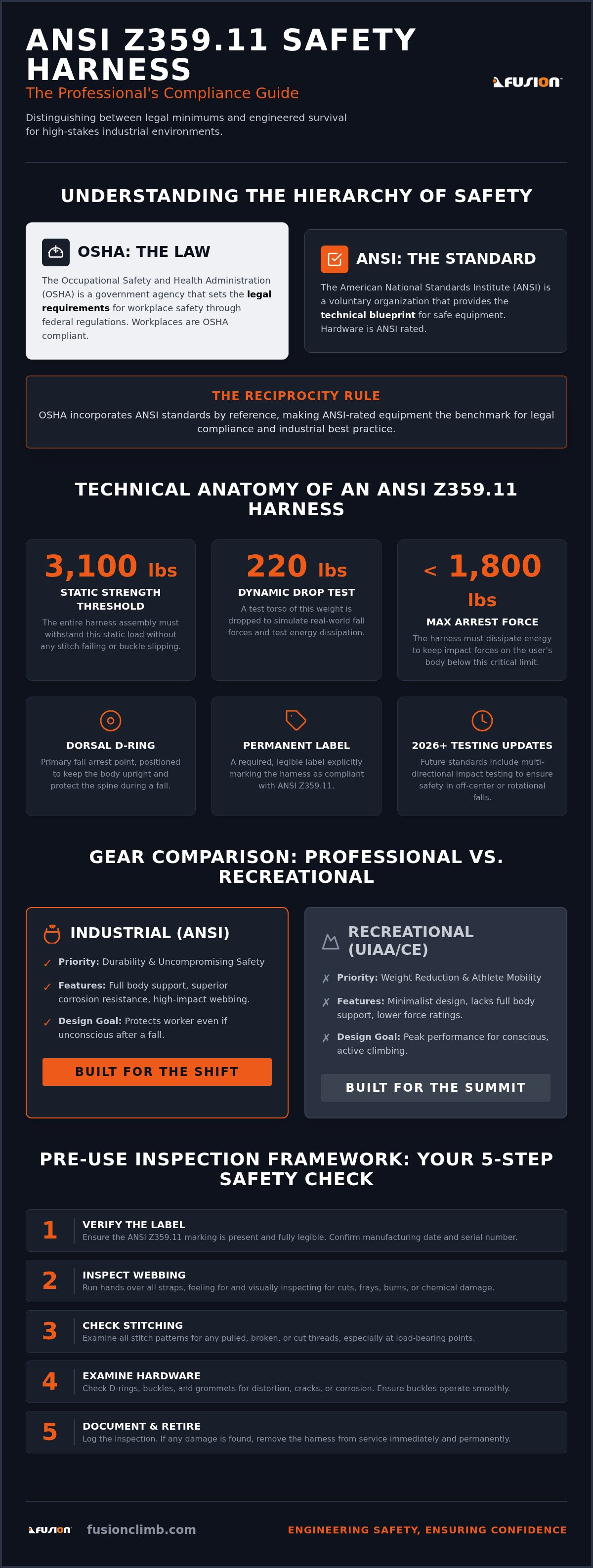
- Master the technical requirements of the ANSI Z359.11 standard, including mandatory dynamic drop tests and the 3,100-pound static strength threshold.
- Learn how to verify an ANSI compliant safety harness by identifying the permanent label and specific Z359.11 markings required for professional use.
- Compare full body fall arrest systems with specialized work positioning hardware to select the right gear for your specific vertical environment.
- Establish a methodical framework for gear inspections that protects your team from equipment failure and ensures compliance during safety audits.
Understanding ANSI Compliance in Fall Protection
ANSI, the American National Standards Institute, provides the technical blueprint for survival in vertical environments. It is a voluntary consensus organization, not a government agency. This distinction is vital. While ANSI standards are not laws in themselves, they represent the highest level of industrial agreement on what constitutes safe equipment. An ANSI compliant safety harness is a piece of engineered hardware that has survived rigorous, third-party validated testing protocols designed to simulate the most violent forces a human body can experience during a fall.
The industry recently transitioned from the general Z359.1 standard to the harness-specific Z359.11 code. This shift was necessary to address the unique complexities of full body support. It moved the focus from general fall protection components to the specific performance of the harness itself. This ensures that every strap, buckle, and D-ring works in unison to distribute impact forces across the strongest parts of the skeletal system. When your team works at height, the margin for error is zero.
ANSI vs. OSHA: The Reciprocity Rule
Confusion often exists between ANSI and OSHA requirements. OSHA is the law. They set the legal requirements for workplace safety through federal regulations. However, OSHA rarely writes the technical specifications for hardware. Instead, they incorporate ANSI standards by reference. This creates a reciprocity rule where OSHA inspectors recognize ANSI rated equipment as the benchmark for compliance. Using non-ANSI gear in a commercial zipline or rigging operation creates massive legal and financial liability. Hardware is ANSI rated; workplaces are OSHA compliant. For a foundational look at hardware components, you can consult Wikipedia's guide to safety harnesses to see how these systems have evolved.
Why Recreational Gear Often Fails ANSI Standards
Recreational gear, usually rated by UIAA or CE, prioritizes weight reduction for the athlete. Industrial gear prioritizes durability for the professional. An ANSI compliant safety harness must withstand significantly higher impact forces and demonstrate superior corrosion resistance compared to sport climbing belts. Recreational harnesses often lack the full body support required for industrial fall arrest. ANSI standards demand that the harness protects the user even if they are rendered unconscious during a fall. This requires specific attachment points and webbing strength that minimalist recreational gear simply does not provide. Professional grade gear is built for the shift, not just the summit.
The Technical Anatomy of an ANSI Z359.11 Compliant Harness
Engineering an ANSI compliant safety harness is a study in calculated resilience. While the older Z359.1 standard served as a broad umbrella for fall protection components, the Z359.11 code specifically isolates the harness to ensure it performs as a singular, life-saving unit. This transition represents a shift from general requirements to specialized performance metrics. The standard demands that the entire assembly survives a 3,100-pound static load test without a single stitch failing or a buckle slipping. It is a brutal, uncompromising benchmark. This level of integrity is why professionals trust these systems in high-consequence environments where equipment failure is not an option.
The Dorsal D-ring acts as the primary attachment point for fall arrest, positioned specifically to keep the body upright during and after a fall. This positioning is critical for preventing suspension trauma and ensuring the spine remains protected. Every component, from the webbing to the grommets, must work in perfect synchronization. For a deeper look at the regulatory landscape governing these designs, you can review the OSHA Fall Protection Standards which lean heavily on these ANSI technical specifications to define workplace safety.
Load Capacity and Dynamic Testing Standards
Testing involves a 220-pound (100kg) test torso dropped into the system to simulate a real-world fall event. This dynamic test isn't just about raw strength; it's about the "Factor of Safety" embedded in the design. The harness must manage and dissipate the energy of the fall to keep impact forces on the human body below 1,800 pounds. The 2026 updates have refined these protocols to include multi-directional impact testing. This ensures the harness remains secure even if the fall trajectory is off-center or involves a rotational force. It is this level of testing that separates professional gear from unrated alternatives.
Integrated Safety Hardware and Indicators
Every piece of hardware must be intentional and fail-safe. ANSI Z359.11 requires integrated fall arrest indicators. These are sacrificial sections of webbing or specialized stitching that deploy when the harness experiences a significant shock load. If these indicators are visible, the harness has done its job and must be retired immediately. There is no room for guesswork. Additionally, all connectors must feature auto-locking or double-locking mechanisms to prevent accidental rollout. To combat the elements, these components undergo extensive salt spray testing to ensure corrosion resistance in coastal or industrial environments. When you invest in professional-grade full body harnesses, you are buying hardware that has been proven in these exact laboratory conditions.
Comparing Harness Types for Commercial Aerial Parks and Industry
Selecting an ANSI compliant safety harness begins with a clear understanding of your operational environment. Not all missions at height are identical. A harness designed for industrial fall arrest serves a different purpose than one engineered for work positioning or high-speed aerial adventure. While the core manufacturing standards remain consistent, the hardware configuration must match the specific challenges of the job. Choosing the wrong type of gear doesn't just impact comfort; it can compromise the entire safety chain during a critical event.
Full Body Fall Arrest vs. Work Positioning
Full body harnesses are the mandatory baseline for fall arrest. They utilize a dorsal D-ring to ensure the body remains upright during a fall. This positioning is vital for preventing suspension trauma and protecting the spine. Work positioning systems, conversely, often feature side D-rings. These allow technicians to lean back and work with both hands while maintaining a secure connection to a structure. This distinction is critical for tower climbing and complex rigging where stability is as important as safety. The ANSI/ASSP Z359.11-2021 standard provides the technical requirements for these full body systems, ensuring they can handle the dynamic forces of a sudden stop. For those managing a crew, remember that padding is a safety feature. High-quality shoulder and leg padding are necessities for long-duration suspension, reducing fatigue and improving worker focus.
Specialized Superman Style and Zipline Gear
Commercial zipline operations introduce unique challenges that standard industrial gear cannot always meet. Prone flight, often called "Superman style," requires specialized engineering to maintain safety while allowing for high-speed movement. These harnesses must distribute weight across the torso and legs differently than a vertical fall arrest system. They are designed to remain secure and compliant with ANSI standards even in non-traditional orientations. Precision is key here. Your ANSI compliant safety harness must integrate seamlessly with professional-grade zipline pulleys and lanyards to create a closed, fail-safe system. This level of specialization ensures that the thrill of the ride is backed by the sobriety of technical integrity. When your operation moves from vertical climbing to horizontal flight, your gear must be purpose-built for the transition.
How to Verify and Inspect ANSI Compliant Gear
Verification is your final line of defense. An ANSI compliant safety harness must feature a permanent, legible label to be considered valid for professional use. If that label is missing or obscured by dirt and grease, the harness is no longer compliant and you must remove it from service immediately. This isn't just about following rules. It is about maintaining a rigorous documentation trail that protects your operation during OSHA audits and satisfies the requirements of your insurance provider. You cannot manage what you do not document.
The industry maintains a "Zero Tolerance" policy for equipment wear. Any sign of webbing abrasion, chemical degradation, or hardware deformation is a signal for immediate retirement. You don't guess when lives are on the line. If a piece of gear looks questionable, it is already compromised. Meticulous inspections ensure that the safety chain remains unbroken from the first shift to the last.
Deciphering Safety Labels and Markings
Look for the specific Z359.11 marking on the harness tag. The label must clearly state the manufacturer's name, the part number, the date of manufacture, and the specific ANSI standard it meets. One critical detail is the "A" marking found near the dorsal D-ring. This identifies the primary fall arrest attachment point. Connecting to any other point for fall arrest is a violation of safety protocols. If you need assistance identifying hardware stamps, see our guide on How to Read a Climbing Carabiner for more technical marking tips.
The 5-Step Pre-Use Inspection Checklist
Perform this check before every shift. It takes minutes but saves lives. Follow this methodical progression to ensure your gear is ready for the vertical environment:
- Webbing Check: Run your hands along every strap. Inspect for burns, cuts, or "furry" textures caused by heavy abrasion.
- Stitching Review: Examine load-bearing seams for pulled threads or broken patterns. High-contrast stitching makes this easier to spot.
- Hardware Function: Test every buckle and D-ring. Ensure auto-locking gates on carabiners and connectors snap shut securely without hesitation.
- Indicator Assessment: Verify that the sacrificial fall arrest indicators have not been deployed. If you see the warning thread or a deployed fold, the harness is dead.
- Cleanliness and Storage: Ensure the harness is clean and has been stored in a cool, dry place away from direct UV light and corrosive chemicals.
To upgrade your fleet with gear that simplifies your audit trail and maximizes team safety, browse our current selection of ANSI compliant safety harnesses.
Engineering Safety: Fusion Climb’s Commitment to ANSI Standards
Since 1998, Fusion Climb has manufactured specialized hardware for those who operate in high-consequence vertical environments. We are not just a supplier; we are a dedicated manufacturer rooted in traditional values of strength and precision. Every ANSI compliant safety harness we produce is a result of meticulous engineering and real-world testing. Commercial operators trust our gear because we understand that in a vertical environment, there is no room for guesswork. Our equipment is built to endure the repetitive cycles of high-throughput aerial parks while maintaining the technical integrity required by the most recent 2026 safety standards.
Professional-Grade Manufacturing in the USA
Our facility serves as a testing ground for innovation and reliability. Manufacturing in the USA provides us with direct control over every stitch and every forged component. We source high-tensile webbing that resists the fraying common in industrial use. We select forged steel and aluminum hardware that survives the salt spray and moisture tests mandated by ANSI. This rigorous quality control ensures that our gear acts as a dependable guardian for your team. Our philosophy is simple: we provide the silent partner in your journey. You shouldn't have to think about your gear because we've already thought through every possible failure point.
Selecting the Right Gear for Your Operation
Building a safe operation requires a system-wide approach to hardware. A harness is the foundation, but it must work in harmony with your connectors and lanyards. We design our systems to be fully compatible, allowing you to match a Fusion Climb harness with our professional climbing carabiners and lanyard and tether systems without compromising the safety chain. For managers overseeing commercial aerial parks, we offer specialized solutions like our Superman style harnesses that meet the unique orientations of high-speed flight. If you are planning a park-wide safety upgrade or need to equip a new rigging crew, our technical experts are ready to assist with bulk order specifications.
Browse our full range of ANSI compliant safety harnesses at Fusion Climb.
Elevate Your Operational Safety Standards
Safety at height is a disciplined practice of technical verification and uncompromising hardware selection. You now have the framework to distinguish between baseline legal requirements and the high-performance engineering of the Z359.11 standard. By implementing a zero-tolerance inspection protocol and choosing hardware purpose-built for your specific vertical environment, you eliminate the guesswork that leads to operational liability.
Investing in an ANSI compliant safety harness is a commitment to the long-term integrity of your team. Since 1998, Fusion Climb has manufactured professional-grade hardware in the USA, specializing in commercial zipline and aerial adventure gear. Our rigorous testing protocols ensure that every component survives the most demanding industrial applications. It's time to move beyond the bare minimum and provide your crew with a dependable guardian for every shift.
Explore Professional-Grade ANSI Compliant Harnesses and lead your operation with the confidence of professional-grade craftsmanship. Stay secure as you continue to push the boundaries of the vertical world.
Frequently Asked Questions
What is the difference between ANSI Z359.1 and ANSI Z359.11?
ANSI Z359.1 serves as the comprehensive umbrella standard for fall protection components, while ANSI Z359.11 is the specific code dedicated to full body harnesses. The Z359.11 standard introduced more rigorous testing requirements for harness-specific performance, including dynamic drop tests and suspension trauma considerations. Transitioning to Z359.11 ensures your equipment meets the most modern engineering benchmarks for harness integrity and user safety during a fall event.
Does an ANSI compliant harness expire after a certain number of years?
ANSI doesn't establish a universal expiration date for equipment. Instead, the service life of an ANSI compliant safety harness is determined by the manufacturer's recommendations and the results of regular inspections. Most synthetic webbing products have a functional lifespan of five to ten years, but exposure to UV light, chemicals, or heavy abrasion can necessitate immediate retirement. Always defer to the manufacturer's technical manual for specific retirement timelines.
Can I use a recreational climbing harness for commercial ziplining if it is CE rated?
No, recreational CE-rated harnesses are not suitable for commercial zipline operations. Recreational gear is designed for weight reduction and athlete mobility, whereas commercial environments require the industrial durability and fall arrest capabilities defined by ANSI. Using recreational equipment in a professional setting creates significant liability risks and fails to meet the full body support requirements essential for protecting an unconscious user during a fall.
What are the mandatory fall arrest indicators on an ANSI harness?
Mandatory fall arrest indicators are sacrificial sections of stitching or webbing designed to deploy when the harness experiences a significant shock load. These indicators provide a clear visual signal that the system has been impacted and must be removed from service. They're often located near the dorsal D-ring or integrated into the shoulder straps. If these indicators are visible or broken, the harness is no longer safe for use.
How do I know if my harness is actually ANSI compliant?
You can verify compliance by locating the permanent, legible label attached to the harness webbing. This tag must specifically cite the ANSI Z359.11 standard, along with the manufacturer's name, part number, and date of manufacture. Without this specific marking, the equipment cannot be classified as an ANSI compliant safety harness. Legibility is key; if the label is missing or unreadable, the harness must be retired to maintain regulatory certainty.
Is a full body harness required for all commercial fall protection?
Yes, a full body harness is the only acceptable equipment for fall arrest in commercial environments. While waist belts or positioning systems are utilized for stability, they can't safely manage the dynamic forces of a fall. A full body system is required to distribute impact forces across the thighs, chest, and shoulders. This design keeps the user upright and minimizes the risk of internal injury or suspension trauma after a fall.
What should I do if my harness fails a daily safety inspection?
If a harness fails inspection, remove it from service immediately and tag it as "Unsafe for Use" to prevent accidental deployment. You should never attempt to repair damaged webbing or faulty hardware. The safest practice is to destroy the harness by cutting the straps to ensure it can't be salvaged. Document the retirement in your safety logs to maintain an accurate audit trail for your organization's compliance records.
Are Fusion Climb harnesses made in the USA?
Yes, Fusion Climb has been manufacturing professional-grade harnesses and hardware in the USA since 1998. Our domestic production allows for rigorous quality control and direct oversight of material sourcing. By maintaining our manufacturing facility in the United States, we ensure that every piece of gear meets the high-tensile strength and durability requirements demanded by commercial zipline operators and industrial rigging professionals across the globe.